Unit Four Teamwork
In this unit, students will
1. Learn how to work with a team.
2. Learn nonverbal social-communication skills: Sensitive Topics.
3. Learn verbal social-communication skills: Expressions for Apologies and Forgiveness.
Ⅰ.Warm-up Activities
1. Read the following passage, and then talk with your partner: How to work together with your classmates and learn from each other?
Working with & Learning from Classmates
Ever watch a cooking show only to realize afterward that without a recipe card or instruction sheet the meal was impossible to repeat? Ever sat in a meeting listening attentively to a PowerPoint presentation only to promptly forget everything just moments later? The same thing can happen in a classroom or lecture hall, which is why many college and university instructors have turned to small groups and group learning projects to enhance the student learning experience. The reason? People learn best when they are actively engaged in the process of learning. In fact, students working in small groups or on group projects tend to remember more of what they have learned—and have a more complete understanding of the material being presented. However, not everyone appreciates the value of collaboration.
Learning to Work Together
Mention the words “small group” and some people immediately recall an unorganized, unstructured group project from back in high school. Others are reminded of difficult projects they’ve participated in at work. However, while these projects have similarities—such as scheduling meetings, holding discussions, organizing data, and developing presentations, they are, in fact, different. Unlike work or high school projects, where different participants may have each had their own personal agenda (or lack thereof)—the primary goal of each participant in a higher-education environment group project is to do well and “make the grade.”
Getting Started on the Road to Group Project Success Making the grade with group projects is easy when team members work together and follow a general project outline. A logical place to begin with group projects is to schedule an initial first meeting where everyone shares their contact information and a general meeting schedule is arranged. The next steps are discussing and outlining the project’s objectives and assigning various tasks, including who will be responsible for what areas of research, data organization, and analysis, as well as how the final presentation is prepared and presented.
Similarities and Differences
While most members of this kind of small group will have a broadly similar goal, chances of each individual participant will be very different. It is this unique variety ofperspectives, skills, and strengths that can make a group project extremely successful. In fact, if the group is able to assign tasks based upon individual strengths while working in collaboration, they will be well on their way to success.
Differences as Strengths
The road to a successful group project can be bumpy at times. Strangely enough, that which makes group projects so successful—the cooperation and collaboration of a variety of people—can also be a source of frustration. After all, whenever a diverse group of people come together to work on a project there may be discussions about things such as who will handle what area of the project and how the project should be organized. However, it’s important to understand that this is, in fact, part of the process—and another reason why group projects are such an effective educational tool. from http://www.worldwidelearn.com/education-articles/group-projects.htm
2. Group discussion: Work in groups to discuss the topic: Improving the team performance.
Your discussion should cover the following points:
● General introduction
● Factors influencing the team performance
● Suggestions
3. Learn from songs
You will listen to one song “WORK THIS OUT”. Please fill the following blanks with the lyrics you hear, and then, talk with your partner about your way of soluting problems.
Work This Out
How did we get from 1) of the world
to the bottom of 2)?
I don’t recall you 3) the boss is such
a creep
We still have the ingredients to make
4) sweet
well, I got rags 5) riches
and all these 6)
just wish i had 7) wishes
(okay guys, break it up)
we’ve got to work, work to 8)
we’ll make things right
the sun 9)
if we work, work
there’ll be no doubt
we can still 10) the summer
if we work this out!
dude, what have you 11) us into?
come on, we can totally 12) around
I’d rather face a seven footer
straight up in 13)
that sure beats hanging here
and burning someone’s toast.
i needed 14)
but this int worth the stress
maybe there’s a better way
to fix this 15)
were a champion team
a well-oiled machine
and we’ve faced tougher problems than this
I know its a grind
but I’ll sure we can find
a way to have fun
while we get this job done
we’ve got to work, work to work this out
well make things right; the sun will shine
Ⅱ.Focused Topic
Teamwork
A.Dialogues
Please read the following dialogues and note the italic expressions.
Dialogue 1
A: Ok. quiet down people, I wish to commence this summary meeting. Its first order is a progress report from the sales team.
B: So far things couldn’t have gone any better. The team has finally come together and is performing as a single entity. It’s incredible to see.
A: Really? Could you elaborate on their progress?
B: Sure, so far our actual sales figure is 160% above our forecasted level of sales. The team has further subdivided into smaller teams to concentrate their focus more.
A: What result has breaking down the team into smaller groups had?
B: It enables them to focus much more intensely on their intended sales target. This has resulted in far more effective sales strategies.
A: But has there been any overlapping or breakdowns in communication? Smaller groups often result in more inefficiency.
B: True, but with constant and tightly controlled overall management, I have managed to keep it together.
A: So the team development consultant we brought in a month ago has worked wonders, hasn’t he?
B: Yes. It has resulted in a remarkable change in team confidence and effectiveness.
Dialogue 2
A: Today is the sports meet. Which sport will you take part in?
B: I’ll be in the relay; I am so nervous.
A: Why are you so nervous?
B: I don’t want to do badly and let my teammates down.
A: Oh, I think you will do a good job. Don’t worry. You’ve practiced hard for the race, I think you can win.
B: Yes, we’ve trained for a long time. We should have confidence in ourselves. But you know, relay is a sport with cooperation.
A: It means everyone in the relay should cooperate with each other. I’m sure your team will win the race.
B: Thank you. We’ll try our best.
A: I’ll be there to cheer you on.
B: Oh, it’s time to get ready.
A: Come on. We are behind you all the way.
Other Useful Expressions
to make a significant impact creative breakthrough
at one’s optimal level shared values
empowered team feel passionate about one’s job
attitude motivation cultural differences
team problem-solving pull together as a team
interpersonal skills team assessment process
powerful team building a productive employee
time management systemic innovation
cross-functional team a good working atmosphere
Practice:
1. Please talk with your partner about the questions below:
1) Which role in a team do you think is the most critical to the success of the team goal?
2) What role would you play when you work with your team members?
3) Which role do you think is the most important in a team?
2. Role-play: Student A will interview student B about two of the following topics:
1) If your partner are more expert in your field, would you be willing to listen to his ideas when you work together?
2) What qualities do you think should an effective team player possess?
3) Have you experienced any conflict with your classmates or partners? How did you resolve the problem?
B.Socio-Communicative Skills
Non -verbal Skill
Sensitive Topics
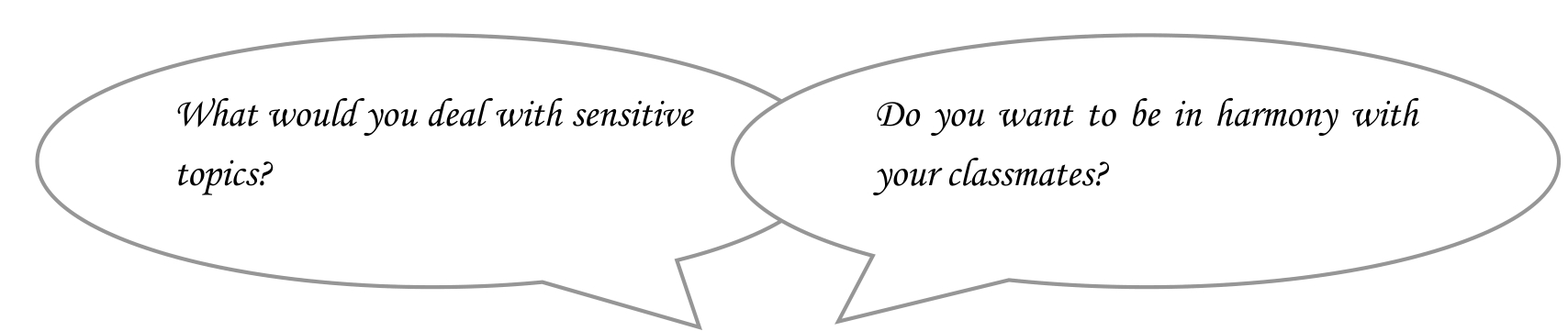
Talking about sensitive topics often stirs a lot of trouble and can easily put you in an embarrassed position that you do not want to be in. It can not be an easy task to bring up a sensitive topic with your classmates, such as teen suicide or drugs. So you should be more careful in the choice of words what you say. Below are some common sense tips to help with addressing sensitive topics.
? Smiling, speaking in a positive manner and generally acting warm and open will help ease the embarrassing situation. Immediately move the dialogue to less personal examinations of why words can hurt, when your comments or actions are potentially hurtful.
? If you don’t think there will be a reaction to an issue you raise, plan ahead what you will do if you encounter one. Don’t personalize remarks. Explain any material or topic you plan to introduce that is sensitive or controversial, and be open to all perspectives, and ask your classmates to voice their points responsibly.
? Stay calm even if your classmates disagree with you on the sensitive topic. Seek to draw out understanding and communication as well as opinions. It is not important what you say, but how you say it. If you are unable to find a workable position, let your students know that this is an important issue and that you will address it later.
Role-play:
Work with your partner on one of these occasions, and pay attention to the sensitive subjects.
1) Your first date with your dream girl/boy
2) Your first meeting with your future boss
3) Your first meeting with your future parents-in-law
Verbal Skill
Apologies and Forgiveness
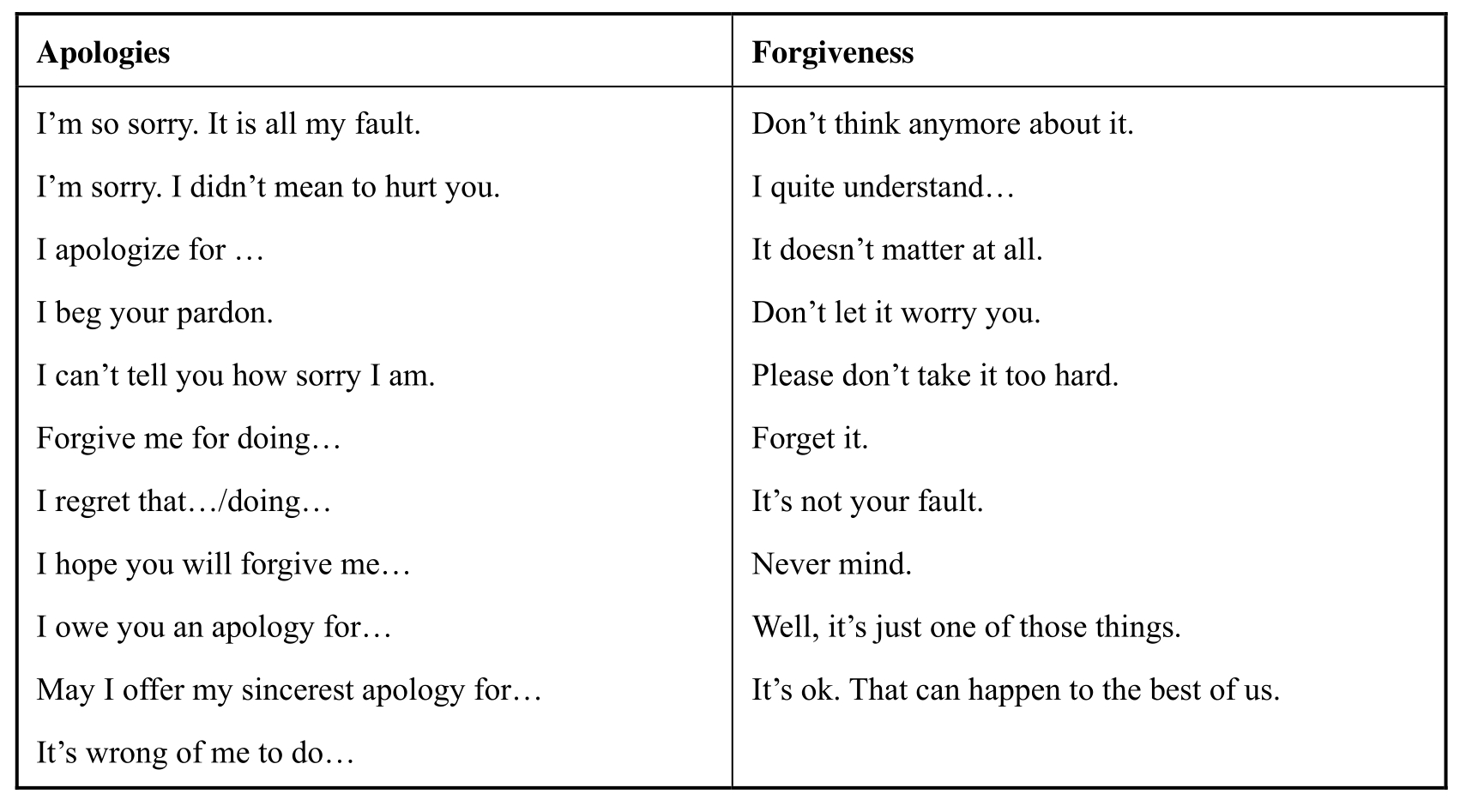
Learn the following conversations and make conversations with your partners based on the situations given below.
1) A: I am so sorry.
B: What have you done?
A: The other day, you were working on your papers, and I knew you need some evidences which I had found before, but I didn’t lend it to you.
B: Oh, I wasn’t angry about you.
A: But I find that I am not a good man.
B: Don’t be too serious, mate.
A: I know, but when I saw you tried so hard to work your paper out, I…
B: Mate, you have the right to keep your effort and you needn’t share it with others.
A: I am really sorry about that.
B: Ok, I accept your apology, and could you have the dinner with me? I am alone.
2) A: Hi, what happened to you? You were twenty minutes late today. We all worried about you, you know.
B: It’s not all my fault. You can’t blame me for this. But I can explain what happened.
A: Yes, please.
B: OK. I was waiting for the bus at the bus stop when an old man standing nearby fell to the ground suddenly and lost his senses. I was so surprised that I didn’t know what to do at first. Then I guessed that he must have had a heart attack. So I called the police there.
A: Did they come?
B: Yes, they soon came over and sent the old man to a hospital.
A: Good. Now I know what happened.
B: Can you forgive me?
A: Of course. You are a good man.
Now, make conversations of expressing apologies and forgiveness based on the following situations by using the expressions above:
1) If you are late for dating with your partner, please apologize to him or her.
2) If your partner apologizes for missing your dinner, please express your forgiveness to him or her.
3) If you quarrel with your partner, please make up with each other again. .
C.Activities
1. Speaking task
Which Quality Is the Most Important?
Look at the following chart of qualities that are needed in order to get your team more effective and then discuss with your partner which quality (ies) you think is/are the most important.

2. Discussion: What should team members do in their team building? The following are some questions for you to consider before discussion:
1) Do team members understand why the team was created?
2) Can team members define their team’s importance to the accomplishment of corporate goals?
3) Are members committed to accomplishing the team mission and expected outcomes?
4) Does the team feel that its members have the knowledge, skill and capability to address the issues for which the team was formed?
5) Do team members clearly understand their boundaries?
6) Do team members communicate clearly and honestly with each other?
3. Deliver a speech on “What can we learn from ants?” In your speech, you’d better mention your ideas on the following questions.
1) Have you ever had any experience of successful cooperation with others?
2) Do you understand the roles or responsibilities of team members?
3) What should you keep in mind if you want to work well with others?
Ⅲ.More Practice
1. Cooperate with your partner together to find out the laws of management in business online or in the library as many as possible, for instance, Cannikin law, Moffe’s Law, Sheep-Flock Effect, Parkinson’s Law, Washington Company Law, Mushroom Law, Flywheel Effect, Halo Effect, Domicile Effect, Break Pane Law, Game Theory, Orientation Law, 80/20 Law, and discuss with your partner the implication of these terms.
2. The following list describes a variety of laws of teamwork. After reading it, discuss with your partner: have you ever broken one or more before? If so, what is the result?
The 17 Indisputable Laws of Teamwork
By: John C. Maxwell
1. The Law of Significance: One is too small a number to achieve greatness
2. The Law of the Big Picture: The goal is more important than the role
3. The Law of the Niche: All players have a place where they add the most value
4. The Law of the Great Challenge (“Mount Everest”): As the challenge escalates, the need for teamwork elevates
5. The Law of the Chain: The strength of the team is impacted by its weakest link
6. The Law of the Catalyst: Winning teams have players who make things happen
7. The Law of the Vision(“Compass”): Vision gives team members direction and confidence
8. The Law of the Bad Apple: Rotten attitudes ruin a team
9. The Law of Countability: Teammates must be able to count on each other when it counts
10. The Law of the Price Tag: The team fails to reach its potential when it fails to pay the price
11. The Law of the Scoreboard: The team can make adjustments when it knows where it stands
12. The Law of the B ench: Great teams have great depth
13. The Law of Identity: Shared values define the team
14. The Law of Communication: Interaction fuels action
15. The Law of the Edge: The difference between two equally talented teams is leadership
16. The Law of High Morale: When you’re winning, nothing hurts
17. The Law of Dividends: Investing in the team compounds over time
from http://1000advices.com/guru/teamwork_17laws_jm.html
3. Games for speaking: the icebreaker game requires several groups of students to build a house of cards using cards simultaneously and to see whose house is the tallest. At the end of the game, they should describe the strategy they used to work together to accomplish the task.
Ⅳ.Assignment
Work with your classmates together to investigate the food safety in your school cafeteria, and then write a report about it.
There are many different types of reports-scientific lab reports, business reports, systems analysis reports, management case study reports, feasibility studies, client case work reports. All of these different reports have their own formats and conventions.
A report aims to inform, as clearly and succinctly as possible. It should be easy to read, and professional in its presentation. Exactly what you include in your report and how you present it will vary according to your discipline and the specific purpose of the report.
A report should generally include three parts: introduction, body and conclusion, and should have the the following features.
● formal style
● analytical thinking
● careful proof-reading and neat presentation