Unit Twelve Traveling
In this unit, students will
1. Talk about traveling.
2. Learn nonverbal social-communication skills: Saying “I don’t Know”.
3. Learn verbal social-communication skills: Describe Places.
Ⅰ.Warm-up Activities
1. Read the following passage,and then retell it to your group members. All the group members will evaluate your retelling by using the assessment sheet in the Appendix.
Sleepless in Argentina
By Tim Leffel
“Could we go out to the restaurant at, say, 8:30 or 9:00?” I ask our hotel front desk clerk in Mendoza. “Well, you could,” she responds hesitantly, with a furrowed brow. “But you will be the only people there for about one hour.”
We decide to arrive at 10:00 instead, even though this is around the time we’d be thinking about bed at home. We sidle past the two people sitting at the bar and follow the hostess to our table. She seats us and we’re not alone: there’s one other couple.
1884 Restaurant Frances Mallman is known as one of the best restaurants in Mendoza, housed in a historic bodega (winery) building, so we’re surprised by the emptiness. When we ask the hostess in Spanish where everyone is, she just smiles and says, “Es muy temprano”—it’s very early. Sure enough, people drift in gradually throughout our meal. The tables start to fill up. As we finish off dessert and ask for the check, at 11:30 at night, there’s laughter in the air, a bottle or two of wine on every table, and great music on the sound system. In the glass-fronted kitchen, the crew is hustling in every direction. The place is jumping and alive at the approach to midnight, even though half the diners are older than we are.
The tables are also filled with slabs of beef in various states of carving. The annual amount of beef consumed in Argentina is the stuff of legend: 60 kilograms per capita every year. Put another way, that’s a pound of beef every 2.7 days, for every man, woman, and child.
They can put back the wine too, but not like they used to. Argentina is the world’s 5th largest wine producer (behind France, Italy, Spain, and the U.S.). In the past, most of this went quickly down the not-too-picky gullets of the locals. In 1970, per capita wine consumption in the country was 92 liters per year-over two gallons per month, per person. Alas, now it has dropped down to a mere 35 liters a year (blame it on rising beer sales), but that is still among the highest in the world.
It’s not all turning into fat while they sleep though. That’s probably because they don’t seem to sleep much. In a country where many dance clubs don’t open until 2:00 a.m., “early to bed and early to rise” is not in the vocabulary.
from http://www.perceptivetravel.com/issues/0906/leffel.html
2. Guess game: Where does it locate?
You will describe a famous sceneries in a city in China or abroad, and your partner will guess where it locates.
3. Learn from songs
You will listen to a song “Packup”. Please fill the following blanks with the song you hear, and then talk about the meaning of packup indicated by the song.
By Eliza Doolittle
I get tired and 1) ____________
And I’m trying to 2) ____________
When I google I only get 3) ____________
I was taught to 4) ____________those issues I was told
Don’t worry
‘Cos no doubt there’s always something to 5) ____________
And when you’re stuck in an angry crowd
They don’t think what they say before they open their mouths
You gotta
[chorus]
6) ____________ your troubles in you old kit bag
And 7) ____________them beneath the sea
I don’t care what the people may say
What the people may say about me
8) ____________ your troubles get your old grin back
Don’t worry ‘bout the cavalry
I don’t care what the whisperers say
‘Cos they whisper 9) ____________for me.
Hot topic
Maybe I should 10) ____________ it
It’s a 11) ____________subject
And I like to tiptoe round the ship going down
You got penny but no pound
So if your business is 12) ____________
It’s not my business to talk about
But they don’t think what they say
before they open their mouths.
You gotta
[chorus]
Pack up your troubles in you old kit bag
And bury them beneath the sea
I don’t care what the people may say
What the people may say about me
Pack up your troubles get your old grin back
Don’t worry ‘bout the cavalry
I don’t care what the whisperers say
‘Cos they whisper too loud for me.
Tweet Tweet Tweet Tweet Tweet…
[chorus]
13) ____________ your troubles in you old kit bag
And 14) ____________ them beneath the sea
I don’t care what the people may say
What the people may say about me
15) ____________ your troubles get your old grin back
Don’t worry ‘bout the cavalry
I don’t care what the whisperers say
‘Cos they whisper 16) ____________for me.
Ⅱ.Focused Topic
Traveling
A.Dialogues
Please read the following dialogues and note the italic expressions.
Dialogue 1 Hotels Go Micro
A: Now, there’s even a way of doing the Big Apple in miniature if you don’t mind small spaces. They’re called micro hotels and they give a whole new meaning to travelling.
B: Yeah. Like the Jane Hotel in New York. The hotel’s trademark is its rooms. At 50 square feet, there’s enough room to stand and sleep, but not much else.
A: What do you think when you came in for the first time?
B: I love it so far.
A: Are you…now, you knew the rooms were going to be small, right? Are you shocked about how actually small they are?
B: No, I’m really comfortable with it, because I want to spend most of my time outside the hotel. So, it’s cozy and the size is perfect for me.
A: In my generation, we were attracted to youth hostels during that time. This generation is more concerned about fit the bill.
B: What you sacrifice in space, here you get in style.
A: One word of warning, you can only use shared bathroom, male and female unisex bathroom, OK?
B: That’s fine. I just come here to have a quick sleep. So that’s OK for me.
A: Developers say the key is managing expectations of first time. For now, the phones keep ringing.
Dialogue 2 London Sightseeing
A: Hi. I’d like to go on a one-day excursion. Is there any tour that you can recommend?
B: Yes, of course. It depends on what kind of sights you’re interested in, modern attractions or historical sites.
A: Well, is there a visit that includes both?
B: Yes, there’s the Regal One-Day Tour that goes from the Westminster Abbey and Buckingham Palace to the Tower of London and then to the London Eye.
A: That sounds perfect. How much does it cost?
B: Forty pounds per person.
A: And does that include lunch?
B: No, I’m afraid not. But there will be time to have lunch when we stop at the Tower. And there are lots of restaurants and cafes to choose from.
A: Ok. And when does the tour start?
B: We leave for Westminster Abbey at 8:30 a.m. and get back to the London Eye at 4 in the afternoon.
A: Great. Do you think you could pick me up at my hotel?
B: Where are you staying?
A: At the Holiday Inn on Liverpool Street.
B: Sure, no problem. We’ll pick you up at 8 a.m. Just be sure to be waiting for us outside the hotel.
A: Ok, thank you. See you tomorrow morning.
Other Useful Expressions
a short trip/a day trip/business trip/round trip/ round-the world trip
on a journey/homeward journey/return journey
travel agency/travel expenses/travel grant
a direct flight/transfer/
Business or economy class?
Bon Voyage!
Some people spend their lives looking for anchors.
economy ticket with an open return
travel insurance/travel pass/traveler’s check
I will be heading to Paris.
What’s the nightly rate?
Are there any vacant beds tonight?
going-away present
morning flight in first class
honeymoon
Package tour is so enchanted.
Time is different when travelling.
Which dorm do you want?
I’m a flexible and adaptable traveler.
I was inordinately peripatetic.
a frequent flier
a must-see place
Practice:
1. Please think of a must-see place and answer the following questions by making a conversation with your partner:
1) Where is the must-see place?
2) What are the features of the must-see place?
3) Why is it a must-see place?
4) What kinds of places are must-see places according to your understanding?
2. Role-play: Student A will interview student B about two of the following topics:
1) If possible, where do you want to spend your future honeymoon with your Mr. Right or Mrs. Right? Why do you choose that place?
2) What factors may result in the success of travelling?
3) Do you want to travel with the travel agency without worrying about the transportation and accommodation or travel by yourself to seek the inner charms of the scenery?
4) How to travel without spending too much money?
B.Socio-Communicative Skills
Verbal communication refers to the communication which is carried out in either oral or written form with the use of words. Nonverbal communication refers to the communicationthrough one’s voice quality, facial expressions, gestures, bodily movement, attitudes towards space and time, and so on.
To achieve successful conversations, it is necessary to learn the skills of both the verbal and nonverbal communication.
Non -verbal Skill

Say “ I don’t know.”
It needs courage to say “I don’t know”. Many people pretend to know the answer or avoid the questions in order to save their face values. For a successful conversation, no matter with friends or on a journey, it’s necessary to tell others “I don’t know” so that you needn’t sound like an idiot.
When someone asks you a question, of course, they want an answer. Our problem is, that sometimes we don’t have an answer for them, and saying “I don’t know” is not good enough. You will feel like people think you’re a dull, blank slate. And saying “I don’t know” can make you seem unprofessional and it may make you seem uninterested in the question! While if you pretend to know the answer, you will get more troubles, not to mention your face value.
? There are times when the perfect answer is, “I don’t know.” At those times, say precisely that, with confidence or authority. People ask questions for all different reasons. Sometimes it’s helpful to know the statement behind the question; other times, it would be insensitive to ask why someone is asking. The key is to find ways to respond that keep you feeling as empowered as possible. It’s also a really good policy to respond in such a way that the person who is asking feels empowered, or at least not disempowered.
? Sometimes it’s unwise to say, “I don’t know.” At those times, you may want to avoidthe question or answer another question. Most politicians do this very well. Not all questions are appropriate, but, even so, it’s also not always appropriate for you to highlight the inappropriateness of the one asking the question.
? Working in an English speaking workplace, there are other, more appropriate phrases we can use. These phrases show that we don’t know the answer—without looking stupid—and that we are going to be helpful and get the answer for them.” I don’t have that information right now, but I’ll be happy to get the answer for you.”, “ I’ve been wondering the same thing. Let’s find out together”, “Let me double-check and then get back to you”…
Practice:
Please prepare a short speech about one of the following topics, and pay attention how to say “I don’t know”.
1) My best friend asks me the answer to the question in exam.
2) The power of saying “I don’t know”
3) How to travel in Italy?
4) When a stranger asks for directions, I have no idea…
Verbal Skill
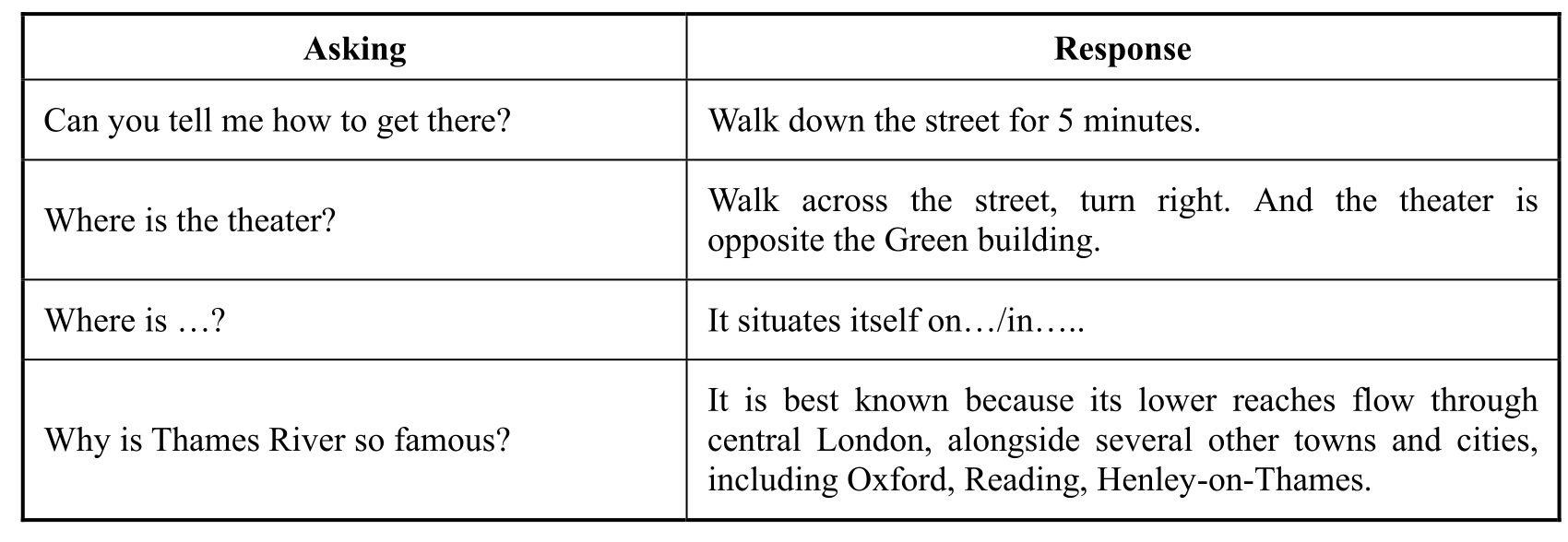
Describing Places
continued
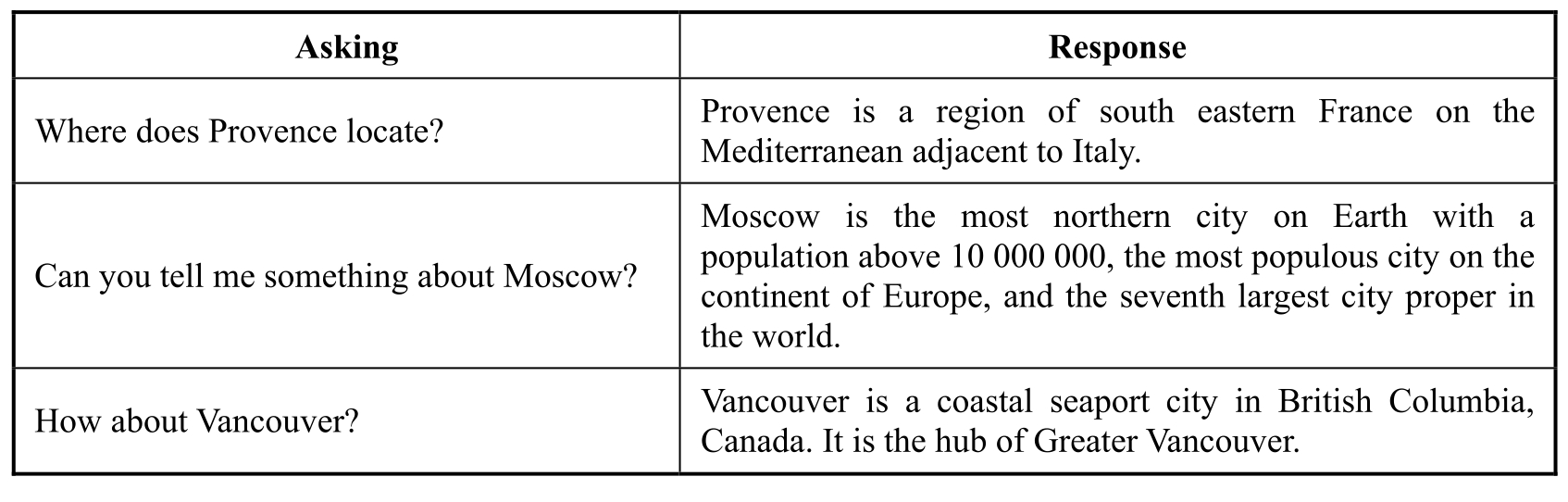
Learn the following conversations and make conversations with your partners based on the situations given below.
1) A: Excuse me, could you please tell me where the Campbell Hall is?
B: Sure. Do you see that brown building over there, behind the fountain?
A: Yes, I see the brown building behind the fountain.
B: Good. Next to the brown building, you will see a camera shop.
A: Camera shop, yes, then…
B: Then, turn right, you are on Bridge Avenue. There are buildings on both sides of the Avenue.
B: All right, Bridge Avenue, then…
A: Then, down Bridge Avenue, there is a park beside the Math Building.
B: Yes, park and Math Building. It sounds more and more complicated.
A: Campbell Hall is opposite the park, and it is the intersection of Campus Road and Jones Street.
B: Yes, thank you a lot. I will try to get there immediately.
A: You are welcome.
2) A: Hi, how was your trip to Switzerland?
B: It couldn’t be better. I feel I am still in a beautiful dream.
A: Oh, I can feel your happiness. Come on, let me share some.
B: Switzerland is a small, landlocked country in the heart of Europe. The whole country is covered with various flowers.
A: You must feel like you’re walking in a fairy tale.
B: Absolutely! Its capital Bern City hosts the well-known mountains that are famous for climbing, skiing, snowboarding, biking, hiking.
A: That must be wonderful. I do like winter sports.
B: Besides, Lake Geneva and hundreds of tiny little lakes in the mountains sparks the scenery.
A: Flowers, mountains, lakes, that must be the most charming place in the world.
Now, make conversations of describing places based on the following situations by using the expressions above:
1) One of your friends has been to Italy, and he described Italy excitedly to you.
2) You want to travel with your parents to Sydney. Describe the place to them, so they can agree to go with you.
3) One stranger is going to the main building in your university, and you try to describe the main building to him/her so that the stranger can find the place more easily.
4) Describe you home to your classmates.
C.Activities
1. Discussion
My Favorite Way of Travelling
We all know travelling gives us lots of joy, experience and adventures. Everyone likes to travel, but everybody does it in different ways. It depends on many things such as money, time, health and traveler’s interests. People prefer different ways of travelling, such like by plains,trains, ship, bus, bicycle-riding, car, walk and so on and they will also have different travelling destination, such as camping, seashore, mountaineering, desert, etc. Discuss with your partner about your favorite way of travelling and the reason you like it.
2. Group work: 10 Useful Things Travelers Tend to Pack
Packing for an upcoming trip is part of the whole travelling experience. People tend to create huge packing lists and then spend lots of time preparing their bags. Everything has its own place, and every backpacker seems to have his own packing strategy. Seeing all your stuff together should bring you already in some kind of backpacking atmosphere where you feel like your journey has already started.
Write down 10 useful things you need to pack when travelling. Tell each other the reason why you choose it and discuss again what the most important things travelers need to pack is.
Item 1: ______________ Reason: __________________________________________
Item 2: ______________ Reason: __________________________________________
Item 3: ______________ Reason: __________________________________________
Item 4: ______________ Reason: __________________________________________
Item 5: ______________ Reason: __________________________________________
Item 6: ______________ Reason: __________________________________________
Item 7: ______________ Reason: __________________________________________
Item 8: ______________ Reason: __________________________________________
Item 9: ______________ Reason: __________________________________________
Item 10: _____________ Reason: __________________________________________
3. Read the following poem “Go and Open the Door”, and then talk about the indcated meaning of it with your partners.
Go and Open the Door
By Miroslav Holub
Go and open the door.
Maybe outside there’s
a tree, or a wood,
a garden
or a magic city.
Go and open the door.
Maybe a dog’s rummaging.
Maybe you’ll see a face,
or an eye,
or the picture
of a picture.
Go and open the door.
If there’s a fog
It will clear.
Go and open the door.
Even if there’s only
the darkness ticking,
even if there’s only
the hollow wind
even if
nothing
is there,
go and open the door.
At least
there’ll be
a draught.
Ⅲ.More Practice
1. Many people say travelling is like another way of living. The only difference is that you go to different places to experience different things. No matter where you have been and what you have done, life itself is a way of experience, at home or though journey. Read the information on Memory, Music, and Travel which can be found in the appendix. Then discuss with your partners what the essential aim of travelling is.
The Essential Aim of Travelling:
2. Give a short summary after reading the following article ecotourism, and discuss with your partner about your own understanding about ecotourism. Do you think it is necessary to encourage ecotourism and in what way we can accomplish it?
Ecotourism
Our world is blessed with countless areas of magnificent natural beauty, from the dense jungles of South America, to the vast plains of Africa. This world is also shrinking in the sense that we can travel around more quickly and cheaply than ever before, making these previously isolated natural environments more accessible to tourists. However, such newfound freedom comes at a price, as the ecosystems are under a growing threat from the impact of tourism. And “ecotourism” is coming to the rescue.
According to TIES (The International Ecotourism Society), ecotourism is“responsible travel to natural areas that conserves the environment and improves the well-being of local people.” Ecotourism appeals to ecologically-and socially-conscious individuals who want to preserve the natural and cultural assets of the places they visit. Use of non-polluting means of transportation, accommodations that blend into the environment, and activities that enrich knowledge of the local area are all important features of this kind of tourism. If ecotourists return home with a greater appreciation of where they’ve been, while leaving that destination untouched, then their trip could be considered an eco-success.
The concept of ecotourism first became prevalent in the late 1980s and has continued to develop ever since. Presently, it is experiencing the fastest growth in the global tourism industry. While it is certainly a worthy idea in theory, ecotourism has not been immune from criticism. In a disturbing trend known as “green washing,” some sites that label themselves as ecotourism projects actually end up doing more harm than good to the environment. One example is Nature’s Sacred Paradise theme park in Mexico, which has displaced the local Mayan Indian population and illegally put endangered animals on show for visitors.
However, environmentalists are doing their best to protect the nature. As the ecotourismindustry expands, the education of tour guides and tourists is also progressing at pace, so that people are increasingly conscious of their impact on the environment. Looking ahead, there is a general agreement that, in order for ecotourism to have a beneficial effect, projects should continue to be small in scale, slow in growth and sustainable.
from English Digest March 2010
3. Further discussion: balancing traveling and environment
“On Memory, Music, and Travel” in more practice 1 tells us that travelling is a way for us to seek for ourselves and seek freedom, “ecotourism”in more practice 2 tells us that protecting environment is also very important. Up to now, we still haven’t found a feasible solution to balance the two. Talk with the partners and try to get your idea of balancing the two.
Ⅳ.Assignment
Group Work: Travelling Log Club on Net
When travelling, one must meet many interesting and unforgettable things. They will experience different customs from different places, which make their travelling exciting and fresh. There is a saying “When in Rome, do as the Romans do”. One’s travelling experience will give a hint to others who will go to the same place later.
You and your group members are going to establish a travelling log club on Internet. You are going to open a net space for the travelling lovers to write their travelling logs, especially how they get along with local people. Talk about your plan together and discuss it in class.