Unit Seven Table Manners
In this unit, students will
1. Talk about table manners.
2. Learn nonverbal social-communication skills: Respect Others’ Opinion.
3. Learn verbal social-communication skills: Make Complaints.
Ⅰ.Warm-up Activities
1. Read the following passage, and then retell it to your group members. All the group members will evaluate your retelling by using the assessment sheet in the Appendix.
Main Differences between Chinese and Western Eating Habits
The main difference between Chinese and Western eating is that unlike the West, where everyone has his own plate of food, in China the dishes are placed on the table and everybody shares. If you are being treated by a Chinese host, be prepared for a ton of food. Chinese are very proud of their culture of food and will do their best to give you a taste of many different types of cuisine. Among friends, they will just order enough for the people there. If they are taking somebody out for dinner and the relationship is polite to semi-polite, then they will usually order one more dish than the number of guests (e.g. 4 people 5 dishes). If it is a business dinner or a formal occasion, there is likely to be a huge amount of food that will be impossible to finish.
A typical meal starts with some cold dishes, like boiled peanuts and smashed cucumber with garlic. These are followed by the main courses, hot meat and vegetable dishes. Finally soup is brought out, which is followed by the starchy “staple food”, which is usually rice or noodles or sometimes dumplings. Many Chinese eat rice (or noodles or whatever) last, but if you like to have your rice together with other dishes, you should say so early on.
One thing to be aware of is that when eating with a Chinese host, you may find that the person is using his chopsticks to put food in your bowl or plate. This is a sign of politeness. The appropriate thing to do would be to eat the whatever-it-is and say how yummy it is. If you feel uncomfortable with this, you can just say a polite thank you and leave the food there, and maybe cover it up with a little rice when they are not looking. There is a certain amount of leniency involved when dealing with Westerners, so you won’t be chastised.
2. Game: How much do you know about table manners?
The following is a quiz of western table manners. Quiz your partner on what kind of things one should or should not do at the dinner table. Check the suggested answers following and compare with Chinese table manners.
1) It is acceptable to keep your napkin on the table during dinner.
2) It is okay to talk while you are chewing or having food in your mouth.
3) Can you wear a hat to the dinner table?
4) Should Pizza be eaten with utensils or with your hands?
5) You drink only when there is no food in your mouth.
6) If your food is too hot, blow on it softly.
7) Never rest your elbows on the table, and both hands should be present during the meal, unless reaching for your napkin.
8) No reaching over anyone for food, instead request for something to be passed to you.
9) Always contribute to the dinner conversation, but do not monopolize it.
10) You must try at last a bite of all food prepared by the host, unless there are allergies or religious convictions involved.
3. Watch the video.
You will watch an episode of western table manner. Please answer the following questions according to the video.
1) What should a man do when he and his girl friend are seated?
2) Where should you put the napkin when having dinner?
3) Where should the knife and fork be placed when they are not used?
4) Is the quantity of wine in the glass in western table manners same as that in Chinese table manners?
5) What should you do with your napkin when you have to leave for a while during the dinner?
6) What manners should be minded when you stir your coffee?
Ⅱ.Focused Topic
Table Manners in Western Restaurant
A.Dialogues
Please read the following dialogues and note the italic expressions.
Dialogue 1 Restaurant Dos and Don’ts
(A, a Chinese student, is learning from her American friend B about restaurant dos and don’ts.)
A: I heard when dining in a Western restaurant we have to pay much attention to some dos and don’ts.
B: Exactly. When you want to eat at a Western restaurant, you should first consider making a reservation.
A: If not, then what will happen?
B: You may risk having to wait for a long time for a table.
A: Anything else?
B: When eating, the Japanese and some Chinese are in the habit of slurping their food. By doing so, they show their host how much they like the food.
A: Then how do Westerners respond to this practice?
B: They find eating soup in this way most unpleasant. They also consider picking one’s teeth and putting on makeup at the table inelegant.
A: What about tipping?
B: When it comes to tipping, they just leave some money on the table. The amount is up to you, but it’s usually 15 to 20 percent of the check.
A: I see.
Dialogue 2 Dining in a Restaurant
(Kevin, Mina, and Lo go out for dinner.)
★ Sitting Down
Hostess: Good evening. Do you all have a reservation?
Lo: Yes, under Wang.
Hostess: Party of 3 for seven o’clock? Right this way Mr. Wang.
Mina: This restaurant looks beautiful!
Hostess: Would you like a table or a booth?
Lo: Table please. Do you have one free next to the window?
Hostess: Here you are. Here are the menu, and the wine list. Your server will be right over.
Kevin: Thank you!
★ Ordering
Server: Are you all ready to order?
Lo: Yes! I would like the green salad with French dressing, and the steak please.
Server: How would you like your steak cooked?
Lo: Medium rare please.
Server: And you, ma’am?
Mina: I’ll have the Greek salad and the pork chops please.
Server: And for you, sir?
Kevin: I’d like a bowl of the cream of mushroom soup, and also the stuffed haddock.
Server: Very well. Can I interest you all in an appetizer tonight?
Lo: No, thank you! We are saving room for dessert!
Server: And anything to drink?
Kevin: Yes, we’d like a bottle of your chardonnay please.
Server: I’ll just need to see some I.D., sir.
Kevin: There you go.
Server: Thank you! I will be back shortly with your wine and some bread.
Other Useful Expressions
Can I take your order now?
What would you like to start?
What soup would you prefer?
It’s our chef’s recommendation.
Could you show me how this noble dish is eaten?
Would you like it rare, medium, or well-done?
What dressing would you like on the salad?
Could you bring us the check please?
Do you have soft drinks?
How about our special cocktail?
It sounds interesting. I’ll take that.
We have a window table reserved for you.
I’m sorry to say we don’t have a vacant seat at the moment.
Please wait in the lounge. We’ll give you a call.
We can seat you in ten minutes or so.
I’ll bring you the menu, sir.
Practice:
1. Suppose you are going to a restaurant with your new friend. Please answer the following questions by making a conversation with your friend:
1) Do you reserve before you go?
2) What kind of table do you prefer to sit by?
3) What will you order?
4) What will you talk about?
2. Role-play: Student A will interview student B about two of the following topics:
1) How much do you know about western eating manners and Chinese eating manners?
2) What is the most important manner in eating manners in your mind?
3) Do you think it is impolite to follow western manners in a Chinese restaurant and vice versa?
4) When you eat with an American friend in a Chinese restaurant, will you explain table manners to him or her?
B.Socio-Communicative Skills
Verbal communication refers to the communication which is carried out in either oral or written form with the use of words. Nonverbal communication refers to the communication through one’s voice quality, facial expressions, gestures, bodily movement, attitudes towards space and time, and so on.
To achieve successful conversations, it is necessary to learn the skills of both the verbal and nonverbal communication.
Non -verbal Skill
Respecting Others’ Opinion
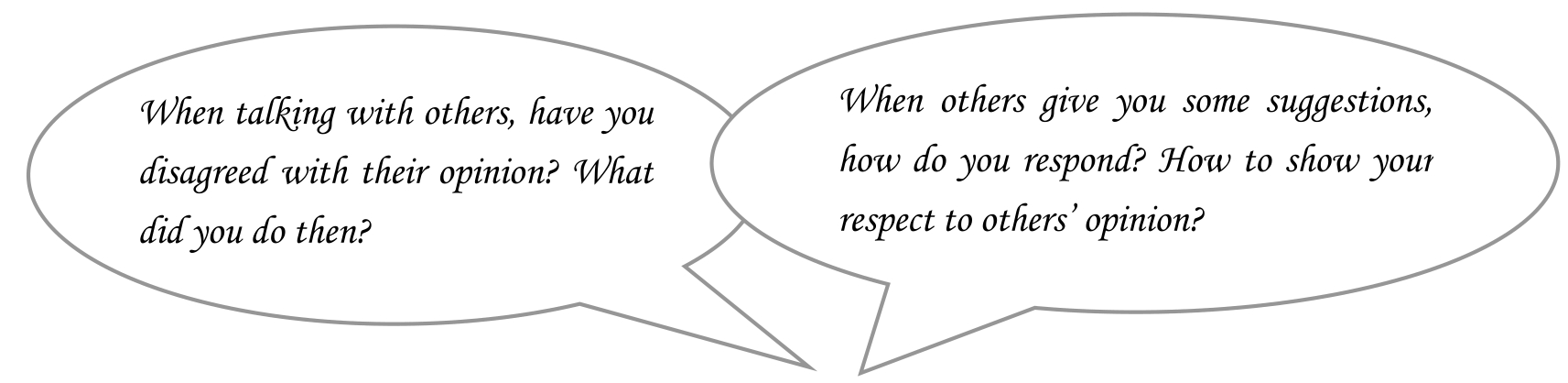
Have you ever wished that you had the power to control your partner’s mind? Wouldn’t it be nice to be able to get people to do what you wanted them to, when you wanted them to? The following is not going to advocate that you control people’s brains, but to give you some hints on the subject of winning people to your way of thinking.
? The first thing that you should do if you want to bring people to your way of thinking is to avoid arguments. No one really wins in an argument. When you feel a disagreement brewing you’d better change the subject. If it is a topic that you know must be addressed you’d better remain calm and march straight into the disagreeable topic. You must be willing to agree to disagree in a way that is respectful to the other person.
? Everyone has an opinion, most of the time you will agree with your partner, but sometimes you will totally disagree. When these times come,show respect for their way of thinking and never, never say “You’re wrong!” You can feel that way about them; just don’t ever use those words. When you use those words you completely destroy any chance of winning them to your side because now they are on the defense.
? Sometimes you will realize that you are wrong. When you realize this, don’t try to cover it up. Simply admit it quickly and emphatically and move on. When you point out that you are wrong about something most people will give you the benefit of the doubt and move on. On the other hand if you get caught being wrong then you hold all the responsibility.
? When you begin talking a person over to your side, do it in a friendly way. Smile, be polite and considerate, show them you actually enjoy their company and you are interested in what they have to say. This will bring you a lot more success than trying to begin with a frown on your face. No matter how serious the conversation there is no excuse for rudeness.
Practice:
Please discuss with your partner about your understanding of one of the following quotes, and pay attention to the importance of respecting others opinion.
1) Every human being, of whatever origin, of whatever station, deserves respect. We must respect each others even as we respect ourselves.
2) I must respect the opinions of others even if I disagree with them.
3) If you have some respect for people as they are, you can be more effective in helping them to become better than they are.
4) Leaders who win the respect of others are the ones who deliver more than they promise, not the ones who promise more than they can deliver.
5) Men are respectable only as they respect.
6) Probably no greater honor can come to any man than the respect of his colleagues.
Verbal Skill
Making Complaints
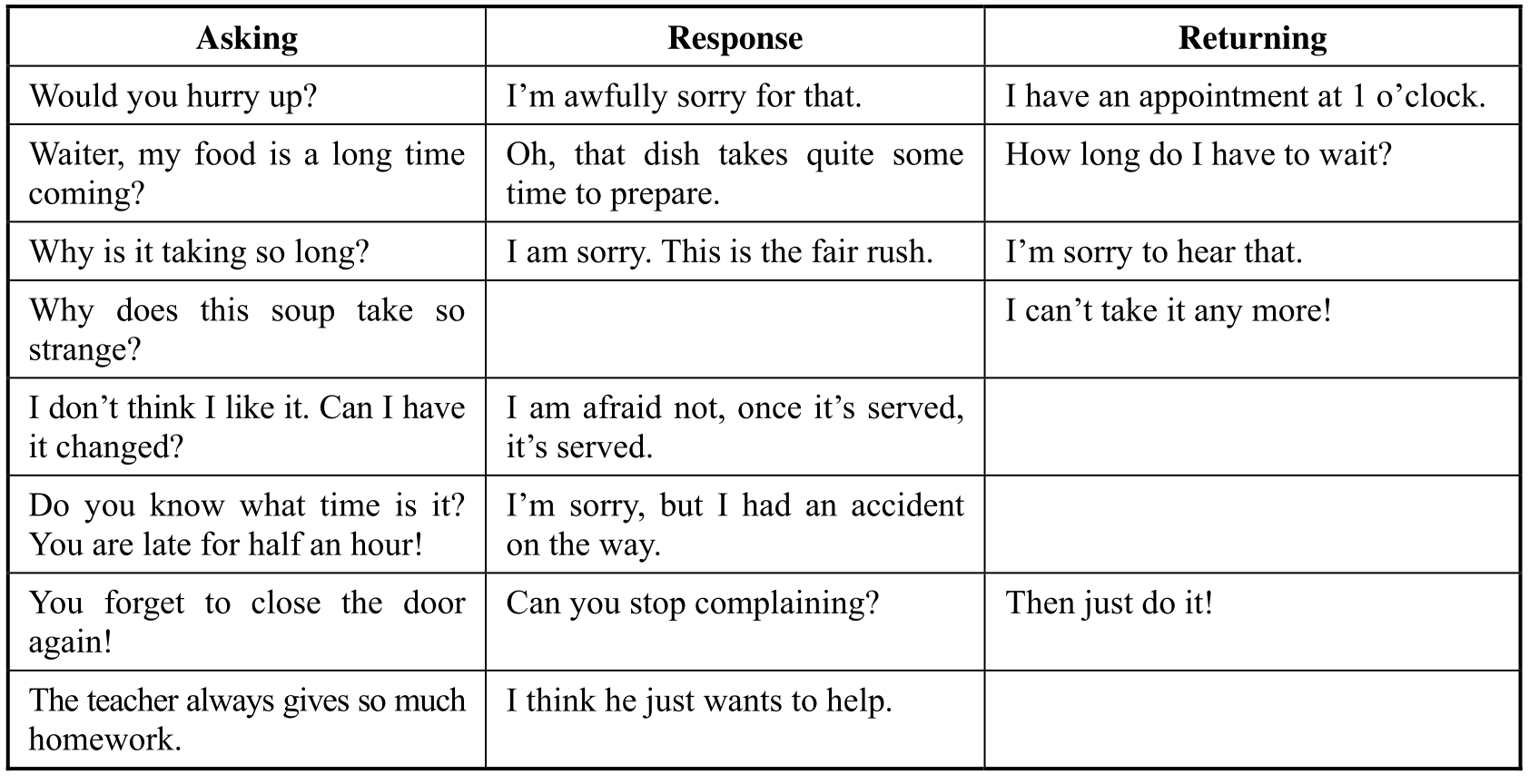
Learn the following conversations and make conversations with your partners based on the situations given below.
1) (Mr. Bell=B, W=Waitress, HW= Head Waiter)
B: Excuse me, miss. I ordered the hairy crab but you gave me the green crab.
W: I’m sorry, sir. I’ll get you the head-waiter.
(Soon the head waiter (HW) comes.)
HW: I’m awfully sorry. There must have been some mistake. I do apologize for giving you the wrong dish. I’ll change it immediately for you. The crab will take 15 minutes to prepare. Would you take some complimentary drink while waiting?
B: I’m afraid I don’t have enough time to wait for the next crab. I have an appointment at 7:00 in my room. Now it’s 6:45.
HW: Oh, you are staying at our hotel. Mr. …?
B: Bell, Henry Bell.
HW: Room…?
B: Room 908.
HW: Oh, Mr. Bell, I shall ask Room Service to serve you a snack at 9:30 tonight and you’ll have your favorite hairy crab. It’s all on the house. And now try the green crab if you don’t mind. We’ll cross the green crab off the bill.
B: That’s good. Thank you.
HW: Thank you for telling us, Mr. Bell. I assure you it won’t happen again. Please take your time and enjoy yourself. And I hope you have a good time at our hotel.
2) (G= Guest, W=Waiter)
W: Here’s your shrimp with beancurd.
G: I don’t think I ordered this.
W: Let me check up. There’s no mistake. This is the dish you ordered.
G: I don’t think I like it. Can I have it changed?
W: I am afraid not. Once it’s served, it’s served.
G: Very well.
G: Waiter, my food is a long time coming.
W: I’m sorry. This is the Fair rush, you know. There are so many guests today. What have you ordered?
G: (I have ordered) Steamed bass.
W: Oh, that dish takes quite some time to prepare.
G: I have an appointment at noon. Will you tell the cooks to hurry up?
W: Certainly.
Now, make conversations of making complaint based on the following situations by using the expressions above:
1. You’ve been waited for ages and the dishes haven’t been served.
2. The price for the cocktail in this restaurant is twice as much as it is in other restaurants.
3. You are enjoying your soup when you find a hair in it.
4. The dish is too salty.
5. There is a stain on the wine glass.
6. The waiter is impatient and lazy.
C.Activities
1. Discussion
The following is a standard table setting for a three-course meal. With the explanation of placement of dinnerware, discuss how to use them.

Two Forks
Both forks are placed on the left of the plate. The fork furthest from the plate is for salad.The fork next to the plate is for the dinner. (Please Note: At more formal meals where the salad is served after the main course, the order of placement is reversed.)
Dinner Plate
The dinner plate is placed on the table when the main course is served and is not on the table when the guests sit down.
Salad Plate
The salad plate is placed left of the forks.
One Dinner Knife
It is on the right side, and directly next to, the plate. If the main course requires a steak knife, it may be substituted for the dinner knife.
Two Spoons
They are on the right side of the knife. The dessert spoon is directly to the right of the knife. The soup spoon is on the far right.
One Butter Plate with Butter Knife
A small bread plate is placed above the forks, above and to the left of the service plate.
One Water Goblet
A water glass will be found just above your knives.
One Wine Glass
At least one wine glass should sit to the right and possibly above the water glass.
Napkin
Place the napkin in the place setting’s center, or left of the last fork.
Coffee Cups
Place a cup and saucer to the right of the place setting. The coffee spoon goes to the left of right of the saucer.
Dessert Spoon and Fork
A dessert fork and/or spoon may be placed horizontally above the dinner plate. These utensils may also be provided when dessert is served.
2. Read the following essay, and then, answer questions. You may also ask some questions based on this essay in a group of 4 or 5 members, and all the group members will answers your questions.
Dining Etiquette When Dating
Be sure to make reservations if the restaurant you chose is a fancy or popular one. It’s very embarrassing to show up without reservations and having to wait for a table, leaving very bad impression on your date. Also, be sure to check to see if they have a dress code and tell your date in advance what to wear.
When your food arrives, proper dinning etiquette requires you to eat at a moderate pace so that you have time to talk. A good measure of how fast you should eat is to count 10 seconds between each mouthful and it’s a bad dining etiquette if you gobble down your food and you spend the ret of the time watching your date eat.
Don’t slurp your soup, smack your lips, or chew with your mouth open. Nothing is more unsightly than watching someone tale and chew their food at the same time. Your napkin should be placed on your lap at all times. Don’t tuck it into your belt or use it as a bib. If you have to get up, place it neatly on your seat.
When eating, insert your fork straight in your mouth. Don’t place your fork in the side of your mouth as it increases the chances of food sliding away, which could be very embarrassing. If you get food stuck in your mouth don’t pick it out with your fingers or fork at the table. Excuse yourself and go to the restroom and get it out with a toothpick.
When dinning, keep your eyes on your date at all times and try to smile between mouthfuls. Occasionally, you should make an effort to show some interest and ask questions like, “How do you like the beef?” If she needs anything, you are the one who is supposed to flag down the waiter by a gentle wave of the hand until someone notices you.
Questions:
1) If you invite someone to a formal dinner in a western restaurant, what should you do beforehand?
2) Why is the eating pace so important in the dining etiquette requires?
3) What should you do when you get your food stuck in your mouth?
3. How much do you know about Chinese table manners? Read the following passage about using chopsticks and discuss with your group members other table manners in a Chinese restaurant.
1) Chopsticks should always be held correctly, i.e. between the thumb and first two fingers of the right hand.
2) When not in use, chopsticks must always be placed neatly on the table with two sticks lying tidily next to each other at both ends. Failure to do so is evocative of the way the dead would be placed in a coffin before the funeral.
3) Never point the chopsticks at another person. This amounts to insulting that person.
4) Never wave your chopsticks around as if they were an extension of your hand gestures.
5) Never bang chopsticks like drumsticks. This is akin to telling others at the table you are a beggar.
6) Never use chopsticks to move bowls or plates.
7) Never suck the chopsticks.
8) Decide what to pick up before reaching with chopsticks, instead of hovering them over or rummaging through dishes.
9) Keep chopsticks off the table, they can be rested horizontally on one’s plate or bowl; a chopstick rest (commonly found in restaurants) can also be used.
10) When picking up a piece of food, never use the tips of your chopsticks to poke through the food as with a fork; exceptions include tearing apart larger items such as vegetables.
11) Never stab chopsticks vertically into a bowl of rice, as this resembles incense sticks used at temples to pay respects to the deceased.
Ⅲ.More Practice
1. Suppose your classroom is a big restaurant with desks arranged into dinner tables. Some students are waiters and waitresses, and some are customers. Prepare some dinner wares if they are available or just some cards with corresponding words on them. The guests in groups will have dinner following western table manners, including ordering food and complaining appropriately. The best role-players will be selected based on their performance.
2. Give a short summary after reading the following passage and then, list the differences between Chinese home dinner manners and those of western’s. Do you agree with these differences? Why or why not?
Dinner Invitations
It is common both in China and in the west to invite friends and acquaintances to dinner. However, the customs associated with this are often very different in the two cultures, so both Westerners and Chinese may easily feel confused, and misunderstandings may then result.
THE ROLE OF THE HOST
When a guest is invited to a home for dinner, probably the most important job for the host is the preparation of the food. At typical Western dinner there are three different courses:
● A Starter/Appetizer, such as soup, fruit juice or salad.
● The Main Course, which usually consists of one type of meat or fish served with potatoes(or possibly rice or pasta),vegetables and a sauce, and perhaps a side dish such as a small salad.
● The Dessert,which is something sweet, such as fruit pie and ice cream.
Tea or coffee is of the served after the three courses, and may be accompanied by cheese and biscuits, or something sweet like a mint chocolate.
Much Western food (such as a cold appetizer or the dessert) can be prepared in advance, and the main meat dish often needs cooking for an hour or more. So compared with Chinese food, the host has relatively little last minute cooking to do. When the guest arrives, everything is usually almost ready; and when the meal is served, the host sits down at the table with everyone else. There are no very definite rules as to who should sit where at the table, although the host of the sits at a place which is near to the kitchen. Normally the host will gesture or state where people should sit, but sometimes may simply say “Sit where you like.” Usually the host is present for the whole of the meal, and only goes briefly to the kitchen to fetch the food.
At the typical Western meal people have their own individual servings of food, and compared with a Chinese meal, there is much less variety and smaller quantities. First the appetizer is served to each person. If it is something cold, it is placed on the table in advance,and if it is something hot like soup, the host serves each person a bowlful. When everyone is ready to eat, the host will usually ask people to start eating by saying “Please start,” or “Do go ahead.” It is rare, though, to make negative comments about the food, such as “This is very simple,” unless the host genuinely feels that is true.
When everyone has finished the appetizer, the host may occasionally offer some more, but often simply collects the dishes and serves the next course.
The main course consists of one type of meat or fish, together with potatoes, vegetables and a sauce. It is common for the host to serve the meat or fish onto individual plates and pass one to each person at the table. The other things are put in dishes in the center of the table, except for the side dishes, which are put to the left of each person’s place. A bread roll is often put on this side dish, and there may also be a side salad. The host will say “Please help yourselves,” and then people will take food from the central dishes and put it on their own plates. When everyone has taken what they want, they will start eating. It is not normal to start eating, though, until everybody is ready.
When the guests have almost finished everything on their plates, the host will offer them some more by saying, for example, “Please help yourself to some more,” or “Would you like some more?” An offer like this will normally only occur once or twice, so it is important for the guests to take what they want when they are offered it. Then when it seems that everyone has had sufficient, the plates and dishes are collected and removed to the kitchen. Often most of the food o the able will have been eaten.
After this, the dessert is served. Sometimes the host may offer two different kinds of dessert, and will ask people which they would prefer. Then each person will be given a portion, and offered some more when they have finished their first helping.
During the first two courses of the meal, it is common for a drink to be served. This could be an alcoholic drink like wine, beer or cider, or a soft drink like orange or Coca Cola. This drink is usually finished, though, when the plates from the main course are removed.
It is not usually polite to smoke at the table during a Western meal. Sometimes people may smoke before or after the dessert, but before lighting up, it is courteous to ask if anyone objects. If the people do not know each other very well, guests often do not take the initiative in asking but wait to see if the host makes a comment.
When the whole meal is over, it is common for the host to suggest that everyone moves to more comfortable chairs, such as in the sitting room, to have some tea or coffee, or more alcoholic drinks. People then chat there until the guests decide to leave.
THE ROLE OF THE GUEST
When people receive an invitation to someone’s home for dinner, one of the questions they may consider is whether they should take a present with them. Westerners seem to differ in their customs with regard to this. Age, religion and social background all have an influence, so it is difficult to make generalizations. Many people take no present at all, especially if they expect to give a return invitation at a later date, but others always take a small gift, such as wine, flowers or chocolates. If people take wine, they may expect this wine to be served. But if the host has chosen a special wine to accompany the particular food being served, it may be just put to the side. Flowers are usually put into a vase, and chocolates may or may not be served after the meal. However, if the guests take no gift, most English speakers would not be offended.
Another question that guests have to consider is their time of arrival. Usually in the West it is impolite to arrive earlier than the stated time, in case the host is still bus preparing. So most people arrive either on time or about five minutes later. For example, if the host has invited the guests to come at 6 o’clock, then it is best to arrive between 6:00 p.m. and 6:05 p.m. To arrive earlier than 6 o’clock or much later than 6:05 would be regarded as somewhat impolite, unless the people are very good friends. If the guest is delayed, it is best (if possible) to telephone the host to inform them. However, if the host says “6:30 or 7 o’clock,” for example, people could arrive at any time between 6:30 to 6:45. Earlier or later than this would still be impolite, though, and would normally require an apology.
After the guests have arrived and the meal is about to be served, the host will ask everyone to sit down at the table. Usually the host will indicate where the guests should sit. Then the food will be served. In Western culture, when eating at a person’s home, it is considered impolite to leave anything but a very small amount of food on your plate, so it is important to eat almost everything that is served. Since there is little choice in a Western meal, this may cause some difficulties. If, for example, guests notice that the host is serving something which they do not like very much, it is best to ask for a small portion. To completely refuse it is not very polite, unless they have a special reason for not being able to eat that particular type of food.
During the main course, most of the dishes are placed in the center of the table, so the guests can take as much or a little as they want. Unlike at a Chinese meal, though, where people continuously take a little and eat a little, it is normal at a Western dinner to place a relatively large amount of food on the plate at the beginning of the meal and then eat all (oralmost all) of this before taking any more. When the host sees that the guests have almost finished the food on their plates, the host will normally offer them some more. But unlike at a Chinese meal, this will usually occur once or twice during a course. It is important, therefore, for the guests to take a suitable amount of food at the start of the main course when people are helping themselves. If they take too much, they may have difficulty in finishing the food, and will thereby cause offense. On the other hand, if they take too little, and the host only once or twice offers them some more, they may find that they are still hungry!
During the course of the meal, and especially near the beginning, it is polite for guests to compliment the host on the food. Sentences such as the following can be used for this:
● This is really delicious.
● This meat is beautifully tender.
● This dish is very tasty.
The host will normally respond to these compliments by simply saying, “Thank you. I’m glad you like it.” However, although it is polite to compliment a few times like this, it is not common at a Western meal to continue giving compliments or to discuss the food at length. Sometimes at a Chinese meal, it seems that much of the conversation revolves around the food. This is not so usual in the West; it is much more normal to make one or two comments and then to discuss personal or general topics.
At the end of the meal, and also when leaving, it is polite for the guests to thank the host and to comment again that they enjoyed the food. Sentences such as “Thank you very much. That was really lovely.” or “I very much enjoyed the meal. Thank you.” can be used for this. The host will usually respond by saying something like “You’re welcome. I’m glad you liked it.”
3. Games for speaking: Below are three restaurant settings. With your partners, practice using the patterns and skills you have learned in each of the following settings. One person is the server and the others are the customers.
Setting 1: Two friends are meeting at a fast food restaurant for lunch. They order at the counter together.
Setting 2: Two colleagues are meeting for lunch to discuss a business project.
Setting 3: A married couple is out to dinner at a nice restaurant to celebrate their tenth wedding anniversary. The wife cannot decide what to order.
Ⅳ.Assignment
Who Will Pay the Bill?
When you eat out with friends, how do you pay the bill? Does each one pay his own bill or one of you pays the whole? Do you know that more and more people prefer to go Dutch when they have dinner with friends in a restaurant which means that they usually share the cost instead of one paying for it all? What’s your opinion about it and why some Chinese still do not like to go Dutch, but to treat alternatively? Interview as many classmates and friends as possible and give a report your survey to your classmates next time.