Unit There Among Colleagues
In this unit, students will
1. Talk about the relationship among colleagues.
2. Learn nonverbal social-communication skills: Don’t Talk Too Much.
3. Learn verbal social-communication skills: Make An Invitation.
Ⅰ.Warm-up Activities
1. Read the following passage,and then retell it to your group members. All the group members will evaluate your retelling by using the assessment sheet in the Appendix.
McDonald’s
By Shelly Miller
Most of my friends are what society would call “punks”. We are the teenagers who hang out at the coffee shops or the movies for lack of anything better to do. But being punks doesn’t mean much.
One evening, after a day of not doing much, we were sitting in McDonald’s when a guy in our group whom I had just met that day walked in. Brian was the typical punk teenager, dressed in black with the dyed hair. Right before he stepped inside, he yelled something outside to a man walking down the street. I just hoped he wasn’t trying to start trouble. He sat down and a minute later, a burly homeless man stuck his head in and looked at Brian.
“Did you say something to me?” the man demanded, and I thought I saw a mean glint in his eyes. I shrank back, thinking that if Brian had tried to pick a fight, this was the wrong guy to do it with. I had seen too many people and places kick teenagers like us out for pulling stuff.
While the rest of us were looking for a place to back into, Brian got up and walked up to him. “Yeah…would you like something to eat?”
The relief was almost audible, and the man smiled and walked in.
After a large meal of hamburgers, fries and dessert, the man left, and even the staff waved good-bye to him. When we asked Brian about it, he explained how he had money that he didn’t need and the man had none, so it was only right.
from Chicken Soup for the Teenage Soul II
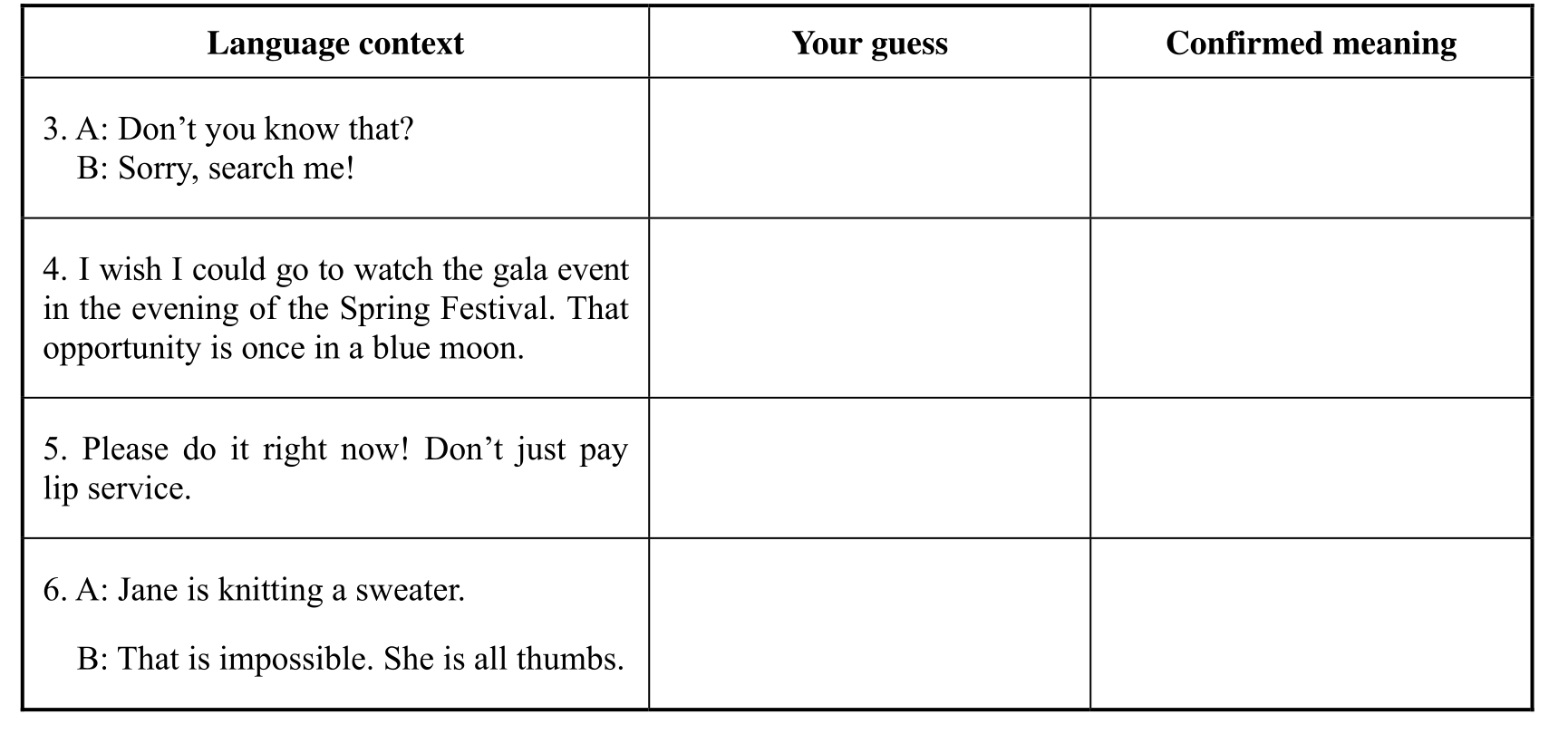
2. Idioms study: Do you know the meanings of following italic idioms? Before you look into dictionary or learn from your teacher, guess the meaning based on the language context.
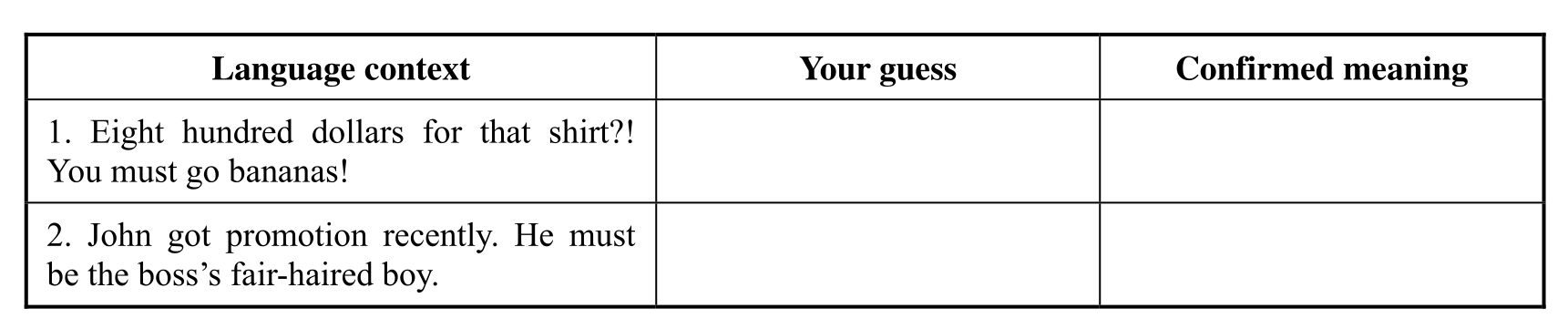
continued
3. Listen to the following episode of the movie “Click”, and fill in the blanks.
(M=Michael A=Ammer E=Everyboday J=Janine)
M: I can’t take this anymore…Fast-forward me to my promotion.
A: So here’s to Michael Newman—the greatest partner I could ever 1)________. Hear!
E: 2) _______!
M: Thank you. Thank you, guys. My family thanks you. I’m gonna do the best I can and I won’t 3)________________, I promise.
E: Yeah!
M: This is great. Thank you.
A: How’s it feel, 4)______?
M: Feels incredible, sir—
A: Well, 5) ___________. I’m telling you. Not just because of that Watsuhita project either. For helping me 6) _______________________ now I’m spending time with my special lady.
J: Dinkie.
M: Are you kidding me? You guys have been dating a couple months now? That’s pretty huge for this one.
J: No, the first few months were easy. It was the one-year hump that was the tough part.
A: Her inappropriate weekend with your brother in Cabo. Well, that was a potential speed bump But, well, Dr. Bergman helped us work through it, didn’t he, honey? How’s he doing for you and Donna?
M: Dr. Bergman. What do you mean?
J: Oh, you know what, sweetie? It’s none of our business. Let’s let Michael (7)_________ his glory. Cheers.
A: Bask away, partner.
M: Took that bastard a year to promote me? What else did I miss?
Ⅱ.Focused Topic
Among Colleagues
A.Dialogues
Please read the following dialogues and note the italic expressions.
Dialogue 1 Instruction on work
(T= Tony, M=Mike)
T: Hi, Mike, could you tell me your secret to get to the top of your profession?
M: Well. I think my secrets are a few big “yeses” and many small “nos”.
T: Wow! Could you explain more?
M: That means I usually say yes to big things like setting goals in work, keeping good professional relationships, or making commitment.
T: Huh? What about many small “nos”?
M: To things like time-wasters, distracting matters, or those that prevent me from achievingbig yeses, I usually say no.
T: For example?
M: For example, chatting online, which is quite time consuming. Or, when someone asks me for information about others, I will say no. And, for things I am not sure, I will also say no.
T: You are right. But, don’t you think you are a very self-disciplined person?
M: Oh! I don’t think so, or have not realized I am such a person yet. Haha…
T: Maybe you are!
M: Maybe! Anyway, it is true that it requires me always be cautious and think carefully before I say nos or yeses.
T: Oh! It’s quite hard for me!
Dialogue 2 Discuss Work
A: Could you spend a few minutes discussing your project with me?
B: Of course. Even if we’re on a very tight schedule, I think we can finish it on time.
A: I heard that a few of your team members are a bit behind in their work. What is wrong?
B: Well, because of the computer problems.
A: How have they decided to deal with that?
B: They will work on this weekend until it is finished.
A: Well, that is true dedication! I’m so impressed.
B: Me too!
A: Maybe we could change the deadline to next Tuesday, and that will allow them to take a rest on Sunday.
B: Oh! That will be very helpful!.
A: Well, make sure every member knows the new deadline.
B: I will. Thank you!
Other Useful Expressions
appreciate one’s guidance in-service staff
in the sales division go-getter
Welcome to join us. live up to expectation
team up with like to get to the point
cooperate with beat about the bush
watch out for each other recommend somebody for promotion
assign a job I’d like to know your ideas about the job.
self-motivated You have worked here longer, and I just
good team player want to know what you think.
Practice:
1. Please make a conversation in which your partner and you will answer the following questions.
1) How to show your good quality as a new comer in work?
2) How to ask for help from colleagues who are more experienced in work?
3) When you have a job, what kind of colleagues would you like to make friends with?
4) How will you deal with your leader’s unfair treatment to you?
2. Role-play: Student A will interview student B about two of the following topics:
1) What are the advantages and disadvantages of office romance?
2) What are the methods to avoid arguments with colleagues?
3) How to communicate with colleagues of different ages?
4) What kinds of behaviors will affect the relationship between colleagues?
B.Socio-Communicative Skills
Verbal communication refers to the communication which is carried out in either oral or written form with the use of words. Nonverbal communication refers to the communicationthrough one’s voice quality, facial expressions, gestures, bodily movement, attitudes towards space and time, and so on.
To achieve successful conversations, it is necessary to learn the skills of both the verbal and nonverbal communication.
Non -verbal Skill
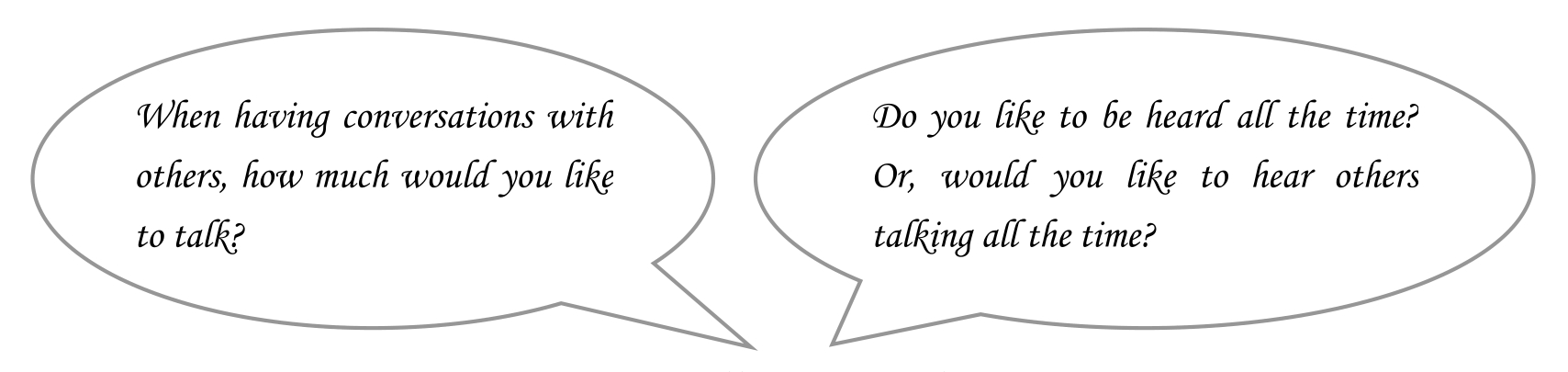
Don’t Talk Too Much!
There’s nothing wrong with wanting people to know our pinions, or how you feel. Everyone likes to be heard. However, it may be a bad thing when we talk too much, because that will annoy the people around you or result in personal embarrassment. Then, what are the methods to avoid talking too much?
? Make a conscious effort to listen more and talk less. Listening shows you are interested in the other person and what they say. People will be flattered by a good listener, because secretly, everyone loves to talk about themselves.
? Don’t fill all the dead air. During conversations pauses are necessary for thinking. Some people like to take a moment to think about their answer carefully. Don’t feel you need to jump in at every pause. This will lead to you talking for more than you should share. Allow 5 seconds, look around, and make sure if nobody seems to want to speak.
? Ask yourself why you’re so chatty. Do you seldom have an opportunity to be heard? Do you feel lonely? Do you drink? When you realize you are talking too much, take a deep breath and remind yourself to adjust your speaking habits.
Practice:
Please talk about one of the following topic with your partner, and pay attention to your speaking habits.
1) Describe one of your parent’s colleague.
2) Ideal relationship with colleague
3) How to get along with foreign colleague?
4) How to get along with a colleague who doesn’t respect you?
Verbal Skill
Making an Invitation

Learn the following conversations and make conversations with your partners based on the situations given below.
1) (J= Jack M=Mary)
J: Hello, Mary. I was wondering if you were occupied on Sunday evening.
M: Er…. Sunday evening?
J: Only, if not, would you like to come to our weekend party?
M: Yes, I’d love to, but I need to check my schedule first.
J: Yes?
M: Oh, it’s great! I can go to the weekend party.
J: Oh, I’m so glad that you can come! Some of our classmates will come too, and we will have a wonderful time.
M: Shall I prepare something for the party?
J: Each of us will bring a dish cooked by ourselves. You may also bring yours.
M: Sure, that’s interesting!
J: I will pick you up at 5 pm.
M: OK, thank you! See you!
J: See you!
2) A: How are you feeling today?
B: Oh, I feel very well! Thank you!
A: I’m glad that you are fine. Now, the president of our university sent me over to say that he would like the pleasure of your company at the dinner this evening.
B: Oh, really? How nice of him. Thank you for your invitation. But, I am afraid I can’t go. I’ve arranged to go out, and will have dinner with my friend living in the city.
A: It’s a pity you can’t come.
B: Then next time.
A: Yes. I will let you know when we have another gathering.
B: Thank you all the same.
Now, make conversations about an invitation based on the following situations by using the expressions above:
1) One of your friends invites you to join his/her birthday party.
2) Your best classmate invites you to chat online tonight.
3) One of your roommates in university invites you to have a trip to Guangzhou.
4) Your college tutor invites some students to his/her home to have a dinner on the evening of Mid-Autumn Day.
C.Activities
1. Group work
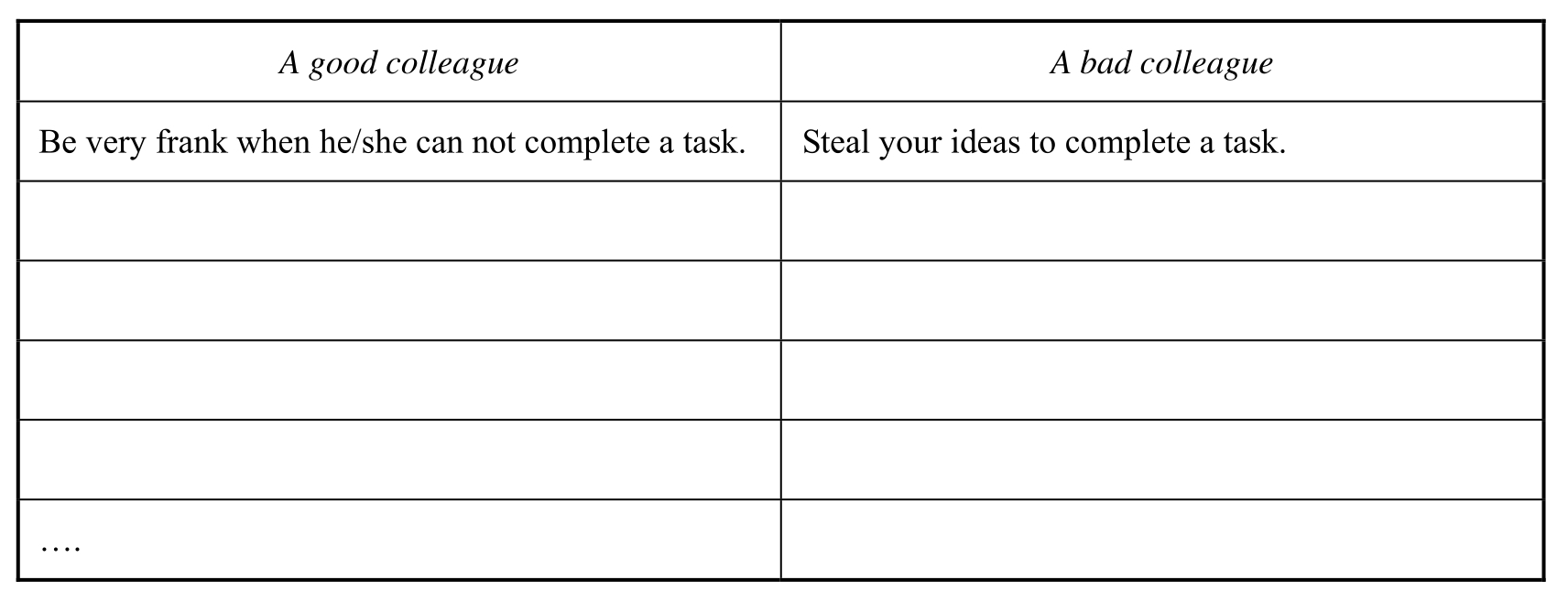
A Good Colleague vs. A Bad Colleague?
Even though you are still students now, you must have heard your parents or relatives talking about their colleagues. Who is good? Who is bad? That is up to your judgment. In your group, could you work out a chart to contrast the qualifications of good and bad colleagues?
2. Read the following story, and then, suppose if you were one of the two ladies what would you do to deal with the situation.
Friendship and Work
By Rodolphe Cote
…
Amy became friends with Sally, a colleague from work. Overtime, they even became best friends. For Amy, her relationship with Sally is what is most precious after her own family. The two young women in their thirties are living with a partner and both have a daughter almost the same age. Both spouses and children get along perfectly, the two families have even made a nice trip down south last winter. On June 1, Sally has been promoted. She became the new project coordinator. She and a colleague postulated to replace the retirement departure of John. Amy was not a candidate. She loves her work and does not see herself in the position of John. Contrariwise, Sally was very excited to get the promotion. She clearly distinguished herself by her leadership capabilities and was the one who was chosen. Starting from August, Sally is the one who deals with customers and suppliers, and will also be supervising the work of five people, including Amy. Presently, John informs and trains Sally. Amy is watching. She can not believe what she sees and can not imagine herself to be under the authority of her best friend. She wonders if she can still invite her at social dinners with her husband and daughter, or still go to the movies together. “What will we talk about now”, she asks herself. Before, they liked to criticize the management style of John and laughed together often to defuse complicated situations. She feels she has lost all her reference points. She says she feels so mixed up. Amy wonders if she should resign and find work elsewhere to preserve her friendship with Sally. She knows she could easily find another job because there are demands in her field. She hesitates to confront the situation as it is today. However, if she finally takes this decision, she wants to know how to deal with Sally and wants to adapt to this change…. what do you think?
from http://EzineArticles.com/4546522
If I were Amy:________________________________________________________________________________________________
If I were Sally:______________________________________________________________________________________________________________
3. Do you know the “Gear Concept”? Don’t you think it indicates a truth in our daily work? Discuss with each other about how a gear system can run successfully, and how this concept relates to the relation with colleague or work?
Ⅲ.More Practive
1. Discussion
If you were a newcomer to a workplace, what kind of preparation you would do to give a good impression to your colleagues? If you were the newcomer’s colleague, how would you give him/her a welcome?
2. Group work
Most people will agree that the relation with classmates or roommates is quite different from the relation with colleagues. In your group, could you figure out the differences? Just imagine you have a job now, and think about the topic from different aspects. List the possible differences in the following chart.

3. Game: BANANAS
One student comes to the front of the class. All the others, in turn, ask him/her WHAT questions. He/she answers every question with the word BANANAS, or any other nonsense word. The aim of the game is to make the questioned student laugh or smile. If he/she does laugh, he/she goes back to his/her seat and the student who asked the last question comes out to be questioned. The students can ask ay questions they like. The following are examples of questions and answers:
What have you got in your bag?—BANANAS
What did you dreamed of last night?—BANANAS
What time did you get up this morning?—BANANAS
Ⅳ.Assignment
Teamwork Spirit
Based on the following short story, please write a short paragraph of 120 words on the topic “Teamwork Spirit”, and deliver a speech in class.
A Japanese samurai warrior has three sons. One day, he takes out an arrow and asks each son to break it; they do so easily. Then he takes out three arrows, bound together, and asks his sons to break them. No one can. “That is your lesson,” the samurai tells them. “If you three stick together, you will never be defeated.”