Unit Nineteen Job Interview
In this unit, students will
1. Learn job interview skills.
2. Learn nonverbal social-communication skills: Look for Incongruent Behaviors.
3. Learn verbal social-communication skills: Talk about Future.
Ⅰ.Warm-up Activities
1. Read the following passage,and then retell it to your group members. All the group members will evaluate your retelling by using the assessment sheet in the Appendix.
Interviewee Strategies and
Behaviors—Nonverbal Behaviors
It may not only be what you say in an interview that matters, but also how you say it (e.g., how fast you speak) and how you behave during the interview (e.g., hand gestures, eye contact). In other words, although applicants’ responses to interview questions influence interview ratings, their nonverbal behaviors may also affect interviewer judgments. Nonverbal behaviors can be divided into two main categories: vocal cues (e.g., articulation, pitch, fluency, frequency of pauses, speed, etc.) and visual cues (e.g., smiling, eye contact, body orientation and lean, hand movement, posture, etc.). Oftentimes physical attractiveness is included as part of nonverbal behavior as well. There is some debate about how large a role nonverbal behaviors may play in the interview. Some researchers maintain that nonverbal behaviors affect interview ratings a great deal, while others have found that they have a relatively small impact on interview outcomes, especially when considered with applicant qualifications presented in résumés. The relationship between nonverbal behavior and interview outcomes is also stronger in structured interviews than unstructured, and stronger when interviewees’answers are of high quality.
Applicants’ nonverbal behaviors may influence interview ratings through the inferences interviewers make about the applicant based on their behavior. For instance, applicants who engage in positive nonverbal behaviors such as smiling and leaning forward are perceived as more likable, trustworthy, credible, warmer, successful, qualified, motivated, competent, and socially skilled. These applicants are also predicted to be better accepted and more satisfied with the organization if hired.
Applicants’ verbal responses and their nonverbal behavior may convey some of the same information about the applicant. However, despite any shared information between content and nonverbal behavior, it is clear that nonverbal behaviors do predict interview ratings to an extent beyond the content of what was said, and thus it is essential that applicants and interviewers alike are aware of their impact. You may want to be careful of what you may be communicating through the nonverbal behaviors you display.
from http://en.wikipedia.org/wiki/Job_interview
2. Group work. The following are several standard myths that smart job-seekers need to get rid of. Read them first and then discuss questions within group.
Myth 1: The aim of an interview is to obtain a job offer
Only half true. The real aim of an interview is to obtain the job you want, which means rejecting job offers you don’t want! Incompetent job-seekers, however, become so used to accommodating employers’ expectations that they often easily qualify for jobs they don’t want. So, be sure you want the job.
Myth 2: Always please the interviewer
Not true. Try to please yourself. Giving answers that you think will suit the potential employer, losing touch with your won feelings (in order to get in touch with some other person’s feelings) and, in general, practicing an abject policy of appeasement are certain to get you nowhere. Of course, don’t be hostile—nobody wants to hire someone disagreeable. But there is plainly a middle ground between being too ingratiating and being hostile. An effective interview (whether you are offered the job or not) is like an exciting encounter in conversation with your seatmate on an airplane.
Myth 3: Try to control the interview
Nobody “controls” an interview—neither you nor the interviewer—although one or both parties often try. When somebody tries to control us, we resent it. When we try to control somebody, they resent us. Remember, you can’t control what employers think of you, just as they can’t control what you think of them. So, never dominate the interview. Compulsive behavior turns off your authenticity.
Myth 4: Never interrupt the interviewer
Study the effective conversationalists: They interrupt and are interrupted! An exciting conversation always makes us feel free—free to interrupt, free to disagree, to agree enthusiastically. We feel comfortable with people who allow us to be natural. So, when interviewing, half the responsibility lies with you. Do you seem uptight? Try being yourself for a change. Employers will either like or dislike you, but at least you’ll have made an impression. Leaving an employer indifferent is the worst impression you can make. And the way to make an effective impression is to feel free to be yourself, which frees your interviewers to be themselves.
Myth 5: Don’t disagree with the interviewer
Another silly myth. If you don’t disagree at times, you become, in effect, a “yes” man or woman. Don’t be afraid to disagree with your interviewer in an agreeable way. And don’t hesitate to change your mind. The worst that could happen would be that the interviewer thinks,“There’s a person with an open mind!” The conventional wisdom says “be yourself”, true enough. But how many people can be themselves if they don’t feel free to disagree?
Myth 6: Always be well groomed and dress yourself fashionably
Only half true. It is good to appear clear and neat or well-groomed when you go to an interview. However, some interviewers might not appreciate the way you “decorate” yourself or, possibly, the positions you are applying for would require more reserved personalities, which, to some interviewers, can be revealed from your appearance. Therefore, the more discreet solution would be to keep to the happy medium—neither appear too “modern” nor too “conservative”.
Discussion:
1) In your opinion, what is the aim of a job interview?
2) In your opinion, should the job seeker please the interviewer?
3) In your opinion, should the interviewee try to control the interview?
4) In your opinion, can the interviewee interrupt and/or disagree with the interviewer during the interview? How should the interviewee behave?
5) Is it wise to dress yourself fashionably to go for a job interview?
3. Watch the video “Interview Dos and Don’ts” and then discuss with your partner about do’s and don’ts in a job interview.
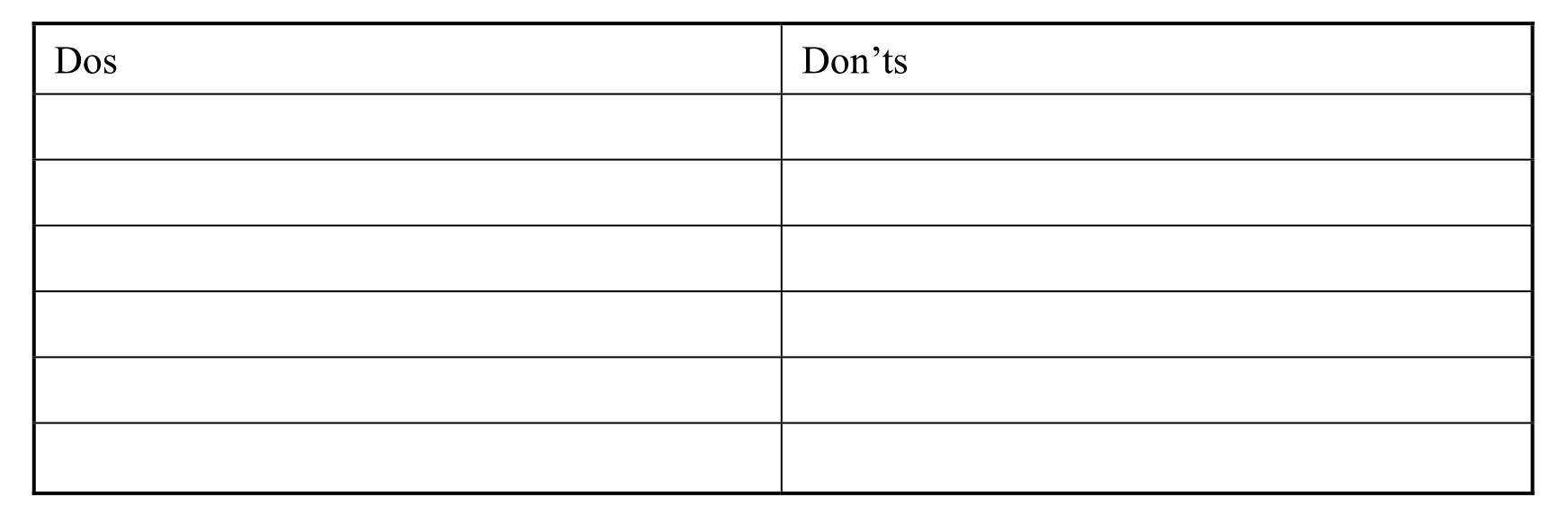
from http://v.youku.com/v_show/id_XMjA2NDI5OTY4.html
Ⅱ.Focused Topic
Job Interview
A.Dialogues
Please read the following dialogues and note the italic expressions.
Dialogue 1 Interview a Candidate for a Work Placement
(I=interviewer…K=Kate)
I: So what made you decide to study law, Kate?
K: A number of reasons. Law interests me a lot. I’ve got a good brain and a good memory. And I’d certainly like to do some part-time work for Legal Aid. And also, I must admit, the money’s good.
I: Well, those are good, honest answers. Certainly, your CV’s very good. I seem to remember that you only want the work placement for six weeks. Is that right?
K: Yes, it is.
I: Why is that?
K: Well, to be honest, I’m planning to go back to the States and spend time with my family.
I: That’s understandable. Now, tell me, what questions do you have?
K: I’ve got some idea. But obviously what I’d like to know is: what does the job involve?
I: Well, for the first few weeks, your main responsibility would be to read files and summarize them. We’d also want you to do some research for us. How does that sound? Rather boring?
K: No, not at all. I think I’d learn a lot.
I: Good, well … you’ll be taking your first year exams soon, won’t you?
K: Yes, in a few weeks’ time.
I: Well, provided they’re OK, I think we can say you’re in.
K: Thank you—that’s wonderful!
Dialogue 2 Interview a Candidate for a Part-time Job
(I=interviewer C=candidate)
I: Can I start by asking if you realize that you need to be perfectly fluent in English and Chinese both in speech and writing in order to get this job?
C: Yes, I have a degree in Translation Studies with English and Chinese as my major languages. I have won prizes for my writing in Chinese and for debating in English. May I show you my diplomas?
I: I am sure we have copies here. That sounds pretty impressive. Have you done a lot of debating?
C: Yes, it was one of my main activities at university. I became one of the main team leaders. I believe it helps to build one’s self-confidence and is a very useful preparation for giving speeches and presentations.
I: Have you had any internships?
C: Yes, I have been trying to equip myself with a range of skills and language skills in an electronics firm so I contacted many companies in the field of e-journalism and was fortunate to be offered an internship. I really learned a lot from that experience.
I: Another question, what qualities do you think are most important for someone working in a PR Department?
C: Well, sir, as you mentioned, excellent command of language and also professional knowledge. I know a reasonable amount about IT, though I am no expert. Personality is also important. One needs to be warm, friendly and know how to put things clearly and tactfully.
I: I’m quite satisfied with your answer. I think we can say you’re in.
Other Useful Expressions
certificate qualification
competitiveness a positive attitude
self motivated self-development
responsible practical experience
recruit realistic
resume job description
shake hands firmly maintain good eye contact
turn your weakness into a strength thank-you letter
ambitious adaptive
a good pay more challenging work
interesting and varied work opportunities for specific training
prospects of good promotion teamwork
favorable working environment strategic thinker
Practice:
1. Please answer the following questions by making a conversation with your partner:
1) Are you doing any part-time jobs? Why or why not?
2) What would you do if you wanted to get a part-time job?
3) What kind of part-time jobs are available for college students?
4) Have you been to a job interview?
2. Role-play: Student A will interview student B about two of the following topics:
1) What kind of clothes is suitable for an interviewee?
2) What should an interviewee bring to a job interview?
3) How can you handle both a part-time job and your schoolwork?
4) How would you try to impress your interviewer(s) during a job interview?
5) If you were an interviewer, what sort of job applicants would you prefer? Why?
6) What preparations should you make before a job interview?
B.Socio-Communicative Skills
Verbal communication refers to the communication which is carried out in either oral or written form with the use of words. Nonverbal communication refers to the communication through one’s voice quality, facial expressions, gestures, bodily movement, attitudes towards space and time, and so on.
To achieve successful conversations, it is necessary to learn the skills of both the verbal and nonverbal communication.
B.Socio-Communicative Skills
Looking for Incongruent Behaviors
If someone’s words do not match their nonverbal behaviors, you should pay careful attention. For example, someone might tell you they are happy while frowning and staring at the ground. Research has shown that when words fail to match up with nonverbal signals, people tend to ignore what has been said and focus instead on nonverbal expressions of moods, thoughts, and emotions.
? Energetic arm pump can sometimes be perceived as insincere. Extending your arm with your palm facing down—this may be seen as disrespectful. During an interview never fold your arms above your head. This will signal to your interviewer that you may be bored during the interview. Shaking the tips of the finger may be perceived as a lack of self confidence.
? Arms crossed shows you are cautious, defensive, uninterested in a conversation.Tapping fingers shows you are agitated, anxious, bored, calculating. Resting you palm on your chin shows you are critical and cynical. Avoid touching your mouth when talking.
? Long stares can be seen as being too direct and can make the other person feel uncomfortable. Staring blankly at the floor may suggest a disinterest in the conversation. Don’t look around the room when you are in a conversation with someone.
Practice:
Please practice a job interview with your partner. One student acts as the interviewer, and the other student acts as the interviewee. During the interview, the interviewee should try to reduce your incongruent behavior and the interviewer should pay attention to the interviewee’s body language and try to find any incongruent behavior in it.
Verbal Skill
Talking about Future
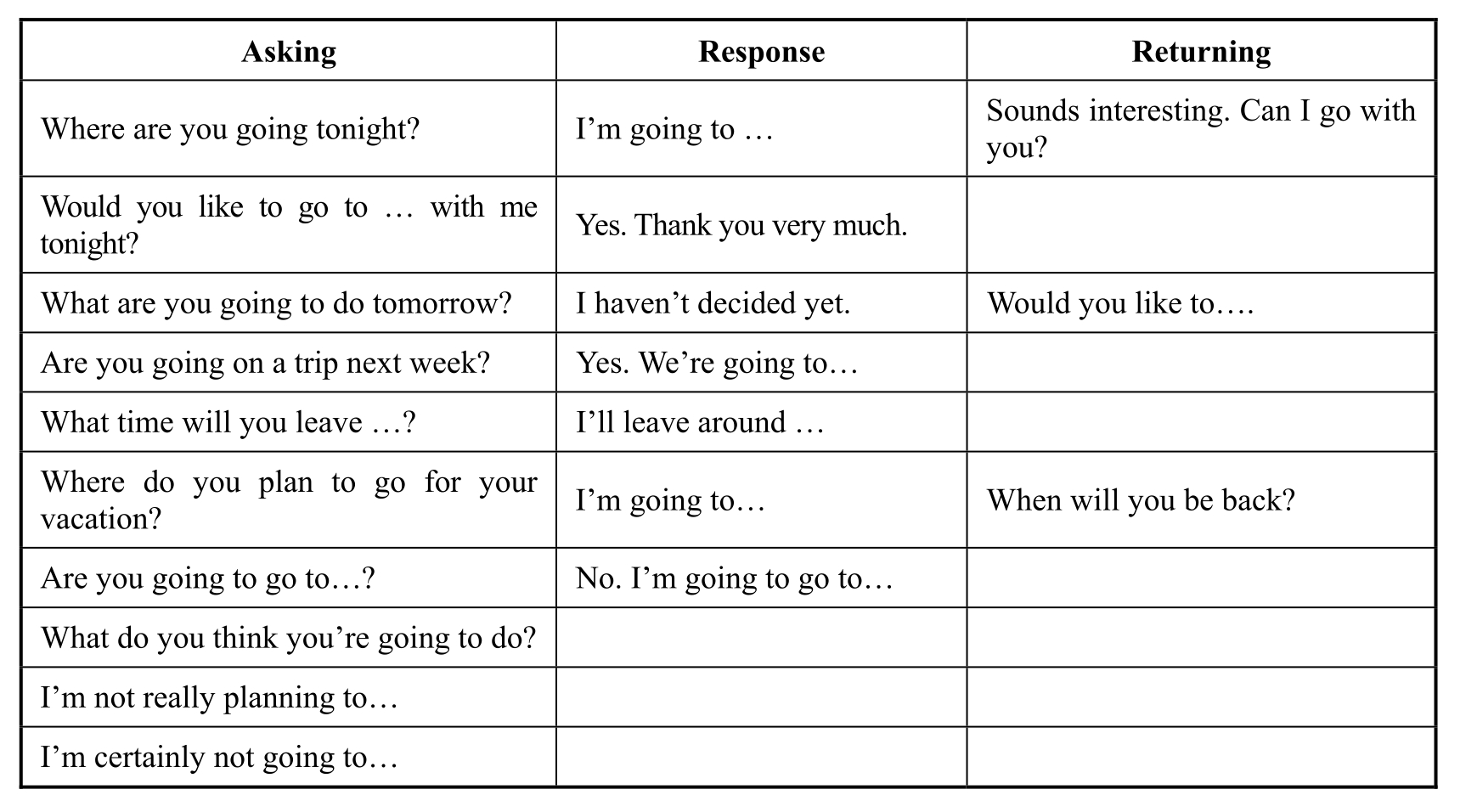
Learn the following conversations and make conversations with your partners based on the situations given below.
1) A: What are you going to do after you graduate, Linda?
B: Oh, I’m planning to do some graduate studies at one of our leading universities.
A: What do you plan to study, still English?
B: Well, as a matter of fact, I’m thinking of majoring in law.
A: That’s a good and popular field. How about you, Heidi?
C: I wish to find a job first. Then I’ll come back to the university in a couple of years.
A: What sort of job will you have?
C: Maybe working as an interpreter at one of the government departments. I’m not sure. But definitely, I’ll stay away from the classroom for a while.
A: I’m quite certain you’ll enjoy the change. But be sure to come back, or I’ll miss you. Susan, what do you think you’re going to do?
D: Um, I’d like to apply for scholarship at an American or Canadian university. And if it’s possible, I’ll switch to psychology. To be more exact, therapy for children with learning difficulties. Actually, I’ve been doing research in that field since last year.
A: That’s a very interesting field indeed. Hope you’ll succeed.
D: Thank you.
2) A: What are you going to do after returning from Washington?
B: I’m going to stay in the city.
A: What will you do all day?
B: I’m going to work with my father at the store. In the evening, I’ll read books. On weekends, I’ll go to the beach with my family. What are you going to do this summer?
A: I’m going to camp. I’ve gone to camp for four summers. What’s John going to do this summer?
B: I think he’s going to the mountains with his parents.
A: Well, so long, Mary. Have fun.
B: You too, Peter. I’ll see you in September.
Now, make conversations of talking about future based on the following situations by using the expressions above:
1) Talk about your evening activities.
2) Talk with your partner about what you’re going to do during your summer holiday.
3) Talk with your classmate about what you plan to do after graduation from university.
4) Talk about your future life.
C.Activities
1. Discussion
What Questions Will the Interviewer Ask?
Preparing for questions that the interviewer may ask is very important for your interview success. Now discuss with your partner about questions that the interviewer may ask:
Question 1: ______________________________________________________________
Question 2: ______________________________________________________________
Question 3: ______________________________________________________________
Question 4: ______________________________________________________________
Question 5: ______________________________________________________________
Question 6: ______________________________________________________________
Question 7: ______________________________________________________________
Question 8: ______________________________________________________________
….
2. Discussion
What Questions May the Interviewee Ask?
Before you’re interviewed, preparing some questions to ask the interviewer is also very important, as it shows that you’re well prepared. Now discuss with your partner about questions that the interviewee may ask:
Question 1: ______________________________________________________________
Question 2: ______________________________________________________________
Question 3: ______________________________________________________________
Question 4: ______________________________________________________________
Question 5: ______________________________________________________________
Question 6: ______________________________________________________________
Question 7: ______________________________________________________________
Question 8: ______________________________________________________________
….
3. First read the following article and then talk about the question with your partner: What other preparations should you make in order to succeed in your job interview?
Pre-interview Preparation
By Deborah Walker
Every great sales presentation starts with pre-sales preparation, which includes client research, and product analysis. Job-seekers prepare for interviews similarly: research on the prospective employer and a thorough catalog of their own accomplishments to illustrate theirpotential contribution and worth to the employer.
Thanks to the Internet, company research is relatively easy, especially on publicly held firms. A few good sources include Yahoo, Hoover’s, Wall Street Journal, as well as company Web sites. Information on privately held companies is often readily available as well. One of the easiest ways to get such information is simply enter the company name into your favorite search engine and see what pops up.
Minimally, you’ll want to find out company size, products or services, major competitors, branch or headquarters and any recent news items. Time allowing, it’s also very helpful to know some of the major players in their organization; a little history of the organization and future products, markets, or growth objectives.
Once you’ve done the research, prepare to communicate your value through your accomplishments. Examine your career for examples of how you have solved problems, saved money, increased revenue, or created revenue opportunities for your former employers. As much as possible, quantify your contributions. Do not depend on your ability to “wing it” through your interviews. Ask any high-producing sales profession, and he or she will tell you that it is impossible to wing your way to success. It takes preparation and practice.
from http://www.quintcareers.com/essential_interviewing_skills.html
Ⅲ.More Practice
1. Discussion
Design a handbook about job application skills for fresh college graduates. Design the handbook in four sections:
Section 1: Job opportunities for different degrees
Include up-to-date information about current trends in the job market.
Section 2: Qualification matters
Cover information about qualifications people can obtain to help them in their career.
Section 3: Having the right attitude
Introduce ideas to help job seekers deal with all the stresses of job seeking.
Section 4: Common mistakes
Mention some common mistakes made by fresh graduate applicants.
2. Role-play: Interview
Students work in groups. One of you will play the role of the interviewer (marketing manager) and the other students will be interviewees (job applicants).
Student A: You are a marketing manager of a large company that makes sportswear. You are looking for someone to be a marketing assistant. You interviewed the job applicants by asking them questions. You need to choose successful candidate and explain to the class why that person was chosen.
Candidates: Pay attention to dos and don’ts; invent qualifications and experiences you already have.
3. Please deliver your ideas on the following proverbs in groups: How to understand “Diligence brings luck?” and “Chances favor the minds that are prepared.”?
Ⅳ.Assignment
Writing the Personal Statement: Top 10 Rules
Read the following top 10 rules for writing the personal statement and then write your own personal statement. Read your personal statement at the beginning of the next class.
1. Strive for depth rather than breadth. Focus on one or two key themes, ideas or experiences.
2. Try to tell the reader something that no other applicant will be able to say.
3. Provide the reader with insight into what drives you.
4. Be yourself, not the ‘ideal’ applicant.
5. Get creative and imaginative in the opening remarks, but make sure it’s something that no one else could write.
6. Address the school’s unique features that interest you.
7. Focus on the affirmative in the personal statement; consider an addendum to explain deficiencies or blemishes.
8. Evaluate experiences, rather than describe them.
9. Proofread carefully for grammar, syntax, punctuation, word usage, and style.
10. Use readable fonts, typeface, and conventional spacing and margins.
from http://www.douban.com/group/topic/14151326/