Unit Fifteen Fashion
In this unit, students will
1. Talk about fashion.
2. Learn nonverbal social-communication skills: Deal with Being Left Out.
3. Learn verbal social-communication skills: Language for Assumption.
Ⅰ.Warm-up Activities
1. Read the following passage,and then retell it to your group members. All the group members will evaluate your retelling by using the assessment sheet in the Appendix.
Post War Fashions: 1947-1949
People anxiously awaited the day when newer types of clothing would be allowed to be distributed. It took quite some time before the U.S. was able to access the same kinds of fashions that were made available in Paris, France or London, England.
American created its own new look during this time. One of the major influences of U.S. fashion after the war was Clair Mc Cardell. One of her signature pieces is a cotton dress that is grey with brown and red stripes, and each of the narrow stripes has tiny hearts imprinted in them.
This Clair Mc Cardell dress has a V-necked bodice. The most memorable attribute of this historical dress is the way the stripes on either side of the dress meet and create a “W” shape around the waist as well as the bodice.
A large amount of casual evening and sports wear was made after the war as well. This was fitting for people of an active lifestyle.
Men’s fashion in the U.S. after the war had changed as well. One of the most dramatic new additions to male fashion introduced after 1947 was the Hawaiian and Carisa shirts. These were first worn on California and Florida beaches, and were made with fabric imprinted with patterns of ocean flora, women, island flowers, or flames.
In the last year of the 1940s decade another new fashion item had emerged. The Esquire jacket had come out. It had broad shoulders and was very loose-fitting. Double-breasted suit jackets designed with center vents and peaked lapels also became more popular after the war.
Sportswear also became the American clothing icon after World War II was over. In fact, Europe turned to the U.S. after awhile for new ideas pertaining to sports fashion.
from http://www.thepeoplehistory.com/40sclothes.html
2. Read the following passage first,and then group members take turns to introduce what to wear in a certain country.
What to Wear?
One of the biggest shocks when you arrive in a new country can be the clothes people arewearing. You may look fashionable at home, but you suddenly find you are behind the times simply someone to laugh at when you arrive abroad. With this in mind, let’s take a look at teenage fashion in the UK for girls.
One of the things that may shock an outsider most is piercings. These days it is not enough to simply wear rings in your ears. You will see many teenagers with rings in their navel, or belly button, nose, lip, or even their eyebrow. Ouch! Some girls go for a ‘glam’ look. They wear T-shirts from India with sequins and beads. Trousers are usually preferred, blue or black, and the look is finished off with metallic bags and shoes and arms full of bracelets. Another alternative is the ‘rocker’ look. You start with a T-shirt of your favorite band and tight jeans or a long skirt. On top of this you can wear a denim jacket. Jewellery tends to be large and metallic, and to add color wear a scarf.
If neither of these is for you, why not go ‘sporty’. T-shirts are usually tie-dyed in hot colors. Wear this with long shorts, short jeans or a denim skirt. And on your feet? Beach sandals, of course!
If you prefer something more feminine, there’s the ‘girly’ look. Skirts are long, to the floor. Wear a top with butterflies or flowers printed on it. In addition, wear ballet shoes and lots of beads!
Finally, how about the ‘Tom Boy’ look? Wear flared jeans and a T-shirt with a logo. Don’t forget your waistcoat, of course! Use lots of different fabrics if possible, like denim, cord and leather, and high-heel boots to finish off!
Follow the fashion tips above, and you shouldn’t feel out of place. However, it’s important to remember to wear clothes and choose a look that you feel comfortable with. Don’t just be one of the crowd—be yourself!
from http://www.bbc.co.uk/worldservice/learningenglish/newsenglish/britain/081118
_what_to_wear.shtml
3. Watch the video first and then answer the following questions:
1) Why do these girls want to be fashion designers?
2) How to be a successful fashion designer?
3) Why was Laila Enrique chosen as the winner?
Ⅱ.Focused Topic
Fashion
A.Dialogues
Please read the following dialogues and note the italic expressions.
Dialogue 1 Fashion
A: Do you think I am still fashionable in this dress?
B: I think so. Blue is still fashionable at the moment.
A: This style came out last year. Though I like the dress, I’m not sure whether last year’s fashions will be the same this year.
B: I think this kind of dress will stay in fashion for a few more years. People don’t change fashions every year. It would be too expensive.
A: Yes. Only the top designers try to tell people to change fashion every year, but only rich people can do it.
B: There are some real fashion victims who just have to keep totally up-to-date with expensive clothes.
A: I wish I could be one of those people, but my budget simply doesn’t stretch that far. I have to limit the amount of money I spend on clothes otherwise I would go on a shopping frenzy.
B: I know what you mean. The situation will be worse if we marry our boyfriends and have children. Then we’ll have even less money to spend on fashionable clothes!
Dialogue 2 Fashion Show
A: Look at these clothes designed by top fashion designer like Versacci, Calvin Klein, and Vivienne Westwood. What do you think of them?
B: Well, they look lovely, but they’re not very practical. I mean, would you wear that dress to the office or walking down the street?
A: I know what you mean. People would stare at you in amazement if you wore something like that in an everyday situation. I suppose only extravagant rich people wear them at cocktail parties.
B: Maybe. I’m not sure why they have fashion shows like this. Hardly anyone will buy those clothes. The clothes you see are nothing like the ones that ordinary people wear. It seems like a waste of money.
A: I think that the designers hold these fashion shows for a few reasons. First, it’s just like a big party. They can meet each other and network. The other thing is that it is great advertising. All the journalists and photographers are there. Thirdly, it gives them a chance to show what they would like to see people wearing.
B: You meant it’s an expression of their fantasies?
A: Yes. I think the designers are saying that these clothes are what they would like to see people wear if those people weren’t concerned with what other people might think. In a way, the designers are saying ‘don’t worry about what others think. Wear what you like!’
B: Very philosophical. I think they design these clothes more for publicity. They try to see who can be the most extreme and outrageous, but still stylish.
A: Come on. All this fashion has reminded me that I want to buy some clothes.
Other Useful Expressions
quality model
well-dressed trendy
elegant chic
boutique brand names
model clothes remain fashionable
see a fashion show cosmetics
go after fashion a fashion follower
follow fashion out of fashion
long-wearing easy to care for
sporty look smart
Practice:
1. Please answer the following questions by making a conversation with your partner:
1) Which is the most important to you in deciding what to buy, brand name, quality, or price? Why?
2) Do you spend much money on fashion?
3) What kind of clothes do you like to wear?
4) Do you find it important to follow the latest fashion? Why or why not?
2. Role-play: Student A will interview student B about two of the following topics:
1) Why do many young people today go after famous name brands in everything they buy?
2) What do you think of those people who judge others by the clothes they wear?
3) Do you believe in the saying “Clothes make the man”? Why or why not?
4) What do you think of girls wearing miniskirts?
B.Socio-Communicative Skills
Verbal communication refers to the communication which is carried out in either oral or written form with the use of words. Nonverbal communication refers to the communication through one’s voice quality, facial expressions, gestures, bodily movement, attitudes towardsspace and time, and so on.
To achieve successful conversations, it is necessary to learn the skills of both the verbal and nonverbal communication.
Non -verbal Skill
Dealing with Being Left Out
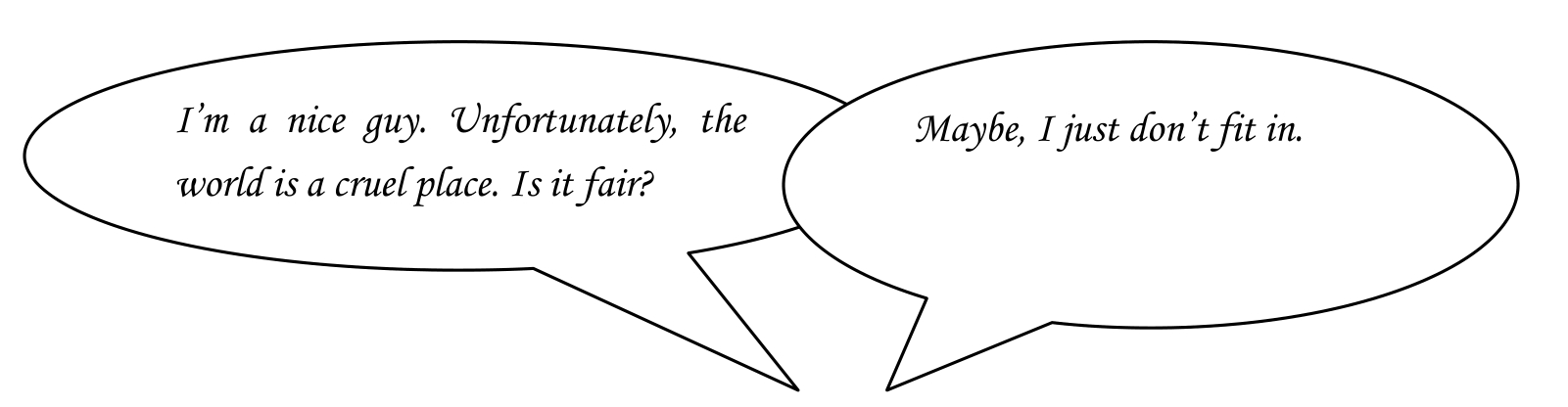
It would be nice to run from all the “nasty” people in the world but that is not always possible. How about the ones you work with, your boss, a person in your family, a neighbor(assuming you own your home, they may be there for a while)? There are some people you just can’t run from. Then how to deal with being left out?
? Maybe you should ask: “Is it all people that don’t give you respect? Or a certain group of people?” Maybe you need to find a different group of people to hang with, those who like you because you’re a nice guy.
? Don’t ever change your ability to be a compassionate person, a caring person. These people that you are dealing with won’t be a part of your life in the future. You’ll find your place in life. It may take some time, but once you do find it, you’ll feel right at home and won’t even remember those other yucky people who suck.
? People are good generally and if you reach out to people, they will generally welcome you with open arms. Just be what you want to be because at the end of the day if people can’t respect you, then are they real friends? Don’t let people change who you are.
Practice:
Please prepare a short speech about one of the following topics, and provide methods to deal with them.
1) People around me don’t respect me.
2) I find it difficult to stay with others.
3) I am not a popular kid in school.
4) I sat alone during lunch everyday.
Verbal Skill
Language for Assumption
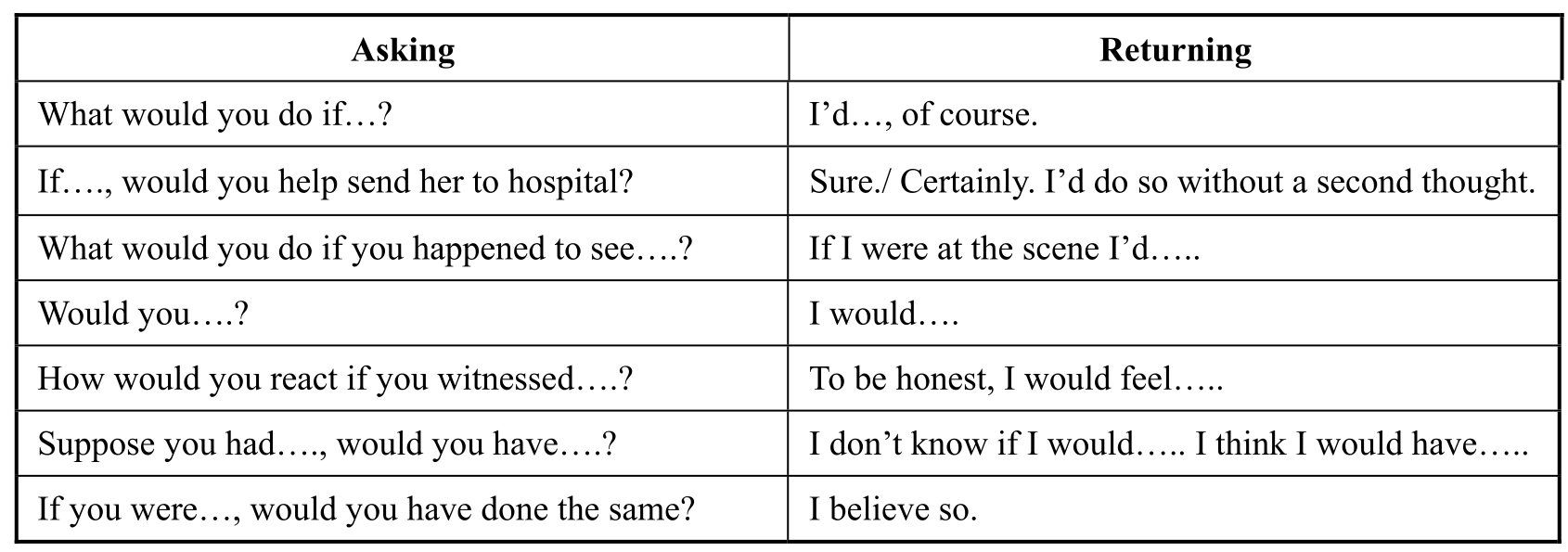
Learn the following conversations and make conversations with your partners based on the situations given below.
1) A: That was a touching story we heard, wasn’t it?
B: Yes. The man is really a noble soul. Not many people would have done that.
A: Well, if you were in his position, what would you do?
B: I think I’d do exactly the same thing.
A: Why?
B: You see, his act moved the thief to tears. If what I do can awaken a criminal’s conscience, I’d be only too happy.
A: That’s a reward in itself, isn’t it?
B: Yes. And more valuable than money.
2) A: I saw on TV last night that an old lady was knocked over by a vehicle.
B: Was she seriously injured?
A: I think so. But she had been lying there helplessly for some time before the police arrived at the scene. The driver drove off and passers-by pretended not to see her.
B: That’s incredible. How could they be so cold-hearted?
A: Horrible, isn’t it? Some people are so mean.
B: Suppose you were one of the passers-by, what would you do then?
A: I would rush her to a hospital and notify her family as soon as possible.
B: So would I. It’s right to offer a helping hand to those in need. Don’t you think so?
A: Absolutely. I wish everyone in our society would be more caring.
Now, make conversations of assumption based on the following situations by using the expressions above:
1) Suppose you are walking along a river, and suddenly you hear a little boy crying for help in the river, but you can not swim. Would you try to save the boy?
2) Suppose you are at home, preparing for an exam. But an old lady next door suddenly falls ill and asks you to accompany her to a hospital far away. Would you go with her?
3) Suppose you are being interviewed for a very good position in a large company. The interviewer suddenly tells you that she has recognized that you are the one who saved her daughter from a fire last year. In fact, you are not. Would you tell the truth or not?
C.Activities
1. Debate: New fashions in clothing are created solely for women.
Key-points for argument:
1) Women are to blame.
2) Afraid to be seen in public in old-fashioned clothes.
3) Cheated by designers, big stores.
4) New clothes discarded; wardrobe full, but nothing to wear.
5) Women waste money: throw away new clothes. Waste time:
6) Interested only in outward appearance. Women put up with great discomfort: e.g. high-heeled shoes.
…
Key-points for counter-argument:
1) Fashion adds something to life: color, variety, beauty.
2) Women follow fashions to please themselves—and men!
3) The world would be a dull place if women always wore the same clothes.
4) A huge demand for new styles always exists.
5) These days, men are fashion-conscious too: hair-styles, shirts, suits, shoes, etc.
6) Huge import-export business, important to world trade.
7) Psychological importance of being well-dressed: confidence in one’s appearance very important.
…
2. Group discussion.
Jeans are the most successful fashion clothes. They have been popular for many years.
But what’s the reason for its popularity? Maybe because:
1) casual, easy to near
2) cheap
3) make you look slimmer
Can you figure out other reasons?
3. Read the following Famous Coco Chanel Quotes (可可·香奈儿名言) and try to translate each into Chinese. Then, discuss with your group members about your understanding to impressive ones.
1) A women who doesn’t wear perfume has no future.
_____________________________________________________________
2) In order to be irreplaceable one must always be different.
______________________________________________________________________
3) A girl should be two things: classy and fabulous.
______________________________________________________________________
4) Nature gives you the face you have at twenty; it is up to you to merit the face you have at fifty.
______________________________________________________________________
5) I don’t understand how a woman can leave the house without fixing herself up a little—if only out of politeness. And then, you never know, maybe that’s the day she has a date with destiny. And it’s best to be as pretty as possible for destiny.
______________________________________________________________________
6) Some people think luxury is the opposite of poverty. It is not. It is the opposite of vulgarity.
______________________________________________________________________
Ⅲ.More Practice
1. Fashion quiz: How many words and expressions do you know about fashion?
1) Which of the following prepositions means that something is fashionable?
a. up b. down c. in d. out
2) If a piece of clothing is a bit big and loose on the body, which word would we use in English to describe it?
a. loosy b. baggy c. tight d. shaggy
3) When British people talk about “high street fashion”—what do they mean?
a. Clothes that they bought at a shop on a main road
b. Expensive designer clothes
c. Clothes bought from one of the many chain fashion shops that you typically see in all towns across Britain
d. Clothes that you can only wear outside
4) Which of the following expressions does NOT mean to be really dressed up in very nice clothes?
a. Dressed to kill b. Dressed to the nines
c. Dolled up d. Dressed down
5) Which of the following is another common expression meaning fashionable?
a. All the rage b. All the anger c. All the fury d. All the upset
6) Skinny jeans are fashionable in the UK at the moment—but what are they?
a. Jeans that make you lose weight b. Jeans that make you look thinner
c. Very long jeans d. Very tight jeans
2. Group activity: Fashion design
1) Put students in groups of four. Ask students to draw sketches of up-to-date clothes together.
2) Ask students to describe their sketches.
3) Encourage students from other groups to ask questions about or make comments on the description when it is finished.
3. Game: What’s the proverb?
Skills Practiced: Recognition and explanation of proverbs.
Time: Flexible.
About this game: In this game a player tries to elicit a proverb by miming the key words. The player begins by indicating with fingers the number of words in the proverb. Then he or she indicates the position of the first word he or she wishes to elicit by raising one or more fingers and then acts in such a way as to suggest this word. Players from either team call out words until someone calls out the correct word. For example, if it is the proverb ‘Birds of a feather flock together’, the player first indicates the proverb has six words and then begins by miming ‘birds’ after raising one finger to indicate that this is the first word. After one of those watching has correctly guessed this word, the player nods and then elicits another word in thesame way, continuing until someone recognizes the complete proverb and states it.
Preparation:
1) Print out the set of cards here.
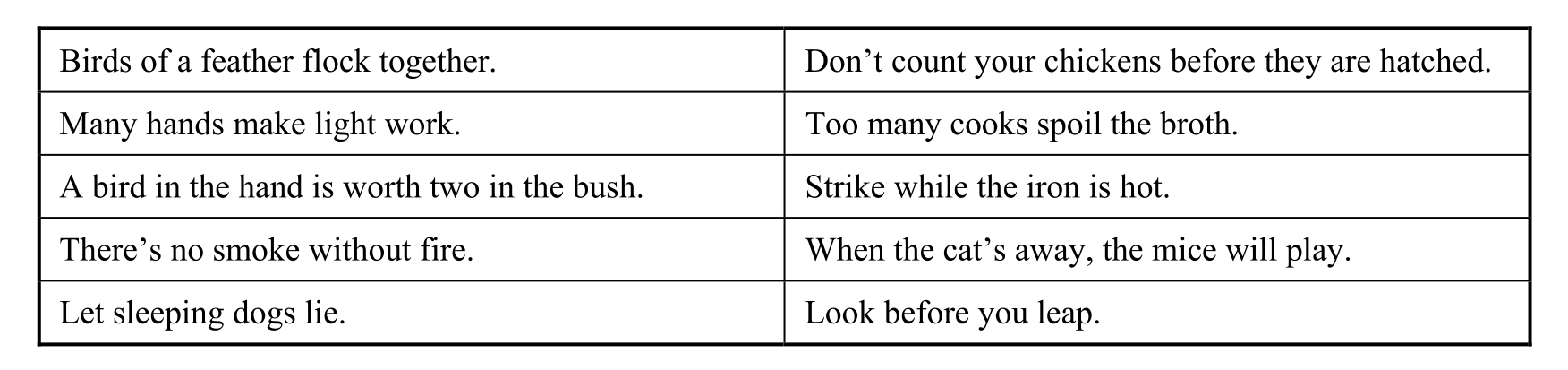
2) Draw a scoring table on the board, like this:

How It Works:
1) After explaining the game and modeling the actor’s role if necessary, divide the class into two teams. Then place the cards face down in a pile at the front of the classroom.
2) Ask for any member of the first team to come forward. This player then takes the top card and tries to elicit the proverb as explained above.
3) If any member of either team thinks he or she knows the proverb, he or she raises a hand. If correct, his or her team wins a point. To earn a bonus point for his or her team, the player correctly stating the proverb can then try to explain its meaning. If the player cannot do this, ask for any other player to explain it. If correct, this player earns a point for his or her team. If no-one can explain it, do so yourself before continuing the game.
4) The game continues with a player from the second team coming forward to elicit the proverb written on the next card, and so on. Play continues until all the cards have been used, with the team earning the most points winning.
Notes:
o—If no-one has guessed the proverb within a reasonable length of time, ask for the player to state it and then ask if anyone can guess the meaning. If no-one can, explain it yourself before asking for another player to come forward to continue as usual.
—To play a shorter game, either set a time limit for the game as a whole or use just a fewof the cards.
Ⅳ.Assignment
Horoscope
Game for Speaking: Students will be in groups of 6. Read the article first. The teacher points out those words in italics for students to be defined. The student can speak out promptly the definition of the word. If he does it correctly, he wins a score for the group. When the game is over, the group with most scores wins.
In astrology, a horoscope is a chart or diagram representing the positions of the Sun, Moon, planets, the astrological aspects, and sensitive angles at the time of an event, such as the moment of a person’s birth. The word horoscope is derived from Greek words meaning “a look at the hours”
It is used as a method of divination regarding events relating to the point in time it represents and forms the basis of the horoscopic traditions of astrology. However, no studies have shown any scientific support for the accuracy of horoscopes, and the methods used to make interpretations are, at best, pseudo-scientific.
In common usage, horoscope often refers to an astrologer’s interpretation, usually through a system of Sun sign astrology or based on calendar significance of an event, as in Chinese astrology. In particular, many newspapers and magazines carry predictive columns based on celestial influences in relation to the zodiacal placement of the Sun on the day of a person’s birth, identifying the individual’s Sun sign or “star sign” based on a conventional zodiac (which is not the celestial one). Such a concept is distinct from horoscopes as typically employed, where only the traditional zodiacal placement of the Sun is considered in interpretation.