Unit Six Vegetarian’s Dining
In this unit, students will
1. Talk about vegetarian.
2. Learn nonverbal social-communication skills: Respect Personal Boundaries.
3. Learn verbal social-communication skills: Make a Refusal.
Ⅰ.Warm-up Activities
1. Many of us know vegetarians. And there are many kinds of vegetarians? Read the following passage and discuss about your understanding of vegetarians.
Different Kinds of Vegetarians
In this section, we will talk about the different kinds of vegetarian diets some people have. Vegetarians are people who don’t eat meat and they often do so for religious, personal, or political reasons. Some, for instance, think it is healthier not to eat meat and some people do not eat it because it is bad for animals and the environment. Because people have so many different reasons, people also follow many different vegetarian diets to suit these reasons. Here are some of the more common types of vegetarians:
—Ovo-vegetarian—A person who will not eat any beef, pork, or chicken but will eat eggs.
—Lacto-vegetarian—A person who will not eat any beef, pork, or chicken but will eat dairy products such as milk, yogurt, cheese, and ice cream.
—Ovo-lacto vegetarian—A person who will not eat any beef, pork, or chicken but will eat eggs and dairy products.
—Pescatarian—A person who will not eat beef, pork, or chicken but will eat fish and shellfish.
—Vegan—Vegans follow the most strict diet. Vegans do not eat any beef, chicken, pork, or fish. They also do not eat any animal byproducts such as milk, cheese, or eggs. Furthermore, they do not use or buy anything that comes from an animal (like leather), even if they are not eating it.
So when someone says they are vegetarian, you may want to ask what kind of vegetarian they are. Many ovo-, lacto-, and ovo-lacto vegetarians will eat fish so you may want them to specify whether they do or not. It is always interesting to ask a vegetarian what the reasons for their diet are, so ask if you are curious!
from “Drew和Nancy的美国生活英语”
2. Do you know the exact difference between a vegan and a vegetarian now? Read the following comments on the topic of “vegan” and give your own.
Vegan or Not
Comment 1:
It’s worth it. For example, organic milk and eggs. No hormones for the animals, and they are generally treated better.
I only eat free range chickens, and kosher meats from local butchers. The meat is cleaner, and the killing process kinder. I respect vegans, but animals eat other animals and I am no different.
I do believe that people who eat meat should do so with more concern for the animals’welfare. The belief that the animal is going to end up dead anyway and that its treatment doesn’t matter is ludicrous. Our local butchers use every last bit of the animal; nothing is wasted. I can respect that.
I don’t wear leather but I do appreciate that our family’s choice in butchers even uses the hides. There are even companies that sell fur and wool yarns made from combing and shaving the animals and most of these animals are treated very well.
I think it is wrong to kill an animal for its skin or fur. I think it is commendable to use every scrap of an animal killed for food.
It’s a delicate balance. I absolutely oppose animal testing and use no product tested on animals. I am glad that there are vegans and vegetarians in the world, but I agree that you may be a part time vegetarian but there is no such thing as a part time vegan.
Ultimately, your choice is your own, but I do wish more meat eaters such as I would take more consideration into the source of their meats and animal products. With a little research, anyone can do it.
Comment 2:
I’m vegan and many of you have called “vegans” hypocrites for wearing leather. Well, from my point of view, these people are not vegans. True vegans do not wear leather, wool, and fur or use any products containing animal ingredients or tested on animals.
As for us all being “self-righteous” preachers: Do you seriously think we never get stick of non vegans telling us stuff like “You need to eat meat.”, “Animals were put on this Earth for us to eat.”, “You’re mad for not eating meat.” and to top it all, they conclude with, “You should respect others’ choices.”
I never lecture. No one listens when preached to. If someone asks me about it andgenuinely seems interested, I’ll talk about it, but if they’re only asking so they can start an argument, I’ll discontinue the debate, so very often, they feel they’ve “won’”. No. I just don’t want “a fight of words”.
I’m not interested in playing in “debates” as a show of strength.
Another form of attack is when someone discovers I’m vegan and starts on me simply because they assume I’ll lecture them and they want to “get their point in first”.
This is not every non vegan by any means. Most just say, “Oh. Okay.” and that’s it. Just as I do when seeing someone eating meat.
Comment 3:
Okay, I’m sick of this! I’ve been a vegetarian for seven years. I’m 19 and I’m so tired of being labeled as “lazy” or “uncaring” because I am not vegan.
Sorry, but maybe I enjoy eating dessert with my boyfriend or having the same cake on our wedding day, or maybe when our kids want to eat ice cream with their mom I don’t have to tell them no. Or you know, maybe at home, I don’t eat certain things like milk, eggs, etc and yet when I go out, if food was made with milk or eggs I don’t fuss over it.
I did it for animal welfare. I’m actually becoming a vet and working for animal shelters. I don’t use medicine; I don’t wear leather, fur, wool, not much silk. I don’t use animal tested products all the way down to my toothpaste. You sit there and say that we are not committed when quite frankly we are on the same page as vegans, just prefer to do things with our significant other.
Make sure the next time someone writes something like this, they think twice about what they say.
It doesn’t matter how far you take it, as long as you are taking some action and something is being saved. Don’t shun one way because it’s not full or not your own. If you are taking the time out of your schedule for a being’s sake or your own, it’s saving a life somehow.
from www.wisegeek.com/what-is-the-difference-between-a-vegan-and-a-vegetarian.htm
3. Listen to a passage.
You will listen to a talk given by a vegetarian. Please fill in the blanks while listening the second time.
Well, I’m going to talk 1) about why I’m vegetarian. Actually, I became vegetarian when I was 8 years old. We did a 2) at school and I found out that animals are actuallykilled for us to eat and as an 8 year-old I thought that was rather 3), so I went home and I told my parents that I didn’t want to 4) anymore so now I eat everything really except for meat and fish and I don’t eat things with animals’ fats in either. I think really I’m a vegetarian now because it’s a 5) and if I were to eat meat, I think I would be quite ill. My favorite food is probably 6) although I like broccoli and I like chocolate as well.
Sometimes because I like 7), I go to places and it’s really difficult for vegetarians because they don’t really have anything for vegetarians to eat, so sometimes I just have like, 8), or an omelet, or something like that, but when I’m at home, I like to cook for myself, and I like to cook nice vegetarian dishes, and stews and things like that. My parents didn’t 9) me becoming a vegetarian, and I think they were really good about it because I don’t know many people, who when their child said they wanted to be a vegetarian would except that, so I was really grateful to my parents for being so nice and 10) about it.
from http://www.tingroom.com/lesson/ybyydh1000g/94709.html
Ⅱ.Focused Topic
Vegetarian’s Dining
A.Dialogues
Please read the following dialogues and note the italic expressions.
Dialogue 1
Thomresss: Excuse me!
Waitress: Yes, sir?
Thomas: I am afraid there is a mistake.
Waitress: Yes?
Thomas: I ordered the cabbage and I told you that I am a vegetarian.
Waitress: I remembered that. Any problem?
Thomas: There is pork in it!
Waitress: Really? … Oh! I am so sorry. I’ll change it for you right now.
Dialogue 2
Alice: So, Bill, why don’t you find a girlfriend here in China? As far as I know, a lot of Chinese girls want to find foreign boyfriends.
Bill: Are you sure? But I want my girlfriend to be a vegetarian, just like me.
Alice: Perhaps you should find someone you like, and then try to change her into a vegetarian.
Bill: Would you like to be a vegetarian?
Alice: Of course not!
Bill: See? Not so easy.
Dialogue 3
Harriet: Thank you for bringing me here, hah, this place looks great!
Hong: You’re welcome. Would you like some cold dishes?
Harriet: Let me see. How about the lotus root?
Hong: Ok, and anything to drink? Maybe some jasmine tea?
Harriet: Oh, that would be nice.
Hong: And your main course? I can recommend the sizzling beef.
Harriet: Actually, I’m vegetarian so I’d like to have the beancurd.
Hong: Oh, that’s a good choice. Very healthy too.
Harriet: Yes, I think so.
Dialogue 4
A: Are you on a diet? You look so slim!
B: No. I’ve become a vegetarian.
A: Really? Since when?
B: Six months ago, when I realized that becoming a vegetarian might help me to lose weight.
A: It seems that it works! But as a doctor, I have to tell you that meat plays a very important role in our health. Some vegetarians are suffering from anorexia nervosa and heart disease.
B: Really? I had no idea!
A: Perhaps you can come to my office some day and let’s talk about it.
B: OK!
Other Useful Expressions
A vegetarian diet focuses on plants for food.
There is no single type of vegetarian diet.
to get all the nutrients they need
be careful to eat a wide variety of foods to meet their nutritional needs
I never eat meat.
I’d like to have bean curd only.
to eat healthily
Do you mind eating eggs?
Would you like some spinach?
Vegetarian diet could somehow boost brain power.
To be a vegetarian is not hard.
Practice:
1. Please think of the reasons to be a vegetarian and answer the following questions by making a conversation with your partner:
1) Why do vegetarians only focus on plant for food?
2) What do you think about that?
3) Do you want to be a vegetarian?
4) If you have dinner with a vegetarian, what will you do?
2. Role-play: Student A will interview student B about two of the following topics:
1) Are there many vegetarians in China? Why there are more vegetarians in western countries?
2) What are the advantages and disadvantages of the diet of vegetarians?
3) Do you have any vegetarian friends? Do you mind if your boyfriend or girlfriend is a vegetarian?
4) Vegetarians usually think their diet is healthy, while some doctors disagree, what’s your opinion about it?
5) Do you think it will affect a child’s health if he or she wants to be a vegetarian?
B.Socio-Communicative Skills
Verbal communication refers to the communication which is carried out in either oral or written form with the use of words. Nonverbal communication refers to the communication through one’s voice quality, facial expressions, gestures, bodily movement, attitudes towards space and time, and so on.
To achieve successful conversations, it is necessary to learn the skills of both the verbal and nonverbal communication.
Non -verbal Skill

Respecting Personal Boundaries
Everyone needs personal space. Sometimes we are the “intruders” who unknowingly cross over into someone’s personal space. We can do better in recognizing and respecting personal boundaries.
? Defining personal space within a home or family setting is not always easy. Especially if your living space is limited. It seems unavoidable-boundaries do get blurred. Recognizing when other family members need their personal space isn’t always easily detected.
? Even in the happiest of marriages or partnerships, individuals need alone time. Children also need time apart from their siblings and parents. However, the luxury of having a quiet room or space to retreat to is not available to everyone. But there are ways you can devise to assure respectful boundaries being honored at times when you desire to be left alone to your thoughts, for quiet time to read a book, or needed solitude to delve into a project without interruption.
? Everyone could be given a KEEP OUT sign to display whenever they need personal space.
Practice:
Please prepare a short speech about your understanding of one of the following topics, and pay attention to the importance of personal boundaries.
1) My personal boundaries
2) A conflict of personal boundaries
3) Personal boundaries in dormitory
4) Personal boundaries at home
5) How to respect other’s personal boundaries?
Verbal Skill
Making a Refusal

continued

Learn the following conversations and make conversations with your partners based on the situations given below.
1) A: Hey Joe, how have you been?
B: I am doing well. How about you, Mary?
A: I am doing OK, Joe.
B: There is a new movie at the mall that I want to see. Want to go with me?
A: I can’t because I already promised my roommate that I would go shopping with her.
B: I could go to the movies on Friday night instead. Would that be better?
A: Did you have a certain movie in mind?
B: I thought the movie about a serial killer who rapes and mutilates his victims would be a good choice.
A: I don’t like that kind of movie. Thank you, anyway.
B: Maybe we can think of something somewhere between a chick flick and a horror movie!
2) A: Why don’t you sit down and relax, darling?
B: I don’t want to.
A: Well. Come over and talk to me then.
B: Certainly not.
A: May I turn on the TV then?
B: Turn on the TV for what?
A: So we can sit down together and listen to some music.
B: Listen to some music? And who will cook dinner? Will you?
A: I will. But let’s go to the disco after dinner.
B: To disco? Oh no! You know I hate it.
3) A: Do you have any plans this weekend?
B: What is the matter?
A: I have two tickets for an art exhibition. Would you like to go with me?
B: I’d love to, but I can’t. My calendar is full.
A: It’s okay. Then would you like to go out to dinner with me tonight?
B: Sorry, I have other plans.
A: Alright, maybe another time.
Now, make conversations of making a refusal based on the following situations by using the expressions above:
1) One of your friends invites you to his birthday party on weekend, but you have to go home that day.
2) A stranger offers to help you to carry your luggage to your university and you just make a refusal.
3) Your neighbor asks you to take care of her baby for one day, but you don’t think you can manage that.
4) Your classmate wants to borrow your bicycle for a week, but you just need it because of your part-time job.
C.Activities
1. Discussion:
Suppose the following is a post by a young man about vegan options in the city where you live. Discuss with your partner and try to reply to it in the following blank post.
I’m a recent Vegan, and I’m trying to figure out which Chinese foods contain eggs, fish oils, and other animals’ products (particularly milk and eggs). I’ve been trying to strategize foods I can eat here, including:
—plain white rice, fried rice
—tofu
—all manner of vegetables
—all manner of fruits
But I still have many questions, since I’m relatively new to this.
—Can I eat bread? Does bread contain eggs?
—Does Baozi have eggs in their stuffing? What about Jiaozi?
—Are Chinese noodles typically made with eggs?
—Are there any good vegan street food options without eggs?
—What other common foods can vegans eat?
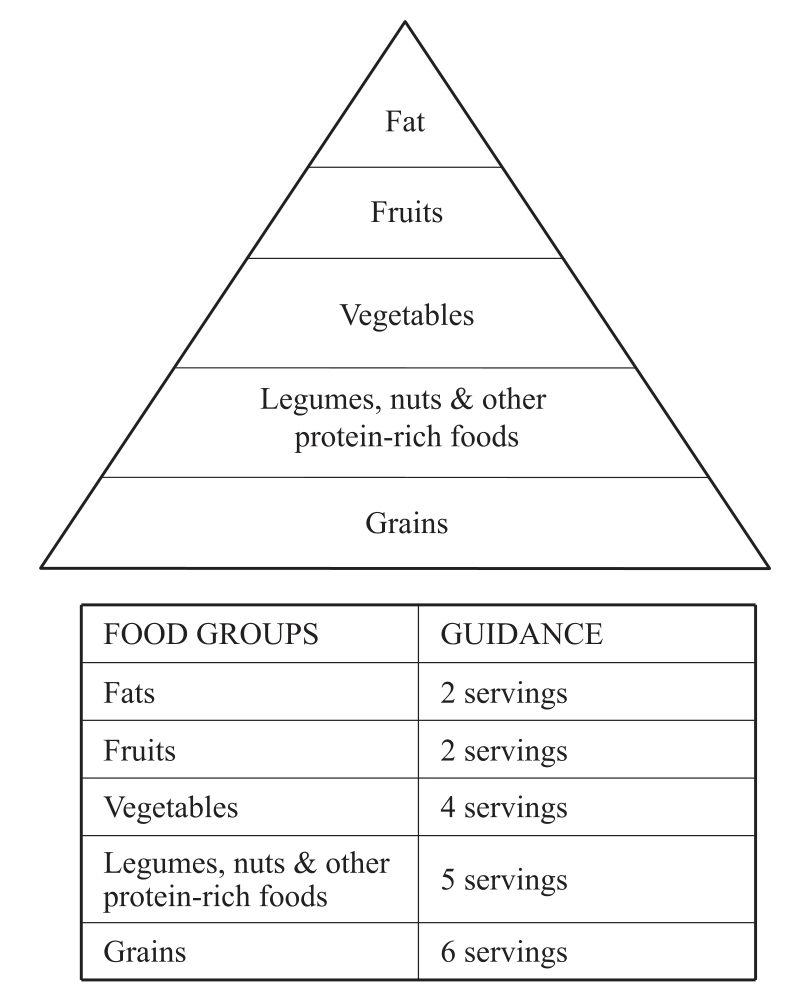
2. The following is a vegetarian food pyramid which says that taking in the right quantities will make a healthy diet. What do you think about it? Talk with your partners about what food could make up each category?
3. Answer the questionnaire below as honestly as you can. Calculate your score and compare your answers with a partner.
Are You Dangerously Unfit?
1) In an average day, do you—
a. climb more than 100 stairs. YES/NO
b. do at least one hour of housework? YES/NO
c. walk or cycle to school or work? YES/NO
2) How often do you walk 5 kilometers or more?
a. once a month
b. once a week
c. never
3) How much sport do you do every month?
a. more than 10 hours
b. 2-9 hours
c. less than 2 hours
4) How often do you spend 20 minutes or more taking exercises that makes you hot or
sweaty?
a. three or more times a week
b. once or twice a week
c. not at all
5) How long does it take you to walk a kilometer?
a. less than 10 minutes
b. 10-20 minutes
c. I can’t walk that far
6) How many of the following activities do you do once a week?
a. Go for a run.
b. Play a ball game.
c. Do some aerobic exercise. (jogging, cycling, etc.)
7) Tick the activities you often do when you are on holiday.
a. Go hiking.
b. Go swimming.
c. Go sightseeing.
d. Go dancing.
e. Lie on the beach.
8) Do you smoke? YES/NO
HOW TO SCORE
1. a. YES: 5 NO: 0 b. YES: 5 NO: 0 c. YES: 5 NO: 0
2. a. 3 b. 5 c. 0
3. a. 5 b. 3 c. 0
4. a. 5 b. 3 c. 0
5. a. 5 b. 3 c. 0
6. a YES: 5 NO: 0 b. YES: 5 NO: 0 c. YES: 5 NO: 0
7. a. 5 b. 5 c. 3 d. 3 e. 0 f. 0
8. YES: -10 NO: 0
WHAT YOUR SCORE MEANS
20 or less: Your health and your life are in danger! You must do more exercise.
21-30: Could be worse, but not much worse.
31-40: Not bad, but could be better.
41-50: You are healthier than the average person and you probably find your life more enjoyable as a result.
51or more: You are super-fit. Are you a professional athlete? (Are you a liar?)
Ⅲ.More Practice
1. Read the following quotations on vegetarianism and translate them into Chinese.
1) Animals are my friends...and I don’t eat my friends. —George Bernard Shaw
2) A vegetarian is a person who won’t eat anything that can have children.
—David Brenner
3) How can you eat anything with eyes? —Will Kellogg
4) If slaughterhouses had glass walls, everyone would be a vegetarian. —Paul McCartney
5) I do not like eating meat because I have seen lambs and pigs killed. I saw and felt their pain. They felt the approaching death. I could not bear it. I cried like a child. I ran up a hill and could not breathe. I felt that I was choking. I felt the death of the lamb.
—Vaslav Nijinsky
6) People often say that humans have always eaten animals, as if this is a justification for continuing the practice. According to this logic, we should not try to prevent people from murdering other people, since this has also been done since the earliest of times.
—Isaac Bashevis Singer
7) Nothing will benefit human health and increase chances for survival of life on Earth as much as the evolution to a vegetarian diet. —Albert Einstein
8) Nothing more strongly arouses our disgust than cannibalism, yet we make the same impression on Buddhists and vegetarians, for we feed on babies, though not our own.
—Robert Louis Stevenson
9) We all love animals. Why do we call some “pets” and others “dinner?” —k.d. lang
10) I do feel that spiritual progress does demand at some stage that we should cease to kill our fellow creatures for the satisfaction of our bodily wants. —Gandhi
2. Give a short summary after reading the following extracted passage, and then comment on it: whether you agree with the author’s opinion or not.
Animal “Shelters”
What you are about to read is disturbing (but there is no graphic language or graphic images). There are good shelters out there but it seems there are more terrible shelters. (For ways to help prevent needless shelter killing (without having to read this article), scroll to the bottom!)
Unfortunately, there are many shelters in our area (our whole country actually) who still kill for space. They also kill shy or aggressive cats and dogs, animals with easily treatable illnesses, some black animals and animals who are relinquished by their owner. They kill relinquished animals because some shelters do not have actual adoptions; they act as only an animal control. These “shelters” are only there for people to find their lost animals. If they are given up to the shelter by the owners, they aren’t lost and there is no reason to keep them anymore. So, they are killed. Most animals have as little as 72 hours to be found. Many shelters do not scan for a microchip and do not post pictures of animals they have found. If not miraculously found by an owner-they are killed.
It seems that many shelters are not trying. They do not see the animal as an individual. They do not try to reunite pets with owners and in some instances, blame the owner for the death of the animal.
They kill shy or aggressive cats and dogs before they even have a chance to calm down.These animals are away from their home, in a scary place being handled by strangers. They have many reasons to be scared yet these shelters deem them inadaptable within minutes of arriving and they are put on the list to be killed.
They kill animals with easily treatable illnesses because it is cheaper to kill them than to treat them and if the treatment (even for serious wounds and broken legs) takes longer than 3 days or whatever the hold time is, it seems dumb (from their perspective) to treat them if they will be dead before the treatment is over. So, some animals who are seriously injured are not treated (even for pain), then killed after the wait time is over. (This happens because the mentality of the shelter staff is focusing on the death of the animal, not trying to save it.)
They kill black animals simply because they feel they are inadaptable because black animals are sometimes the last to be adopted, cats especially.
They kill relinquished animals because there is no reason to keep them until their owners can find them because the owners brought them in. Since many animal controls don’t have adoptions and exist simply to return animals to owners, the animal is killed. Sometimes owners bring in their pets because of behavior problems that they don’t want to work with. An animal with a behavioral problem will definitely be killed because the animal is not ready for adoption and the shelter staff don’t want to work with them to fix the problem.
They kill young puppies and kittens (those still needing to be bottle fed) because they require too much care.
They kill mama cats and dogs but keep the babies if they are old enough. Mama cat is worthless to them; they just want the cute babies. Sometimes they just kill all of them.
Unfortunately, there are many communities that have Breed Specific Legislation on the books. What this means is that any dog that “looks” mean, they kill. They kill Boxers, Pit Bulls, Bulldogs and any mixes of those.
Don’t think that puppies and kittens are saved-because they aren’t always saved. Some places with no foster system in place kill the youngest animals because they need extra care such as bottle feeding. Old animals are killed because they are deemed inadaptable. When they kill them, they sometimes don’t use anesthesia because it is an added cost.
from http://askville.amazon.com
3. Read the following poem and paraphrase the meaning of it.
Living Graves
George Bernard Shaw
We are the living graves of murdered beasts,
Slaughtered to satisfy our appetites.
We never pause to wonder at our feasts,
If animals, like men, can possibly have rights.
We pray on Sundays that we may have light,
To guide our footsteps on the path we tread.
We’re sick of war, we do not want to fight-
The thought of it now fills our hearts with dread,
And yet-we gorge ourselves upon the dead.
Like carrion crows we live and feed on meat,
Regardless of the suffering and the pain
we cause by doing so, if thus we treat
defenceless animals for sport or gain,
how can we hope in this world to attain,
the PEACE we say we are so anxious for.
We pray for it o’er hecatombs of slain,
to God, while outraging the moral law,
thus cruelty begets its offspring-WAR.
Ⅳ.Assignment
Do you know the differences between the Chinese and western table manners? List them as much as possible.