Unit Two Reunion with Old Friends
In this unit, students will
1. Talk about reunion with old friends.
2. Learn nonverbal social-communication skills: Listening Skills.
3. Learn verbal social-communication skills:Talk About Past Events.
Ⅰ.Warm-up Activities
1. Read the following passage, and then retell it to your group members. All the group members will evaluate your retelling by using the assessment sheet in the Appendix.
Walking and Health
I am often teased for my stubborn habit of traveling by foot. I often walk the 3 mi. home from work rather than take the subway. When I visit less pedestrian-friendly cities, kindhearted motorists regularly pull over and offer me a ride, assuming that my car has broken down or I’m in need of some help.
But for me, walking is a good opportunity to process the day and let my mind wander without the oppression of the endless to-do list that awaits me at home. Plus, it helps my back recover from a day spent bent in front of a computer screen. Health-wise, I have always assumed I’d have the last laugh, and now there’s even more evidence on my side.
Nine years later, the walkers underwent brain scans, which revealed that those who had walked more had greater brain volume than those who walked less. Four years after that, the volunteers were tested again—this time for dementia. Among the group, 116 people showed signs of memory loss or dementia. Those who had walked the most—at least 72 city blocks (or about 7 mi.) each week—were half as likely to have cognitive problems as those who walked the least.
A study published in Neurology has found that the simple act of walking may improve memory in old age. As we age, our brains shrink and the shrinkage is associated with dementia and loss of cognitive functions such as memory. To test whether physical activity could mitigate some of these degenerative effects, researchers from the University of Pittsburgh tracked the physical activity of 299 healthy men and women with an average age of 78. The participants’ activity ranged anywhere from walking 0 blocks to 300 blocks (up to 30 miles) per week.
The findings are in line with past studies linking physical activity with brain function, but dementia experts say there’s not enough data yet to prescribe exercise to prevent memory loss. It’s also too soon to say whether exercise may prevent dementia or simply delay it in people who would eventually develop it anyway. But when it comes to Alzheimer’s, even a short delay could mean great gains in quality of life. MSNBC reports:
“Even if we are delaying [Alzheimer’s disease] by several months or years, that’s a significant improvement in what we know already, and a change in costs for treating health care, Erickson said. Delaying the condition could also ease the emotional burden and problemsthat come along with it, for both patients and their families, he said.
from http://www.kekenet.com/read/201011/117095.shtml
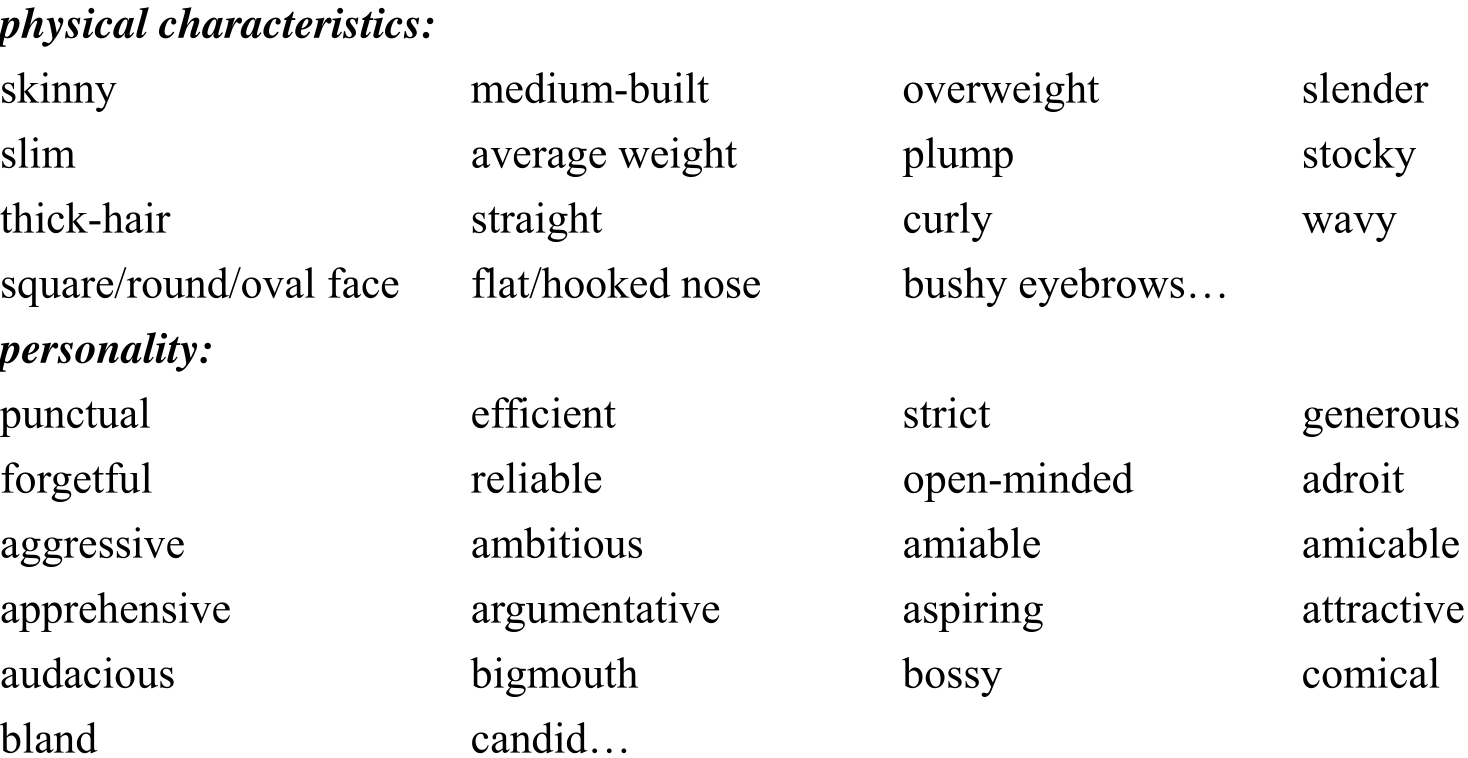
2. Description. Describe one of your old friends. Your description should not only include physical characteristics but also his/her personality. Some useful expressions are listed below.
3. Learn from movies
You will watch an episode of “Family Album U.S.A.” Please fill the following blanks with the words you hear, and then talk about the scene of reunion shown in this episode.
I Recognize You!
(A=Arnold, P=Peggy, M=Malcom)
A: Don’t tell me. Please don’t tell me. I recognize you...
P: Oh, don’t be 1)___________, Arnie. Of course you recognize him. Except for the beard, he hasn’t changed in fifty years. It’s Malcolm Stewart!
A: I know it’s Malcolm Stewart. You haven’t changed much in fifty years.
M: Peggy—Peggy Pendleton! You’re Peggy Pendleton!
A: Who am I, you old 2)__________? You don’t recognize me, do you?
M: I know who you are. You’re Arnold Franklin! I know who you are!
P: You look 3)_________, Malcolm!
M: Sit down. Sit down. Pete isn’t home.
A: Really?
M: No. He left a note on the door saying he was going to the railroad station to 4)_________ up a surprise.
P: He’s so 5)________. Always full of surprises, even fifty years later.
M: The two of you look 6)_________!
A: How’s your family? Oh, I was sorry to hear about your wife having passed away.
M: Yes. About 7)_________years ago.
P: And you’re living with your children now? In New York? Pete wrote us and told us.
M: Yup. 8)_________ and moved to New York to live with my son and his family.
P: By the way, what do you think this big surprise is?
A: It could be most anything, knowing Pete.
Ⅱ.Focused Topic
Reunion with Old Friends
A.Dialogues
Please read the following dialogues and note the italic expressions.
Dialogue 1 Encounter
A: Hey, I think I know you, are you Sam?
B: Yes, you must be Mark! How are you? Never in a million years would I have thought I would meet you here.
A: I’m ok. It’s been almost 20 years since I saw you last. Give me a blow-by-blow of your past 20 years.
B: I have been a vet since graduation. I heard that you had been in New York. What did you do?
A: After graduation, I got a job as a teacher in a middle school in New York, but it proved that I was biting off more than I can chew. So I moved to the New York Times as a journalist.
B: Journalist? A wonderful job.
A: But it seemed that I needed some time to ease into it.
B: It takes time to get familiar with any kind of job.
A: Sure does! But it took me three years to get myself familiar with this job until I moved to a salesman.
B: How does this job come out?
A: I only did that for three months. It is really hard work. Two years ago, I moved here when I finally got a job in a factory just out of the city. Life really knocked me around.
B: Fortunately, you have got all these over. And the best thing is we can see each other more.
Dialogue 2 Wonderful Memories
A: We have so many wonderful memories when we studied in the university!
B: You can say that again! Do you remember our visits to our foreign teacher’s apartment?
A: Certainly! We visited our foreign teacher every Saturday.
B: Yeah, we spoke English and played games with friends. How much fun we had there!
A: Not only fun, but also English speaking!
B: She was so kind to provide us a place to practice speaking English.
A: She even organized us to have a picnic outside.
B: When we heard the news, we felt like we were walking on air.
A: We had dreamed that for many days. But that was not the most exciting thing.
B: I know what you mean. That snowballs fight!
A: We ran and threw snowballs to each other. Anyone might get a surprise attack, no exception.
B: And we didn’t even feel a little bit of the coldness.
A: We just wish we could have it again!
Other Useful Expressions
to miss someone to feel superior/inferior to
to be nostalgic to meet up with
to drop in/stop by/call in/come by to walk someone out
to come out with someone to get together
to make up a party to come back
to have a reunion to be concerned for
school reunions to have a stag party
forget-me-not childhood sweethearts
to bolster one’s self-esteem
Practice:
1. Please think of a reunion with some friends and answer the following questions by making a conversation with your partner:
1) At what time do you and your friends get together for a reunion?
2) What do you do when you get together?
3) What do you like to talk about?
4) What do you feel in a reunion?
2. Role-play: Student A will interview student B about two of the following topics:
1) Do you often attend some reunion parties with your friends? Will a reunion strengthen friendship? What can you get in such reunions?
2) What will you do if you meet someone you dislike in a reunion?
3) Will you feel embarrassed when you can’t find topics with friends who you haven’t seen for a very long time in a reunion party? Why?
4) What type of reunion do you like most? What type of reunion do you dislike most?
B.Socio-Communicative Skills
Verbal communication refers to the communication which is carried out in either oral or written form with the use of words. Nonverbal communication refers to the communication through one’s voice quality, facial expressions, gestures, bodily movement, attitudes towards space and time, and so on.
To achieve successful conversations, it is necessary to learn the skills of both the verbal and nonverbal communication.
Non -verbal Skill
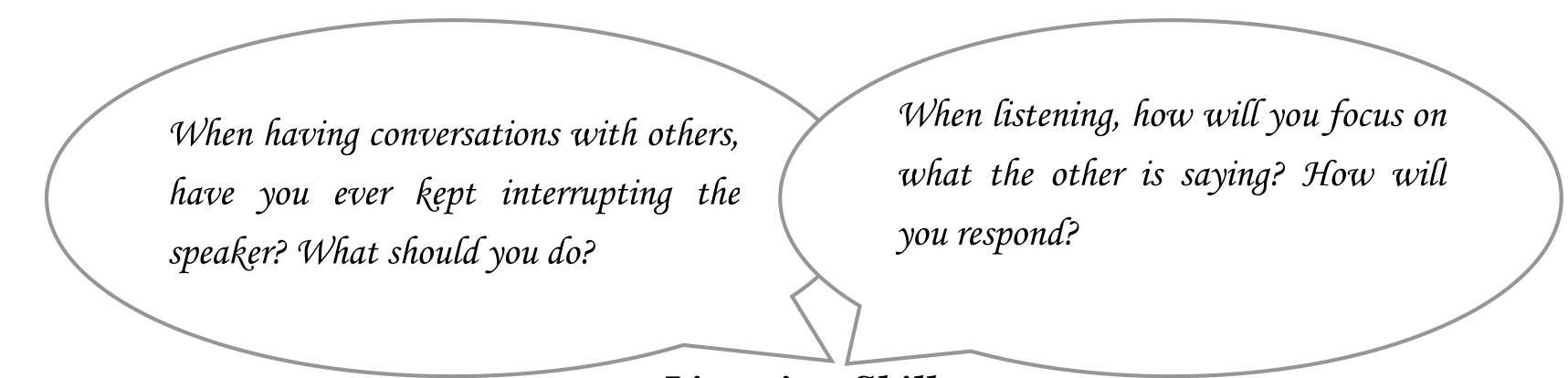
Listening Skills
Perfecting your listening skills can put you ahead of the game faster and better than even the best speech or oratory skills. This is a step by step guide to mastering this seemingly simple task that hopefully will inspire you into making yourself a better listener and thereby a better person!
? Step 1. Connect with your intention
Listening requires you to be centered, with an alert and receptive mind. If you yourself are triggered, then it is time to center yourself rather than snapping back. You can even do this within the conversation by make a request for a moment to compose yourself, such as “I need a few seconds to think.”
? Step 2. Stop talking!
Some people, when they are trying to listen, are really wanting to talk. Listening is not giving advice such as saying “I think you should....blah blah blah..” or story telling “That reminds me of the time ...blah blah blah.” or taking blame “Sorry, I should have .....” or shutting the person down “Don’t worry about it.” Be mindful of whether you are talking orlistening. A good exercise to be done with a partner, spouse, or friend is to take turns listening without interrupting.
? Step 3. Listen for the feelings
While you are listening, see if you can identify the feelings of the speaker. For men, this is more difficult and even challenging task since boys are raised to suppress them. Some examples of feelings include distressed, scared, hurt, disappointed, lonely, uncomfortable, relieved, happy, sad, angry, excited, overwhelmed, inspired, depressed, etc.
? Step 4. Putting it all together
You are now ready to reflect, to make a guess to check out the actual experience of the speaker. Remember to listen long enough to get a good idea. although there is no hard and fast rules about this. You might just be saying uh huh , yeah, for a while, or even talking yourself a little (but not too much!), but once you are ready to reflect, say something like this (fill in the blanks): “When you see .....(observation)...., I’m guessing you are feeling ...(feeling word)..... because you are needing ...(need)....etc.
Practice:
Make a conversation on the following topics with your partners and pay attention to your listening skills.
1) Wonderful memories
2) My parents
3) An embarassing thing for me
4) My favorite teacher
Verbal Skill
Talking about Past Events

continued
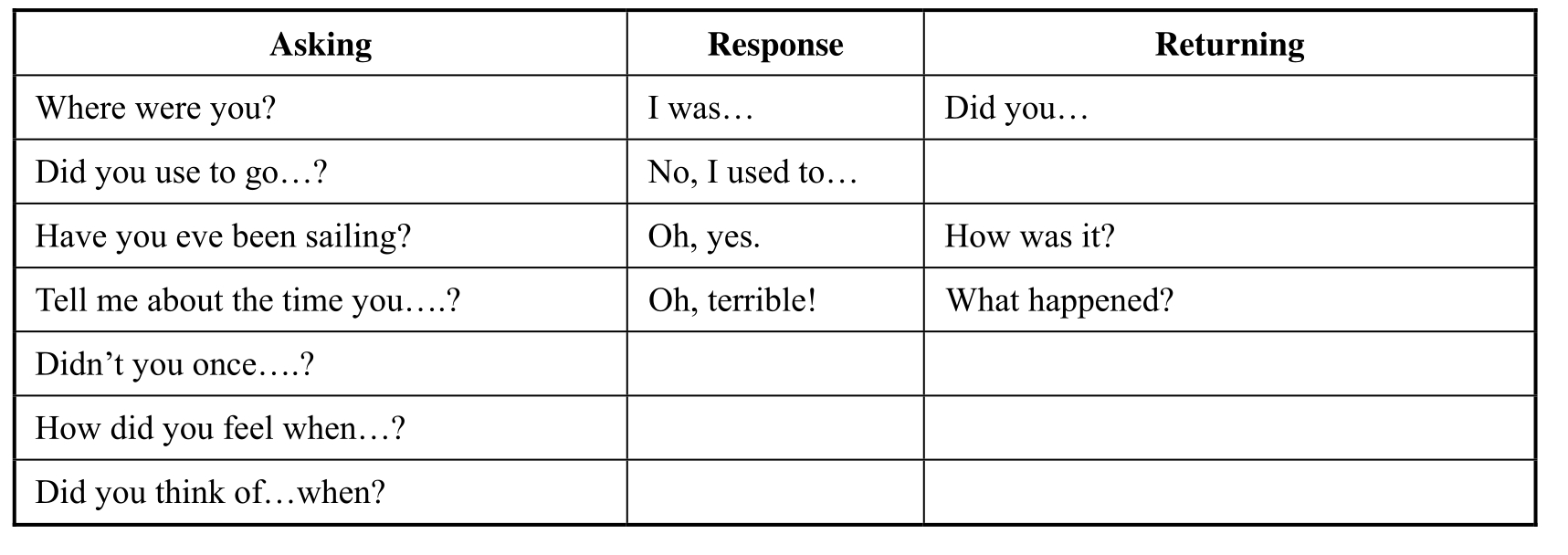
Learn the following conversations and make conversations with your partners based on the situations given below.
1) A: Have you ever been in an earthquake?
B: Yes. It was a terrifying experience. I never want to experience anything like that again.
A: What happened?
B: Well, when the tremor started, I jumped out of the window. I was so frightened.
A: Why didn’t you use the staircase?
B: I don’t know. I should have done so, I know, but I did the first thing that came into my head.
A: What would you have done if your room had been on the tenth floor?
B: Well, it’s difficult to say, but I think I might have jumped in any case. Or maybe, I might have thought more carefully before jumping, and used the stairs.
2) A: Tell me about the time a burglar went into your students’ dormitory.
B: Well, I’m not sure I can remember all the details, but it happened about 6 p.m., and I saw a man walking up stairs.
A: What did you do then?
B: Well, I didn’t recognize him and I became suspicious, so I followed him…
A: Then what happened?
B: Well, I got frightened and tried to find someone to help. But while I was gone, he got away with quite a lot of money and a portable computer.
A: Why didn’t you follow him into the bedrooms?
B: I should have followed him, I know. If I had raised the alarm earlier or tried to stop him, I suppose I might have prevented the theft.
Now, make conversations of a past event based on the following situations by using the expressions above:
1) One of your friends never attended any kind of reunion before. So he/she asked you some questions on a reunion party which you attended some days ago.
2) Your friend just came back from a trip which you are talking about.
3) You witnessed an accident and you are telling it to your friend.
4) You are talking about an adventure your friend experienced.
C.Activities
1. Read the following passage and list suggestions on organizing a reunion party. Then, answer questions: Do you prepare your reunion in such a procedure? Why or why not? Do you have better ways to organize a reunion party?
How to Organize a Reunion Party?
So, you’ve graduated and you’ve started your career. Maybe you’ve even started a family. Years have past since your last prom so what better way to catch up with old friend and plan a reunion. The keys to creating a successful reunion involve an efficient reunion committee and as much advance planning as possible
Begin the planning process at least a year in advance. Select a reunion committee of 5 to10 alumni, and conduct your first meeting to brainstorm and develop an initial plan.
Locate as many alumni as possible through your alma mater’s alumni center. Make a list of missing classmates, and begin a more extensive search to locate these people.
Consider working with a reunion planning specialist. These professionals can help plan your reunion, and will often front the money until attendees have sent in RSVPs and paid.
Plan an entire weekend around your reunion festivities, since many attendees will be traveling from out of town solely for the event. Plan one main reunion event on a Saturday night, as well as planning a Friday night welcome mixer and a post-reunion brunch or picnic.
Send out initial reunion “save the date” invitations approximately nine months before the reunion date. Include a missing classmates list, and ask people to respond if they have any information about the lost alumni.
Ask local businesses to provide door prizes and awards for the event. Businesses can receive logos and advertising in the reunion invitations and event schedules in exchange for their donations.
from http://www.ehow.com/how_8693_class-reunion.html
2. Read the following passage, and then answer questions.
Family Reunion Activities
Games
The most common family reunion activities are the games. There is a huge variety of games, from sports (like softball and volleyball), to “kids” games (which are especially fun if the adults join in), to board games.
Storytelling
Sit around in a group and tell stories (preferably embarrassing) about each other. The best story wins! Try to aim for funny and embarrassing (therefore funny) areas. Kids always love to hear grandpa and grandma tell stories about their parents (you know why kids and grandparents get along so well... they have a common enemy). And don’t forget to ask the kids to tell stories—they’re the best way to get the good stories about their parents.
Keeping the Kiddies Busy
Kiddie pools, coloring books, and sidewalk chalk are good ways to keep those kids busywhen the “grew-ups” want to sit around and talk. Keep plenty of crayons handy to prevent squabbling, and make sure it’s a hot day so kids won’t protest the cold hose water in the pool. And make sure they only use the sidewalk chalk in places the rain can reach (if they color on the floor of the garage, it’s never going to go away).
Family Memorabilia
Create an attractive display of old photographs and family paraphernalia. Ask everyone to bring something to display. Set aside a table for “missing persons”—pictures of ancestors whom you can’t identify. Maybe someone else will recognize them. You might get lucky.
Group Photos
A family reunion is the perfect place to use that camera. Where else could you possibly get a photograph of four or five generations of a family all together at one time? Other groups that you may like to photograph include: grandma and grandpa with their grown-up children, all the young cousins or all the older cousins. Make sure that after you get the pictures developed, you write down who each person in the photo is, so that twenty years from now people aren’t asking, “Who was that”?
Family Talent Show
You would probably be surprised at the talents of your various family members. Put on a talent show at your reunion. Make sure you tell everyone about this in the invitation or information packet, in case they need to bring something with them (like their violin, juggling balls, or blowtorch). Print up certificates or awards for the various categories.
Dinner and Dance
A dinner and dance can be a fun activity, especially at reunions with mostly adults. Most adults would appreciate anything that would give them an excuse to get away from their kids and stay out late—it helps even more when that’s fun.
from http://family-reunion.com/activity.htm
Questions:
1) Can you list some more games that you can play in a family reunion?
2) Do you do some activities in family reunion?
3) Will you try to carry out some activities listed above in the coming reunion?
3. Group work. Work out a role play with your partners to present a scene of your high school classmates’ reunion
Ⅲ.More Practice
1. Do you know “Thanksgiving Day—A Time for Reunion”? Read the information about Thanksgiving Day, and tell each other in pairs what you are going to do on the next Thanksgiving Day.
History of Thanksgiving Day
In 1620, a boat “May Flower” filled with more than one hundred people sailed across the Atlantic Ocean to settle in the New World. This religious group had begun to question the beliefs of the Church of England and they wanted to separate from it. The Pilgrims settled in what is now the state of Massachusetts. Their first winter in the New World was difficult. They had arrived too late to grow many crops, and without fresh food, half the colony died from disease. The following spring the Indians taught them how to grow corn (maize), a new food for the colonists. They showed them other crops to grow in the unfamiliar soil and how to hunt and fish.
In the autumn of 1621, bountiful crops of corn, barley, beans and pumpkins were harvested. The colonists had much to be thankful for, so a feast was planned. They invited the local Indian chief and 90 Indians. The Indians brought deer to roast with the turkeys and other wild game offered by the colonists. The colonists had learned how to cook cranberries and different kinds of corn and squash dishes from the Indians. To this first Thanksgiving, the Indians had even brought popcorn.
After the first New England Thanksgiving the custom spread throughout the colonies, but each region chose its own date. In 1789 George Washington, the first president of the United States, proclaimed November 26 a day of Thanksgiving.
Thanksgiving Day continued to be celebrated in the United States on different days in different states until Mrs. Sarah Josepha Hale, editor of Godey’s Lady’s Book, decided to dosomething about it. For more than 30 years she wrote letters to the governors and presidents asking them to make Thanksgiving Day a national holiday.
Finally, in 1863, at the end of a long and bloody civil war, Abraham Lincoln asked all Americans to set aside the last Thursday in November as a day of thanksgiving, he issued a White House proclamation calling on the “whole American people” wherever they lived to unite “with one heart and one voice” in observing a special day of thanksgiving.
In 1939 President Franklin D. Roosevelt advanced Thanksgiving Day one week. However, since some states used the new date and others the old, it was changed again 2 years later. In 1941, American Congress passed the law to celebrate Thanksgiving Day on the fourth Thursday in November.
from http://www.citehr.com/157514-story-about-sharing.html
2. Give a short summary after reading the following extracted part of a passage, and then, list some purposes of attending a reunion and some types of reunion. What do they do in a reunion according to the passage? How about you? Do you agree with the ideas of this passage? Why or why not?
High School and College Reunions
School reunions are a chance for Americans to get together with people they may not have seen in years. Some have not seen each other in half a lifetime.
Reunions can be a lot of fun, but also a lot of pressure. Sometimes people feel they must improve their appearance before they go to a reunion. This is true of both men and women. They may try to lose weight. They may change the color of their hair. Or they may buy costly new clothes.
People may feel they have to prove to others how successful they are. Then, if they talk too much about their success, others accuse them of “bragging.”
People at reunions often talk about their children and grandchildren. They may talk about them for a long time. Most people who are parents and grandparents also carry pictures. So it is common to overhear former classmates saying things like, “I think that baby looks just likeyou.” Or, “Oh, your granddaughter is beautiful!”
People who attend high school and college reunions sometimes try to make business connections. They try to get former classmates to invest in their companies or buy their products. Some people ask old school friends for a job.
Political candidates are no strangers to high school and college reunions. For example, Senator Joseph Lieberman of Connecticut attended Stamford High School in his state. He completed his studies in nineteen-sixty. Since then, he has attended seven of the eight class reunions.
Many different kinds of reunions take place. Some may be formal and cost a lot. This kind usually takes place in a hotel. A big dinner is served. A band or orchestra usually plays.
Other reunions are informal. This kind of party is often held in the high school or college itself. The people who went to school together share a meal. Then they may dance to music just as they did years before.
Reunions can even take place in the home of one of the former students. That is what happened several years ago with the graduating class of nineteen-sixty-nine from Wellesley College. That is a women’s school in Wellesley, Massachusetts.
Many high school and college reunions take place at the same time as an event called homecoming. Schools plan this event to invite their graduates to return for a visit. Homecoming almost always is held in the fall. The schools plan events for the returning graduates. There usually is an important football game or other sports event that former students can attend. And there usually is a party called an open house. Teachers or professors welcome back their former students.
The main program is usually led by one or more speakers from the class. They tell jokes and remember stories about their classmates. They introduce former teachers. They introduce classmates who fell in love with other classmates and got married.
Reunions are also famous as a second chance for love.
The people who organize reunions may show films of when everyone was a teenager. If the students were in school a long time ago, they laugh at the clothes they wore.
And there is something else people do at reunions. They almost always sing their school song.
from http://www.unsv.com/voanews/specialenglish/scripts/2003/08/04/0045/
3. Debate: divide the class into two parts and debate on the following topic: Class Reunion Is a Waste of Time and Money.
Ⅳ.Assignment
Work out Tips to Get Well Along with Colleagues
Everyone works or will work together with colleagues. A good relationship with colleagues will help you work more efficiently and effectively. On the contrary, a bad relationship with colleagues will stand in the way of your work and will make you feel depressed and gloomy every day. So to get well along with colleagues is very important in your career. If you have a job, what shall you do to improve the relationships with colleagues? Write down the tips you think necessary. Bring your tips to class, and discuss with which is the most important.
Tips for Improving the Relationships with Colleagues
1. __________________________________________________________________________
2. _________________________________________________________________________
3. _________________________________________________________________________
4. _________________________________________________________________________
5. _________________________________________________________________________
6. _________________________________________________________________________