Unit Eighteen Job Hunting
In this unit, students will
1. Learn how to hunt for jobs.
2. Learn nonverbal social-communication skills: Consider Context.
3. Learn verbal social-communication skills: Talk about Possibilities.
Ⅰ.Warm-up Activities
1. Read the following passage, and then talk with your partner: will you go on your study or hunt for a job after graduation from college?
Graduate School Entrance Examination or Job Hunting
By Zhang Zhaoxin
Since the college students meet more and more difficulties in finding jobs, they make their efforts to take part in the entrance exams for postgraduate schools. A higher degree is a better guarantee for good jobs as far as they can see. At the same time, there are still many students opting to find a job directly after their bachelor’s degree. There are both advantages and disadvantages in further study or finding a job and you should take everything into consideration to decide which way to go.
One obvious advantage of further study is that it provides an opportunity to go on with your studies in the area you like. It’s surely a pleasure to be with your favorite subject. What’s more, you are more likely to succeed to continue studies that interest you. Another advantage is that you can develop more technical or professional knowledge. In that case, it’s easier for you to realize your self-value. The current world is more competitive, thus we should learn more to adjust to the world. In addition, postgraduate enhances the possibilities to be employed. In many areas, a higher degree is a great advantage to be more competitive.
Surely the advantages above lead many students to the road of examination, and there are still some other reasons about the disadvantages of work that evoke so many students not to work instantly. Unlike the postgraduate, a lack of degree always makes graduates awkward in finding jobs. Besides, they always get a much lower salary when compared with postgraduates. Here you can see the reason of choosing to be a postgraduate includes two aspects, the advantage of further study and the disadvantage of instant job.
However, it’s not unreasonable to choose to work for many students. Just as a saying goes,“every coin has two sides”. It’s obvious that there are still many disadvantages for further study. First of all, it takes a lot of time and money to prepare for the entrance examination. You must study hard while others playing basketball or playing computer games, for example. Anyhow, it’s hard work and difficult to persist. Second, postgraduates get a degree in the sacrifice of work experience.
Besides, the advantages of job are an essential part to consider when you are in the forked position. As is mentioned in the above, work experience is increasingly significant. It’s another qualification besides diploma since many employers value work experience and practical industry knowledge very much. On the other hand, for some particular job, college graduates are more competitive because they demand a lower pay. That’s all about why many students choose to work instantly.
Postgraduate or job, which one is better? There is no absolute answer, only the alternative that is your appetite. After all, the best road is the road that suits you. You should take everything into consideration and weigh the pros and cons to decide the future road.
from http://www.24en.com/study/excellent/2008-01-03/59625.html
2. Group discussion. Topic: College Graduate’s Employment.
Your discussion should cover the following points:
● Phenomenon
● Reasons
● Possible Solutions
3. Learn from songs
You will listen to one song “What U Wanna B”. Please fill the following blanks with the lyrics you hear, and then, talk with your partner about your dream job.
What U Wanna B
Doctor actor lawyer or a singer
why not 1) _________ be a 2) _________
you can be just the one you wanna be
police man fire 3) _________or a 4) _________ man
why not something like your old man
you can be 5) _________ the one you wanna be
doctor 6) _________ lawyer or a singer
I know that we all got one thing
that we all 7) _________ together
we got that one nice dream
we live for
you never know what life could 8) _________
coz nothing 9) _________ for ever
just hold 10) _________ to the 11) _________
you 12) _________ for
I know you could 13) _________ the top
make sure that you 14) _________ stop
be the one that you wanna be
now sing this with me
we may have different ways to think
but it doesn’t really matter
we all 15) _________up in the steam
of this life
16) _________ on every little thing
that’s what does really matter
17) _________ cars and 18) _________
that’s not real life
last year I 19) _________ to dream about this day
now I’m here I’m singing for you
I hope I could 20) _________ you
coz I’ve got all the love
coz I’ve got all love for you
Ⅱ.Focused Topic
Job Hunting
A.Dialogues
Please read the following dialogues and note the italic expressions.
Dialogue 1 The Wrong Sex or the Wrong Clothes?
A: We’ve got a new manager in our department.
B: Oh? You hoped to get that job, didn’t you?
A: Yes, I did.
B: I’m sorry. That’s too bad. Who is it? Who got the job, I mean?
A: Someone called Drexler. Carl Drexler. He’s been with the company only two years. I’ve been here longer. And I know more about the job, too!
B: Hmm. Why do you think they gave it to him and not to you?
A: Because I’m the wrong sex, of course!
B: You mean you didn’t get the job because you’re a woman?
A: Yes, that was probably it! It isn’t fair.
B: What sort of clothes does he wear?
A: A dark suit. White shirt. A tie. Why?
B: Perhaps that had something to do with it.
A: You mean you think I didn’t get the job because I come to work in jeans and a sweater?
B: It’s possible, isn’t it?
A: Do you really think I should wear different clothes?
B: Well…perhaps you should think about it.
A: Why should I wear a skirt or a dress?
B: I’m not saying you should. I’m saying you should think about it. That’s all!
A: Why should I do that? I’m good at my job! That’s the only important thing!
B: Hmm. Perhaps it should be the only important thing. But it isn’t. Not in this company.
Dialogue 2 Decision-making
A: Have you decided what you want to do after college?
B: Not really. There’s a possibility of going into software design, or I may make a good living selling computers. There’s also a possibility of working on online advertising.
A: Which would you enjoy the most?
B: I think the advertising would be very interesting. I like being creative and have lots of ideas for interactive ads.
A: You won a prize for web page design, didn’t you?
B: Yes, using Flash software. Anyway, what about you? Any plans?
A: Yes, I really think you have to plan ahead so I decided long ago to go into finance in the banking sector. I have been taking the necessary courses and exams and even making some contacts.
B: Wow, you are organized. I hope your dream comes true.
A: You know there’s a career fair on in the City Hall. Let’s go and have a look around and see what there is about computing and advertising. It might help you reach a decision.
B: Thanks. That’s a very good idea!
Other Useful Expressions
employment phobia recruitment fair
labor market supply glut
oversupply of graduates accumulate relevant work experience
work at the grassroot level pursue challenging jobs
insufficient capability the job hunting pressure
expansion of university enrollment global economic crisis
economic downturn / slowdown to adjust one’s mindset
to bring one’s talents into play career counseling and training
employment guidance great prospects
Practice:
1. Please talk with your partner about the questions below:
1) Would you rather be a doctor or a banker? Why?
2) If you could own your own business, what would it be?
3) If you had to choose between a satisfying job and a well-paid one, which would you choose?
4) Name three occupations that you could do.
2. Role-play: Student A will interview student B about two of the following topics:
1) What jobs do you think would be boring?
2) What jobs do you think would be fun?
3) Do you think people over 65 should be made to retire?
4) What are you trying to do in order to find a job that you really like?
B.Socio-Communicative Skills
Verbal communication refers to the communication which is carried out in either oral or written form with the use of words. Nonverbal communication refers to the communication through one’s voice quality, facial expressions, gestures, bodily movement, attitudes towards space and time, and so on.
To achieve successful conversations, it is necessary to learn the skills of both the verbal and nonverbal communication.
Non -verbal Skill
Considering Context
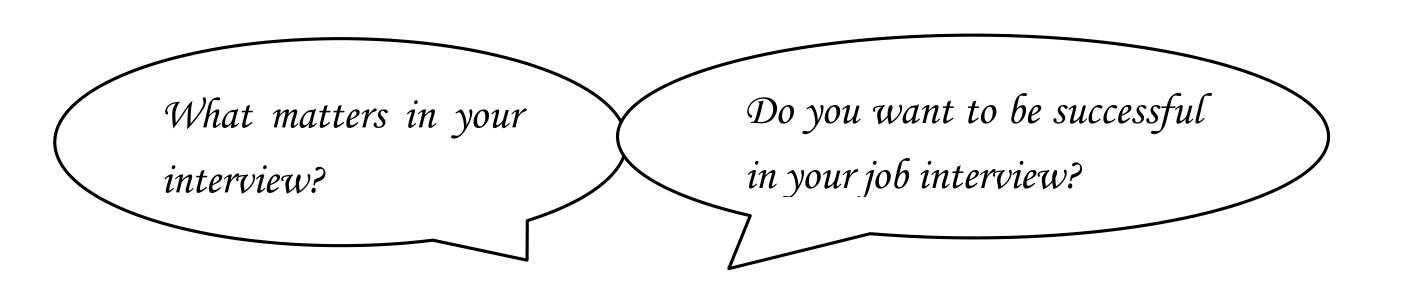
When you are communicating with others, always consider the situation and the context in which the communication occurs. Some situations require more formal behaviors that might be interpreted very differently in any other setting. Consider whether or not nonverbal behaviors are appropriate for the context. If you are trying to improve your own nonverbal communication, concentrate on ways to make your signals match the level of formality necessitated by the situation.
? Talking on your cell phone or listening to an IPod while waiting to be called for the interview may lead to your failure.
? The way you sit in the lobby, the way you greet the receptionist and the interviewer, and the way you wait, will all have an impact on whether you are going to be considered for the job. Be friendly and pleasant, but, not overbearing. If you need to wait, sit quietly(no phone calls) and patiently. Shake hands with the interviewer. Your handshake should be firm—not sticky or wimpy. To avoid sweaty palms, visit the rest room, wash your hands, then run them under cool water prior to the interview. Keep your palms open rather than clenched in a fist and keep a tissue in your pocket to (surreptitiously) wipe them.
? Smile and nod (at appropriate times) when the interviewer is talking, but, don’t overdo it. Don’t laugh unless the interviewer does first. Be polite and keep an even tone to your speech. Don’t be too loud or too quiet. Don’t slouch. Don’t lean back, as you will look too casual and relaxed. Stay calm. Even if you had a bad experience at a previous position or were fired, keep your emotions to yourself and do not show anger or frown. Not sure what to do with your hands? Hold a pen and your notepad or rest an arm on the chair or on your lap, so you look comfortable. Don’t let your arms fly around the room when you’re making a point.
Pratice:
Role-play: Work with your partner on one of these occasions, and pay attention to the context.
1) Your first date with your dream girl/boy
2) Your first meeting with your future boss
3) Your first meeting with your future parents-in-law
4) You’re interviewed by a reporter
Verbal Skill
Talking about Possibilities
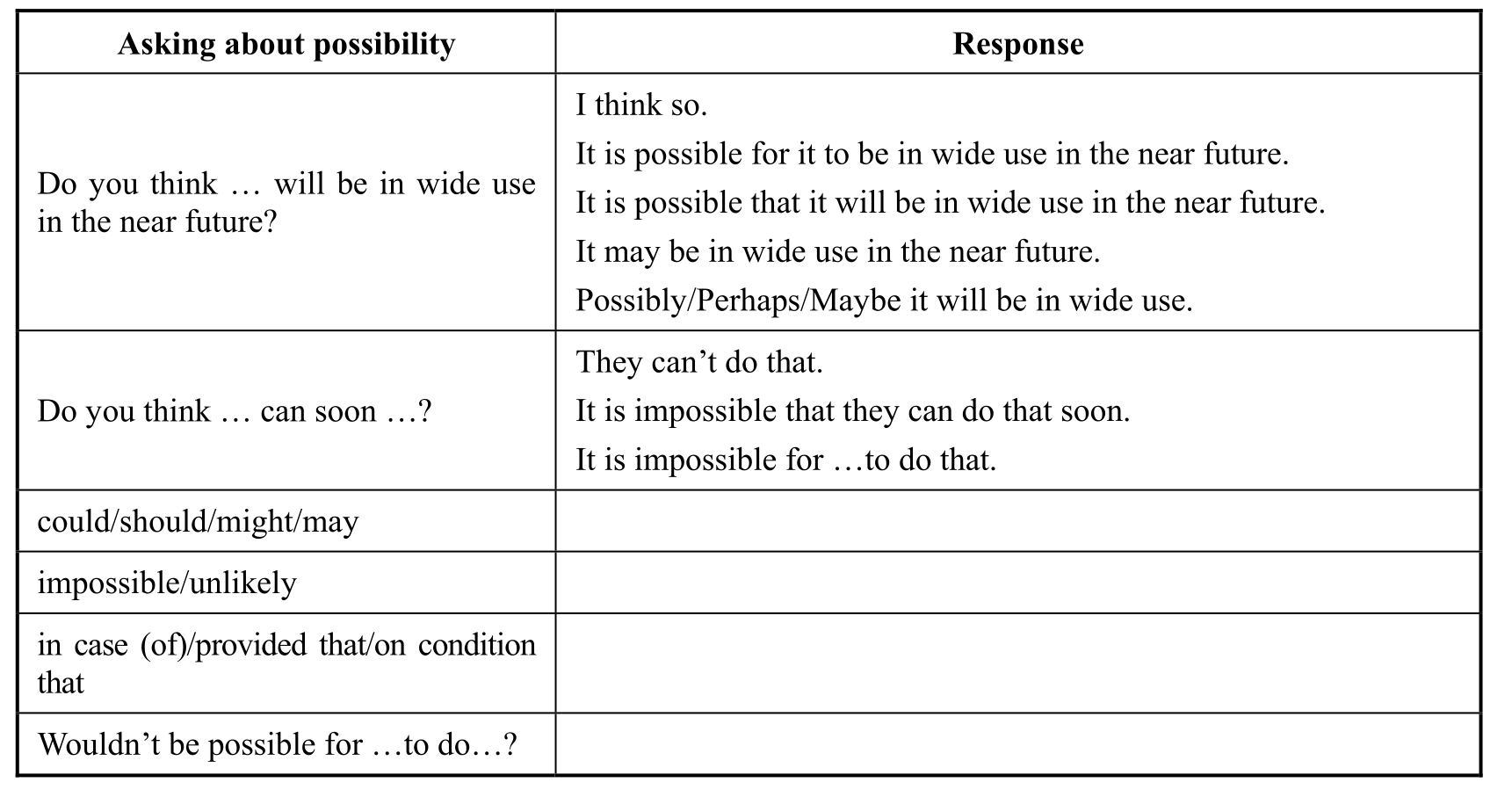
Learn the following conversations and make conversations with your partners based on the situations given below.
1) A: I’m looking forward to relaxing this coming weekend.
B: I hope that I can finally find some free time too. I’ve been so busy at work recently.
A: How might you spend the weekend?
B: I hope to do a little gardening. I find it very relaxing.
A: I might do that too. I hope the weather is nice. I could go and play some golf.
B: I heard that the weather should be good. There’s a possibility of a shower, but it’snot very likely.
A: Hopefully, we’ll both have relaxing weekends.
B: Of course, but something could come up unexpectedly and stop that wish coming true.
A: You’re right. It seems there’s always the possibility of some urgent work requiring our attention.
2) A: What do you hope to do when you finish university?
B: I’d like to go into management. I’ve applied for several jobs already and I’m hopeful that I’ll get some job offers. How about you?
A: After I graduate, I have to do some more studies to pass exams to become a lawyer.
There’s a possibility of getting a job with a law firm in London, provided that I do well.
B: We both have to overcome several obstacles if we are to achieve our ambitions.
A: If life were easy, then we’d achieve our ambition quickly and then get bored.
B: Unfortunately, it’s inevitable that some people are going to work hard yet not succeed.
A: That’s why ambition needs to be realistic. You can’t achieve something that’s totally unrealistic.
B: As long as you plan carefully, most things are possible. It’s always good to have a backup plan in case things go wrong.
A: I think it’s important to be successful in a field you are truly interested in, not something that other people force you to be interested in.
B: My father wanted me to become a doctor, but I knew it would be impossible for me to be successful in that field.
A: Then you should stick to your own dream.
Now, make conversations of expressing possibilities based on the following situations by using the expressions above.
1) Ask your partner about the invention of telephone. Use the language for expressing possibility to find out if your partner is sure about it.
2) Ask your partner about the invention of walkman. Use the language for expressing possibility to find out if your partner is sure about it.
3) Talk with your partner about your activities during your summer vacation.
4) Talk with your partner about weather at the weekend.
C.Activities
1. Speaking task:
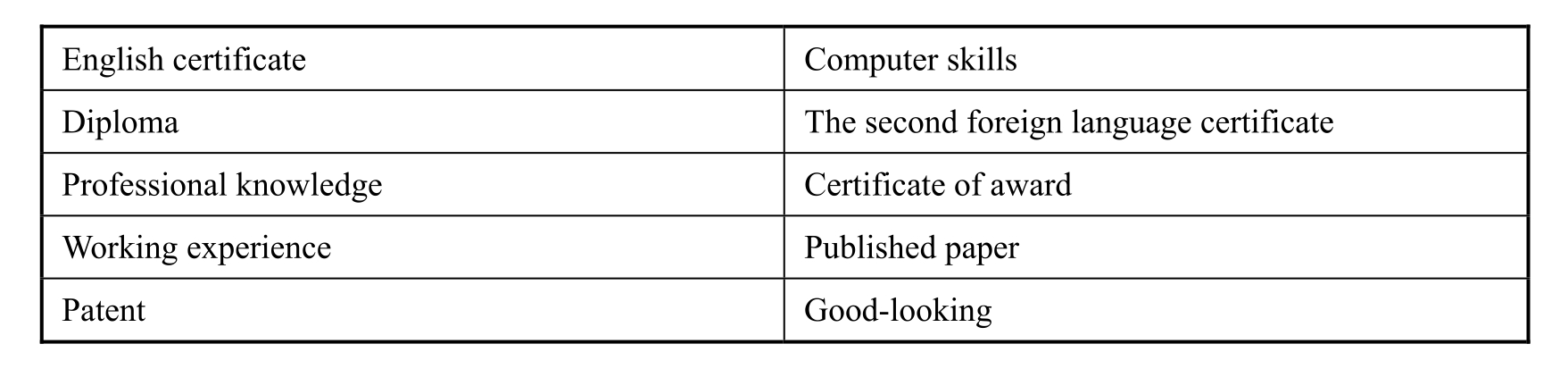
Which Qualification Is the Most Important?
Look at the following chart of qualifications that are needed in order to get your dream job and then discuss with your partner which qualification(s) you think is/are the most important.
2. Debate: Certificates to find a Job, the more the better?
Here are some expressions for your reference:
Certificates can approve a person’s ability.
Certificates show the pursuit of progress.
Some of the certificates are necessary; without them, you may fail to cross the threshold of your dream job.
Certificates are but the chips for you to increase your competitiveness. You can show your ability through other ways.
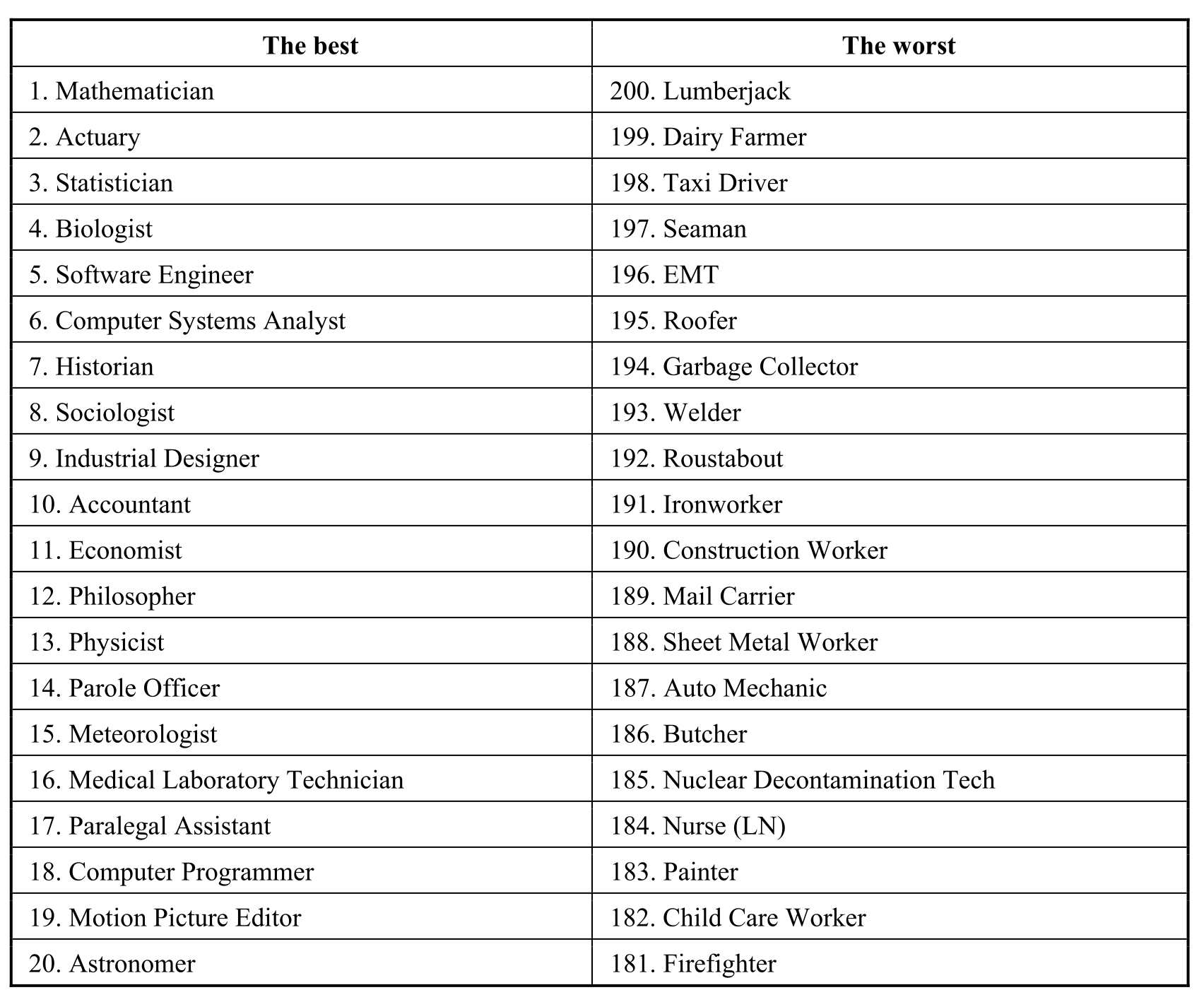
3. Pair work: First read the following chart chosen from Sarah E. Needleman’s article: Do the Math to Find the Good Jobs and then discuss the following questions with your partner:
The Best and Worst Jobs
Of 200 jobs studied, these came out on top—and at the bottom:
from http://online.wsj.com/article/SB123119236117055127.html
1) Does any of this information surprise you? Why?
2) What jobs do you think are “the best” and “the worst” in your country? Are they the same as the jobs above?
3) Rank the jobs from the most interesting to the least interesting.
Ⅲ.More Practice
1. Read the following “Job Hunting Tips” in the appendix, and then discuss with your partner. Which tip(s) is/are the most important for your job-hunting success? Why?
Job Hunting Tips
2. Here are examples of items that could appear on a work value inventory, along with a definition of each one. When reading this list, think about how important each value is to you.
Identifying Your Work Values
By Dawn Rosenberg McKay
● Autonomy: receiving no or little supervision
● Helping Others: providing assistance to individuals or groups
● Prestige: having high standing
● Job Security: a high probability that one will remain employed
● Collaboration: working with others
● Helping Society: contributing to the betterment of the world
● Recognition: receiving attention for your work
● Compensation: receiving adequate pay
● Achievement: doing work that yields results
● Utilizing Your Skills and Background: using your education and work experience to do your job
● Leadership: supervising/managing others
● Creativity: using your own ideas
● Variety: doing different activities
● Challenge: performing tasks that are difficult
● Leisure: having adequate time away from work
● Artistic Expression: expressing one’s artistic talents
● Influence: having the ability to affect people’s opinions and ideas
from http://careerplanning.about.com/od/selfassessment/a/work_values.htm
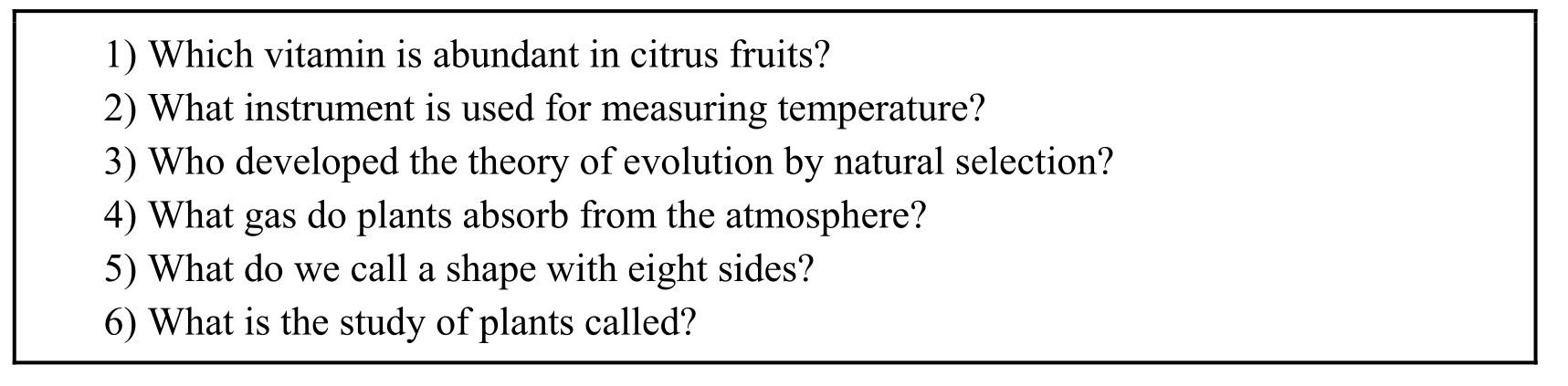
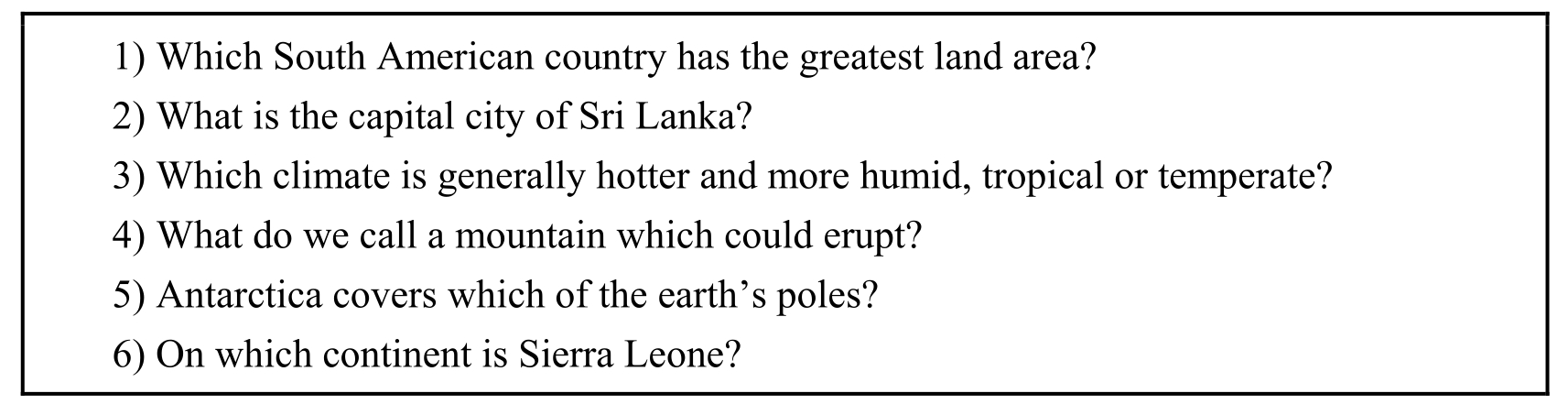
3. Mastermind questions.
SCIENCE
GEOGRAPHY
from http://www.teflgames.com/mmquestions3.html
Ⅳ.Assignment
Sample Thank-you Letters
By Alison Doyle
Writing a thank-you letter after a job interview is a must! In fact, some employers think less of those interviewees who fail to follow-up promptly. Now look at the following basic layout format of writing a thank-you letter and practice writing your own thank-you letter.
Contact Information: (Your contact information)
Your Name
Your Address
Your City, State, Zip Code
Your Phone Number
Your Email Address
Date:
Contact Information: (The person you are writing to)
Name
Title
Company
Address
City, State, Zip Code
Greeting:
Dear Mr./Ms. Last Name:
Body of Thank You Letter:
When writing a thank-you letter, keep your letter simple and focused. Single space your letter and leave a space between each paragraph. Left justify your thank you letter. Use a plain font
like Arial, Times New Roman, or Verdana. Select a font size of 10 or 12 points.
The first paragraph of your letter should thank the hiring manager for taking the time to interview you.
The second paragraph of your thank you letter should include the reasons why you are a strong candidate for the position. List specific skills that relate to the job you interviewed for.
If there is information about your qualifications that you wish you had mentioned during the interview, but didn’t get a chance to discuss, use the next paragraph to explain.
In your closing paragraph, reiterate your appreciation for being considered for the job and let the hiring manager know you are looking forward to hearing from him or her soon.
Leave a blank line after the salutation, between each paragraph, and before the closing.
Closing:
Best Regards,
Signature:
Handwritten Signature (for a mailed letter)
Typed Signature
Email Thank You Messages and Handwritten Thank You Notes
When the company is making a hiring decision quickly, it’s appropriate to send an email thank you message. That way you’ll be sure the hiring manager gets it in a timely manner. Handwritten thank you notes are also an option, when time permits.
from http://jobsearch.about.com/od/thankyoulettersamples/a/thankyouletterformat.htm