Unit Fourteen Culture Shock
In this unit, students will
1. Talk about Culture shock.
2. Learn nonverbal social-communication skills: Deal with Teasing.
3. Learn verbal social-communication skills: Language for Differences.
Ⅰ.Warm-up Activities
1. Matching game: Which phase is it?
Culture shock is the difficulty people have when adjusting to a new culture that differs markedly from their own. The shock of moving to a foreign country often consists of distinct phases, though not everyone passes through these phases and not everyone is in the newculture long enough to pass through all four. There are no fixed symptoms ascribed to culture shock as each person is affected differently.
There are generally four phases during the culture shock. The followings are the four phases and their corresponding phenomena. Match each phase with its phenomena. Then please place the four phases in order according to your understanding.
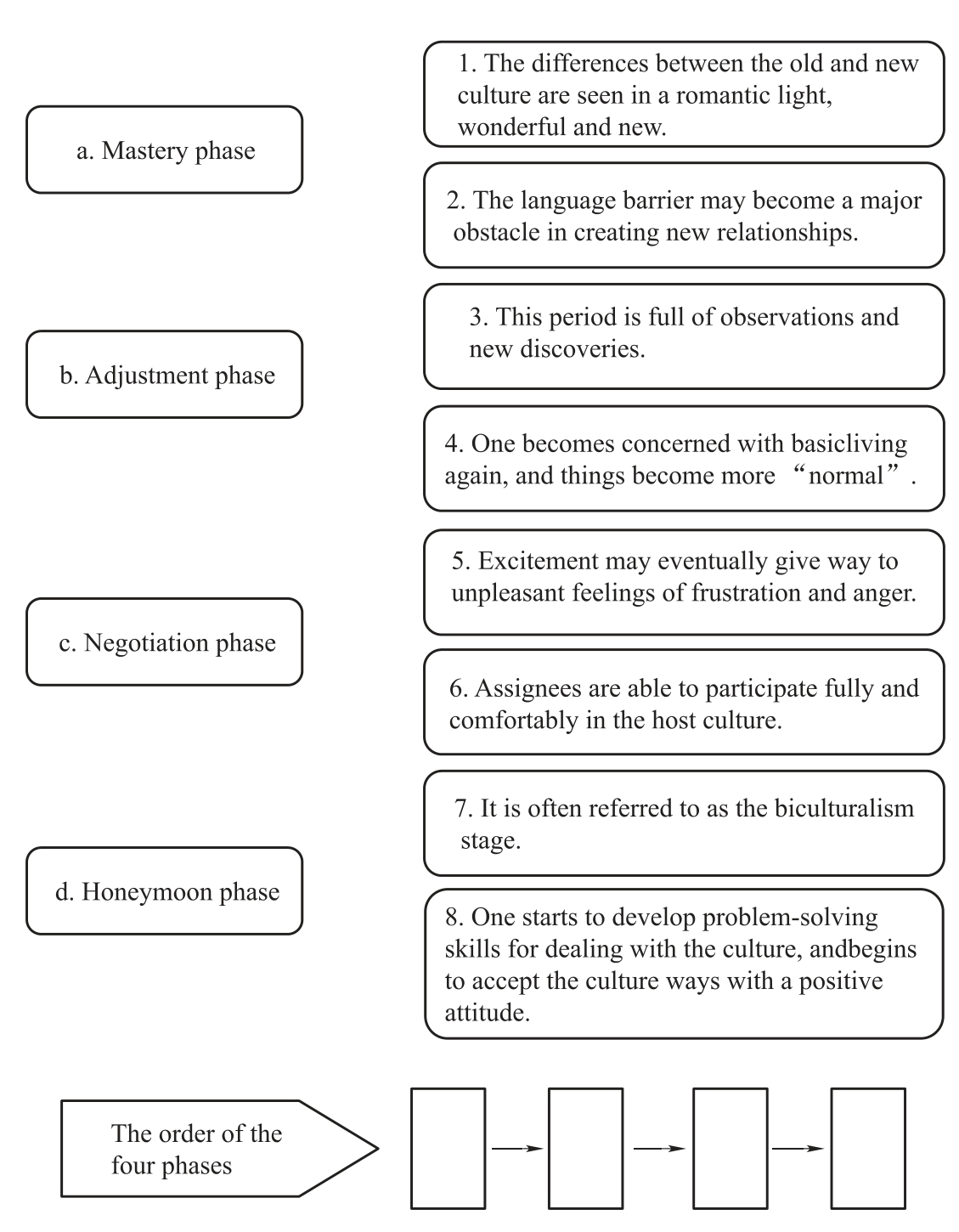
from http://en.wikipedia.org/wiki/Culture_shock
2. Group work: Transition shock
Culture shock is a subcategory of a more universal construct called transition shock.Transition shock is a state of loss and disorientation predicated by a change in one’s familiar environment which requires adjustment. There are many symptoms of transition shock, such as homesickness, excessive sleep, irritability. Discuss with your group members and list more of the symptoms of transition shock.
Symptoms of Transition Shock:
3. Song appreciation: Echoes from Great Souls
The following song is composed by a great musician for a great painter for the mutual understanding and humanity. Please fill in the missing words in the blanks while listening.
Vincent
By Don Mclean
Starry Starry Night
1) ____________ your palette
blue and gray
Look out on a summer’s day
With eyes that know the
2) ____________ in my soul
Shadows on the hills
3) ____________the trees and daffodils
Catch the 4) ____________
and the winter chills
In colors on the snowy linen land
Now I understand what you tried to
say to me
How you suffered for your 5)
____________
How you tried to 6) ____________
They would not listen they
did not know how
Perhaps they’ll listen now
Starry starry night
7) ____________ flowers that
brightly blaze
Swirling clouds in violet haze
8) ____________ in Vincent’s eyes of
china blue
Colors changing hue
Morning fields of amber grain
9) ____________ faces lined in
10) ____________
Are 11) ________________________
Now I understand what you tried
to say to me
How you suffered for your 12)
____________
And how you tried to 13) ____________
They would not listen, they
did not know how
Perhaps, they’ll listen now
For they could not love you
And still your love was 14) ____________
And when no hope was left inside
on that starry, starry night
You took your life as lovers often do
But I could have told you Vincent
15) ______________________________
Starry starry night
Portraits hung in empty hall
16) ____________ heads on
17) ____________ walls
With eyes that watch the world and
can’t forget
Like the strangers that you’ve met
The 18) ________________________
The silver thorn of bloody rose
Lie crushed and broken on the virgin snow
Now I think I know what you
tried to say to me
How you suffered for your 19)
____________
Then how you tried to 20) ____________
They would not listen they’re not
listening still
Perhaps, they never will
Ⅲ.More Practice
Culture Shock
A.Dialogues
Please read the following dialogues and note the italic expressions.
Dialogue 1 Old Men’s Living Ways
A: Today Jim told me his grandfather is going to move into a nursing home. He said in a very relaxed and casual way, which really surprised me.
B: Why? In our country, when people reached the age that they can’t live by themselves, a nursing home is the best place to go for there are many professional nurses and doctors to care for him.
A: Really? But he is too old to live alone. In my country, it’s the family’s responsibility to take care of the old.
B: Well, it sounds reasonable. But do you think he will feel lonely to stay at home alone? Other family members have to work or to go to school. He needs somebody to talk to, and enough attention to him.
A: That’s really unacceptable. For my grandfather, he is old, and needs his family to be with him. I’m not happy about moving him out. And there is no way to do that in my country.
B: But it’s for his own good. He’ll have a lot of friends, friends at his age. They can play chess together, chat together and eat together.
A: Why are you being so hard-hearted about this? It wasn’t an easy decision to force him to leave his house.
B: How can you say “force”!? In my country, the older people prefer to stay in the nursing home.
A: To be honest, no one can give him the best care except his family.
B: Come on, have you ever been to the nursing home in our country?
A: Not yet. I think it’s unnecessary.
B: You will change your idea when you visit there. It is really cozy and comfortable.
A: But at least he feels safe at home, waiting for his family come back to be with him.
B: But you can go there to see him whenever you have time and during the weekend you can get him back home to enjoy the family hour, too.
A: Well, it’s still hard for me to accept it and it’s impossible for my grandfather to accept it. He will think we are going to abandon him.
B: That’s interesting. Maybe in our two countries, we have different understanding about independence and the happiness of the family.
Dialogue 2 American Daughter-in-law’s Spring Festival
A: Hi! How about your winter vacation? Is Spring Festival in China interesting?
B: The Spring Festival is very interesting. But I’m totally exhausted. It’s really a nightmare.
A: How? That must be a happy big family union with your 2-year son. The grandparents must be very excited.
B: Yes, they are very excited. But I’m totally frustrated.
A: What happened? What made you so irritated?
B: They loved my son too much, and almost spoiled him.
A: That’s Chinese grandparents’ way to show their love towards their grandchildren.
B: I can understand. But that’s really not good for my son. I have spent one year teaching him to be independent.
A: Take it easy. One month won’t ruin your efforts. What else troubled you?
B: Actually we have bought many gifts to my husband’s relatives. But my mother-in-law told us to give money to the relatives’ children, some of whom my husband has never seen before.
A: Because people was very poor in the past and the adults don’t want to lose face. It’s their custom to give money to the children. Actually the parents will use the money to buy what the family really need.
B: I don’t care about the money. But I have spent so much time choosing the gifts…
A: Come on, don’t be too critical.
B: Well, what made me angry mostly is my husband.
A: Your husband? You said he was the perfect man in the world.
B: He changed into a strange person. He listened to everything his parents told him to do. He even asked me to help cook and wash dishes in the kitchen. You know he does everything for me in America.
A: Oh, poor baby. You must suffer a lot. Let me comfort you with a cup of hot coffee.
Other Useful Expressions
Every relationship has a clear-cut hierarchy.
the strain of living in a different country without parental support
to isolate oneself from the community
to lose their original identity.
When you move to a new place, you’re bound to face a lot of changes.
It is not advisable to sleep excessively.
to encounter unfamiliar values
It’s natural to have difficulty adjusting to a new culture.
It’s a good idea to become comfortable with the language as soon as you can.
It’s best not to withdraw.
Family and friends will be a great source of support.
chances are they’re trying to manage their culture shock
to adjust oneself to the culture
Medicines may have different names from the native country’s.
The cultural distance is wide.
to create unique blend
negative reactions and responses to the culture are reduced
keep many traits from their earlier culture
to become second-nature
a culture that values a more fast-paced lifestyle
Dealing with the differences can be very unsettling
People are excited about their move.
The excitement gives way to frustration as time goes on.
Watch and learn from the people around you.
Practice:
1. Please think of some culture shocks you’ve met and answer the following questions by making a conversation with your partner:
1) Where did you meet the culture shock?
2) What happened on that day?
3) Why is it a culture shock?
4) How did you deal with the culture shock at that time?
2. Role-play: Student A will interview student B about two of the following topics:
1) It is not uncommon for people to meet culture shock nowadays; the fact is that majority don’t take notice of it. What’s your understanding about culture shock?
2) What factors may result in the culture shock?
3) Is culture shock really a bad thing that will bring negative effects to the person? If not, what kind of positive influence will culture shock bring to us?
4) In what way can other people help the person who suffers from culture shock, show sympathy, encourage him/her, let him/her be, and etc.?
B.Socio-Communicative Skills
Verbal communication refers to the communication which is carried out in either oral or written form with the use of words. Nonverbal communication refers to the communication through one’s voice quality, facial expressions, gestures, bodily movement, attitudes towards space and time, and so on.
To achieve successful conversations, it is necessary to learn the skills of both the verbal and nonverbal communication.
Non -verbal Skill
Dealing with Teasing
In a total new environment, your accent might be different from everybody else’s. Your clothes may also be very different from those around you. Sometimes it can be really difficult being different, especially when compared to the other students at school. But some people at your school will want to get to know you because your differences seem really cool. Other people, though, might try to give you a hard time. How to deal with it successfully will decide your future there.
Teasing is one of those things that most of us experienced and hated. The words cut deep into our souls when we were impressionable and not sure of ourselves. Unfortunately, as long as people have existed, teasing has too. So, how do we protect ourselves when being teased? There are some things we need to keep in mind about teasing so that we can help ourselves.
? First of all, it’s important to note that almost everyone gets teased at one time or another. Particularly, in a new environments, when anything different stands out to people, teasing might happen. As soon as they get to know a person’s personality, they are more accepting of the teased one.
? Talking about the hurt alleviates pain. Build yourself up so that the comment becomes smaller and is put in perspective.
? Try to find kinder playmates. It also helps to find people at school to hang out with who are cool enough not to care what the bully says.
? If someone harasses you, walk away—don’t give the person the satisfaction of seeing that his or her comments bother you. If you can’t shake off the comments, talk about it with good friends, siblings, or parents.
? Confront the bully. That makes the person think about his words or actions, often leading to a ceasefire.
? Remember, family support mends a lot of hurts. Ultimately, the more self-esteem you have, the less you will be upset by teasing.
Practice:
Please prepare a short speech about one of the following topics, and tell you classmates how you avoided tease.
1) When someone laughed at my home accent.
2) When someone laughed at my curling hair.
3) When someone laughed at my height.
5) My personal way of dealing with tease.
Verbal Skill
Expressing Differences
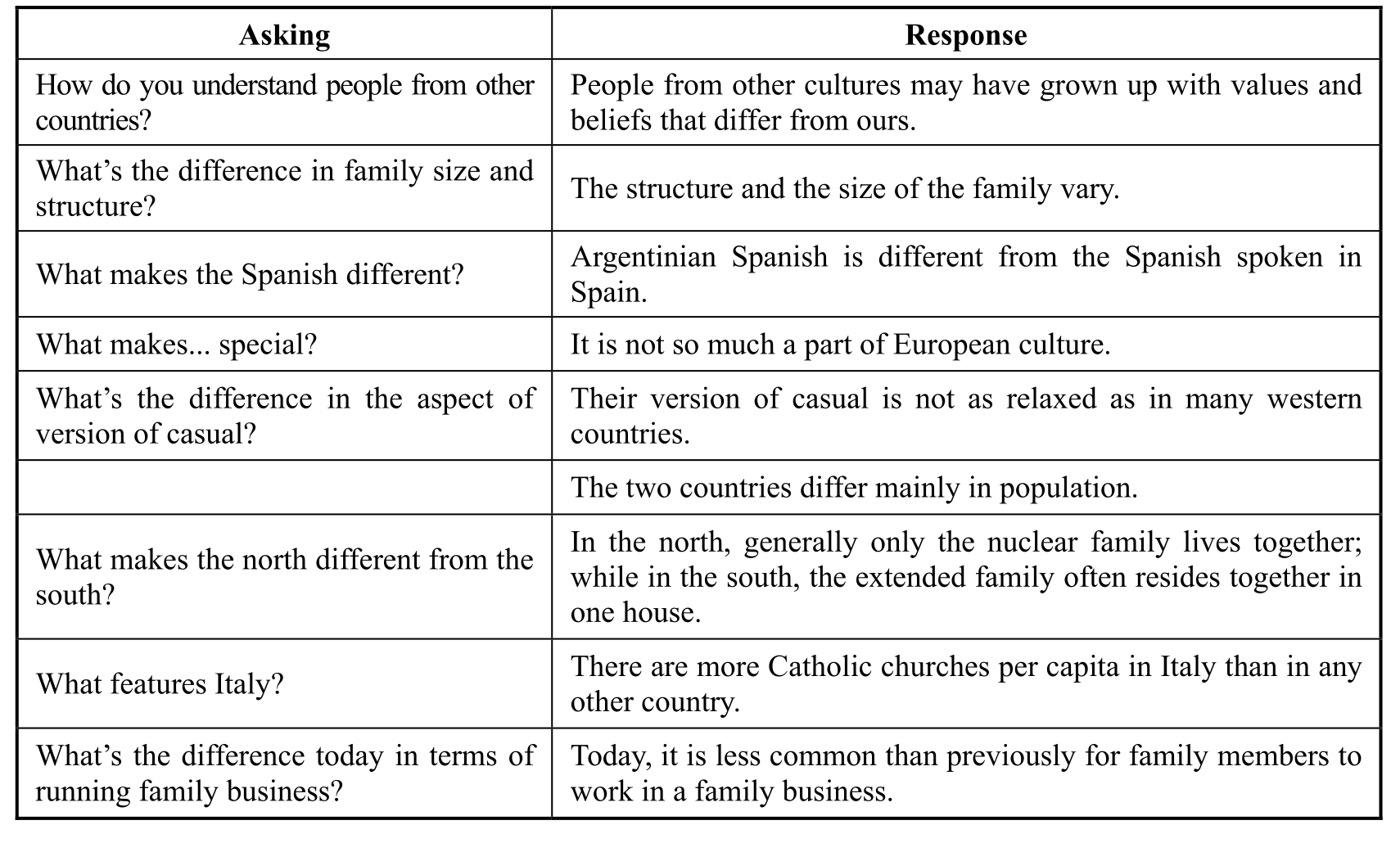
Learn the following conversations and make conversations with your partners based on the situations given below.
1) A: You know, that sounds cool. Opposites attract. I like country. She likes rock and roll. But do opposites make for good relationship?
B: No, man. That opposites stuff may get you together, but it won’t keep you together.
A: How?
B: Love based on true compatibility.
A: Really? It is said that ninety of your clients get married on average every day?
B: Yes. Ninety people a day get married on our site. And our website matches people who are anything but opposites.
A: But I keep hearing opposites attract.
B: Well, opposites do attract oftentimes, but then they attack.
A: Wow, I can’t imagine…
B: Yeah. We’ve found that people who are a lot more alike tend to have longer, better and really richer marriages than people who are quite different.
A: That’s interesting.
B: Because what you may see as attractive initially may really destroy your relationship.
2) A: Hi, you have come back from Hong Kong. How was your stay there?
B: Fascinating! There are many differences between Hong Kong and Beijing.
A: Really? Tell me.
B: The car drives on the left in Hong Kong, while in Beijing people drive on the right.
A: That’s odd. We must remember it, or we will be in danger when in Hong Kong.
B: Don’t worry. There are many signs reminding you to avoid danger.
A: How about the transportation?
B: Both cities have convenient transportation, but they differ in price. In Hong Kong, the transportation price is much higher.
A: How about people’s lives there? Do they have an easy and casual life?
B: The living style in Hong Kong is different from that in Beijing. People in Hong Kong are always on the run. They walk quickly and work devotedly. The whole Hong Kong is a dynamic city.
Now, make conversations of expressing differences based on the following situations by using the expressions above:
1) The different educational method in high school and university.
2) The difference between your hometown and the city where you get higher education.
3) Your parents’ different attitude towards you after your study in university.
4) Your attitude towards English study differs from that in high school.
C.Activities
1. Discussion
University Culture Shock
There will be some education culture shock when you enter into university after graduation from high school. People usually take it for granted that most of the students stay in the motherland speaking the same mother tongue. But their home dialect will affect them to pronounce proper and standard mother tongue, but the language barrier is not very serious and people can understand what they say. Besides, the students will start a new educational system that will depend on their own decision and self-discipline. What’s more, they have to live independently. So if students are not ware of the importance of university culture shock, they may fail in their future life.
Discuss with your partners what kind of university culture shock you’ve met and how do you face it and solve it.
2. Group work
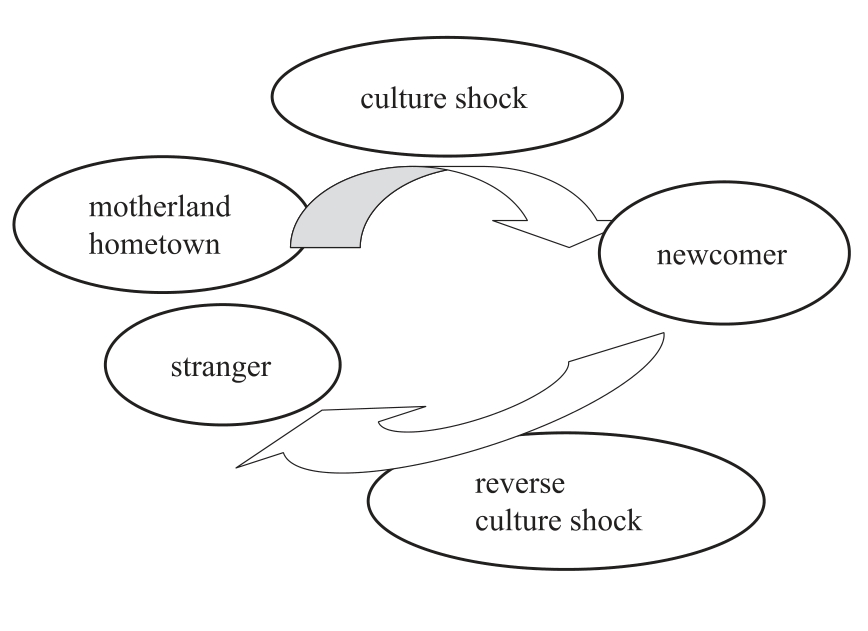
Reverse Culture Shock
Reverse culture sock may take place—returning to one’s home culture after growing accustomed to a new one. This results from the psychological consequences of the readjustment process to the primary culture. The affected person often finds this more surprising and difficult to deal with than the original culture shock.
Have you ever met this kind of reversed culture shock when you returned to your hometown during the winter vocation or have you ever witnessed or heard this kind of change when a person returned to his motherland or hometown? The group work will interview each other and try to find out the reason.
3. Further Talking
Future Shock
Future Shock is a book written by the futurist Alvin Toffler in 1970. In the book, Toffler defines the term “future shock” as a certain psychological state of individuals and entire societies. His shortest definition for the term is a personal perception of “too much change intoo short a period of time”.
Discuss with your partner what kind of future shock your grandparents, your parents and even you have experienced domestically and internationally. Are these kinds of future shocks expectedly or unexpectedly? In what way will the culture shock influence the future shock positively or negatively?
Ⅲ.More Practice
1. Do you know “Comfort Zone”? Read the information about hot to analyze comfort zone, give a short summary after reading, and tell each other in pairs how do you understand this article and Analyze Your Comfort Zone
The Comfort Zone is our living, work, and social environments that we have grown accustom too. It determines the type of friends we make or people we associate with. It determines a life style we accept or reject.
Young people are very adaptable, they can adjust to changing comfort zones with ease. They can socialize with homeless people in the morning and be equally at east at a formal banquet in the evening. As we age, the ability to adapt to wide-ranging comfort zones, becomes more difficult. Social prejudice narrows the comfort zone range. Our present comfort zone is in one of the following conditions.
We want to maintain our current comfort zone.
We are dissatisfied with current conditions and want to move to another comfort zone.
We were suddenly thrust from our comfort zone and want back in.
We need to make decisions without supporting facts. The comfort zone can be a decision making tool.
If you were content with your current comfort zone, you would not be reading this article. Because you are reading, it is assumed you want to make some changes in the way you live and work. That brings us to step two. If you are dissatisfied with your life style, you canchange it by changing your comfort zone.
Comfort zones are directly related to our dreams or goals, which is associated with self-fulfilling prophecy. In order to grow and change, we must first be discontent with our current comfort zone. To change to different life style, establishing a business, or succeeding at a challenging project, we must realize that all meaningful and lasting changes occur first in daydreaming (fantasizing) and then they work their way into reality. If we clearly and vividly imagine ourselves being and having the things we truly want, we will create a new picture of ourselves. The old comfort zone, in time, will be unacceptable and we will find ways to acquire the new.
For example, if we want to sail the South Pacific in our own sailboat, we must clearly and vividly, image ourselves sitting in the cockpit of our boat and think about the challenge this environment would bring. This includes accepting the dangers along with the pleasures. The key to upgrading our comfort zone is to raise our self-image and level of what we expect or want first, then we will find opportunity to make the goal reality.
The more clearly and vividly we fantasize our dream, with frequent repetitions and emotional impact, the stronger and more real the pictures on the subconscious level will become. Once our subconscious accepts this image and its expectation, the subconscious will go to work, searching for a way to bring it into reality. If we feel that these things are too good for us, we will find ways to fail. If, however, we intentionally use our imagination to:
Imagine the change we want.
Build an expectation of the change.
Mentally and emotionally, prepare ourselves for the change by anticipating what it will be like.
We will find ways to acquire dream and, when mentally ready, it will arrive faster than we ever thought possible. In effect, what we are doing is deliberately preparing for self-fulfilling prophecy. As has been repeated many times, “Whatever the mind can conceive and believe, it can achieve.”
For some people, problems, suffering, poverty, bad breaks are their comfort zone. Try to take away these problems and they will fight back. They find comfort in finding fault and complaining about their misfortune. The same is true for businesses. Daily crisis, employees making bad decisions, accidents, trivial problems, confrontation between management and workers is a workforce comfort zone. Management and workers have grown accustom to seeing things go wrong and expect them too. Management finds comfort in finding fault withworkers and workers find comfort in finding fault with management.
Negative comfort zones can be overcome by setting and thinking about positive goals. What we think about all day and what we expect, be it positive or negative, is our comfort zone.
Note: If the comfort zone we are seeking is beyond our current income, then, we need to develop a service that has greater value than our current one. Money, power and influence are not goals, they are rewards ONLY for personal achievement.
from http://www.motivation-tools.com/elements/comfort_zone.htm
2. My comfort zone
Based on the above article, think of your possible comfort zone and create your own comfort zone graph according to the following referential graphs. Then share with your partners and tell each other the reason.

3. Culture comfort zone
Based on the article “Analyze Your Comfort Zone” and the activity “my comfort zone”, the group members are going to work together to find out in what way we can build culture comfort zone so that different cultures are respected and culture shock will diminish.
Ⅳ.Assignment
Modern Fashion, Another Culture Shock or Another Culture Assimilation
Modern fashion in different countries will bring different influences to people. For example, modern dress fashion with less clothes on meets controversial voices in China for it challenges Chinese tradition culture and value. And Lady Gaga is a typical modern-marked fashion star that gets millions of supports and blames globally at the same time. Will the modern fashion emerged from alien lands become a culture shock or culture assimilation in different countries? Your and your group will have an English debate to discuss about its advantages and disadvantages.