Unit Seventeen Study Abroad
In this unit, students will
1. Talk about studying abroad.
2. Learn nonverbal social-communication skills: Accept Criticism.
3. Learn verbal social-communication skills: Give Advice.
Ⅰ.Warm-up Activities
1. Top ten universities in the world
Look at the top ten universities in the world and then discuss the following topic with your partner: What is your favorite university if you want to study abroad?
Please list your reasons.
Top Ten Universities in the World
1) Harvard University
2) Yale University
3) Cambridge University
4) Oxford University
5) California Institute of Technology
6) Imperial College London
7) University College London
8) The University of Chicago
9) Massachusetts Institute of Technology
10) Columbia University
(The Times Higher Education Supplement, 2008)
2. Application form
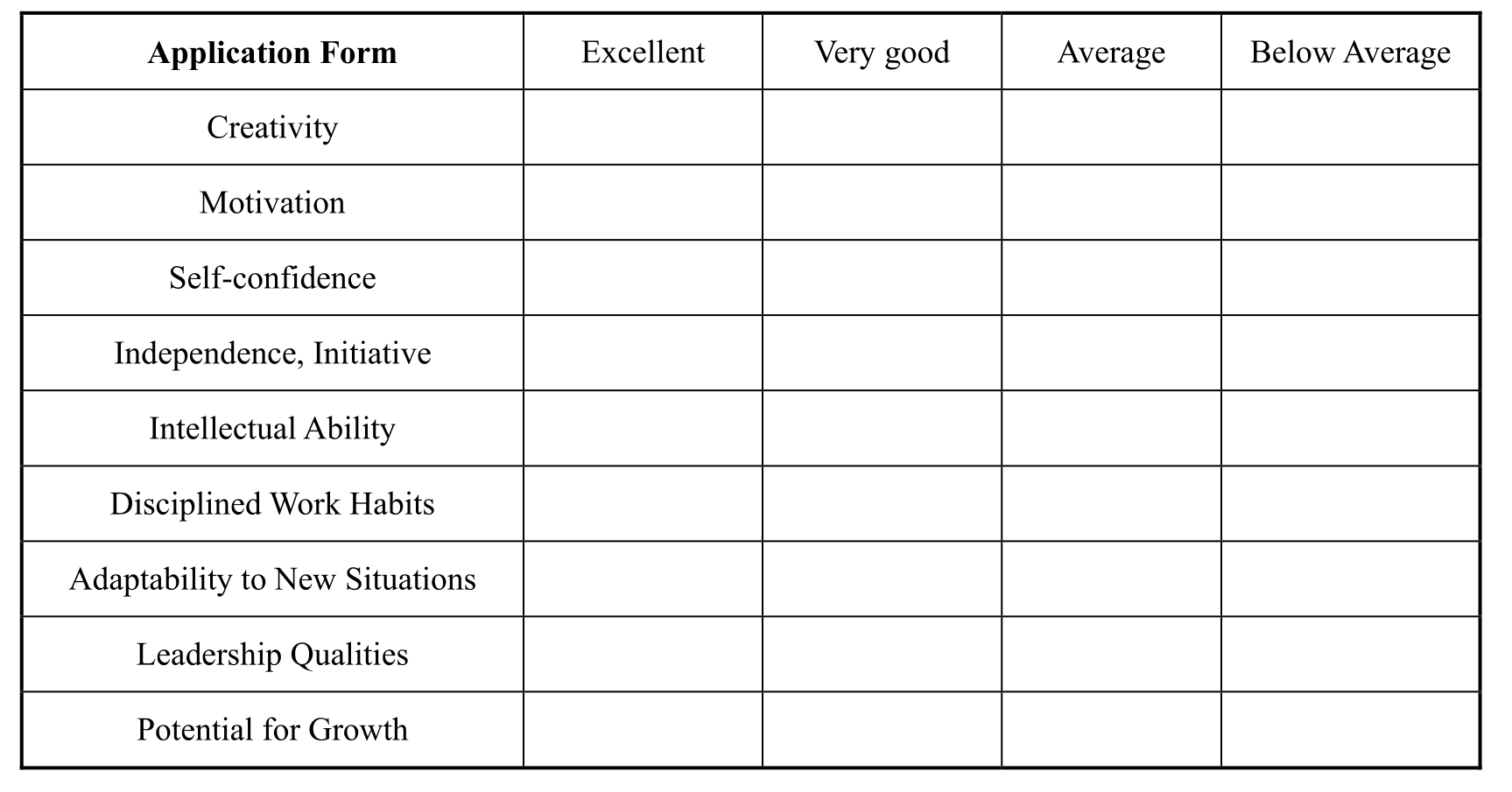
Fill in the following application form and then discuss with your partner: what aspect(s) will the Admissions Committee consider the most important?
3. Applying to study abroad involves a lot of hard work and the decision to do so
shouldn’t be made lightly. The rewards can be great, and all the more so if you identify your aims—your true quest—and keep focused. Now please listen to one recording about applying to study abroad and then answer the following questions:
1) What are the important issues to consider before applying to study abroad?
2) How to choose the right program?
3) What paperwork should you deal with?
4) What can you do after sending the application?
Ⅱ.Focused Topic
Study Abroad
A.Dialogues
Please read the following dialogues and note the italic expressions.
Dialogue 1 A Summer School Language Course
A: Have a look at this prospectus. It’s for a summer school language course in France that I’m really keen to attend.
B: Wow, it looks interesting. It says here that it’s an immersion program. Does that mean that you will only be exposed to French?
A: Yes, that’s the point. When you’re ‘immersed’ in a language, you learn it much faster than when you also hear your native language.
B: I see. But aren’t you nervous? You don’t speak any French at the moment!
A: Oh, I’m sure it will drive me nuts in the beginning when I can’t understand anything, but I’ve always been on a quest to learn French.
B: You’ve highlighted this paragraph here, the one about applicants needing to stand out from the crowd. Is it very difficult to get accepted for this course?
A: Well, they have a lot of people applying so your application really needs to grab their attention. After all, they have to sift through hundreds of applications.
B: I’m sure you’ll get accepted. It seems like you’ve done your homework and I know your CV is impeccable. But I hope you haven’t embellished it at all? It would be crazy to lie!
A: Of course not! I hate any type of fraud. I always think that if the truth is not sufficient to get you something you want, then it’s just not meant to be.
B: I agree with you. I bet you’ll be accepted.
Dialogue 2 Harvard University
(V=Voice-over Al=Alex Ash=Ashley Ad=Adam B=Brian J=Jodie)
V: Harvard University in Cambridge is one of the best universities in the world. We spoke to Alex Jude, the university’s Head of Communications. He explained that Harvard looks for the best and most talented students from around the world.
Al: Harvard actually seeks students from around the world, the best students that we can find, to study chemistry, literature, government, or business. Our business school is particularly well-known around the world, as is the medical school and law school, so, we do seek very, very talented students and we have open doors for them.
V: We asked four students at Harvard to tell us what kind of social life they have.
Ash: Um, well relaxing is a little hard to do around here, but basically, I live nearby anyway, so I see a lot of my friends, and there’s a good social life here if you look for it. I go to the gym, run. So that’s what I do.
Ad: It’s whatever you want it to be. It’s good. If you wanna go out party, do anything you can. If you wanna sit in your room and study all night like my friend over here, you can also do that.
B: Socially, like he said, it’s a lot of what you make it. Um, we don’t have fraternities here, and so, you know, it’s obviously not as social. There’s not as many parties as there would be on another campus. But on a Friday or Saturday night, there will be a party. Usually we end up studying until about 10 o’clock. And then we’ll go out and have fun maybe, or just watch a movie with friends, or, you know, whatever is goingon for the night.
J: Not everyone would agree with me, obviously, but I think it’s a fun place to be.
Other Useful Expressions
transcript reference letters
application form school ranking
to charge application fees university prospectus
acknowledgement note scholarship
application procedure Curriculum Vitae
a thirst for immersion program
forum deal with paperwork
cover sheet formal application
online application entrance exams
resume Personal Statement
Practice:
1. Please answer the following questions by making a conversation with your partner:
1) If you were to study overseas, where would you like to go? Why?
2) How can you support your study abroad?
3) Do you know anyone (your friends or relatives) who is studying abroad? Why did they choose to study abroad? Do they think it is worthwhile or not?
4) How to compare graduate programs?
2. Role-play: Student A will interview student B about two of the following topics:
1) What is the relationship between personal honesty and the quality of one’s academic work?
2) What are the advantages and disadvantages of studying abroad?
3) If you are going to study abroad, which courses would you like to choose and why?
4) Are there any difficulties about studying abroad?
B.Socio-Communicative Skills
Verbal communication refers to the communication which is carried out in either oral or written form with the use of words. Nonverbal communication refers to the communication through one’s voice quality, facial expressions, gestures, bodily movement, attitudes towards space and time, and so on.
To achieve successful conversations, it is necessary to learn the skills of both the verbal and nonverbal communication.
Non -verbal Skill
Accepting Criticism
Very few people can take criticism graciously. For most of us, being criticized is uncomfortable at best—de-stabilizing (or even devastating) at worst. The ability to take criticism in stride, it seems, is almost universally elusive.
? Why almost all of us are susceptible to criticism? It should be emphasized, however, that as common and understandable as this felt vulnerability may be, we hardly need be subjugated by it indefinitely. But if we’re to overcome our habitual defensiveness to criticism, we must first learn how to become more self-validating. For once our feelings of personal security become anchored from within, what others think of us will no longer be of primary concern.
? When we’re unfavorably evaluated or disagreed with, we can experience such discordalmost as a put-down. Negatively sensitized to criticism, we may respond as though we were told (in so many words) that we were bad, ugly, or stupid. In such instances, the hurt child within us—never fully healed from the wound of early, and quite possibly excessive, parental criticism—is likely to bleed anew. And so we’re simply unable to listen objectively to the other person’s remarks, calmly appraise them, and respond accordingly.
? If their criticism pushes our buttons—and it can hardly be over-emphasized that it’s our child self that controls these buttons—we’re compelled to react far more emotionally than rationally. So if we’re ever to overcome this ultimately self-defeating habit of reacting emotionally—and negatively—at the first sign of another’s judging us, it’s crucial that we learn how to talk, compassionately and reassuringly, to this insecure child within us.
? Despite this inborn vulnerability to criticism, however, if we can repeatedly tell ourselves that the subjective threat we’re experiencing is actually nothing more than a“perceptual illusion,” in time we should be able to forestall the potential hurt of such criticism. Such a procedure for averting psychological pain is analogous to how, ideally, we might learn to better deal with life stressors—so that the kinds of situations that in the past might literally have given us headaches will no longer be able to. Finally, no matter how understandable it may be that the great majority of us don’t take criticism particularly well, it’s still essential—if we’re to improve our relationships to others (to say nothing of our relationship to ourselves)— that we learn to transcend this negative knee-jerk reaction to others’ judgment.
Practice:
Please prepare a short conversation with your partner about one of the following topics, and think about how to accept criticism.
1) You are criticized by your teacher for your being late for class.
2) You are criticized by your mother for breaking the vase.
3) You are criticized by your elder brother for losing his badminton racket.
4) You are criticized by your neighbor for stepping on his grass.
Verbal Skill
Giving Advice
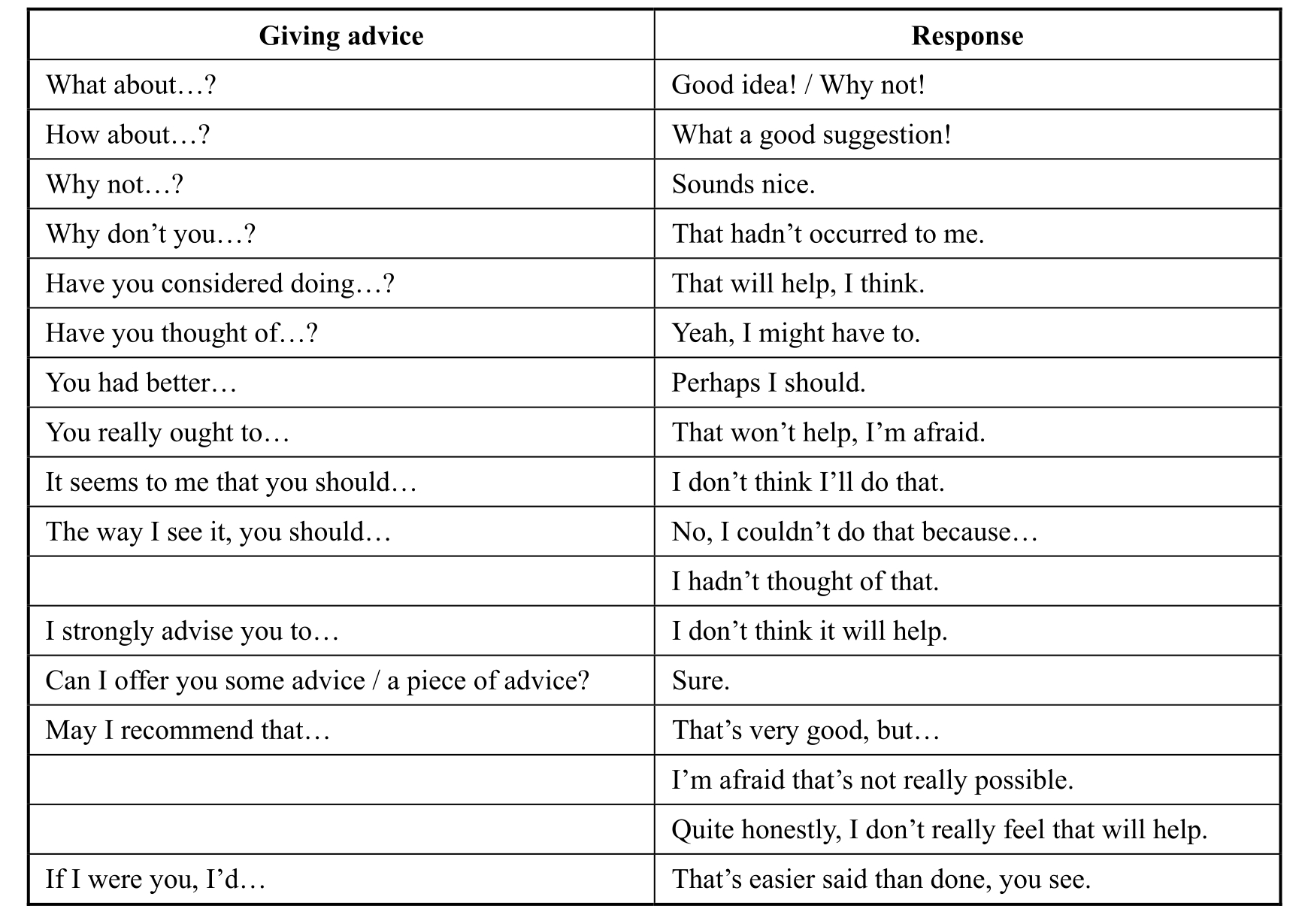
Learn the following conversations and make conversations with your partners based on the situations given below.
1) A: I’m really having problems with my son. I just don’t know how to deal with him. It seems that he’s starting to lose interest in school. He doesn’t want to study anymore. His marks are getting worse. I tried to talk to him, but he won’t listen. I can’t get through to him. What do you think that I ought to do?
B: How old is he?
A: Fourteen.
B: Mm…fourteen. Yes, early teens are rough sometimes. It might be a good idea to set up some rather strict requirements to guide him through.
A: Strict requirements, such as what?
B: For instance, you could arrange him two hours of study a day. Be consistent. Two hours every night.
A: I tried that, but that doesn’t help much.
B: Well, why don’t you set up a system of rewards and punishment? No study, no rewards.
A: No rewards? What do you mean?
B: No TV, no food. I mean no food between meals. No entertainment, etc. If he improves, you introduce the rewards.
A: Like buying him something or going to the movie?
B: Yes, something like that.
A: Maybe it’s a good idea. Thanks for your advice.
2) A: Hi. Could you give me a hand with this report?
B: Sure. I’d be happy to give you some hints and advice.
A: Thanks. Would you mind taking a look at the layout? Do you think it’s appropriate? I want it to be formal, but not boring to look at.
B: It looks good to me. I would suggest that you put the client’s logo and our logo on each page. The bosses seem to like that.
A: That’s an excellent suggestion. I can easily do it on the computer.
B: Why don’t you use a different font for headings? They’ll be more distinct.
A: I’ll take that suggestion too. How about the content?
B: I think you’ve included all the essential things. You might want to make the conclusion a little longer. Restate your reasons clearly.
A: Is it OK to include the pictures?
B: Definitely! I would include one or two on each page if possible. Remember that you should make the report as eye-catching as possible.
A: Thanks for those ideas. I’ll get to work on them right away.
Now, make conversations of giving advice based on the following situations by using the expressions above:
1) You have just failed an exam. You are worried about your parents’ reaction to the news. You ask your partner for advice.
2) You always seem to feel overtired. You ask a doctor.
3) You are interested in becoming a teacher, but you do not know what teaching involves, and you wonder if you are the right kind of person to be a teacher. You ask one of your teachers for advice.
4) It’s the first day of your English class. You want to know how to improve your English skills. You talk to one of your classmates for advice.
C.Activities
1. Role-play: Study abroad or not?
Three students work as one group. One student acts as father, one student acts as mother and the last student acts as son/daughter. The son or daughter wants to study abroad but the parents don’t agree. Both the parents and the son or the daughter try to persuade each other.
2. Game
Each group nominates two students to play the game as a pair on behalf of their group. One of the pair is to describe the word(s) shown on the screen to the other one, who faces his/her partner and thus with his/her back to the screen. Within one minute, each pair will have to try four words or expressions, which are all concerning application to study abroad or study abroad itself. The group who gets the most words within the least time wins the game. WINNERS GET TREAT.
3. At first read the following article about studying abroad and then discuss with your partner: what other preparations should you make in order to realize your dream of studying abroad?
Travel expands the mind and so does education. Little wonder then that many youngpeople dream of combining the two and studying abroad. International studies not only confer a prestigious or unusual degree but also expand your horizons—literally and otherwise! Being in a college abroad lets you soak in the atmosphere of an alien place until it becomes your own. Living in a place thousands of miles from home increases independence and self-reliance and meeting other students from diverse countries and cultures broadens your understanding about the world. Studying abroad is no impossible dream. All it takes is some careful planning and preparation. Here are some quick, simple tips to help you on your way:
Research! Research! Research!
Knowledge is power—and in this case even more so. In most cases, you will not be able to visit the colleges that you want to apply to. The best way to know more about them is to read as much as possible about international studies. Most colleges abroad have websites that you can visit, which give extensive information about admission procedures, fees, scholarships and specific subjects such as math, science or language study programs.
Plan meticulously
Once you’ve read enough, chart out a plan for studying abroad. Treat it like a special project because it will probably require as much time, energy as one. Zero in on the colleges you want to apply to. Identify what the pros and cons of each college is. Create a spreadsheet timeline or calendar with important dates and deadline marked out. International colleges usually require extensive documents. Prepare lists of everything you will need and tick off items as they get done.
Prepare for the tests
Many international countries will require you to sit for special exams to be eligible to study in their colleges. Find out what tests you need to sit for and where you can take them. Explore the possibility of attending special classes or language study programs to prepare for the tests. It’s best to prepare for at least a period of three months before attempting the tests because a low score will affect your application. Put aside some time every day to study.
Organize your paperwork
International studies require a lot of documentation. Make sure that your passport and other documentation is up-to-date and valid. Keep everything in one drawer or folder so that it’s all in one place. Keep photocopies of important documents because you may need them for multiple purposes. Some colleges abroad may require recommendations from old teachers or managers. Approach those who are likely to give you good recommendations and keep these ready.
Keep an eye on finances
Studying abroad can be expensive. Many colleges abroad, however, do offer scholarships and other kinds of assistance. Sometimes, this will finance only a part of your education abroad and you will need to arrange for the rest. Explore multiple options for financing your international education. Do the banks in your country give education loans for international studies? Are there organizations or trusts that help deserving students? What criteria do you need to meet to apply for these?
Get ready to fly!
Once all the details have been ironed out and it is definite that you will be studying abroad, start preparing for your stay in a new country. Read up as much as possible. Finalize your living arrangements. Talk to people who are already there and find out what you need to take with you. Decide what you want to leave behind or give away. Spend time with family and friends—you may not see them again for a while. And most of all, be excited; you’re finally on your way to being an international student!
from http://www.papercn.cn/news/yybylw/15131.html
Ⅲ.More Practice
1. Read the following material: Why Think about Studying Abroad? Then, discuss with your group members about your understanding about these reasons.
Why Think about Studying Abroad?
Studying abroad can be an enriching and eye-opening adventure, where learning extends to the world beyond the classroom walls. There is no substitute for living and studying in aforeign country if you want to gain in-depth knowledge of another culture’s customs, people, and language. In addition, you will find that living and studying or working in another country can develop important transnational competencies that can be of interest to future employers.
1) Personal Growth
Students who return from a study abroad program often see it as an experience which matured them personally and intellectually. They praise being exposed to new ways of thinking and living, which encourages growth and independence. And it is universally praised as worthwhile, often even life-transforming. After immersing themselves in a new culture, mastering the challenges ofof being a ‘foreigner’, students typically return home with increased self-confidence and justifiable pride in what they have achieved.
2) New Perspective on World Affairs
Studying abroad can broaden your intellectual horizons and deepen your knowledge and understanding of international, political, and economic issues. It is almost certain that you will return from your sojourn abroad with a more informed and accurate perspective on world affairs. You will probably also gain a broader understanding of, and appreciation for, the United States, its way of life, and its role in international affairs.
3) Career Enhancement
But studying abroad does more than promote academic enrichment and personal growth. It also can enhance your employment prospects, especially in the fields of business, international affairs, and government service. Employers increasingly seek graduates who have studied abroad. They know that students who have successfully completed a study abroad program are likely to possess international knowledge and often second-language skills. Such students are also likely to have other transnational competencies such as cross-cultural communications skills, analytical skills and understanding of and familiarity with local customs and cultural contexts, flexibility, resilience, and the ability to adapt to new circumstances and deal constructively with differences.
1. Read one piece of news which can be found in the appendix, and then discuss with your partner: Why more and more American students choose to study in China?
News: Study Abroad Flourishes, With China a Hot Spot
2. Debate on the topic: Going abroad to study or not?
Ⅳ.Assignment
Resume-writing
Here is an outline for resume. Now it’s your turn to write your own resume.
OBJECTIVE: (1 or 2 sentences)
PERSONAL INFORMATION:
1. name and address _______________________________________________________________________________________________________________________________
2. telephone No. __________________________
3. marital status: ___________________________
EDUCATION: most recent school attended listed first
________________________________________________________________________________________________________________________________________________________________________________________________________________________
WORK EXPERIENCE: most recent listed first
________________________________________________________________________________________________________________________________________________________________________________________________________________________
REFERENCES should be past employers, teachers (at least 3)
________________________________________________________________________________________________________________________________________________________________________________________________________________________
ENGLISH PROFICIENCY____________________________
COMPUTER SKILLS________________________________