UNit Thirteen When in Rome
In this unit, students will
1. Talk about different customs in different places.
2. Learn nonverbal social-communication skills: Deal with Rumors.
3. Learn verbal social-communication skills: Language for Similarities.
Ⅰ.Warm-up Activities
1. Read the following passage,and then retell it to your group members. All the group members will evaluate your retelling by using the assessment sheet in the Appendix.
Can You Do This for Me?
By Ed Hewitt
During a business trip to Spain a few years ago, I decided to take a break from the intense 18-hour days I was working and explore the southern coast of the country. Alone in my rental car, I enjoyed the solitude after nearly a week of working very closely with a lot of people. For at least a couple of days I barely spoke to anyone of any culture or in any language.
As I neared Gibraltar, I made a snap decision to see if I could get on a ferry to Tangier; I had never visited Morocco, and Tangier’s reputation as a haven for artists, outcasts and authors seemed to offer a perfect adventure. Luckily my timing was perfect, and in short notice I was on a boat and on my way.
On the way across, I stared out to sea some more, and figured I was ready to re-enter civilization again in a famous Moroccan city with an exceedingly rich history and exotic reputation.
I wasn’t even completely off the boat when I encountered what I can only describe as an assault on the senses. A horde of hustlers, con men, would-be guides and loiterers descended on me like seagulls on an oyster. They offered to walk me through town, find me a hotel, take me to shops, protect me from thieves and hustlers, you name it, all at no cost—unless I felt it appropriate to pay, of course.
I said “no thank you” in as many ways as humanly possible, until finally I spoke up very firmly: “Sir, I said no thank you.”
His response was swift and direct, yelled loudly as he stormed away. “You are evil, my friend,” he said. “Your face is like poison. Yes, your face is like poison, my friend. Your nose ... your nose ...” All I wanted to do was take a walk!
I got about 50 yards along before he was back, making all the same offers. Finally, I stopped walking, turned to him, and said, “Sir, there is something you could do for me, if you would be so kind.”
“Certainly, what can I do?” he asked. “I am sure we can come to an agreement.”
“My hope now is simply to be left alone to take a walk. Can you do this for me?”
His eyes flashed in anger, but then he relented; I had asked politely and directly, and disarmed the situation. He shook his head, but finally said, “Go ahead, have a good day.” Ithanked him, and he walked away.
from http://www.independenttraveler.com/resources/article.cfm?AID=846&category=13
2. Class game: Global Village, International Citizen
“When in Rome, do as the Romans” is a well-known saying around the world, which means if you were in Rome, live in the Roman way; if you are elsewhere, live as they do there. This will help you adapt yourself into a new environment easily and quickly, and will reduce the unease when meeting with strangers. What’s more, it will help you broaden your horizon and experience the wonderful world.
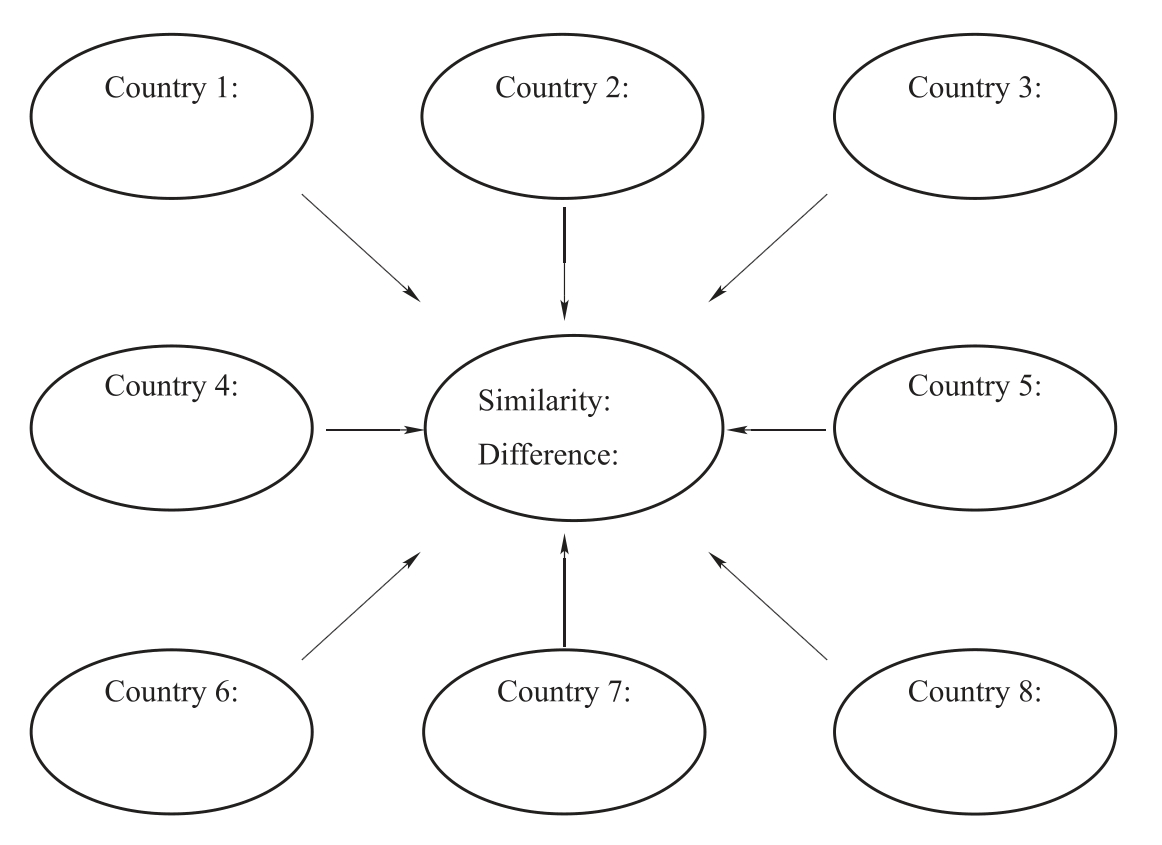
In this class game, each group will choose one country and act as the people in this country. Each group will send one or two students to other countries, while the rest of the group will stay and welcome the new comers. When the new comers (the students from other groups) come to your country, you will share with them the custom in this country(such as greeting, table manner, dressing, behavior, etc.)
After the global travelling, each group will summarize the custom in its country to the whole class and the whole class will make a comparison between the similarities and differences in various countries.
(Before class, the students need to find more information and be well-prepared, then they can learn more and do better in class)
3. Song appreciation
You are going to listen to a classical song by Lionel Richie and try to understand the essence of “Say you, say me”. This song may also help us when we are in Rome for let’s be with each other together, and then we will make more friends and get more comforts. Please fill in the missing words in the blanks while listening.
Say You, Say Me
By Lionel Richie
Say you, say me
Say it 1) ____________
That’s the way it should be
Say you, say me
Say it together, 2) ____________
I had a dream, I had an 3) __________ dream
People in the park
Playing game in the dark
And what they played
Was a masquerade
But from behind the walls of 4)
____________
A voice was crying out “Help me!”
Say you, say me
Say it 5) ____________
That’s the way it should be
Say you, say me
Say it together, 6) ____________
As we go down life’s 7) ____________
highway
Seems the 8) ____________ thing to do
Is to find a friend or two
That 9) ____________ hand
Someone who understands
When you feel you’ve
10) ____________
You’ve got someone there to say
11) ____________ oo, oo, oo
Say you, say me
Say it 12) ____________
That’s the way it should be
Say you, say me
Say it together, 12) ____________
So you think you know the 13)____________
Oh no!
Well the whole world’s got ya dancing
That’s right I’m telling you
It’s time to start believing
Oh Yes!
Believe in who you are
You are a 14) ____________...oh
Say you, say me
Say it 15) ____________
That’s the way it should be
Say you, say me
Say it together, 16) ____________
Ⅱ.Focused Topic
When in Rome
A.Dialogues
Please read the following dialogues and note the italic expressions.
Dialogue 1 When in China
(Tom=T Jane=J)
J: Hi, Tom. Happy Birthday! This is the gift I chose for you.
T: Thank you so much, Jane. You are so kind. How can I accept it?
J: Come on, get it. I know in China gifts may be refused three times before they are accepted.
T: Thanks a lot. So I will get it. I will go to the library now. How about having dinner together to celebrate my 21 birthday.
J: That’s fine. Well…you don’t want to open it and have a look?
T: Open it? In China, it may consider impolite to open the gift in front of the gift-giver.
J: In France, gifts are usually opened when received. So we can share the happiness together.
T: Ok, Let’s open it. Eight heart-shaped chocolates! That’s unbelievable.
J: Yes, I know eight is the luckiest number in China, so giving eight of something will bring luck to you.
T: Jane, you are so considerate. You really remind me of my family.
J: I’m so glad you like it. And I’m so glad to have you as my friend.
T: Let’s go to the library together, and then we can go to the Chinese restaurant nearby to celebrate it.
J: Good idea. Let’s go.
T: One more thing, Jane. Do not be offended if a Chinese person makes slurping or belching sounds; it merely indicates that they are enjoying their food.
J: I know it. And I also know that leaving a small amount of food on your plate indicates that your hosts have provided ample hospitality and by doing this, you won’t be urged to eat again and again.
T: Oh, Jane, you really know lots about China.
J: When in Rome, do as the Romans do. But I won’t leave any food on my plate for in my country we must finish everything on our plate.
T: That’s fine. I know your custom, too. Let’s go.
Dialogue 2 Being a British Guest
A: Good afternoon, are you free now?
B: Me? Sure. You are always welcome. What can I do for you?
A: My British professor invited me to dinner in his home tomorrow. Can you give me some suggestion?
B: No problem. British people value punctuality a lot. You’d better arrive on time. Usually British people will expect you to be there on the dot.
A: Really? In my country, people always take it for granted that some will be late for half an hour, or even one hour. What if we meet traffic jam or something unexpected?
B: You need call your professor immediately to explain it.
A: I see. It’s better for me to go there early. Do I need to bring something as a gift?
B: Usually unnecessary. But it is considered polite to do so, especially if you have been invited for a meal. Flowers, chocolate, or a small gift are all appropriate.
A: Ok, I will think about it this evening.
B: In Britain, food may be served in one of several ways, such as “family style”, “buffet style”and “serving style”. It depends on the host. But you should remember guests usually wait until everyone at their table has been served before they begin to eat. Food is eaten with a knife and fork and dessert with a spoon and fork. Do you know how to use knife and fork?
A: My university teacher told me before, but I almost forgot it.
B: Well, The fork is held in the left hand and the knife in the right. When you put your knife down, you can turn your fork over and eat with the fork in your right hand.
A: It always confused me. I will watch and learn tomorrow.
B: Yes, there are too many table manners in British; even the natives get tired of it sometimes for it is not an enjoyment at all. Everything is not so easy in Britain.
A: Any how I still expect to experience it.
B: That’s good. One more thing, a thank-you note or telephone call after the visit is also considered polite to express your appreciation for the invitation.
A: Yes, I will. Thank you a lot.
Other Useful Expressions
relaxed pace of life
lucky colours/luck numbers
to arrive close to the appointed time
diverse dietary restrictions
The guest of honour is served first.
to dress conservatively in suits or dresses
to take great pride in their cultural heritage
to take second helpings
Appointments are necessary and should be made in advance.
to be generally polite in all dealings
The French are fashion conscious
Mutual trust and respect is required to get things done.
Trust is earned through proper behaviour.
This is a culture that prizes forward thinking and knowing.
a cultural mish-mash in every sense of the word
Shoes should be highly polished.
It is customary to shake hands.
Chinese are extremely hospitable.
graciously thank the host
Turkish coffee is a national drink.
Gift giving has no real place in business relationships or etiquette.
Dressing well shows respect for your hosts.
at face value
to adopt more ideas about socializing from other countries
Kinship plays an important role in all social relations.
unwritten rules
It is considered a sincere compliment to take second helpings.
direct eye contact is a sign of honesty and sincerity
Different religious groups have coexisted.
It is always a good idea to learn a few key phrases.
Practice:
1. Please think of one place you have been to and answer the following questions by making a conversation with your partner:
1) Where did you go?
2) What kind of special custom you’ve met?
3) How do you deal with it?
4) In general, what kind of custom would you like to follow?
2. Role-play: Student A will interview student B about two of the following topics:
1) It is natural to meet different customs in other places. What are the advantages and disadvantages of these custom?
2) What factors may result in the misunderstanding of local custom?
3) Do you think it is possible to popularize the custom nationally or internationally?
4) Does the local custom help you in communicating with the local people?
B.Socio-Communicative Skills
Verbal communication refers to the communication which is carried out in either oral or written form with the use of words. Nonverbal communication refers to the communication through one’s voice quality, facial expressions, gestures, bodily movement, attitudes towards space and time, and so on.
To achieve successful conversations, it is necessary to learn the skills of both the verbal and nonverbal communication.
Non -verbal Skill
Avoiding Rumors
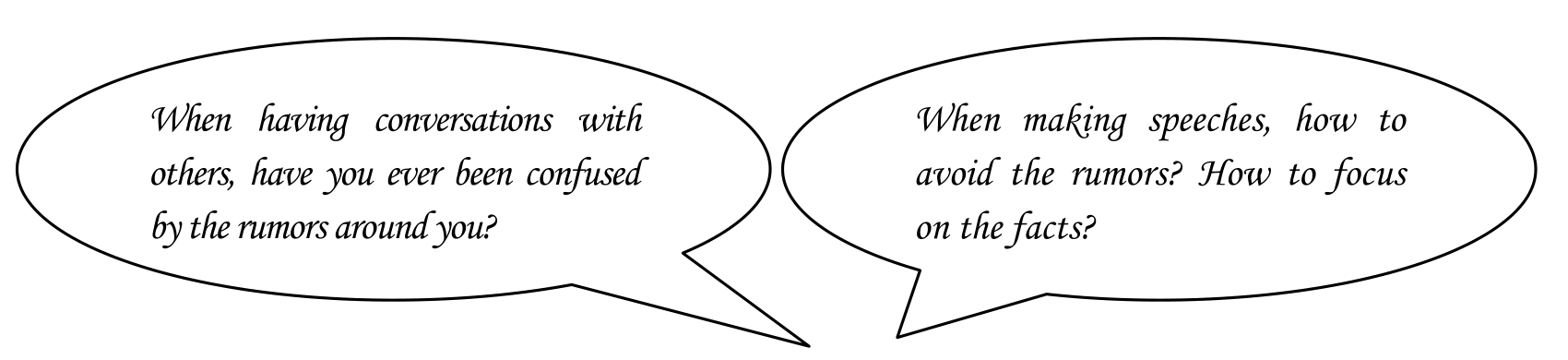
People always say “rumor runs”, which is a serious communication barrier and will damage the effective communication. But in reality, people are surrounded by rumors in school, in new environment, even at home. It’s much easier to ruin a person by rumor than praise a person with compliments. Since we cannot stop rumor, we have to build up ourselves in front of rumor during communication.
Rumors can be damaging to other’s lives, self esteem, and relationships. A participant in gossip is as guilty as the person who started the rumors. People who work in an office environment know all too well how damaging rumors can be. A seemingly small tale, which might actually be 95% true, starts at one end and becomes a tall tale with 95% lies by the time it reaches the top floor.
? Avoid discussing it. When someone comes to you with a little story about someone else you can say “I’m sorry, I really can’t talk right now, I have so much to do before I leave today.” As you get done saying that, pick up the phone and start dialing—maybe you can call IT and ask for help on some PC issue or call someone you meant to call anyway.
? Use distraction. Another thing you can do is to pick up some of your folders and mail and start walking towards the mail room or somewhere away from your desk. Give the impression of being in a bit of a rush.
? Be forthright. At the first sign of someone who likes to gossip—know who they are and have a plan so that you’re not caught off guard—politely say, “I don’t think it’s fair to talk about Lisa behind her back, maybe we should address this issue with her right now. Let’s give her a call.” If they say no, then it’s likely they’ll never be back to tell you any office secrets. If the answer is, “Yes, great,” the issue will be resolved.
? Keep calm at home too. Stay-at-home/work-from-home moms also have similar situations. In these cases it’s more of a neighborhood issue. You live with your neighbors so professionalism is not the issue anymore. You can, however, use the same tactics. If a neighbor comes by to chat about the couple down the street with the cheating husband, etc., simply say, “I don’t like to get involved in other people’s private lives. I’d rather not know about it,” or “It’s sad that they are having difficulties. Oh well, it’s none of my business. So what are you doing this weekend?” or “Look at the flowers I planted in my garden.” Change the topic after making your point.
? Avoid rumors as a kid. Rumors aren’t always about adults, and many rumors can be aimed at children. If you have a rumor about yourself that is small, do everything in your power to stop it, as it will grow quickly, and you will start to drown in rumors.
? Challenge the veracity. Big rumors are the hardest to deal with, as they are not easily stopped. To try to stop them, tell everyone they aren’t true. It can be embarrassing, but it will just become worse over time if you do nothing to stop it.
Practice:
Please prepare a short speech about one of the following topics, and pay attention to the consistency of your speech.
1) What makes rumor run?
2) When I friends lie to me…
3) Rumors and white lie
4) Rumors stop at the wise.
Verbal Skill
Expressing Similarities

continued
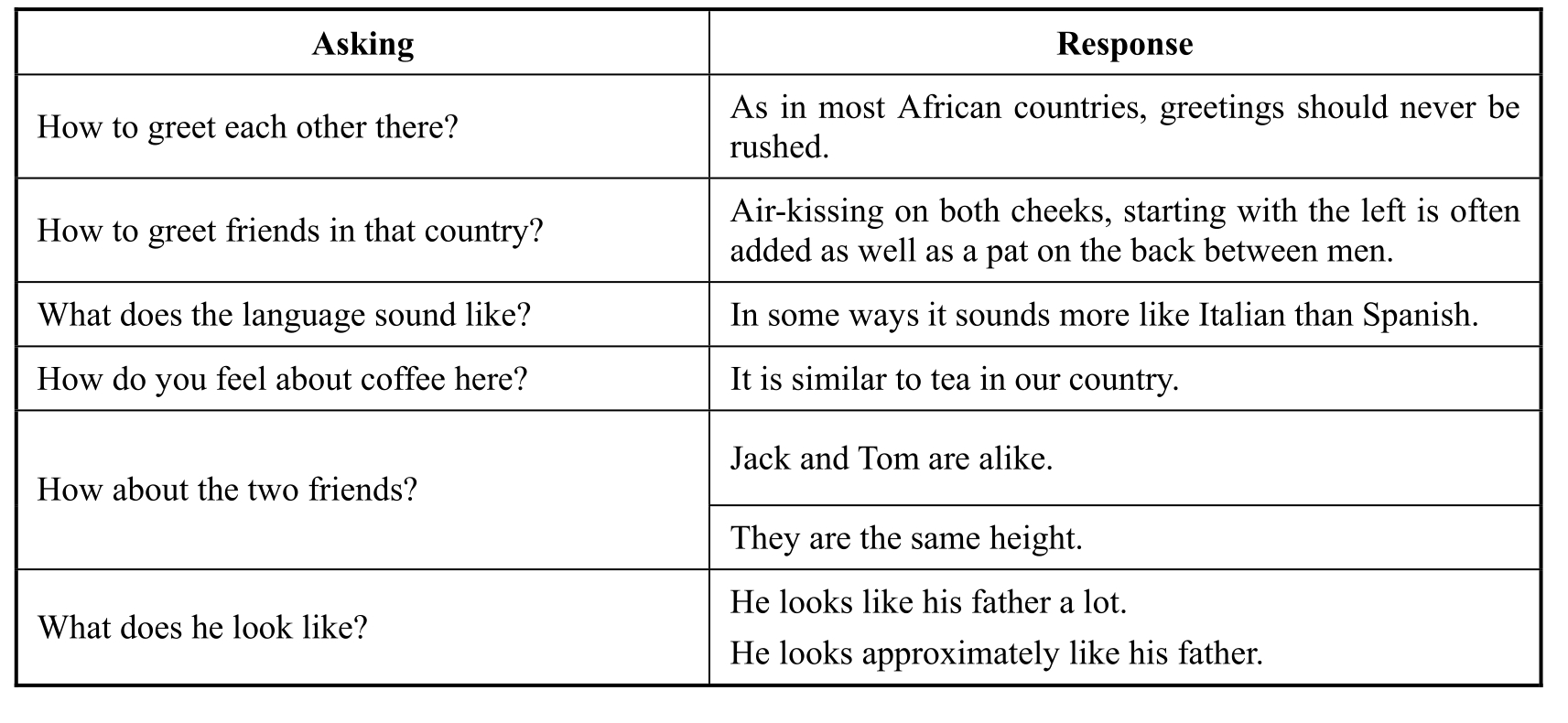
Learn the following conversations and make conversations with your partners based on the situations given below.
1) A: Let’s go over the notes from the lecture on heart.
B: Great idea. That’s really a very inspiring lecture.
A: This is one thing very interesting. The professor talked about how the shape of the heart is similar to a pear. While, in which way is the pear supposed to be leaning?
B: In my opinion, it does look like a pear, right side up, with the widest part at the bottom, leaning a little to the right.
A: Yeah, I get it now. And what did the professor say about the walls of the heart?
B: He said that they’re fairly thick, approximately like a slice of bread, at the bottom. And what he said about the top of the heart makes more sense to me; he said at the top, they’re thinner, about as thin as an orange peel.
A: That’s really amazing. What’s more, I like how he had us each make a fist and look at it so we could see that it was about the same size as a heart.
B: Yup. Then remember how he told us to open and close our hands? He wants us to see how the muscles contract and relax over and over again during our whole lives.
A: That’s right. That’s the heartbeat. The beat is just like the tick tock of a clock.
B: But did he mention that the rate can vary?
A: Yeah…In general, the rate of the heartbeat varies in relation to the size of the person or animal. The heart of a human infant at birth beats about 130 times a minute. In a small child, it beats about 90 to 100 times a minute. And the average adult rate for men is about 75 beats per minute.
B: Yes, I see. I have one more question: how does the heart work with all of the other organs?
A: Well, the heart is similar to a pump. Basically, it pumps blood to the rest of the body.
B: The professor’s lecture is really interesting and easy to understand.
2) A: I’m going to study in Hong Kong for half a year. I’m not sure whether I can adapt my new life or not.
B: Don’t worry too much. Actually there are many similarities between Hong Kong and Beijing.
A: Really?
B: Yes, Some of the customs are similar, such as respecting senor citizens, concerning about the environment.
A: Yes, what else?
B: In both cities, meal is a time for relaxing and engaging in some good conversation.
A: So I can have good chats with my Hong Kong friends.
B: The subway in Hong Kong is as busy as that in Beijing, with crowded people everywhere.
A: That’s terrible. I prefer staying in the university during the weekend.
B: Take it easy. Hong Kong people is as nice as Beijing people.
Now, make conversations of expressing similarity based on the following situations by using the expressions above:
1) One of your friends have been to Korea; you will go there soon. You ask your friend about the similarity between the two countries.
2) You cousin likes to play computer games and dislike study. You are trying to persuade him and tell him studying is similar to playing computer game.
3) Your are interviewing the twins and talking about the similarity between them.
4) You and your friends are going to do a project about the similarity between love and like.
C.Activities
1. Matching game: the different ways of greeting in different countries.
Greeting is a very important social custom in very country because it shows the whole nation’s politeness and hospitality. While every nation greets people in different way due to different histories. The followings are the different ways of greetings from different countries, please match them properly.
1) A quick, firm handshake is the traditional greeting. a. Russian
2) There are seldom handshakes between men and women b. Egypt because of religious beliefs.
3) When female friends meet, they kiss on the cheek three c. Germany times, starting with the left and then alternating.
4) Friends and relations would greet each other with either d. Italy
one or two kisses on the cheek.
5) In any greeting between men and women, the woman e. Turkey
must extend her hand first. If she does not, a man should
bow his head in greeting.
6) You are expected to say ‘bonjour’ or ‘bonsoir’ (good f. Indian
morning and good evening) ‘au revoir’ (good-bye)
when leaving.
7) The usual handshake with direct eye contact and a smile g. France
suffices between strangers.
2. Q and A competition:
In the following are some questions relating to different customs in different countries. The students are asked to judge whether these statements are true or false and give the quick answer. The team that finish all the question in the shortest time will be the winner.
Q1: Indians do not like to express ‘no,’ be it verbally or non-verbally. Indians will offer you the response that they think you want to hear.
A1: ____________________________________________________________________
Q2: In America, Gifts are not opened when received.
A2: ____________________________________________________________________
Q3: Most Russians will join a table of strangers rather than eat alone in a restaurant.
A3: ____________________________________________________________________
Q4: Turkey people like to share a bill.
A4: ____________________________________________________________________
Q5: In China, the guest of honour will be given a seat behind the door.
A5: ____________________________________________________________________
Q6: Gifts are usually opened when received in France.
A6: ____________________________________________________________________
Q7: Work and personal lives are rigidly divided in Germany.
A7: ____________________________________________________________________
Q8: People are often referred to as Don or Dona and their first name when in formal occasion as a general rule in Italy.
A8: ____________________________________________________________________
Q9: In Argentina, guests should arrive on time.
A9: ____________________________________________________________________
Q10: In Argentina, people are encouraged to pour wine.
A10: ___________________________________________________________________
3. Poem appreciation:
When in Rome
By Lawrence S. Pertillar
When in Rome,
One should adjust to do...
Those activities that Romans choose.
It is not one’s place,
To advocate...
What IS or IS NOT acceptable.
Or in poor taste.
When ‘not’ in Rome...
And that visit of condoning,
Has been left behind and alone...
There is no obligated need,
To continue to feed those traditions.
And ‘when’ one finds it comforting,
To do what one wishes in one’s own home...
That’s when it is best to profess and address one’s beliefs.
With a feeling,
If one so desires...
To dismiss what is not suitable or fits.
In one’s ‘own’ environment.
With no debate or argument to invite about this.
When ‘not’ in Rome.
from http://www.poemhunter.com/poem/when-in-rome-3/
Ⅲ.More Practice
1. Group work: How to blend in with the locals?
The key point of the saying “When in Rome, do as Romans do” is to blend in with the locals. Your group members will discuss together to find out the proper way to blend in with the locals and write down the important tips.
Tip 1: _________________________________________________________
Tip 2: _________________________________________________________
Tip 3: _________________________________________________________
Tip 4: _________________________________________________________
Tip 5: _________________________________________________________
Tip 6: _________________________________________________________
...
2. Further reading and talking:
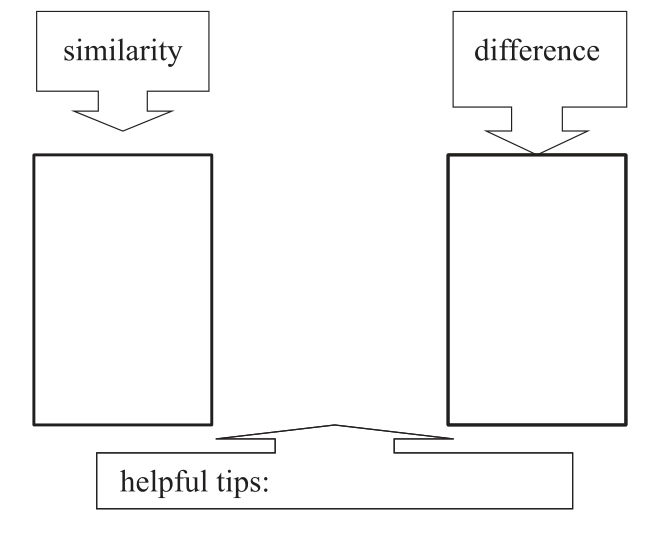
Read the information about How to Blend In with the Locals: 20 Tips which can be found in the appendix. Then make a comparison about the tips you figure out in Activity 1 and the 20 tips the author suggests to you. What’s the similarity and difference between the two? Which tips in the article are helpful while you don’t find out in the above activity?
3. Further discussion: when in Rome, do as I do.
After so many discussions about the saying “When in Rome, do as Romans do”, we come to the point: how can we “When in Rome, do as I do”? What’s the negative result it will bring to us? And in what way can we “When in Rome, do as I do” and blend in with the locals?
Ⅳ.Assignment
Culture Shock Clinic
Blending in with the locals is an effective way for the newcomers to get along with the natives and live easily and happily. But the fact is that the majority of newcomers hold on their own culture values and living habits so much that they can’t adapt themselves to the new environment. They complain about the weather, the food, even hospitality or how the locals irritate them. If the newcomers stay in the new place for a short time, things will be OK. But if they stay longer, troubles may come, which leads to serious physical or mental problems. We call it culture shock.
You and your group member are trying to open a culture shock clinic to help newcomers to solve their problems. Discuss in detail, write down your project and discuss in the class.