Unit Nine Olympic Spirits
In this unit, students will
1. Talk about sports in Olympics.
2. Learn nonverbal social-communication skills: Compliment Others.
3. Learn verbal social-communication skills: Language for Compliments.
Ⅰ.Warm-up Activities
1. Read the following passage,and then retell it to your group members. All the group members will evaluate your retelling by using the assessment sheet in the Appendix.
Winner Never Quit
Derek Redmond was prepared for the 400m semifinal race at the Olympics in Barcelona in 1992. He felt he was in the best shape of his life. Despite 8 operations on his Achilles tendons over the past 4 years, he felt very confident. His father Jim, sitting in the stands, also had high hopes. Jim and his son were very close and he made it to all of the championship races.
Derek gets off to a good start. Coming around the first bend in the track, tragedy struck as Derek’s hamstring went. Initially he thought he had been shot because the pain was so great. His leg would not function. London’s The Guardian newspaper quoted him, “Everything I had worked for was finished. I hated everybody. I hated the world. I hated hamstrings. I hated it all. I felt so bitter that I was injured again. I told myself I had to finish. I kept hopping round. Then, with 100 metres to go, I felt a hand on my shoulder. It was my old man.”
Derek hopped on one leg for half a lap before his father came to his aid. Together they finished the race arm-in-arm to a standing ovation. Now, some 17 years after the race, not many people remember who won that semi-final race or who even won the final. But, many still remember Derek Redmond.
http://www.sportsfeelgoodstories.com/2009/04/03/derek-redmonds-olympic-spirit-1992/
2. Game: Olympics Sports You and Me
Group work 1 The students are going to be divided into several groups. In the first five minutes, the group will work together to list the Olympic games and write on the blackboard. The group that lists the most will win the game.
Group work 2 The group work will work together and write down 10 questions and the corresponding answers that relate to the Olympic Sports. All the questions will be collected to the teachers. The teacher will read the question to the whole class and the whole class will have a competition to see which group wins. (Note: Each group is not allowed to answer the questions written by their own.)
3. Learn from songs
You will listen to the famous classic Olympic song “Hand in Hand”. Please fill the following blanks with the song you hear, and then, talk about the meaning of Olympic spirits indicated by the song.
Hand in Hand
See the 1) ____________ in the sky
We feel the 2) ____________ of our hearts together
This our time to 3) ____________
We know the chance is here to live forever
For all time
Hand in hand we stand
4) ____________
We can make this world a better place in which to live
Hand in hand we can
Start to understand
5) ____________ the walls that come between us for all time
A li la
Every time we give it all
We feel the 6) ____________ eternally inside us
7) ____________ our hands up to the sky
The morning 8) ____________ helps us to live in 9) ____________
For all time
Ⅱ.Focused Topic
Olympic Spirits
A.Dialogues
Please read the following dialogues and note the italic expressions.
Dialogue 1 Interviewing Michael Phelps
(M= Michael Phelps, H= Host)
H: Let’s welcome Michael Phelps. How do you feel with the eight gold medals? That’s really a miracle.
M: I put them all on for the first time this morning and they’re pretty heavy around my neck. I can’t say enough. It was just an unbelievable experience.
H: I’m curious, now that you got the eight medals, which is heavier, the eight medals around your neck or the expectations that were put on you to win them?
M: That’s a hard question to answer. You know, I was able to accomplish all of my goals. So it’s been a great four years.
H: Do you recall the first time you thought about this Spitz record and when that was?
M: I don’t know when exactly it was. I just wanted to be somebody and do new things for the sport. You know, I wanted to do something that nobody in this sport has ever seen.
H: Were you attempting to do this in Athens, four years ago?
M: I tried. I came up a little short but I was still successful.
H: You’ll be 27 when the Olympic Games come around in 2012, still very much in your prime as a swimmer. Will you try this again, or, do you need a new challenge for those Olympics?
M: Well, I’ve never been to London. And I’m going to London for the first time in the nextfew days. Trying this again will be tougher than it was in Beijing.
H: Yes, and…
M: I’m not sure if I’ll do it again, but, you know, it’s fun for me to have people say it’s not possible and be able to come out and do it. It makes it 10 times better.
Dialogue 2 Interviewing He Zhenliang
(H=Host, He= He Zhenliang)
H: Today we are honoured to talk with Mr. He Zhenliang. He is widely believed to have played a pivotal role in convincing the IOC that China is ready. How sincere have you been throughout the whole process of the bidding?
He: It is not due to my own personal merit only. The merit of all team brought success. I’m always very sincere and straightforward.
H: Back in 1993 you were equally sincere, but why did we lose the bid by two votes to Sydney?
He: The main factor is that during these eight years, China has become economically very strong, and the economic growth in China is unprecedented in other countries. And our athletes won twenty-eight gold medals and many silver and bronze medals, which means that China is really quite a remarkable sporting power.
H: When did you first dream of having an Olympic Games in Beijing?
He: I should be frank. That’s during the planning of the 1990 11th Asian Games, everything was already planned accordingly so that one day we would have the Olympic Games.
H: And you have been elected executive board member of the IOC at least twice unanimously. Why were you so popular?
He: Personally I think that’s because China’s sport is so important for world sport that everybody thinks it’s proper for a Chinese to be in the executive board.
H: To what degree do you think you were accepted because of your personal charm and because of the strength and the influence of our motherland?
He: I think both factors played some role in this.
H: In your presentation you said the IOC members would be proud of their voting decision in Moscow. What was the original statement you made in your speech?
He: “Dear colleagues, if you honour Beijing with the right to have the Olympic Games in 2008, I can assure you that in seven years from now, Beijing will make you proud of yourdecision today.” That’s what I said if I remember correctly.
H: Thank you very much.
Other Useful Expressions
an Olympic event International Olympic Committee
Olympic record Olympic security
a real pro Olympic theme song
Olympic motto: faster, higher, braver Olympic bid
Olympic symbol: five circles link together Olympic ceremony
Olympic creed: (see quotation part) Olympic flame
Olympic oath Olympic host
Practice:
1. Please think of various Olympic Games and answer the following questions by making a conversation with your partner:
1) Do you enjoy watching Olympic Games?
2) Which Olympic sports do you favor best?
3) What’s the unforgettable moment in the Olympic events in your mind?
4) Who are your Olympic heroes?
2. Role-play: Student A will interview student B about two of the following topics:
1) What is more important in Olympic Games, participation or championship?
2) What factors may result in the success of Olympic sports?
3) According to your understanding, what’s the spirit of Olympics?
4) If possible, what kind of new sports should be added into Olympic Games and why?
B.Socio-Communicative Skills
Verbal communication refers to the communication which is carried out in either oral or written form with the use of words. Nonverbal communication refers to the communication through one’s voice quality, facial expressions, gestures, bodily movement, attitudes towards space and time, and so on.
To achieve successful conversations, it is necessary to learn the skills of both the verbal and nonverbal communication.
Non -verbal Skill
Complimenting Others
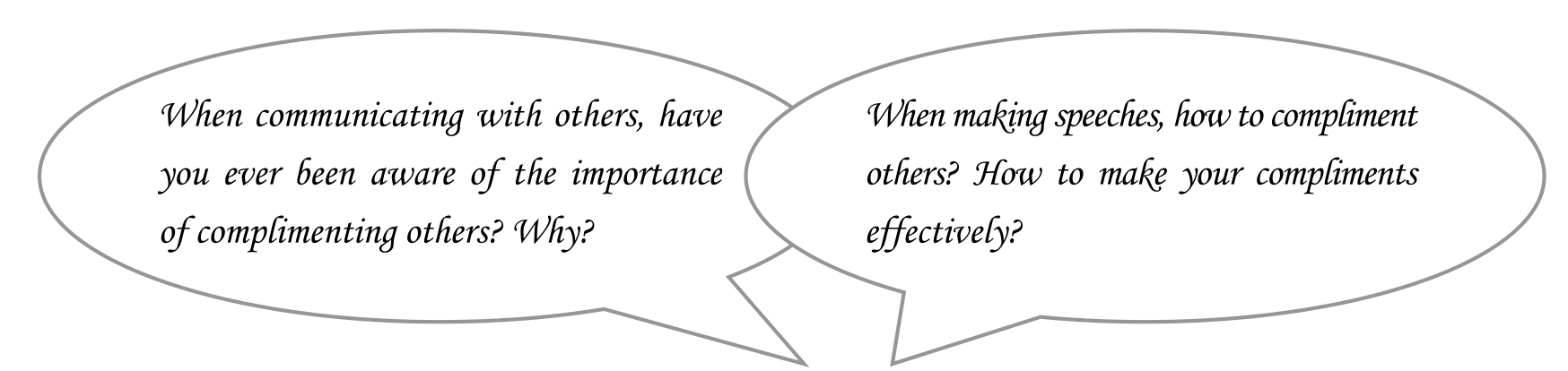
Most people appreciate being complimented. When someone pays you a compliment, you feel proud and good about yourself. Some people feel a bit embarrassed from this sort of attention, but generally speaking, being complimented gives your spirit and self-confidence a boost. The truth is that complimenting others is good medicine for your life too.
? The right way to compliment is to call the person by their name, make eye contact, and tell them what you think about them directly to them. This is the most expressive way of complimenting people; it does not matter then whether you compliment them separately or in front of other people. Your praise becomes heartfelt to them.
? One of the best ways to be sincere about praising someone is to feel good about it yourself. Let your eyes spark up when you praise someone. Smile, be happy about it. When you show that their work has genuinely pleased you, your compliments will carry more value.
? When you are praising someone, try to point out the task that was accomplished by the person. Speak about what difficulties they might have faced, and still they overcame those problems and accomplished. Acknowledging the fact that it wasn’t easy for them to achieve what they did makes the praise more meaningful.
? Make your compliment specific: “That necklace looks really good on you” makes a bigger impact compared to “you look really good today”. The more specific the better, it makes the person feel like you notice him/her.
? Back up your compliment: Don’t just stop at “that necklace looks really good on you”. Your compliment becomes stronger when you say why you think so; “that necklace looks really good on you because it matches your eyes”.
? Ask a question with your compliment: And if you want to use it as a conversational starter, ask a question about the subject of your compliment; “that necklace looks really good on you because it matches your eyes. Where did you find it?”
? Compliment the person, not the object: “Nice car, Bob!” is really complimenting the car, or perhaps the company that designed and built the car. For this compliment to have maximum effectiveness, compliment Bob on his decision to buy the car, his taste in cars, how great he looks in the car, or anything that has to do with Bob, not just the car.
? Compliment often: Compliments are free so why not give them away any chance you get? Of course, too much of anything is not a good thing (that is why it is too much and not just much), usually common sense will tell you if you are overdoing it.
Practice:
Please prepare a short speech about one of the following topics, and pay attention to the way you compliment people and things.
1) The losers in Olympic Games
2) The invisible heroes in Olympic Games
3) The founder of Olympic Games
4) The sweetest smile in Olympic Games
Verbal Skill
Language for Compliments
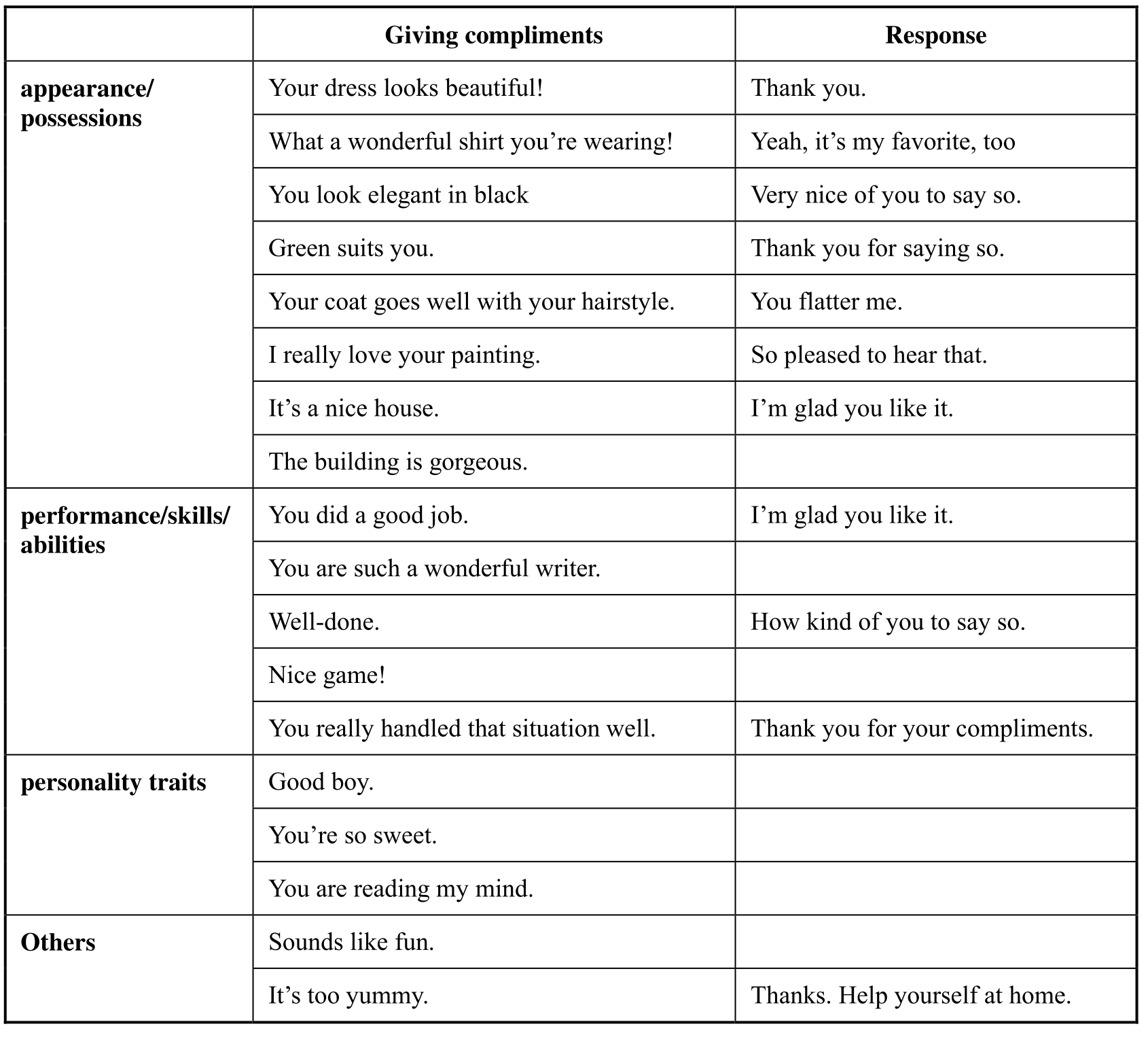
Learn the following conversations and make conversations with your partners based on the situations given below.
1) A: Honey, is something wrong?
B: No. Why would you think that?
A: I just read your blog, and it was strange. Have you stopped cooking?
B: Just temporarily. Just taking a break from cooking.
A: Well, get back to it. It’s gonna be good for you to finish something for once in your life. Don’t give up.
B: But the publisher didn’t like my book.
A: No, they say the book is good.
B: But they don’t want to publish it.
A: Well, they think it’s too expensive.
B: Now what?
A: You’re a teacher, you can teach.
B: Hm, hmm.
A: You can teach on television.
B: You must be kidding.
A: Oh, no. I think you would be excellent on television. I do.
B: Don’t…
A: I’m not kidding you. I’m not. Someone is going to publish your book. Someone is going to read your book and realize what you’ve done. Because your book is amazing. Your book is a work of genius. Your book is going to change the world. Do you hear me?
B: Oh, darling. You are so sweet. You are the sweetest man.
2) A: What does it feel like to be a celebrity?
B: Am I a celebrity? It means you don’t have too much time for yourself, but in a certain way it may help you with your career, so it’s a double-edged sword.
A: Many successful women would agree with you. What makes you special that it seems easier for you to retain your individuality in such a commercial society?
B: Thank you for saying so. For me, it is possible to keep myself as who I am and what I am for many people like me because I am myself.
A: So sticking to the true side of life is the principle of life?
B: Yes, I think that’s the most comfortable way, because if you want to disguise yourself and become somebody else, it’s very painful.
A: Do you regard yourself as lucky or unique in achieving such incredible success atsuch a young age?
B: Thank you for your compliments, but I don’t think I’m very successful yet. I just enjoy my life, that’s all.
Now, make conversations of expressing compliments based on the following situations by using the expressions above:
1) One of your family member won the Championship in a sport game. You are so pleased and proud. Make a conversation with your family and praise him or her.
2) One day you meet your favorite Olympic athlete on the street; you are so overjoyed and talk to him or her about how you feel about him or her.
3) One of your friend failed in the mid-term examine and lost confidence, you try to encourage him or her and compliment him or her.
4) One of your roommates succeeded in getting full scholarship from Harvard University.
C.Activities
1. Discussion:
How to Face the Failures in Olympics?
It is not uncommon to see athletes fail in Olympic Games. But the good news is that most of them can recover from the misfortunes and gain their popularity eventually. Are you moved by the courage of these athletes? Talk to your neighbor about the moments that really touched you during the Olympic Games, and give your own comments.
2. Read the following poem “The Olympics 2004”, and then, answer questions.
The Olympics 2004
By James H. Lee Jr.
The Olympics is for champions who’ve trained to do their best,
And striven for perfection, so they may pass the test,
And thus receive Gold Medals for all their efforts here,
As Champion of Champions, for whom the crowds do cheer.
But if their act’s not perfect, the Silver or Bronze may be
The thing they’re apt to here receive, though less excitedly.
Then there are those who fail the test, and lose the victor’s crown
Reserved for those who do their best and NEVER do let down.
Their face reflects the sorrow and misery they feel,
Deep inside their heart and soul, which will NOT ever heal,
But it will keep reminding them of each mistake they made
While reaching for Olympic Gold, and oh the price they paid.
Life is like the Olympics, where those who want the “Gold,”
Must work hard to obtain it, though they be young or old,
And strive to reach perfection each day, their whole life through,
So they may win Celestial Gold, that’s worthy to pursue.
For nothing else will satisfy, nor bring eternal joy,
Except to gain Celestial Gold which time can ne’er destroy.
So reach for the Celestial Gold, and strive each day to be
A Champion of Champions, of true nobility,
Who knows what he must do here, and does it every day,
Who lives in perfect harmony with what the scriptures say,
And prays with faith undaunted, that he may one day be
A Champion of Champions for all eternity.
from http://www.poetrygalore.com/poems/inspirational/olympics_2004.htm
Questions:
1) What is your understanding to the sentence “Who knows what he must do here, and does it every day, Who lives in perfect harmony with what the scriptures say, And prays with faith undaunted, that he may one day be a Champion of Champions for all eternity.”?
2) Why does the author say a Champion of Champions?
3) What does “pass the test” refer to? Then, what does “Celestial Gold” refer to?
3. Read the following well-known sayings, .then discuss with your group members about your understanding to the most impressive one.
1) Part of being a winner is knowing when enough is enough. Sometimes you have to give up the fight and walk away, and move on to something that’s more productive.
—Donald Trump
2) Thanks to his extraordinary vision and talent, Samaranch was the architect of a strong
and unified Olympic Movement. —Jacques Rogge
3) The most important thing in the Olympic Games is not to win but to take part, just as the most important thing in life is not the triumph but the struggle. The essential thing is not to have conquered but to have fought well. —Olympic creed
4) Winning is neither everything nor the only thing; it is one of many things.
—Joan Benoit
5) To strive, to seek, to find, and not to yield. —Alfred Tennyson
Ⅲ.More Practice
1. It is never a secret about Olympics and Drugs. Read the information about Olympics and Drugs which can be found in the appendix, and tell each other in pairs what you think of drug-use in Olympics and how to solve the problem.
2. Give a short summary after reading the following passage, and then, list the roles the Olympics has played for the host country. Do you agree with the author’s opinion? Why or why not?
Does the Olympics Help an Economy?
By Conor Clarke
Matt Yglesias says that even though competition to host the Olympics is fierce, “the reality is that cities only very rarely manage to reap the financial windfall that Olympics-boosters advertise. Ryan Avent responds with the argument that the Olympics help leaders overcome“significant constraints in trying to get necessary policy changes put in place”:
The games often get cities to undertake massive infrastructure investments, many of which have been in limbo for decades. London’s program of transit expansion in advance of the 2012 games is well documented for instance. Now, London may lose money on the games themselves, and it may end up throwing some money away investing in soon-to-be underused natatoria, but the new transit capacity will be around forever, boosting the local economy. Hard to see how that expansion doesn’t easily pay for the games in just a few years.
But a newly delivered NBER paper by Andrew K. Rose and Mark M. Spiegel takes a third position: hosting a mega-event might not have immediate tangible benefits but it might have a large effect on national exports. They write: “We conclude that the Olympic effect on trade is attributable to the signal a country sends when bidding to host the games, rather than the act of actually holding a mega-event.” Here’s the abstract:
Economists are skeptical about the economic benefits of hosting “mega-events” such as the Olympic Games or the World Cup, since such activities have considerable cost and seem to yield few tangible benefits. These doubts are rarely shared by policy-makers and the population, who are typically quite enthusiastic about such spectacles. In this paper, we reconcile these positions by examining the economic impact of hosting mega-events like the Olympics; we focus on trade. Using a variety of trade models, we show that hosting amega-event like the Olympics has a positive impact on national exports. This effect is statistically robust, permanent, and large; trade is around 30% higher for countries that have hosted the Olympics. Interestingly however, we also find that unsuccessful bids to host the Olympics have a similar positive impact on exports. We conclude that the Olympic effect on trade is attributable to the signal a country sends when bidding to host the games, rather than the act of actually holding a mega-event. We develop a political economy model that formalizes this idea, and derives the conditions under which a signal like this is used by countries wishing to liberalize.
fromhttp://www.theatlantic.com/politics/archive/ 2009/04/does-the-olympics-help-an-economy/13051/
3. Who is who?
There are many Olympic winners in China. The group members are going to have a game named “who is who”. Every student choose the one he or she likes and write down some of the Olympic winner’s characteristics. Then the student will read the characteristics he or she has written down one by one to the other group members, the other group members try to figure out who the person is.
Ⅳ.Assignment
Guess, Guess, Guess: Eighteen Arms of Kung Fu
The Eighteen Arms is a list of the eighteen main weapons of Chinese martial arts. The origin of the list is unclear and there have been disputes with regards to what the eighteen weapons actually are. You and your partners are going to find out the eighteen arms in China after class, and then the whole class is going to talk about it together in the next class.