Unit Two The Sentence
What is a sentence? A sentence refers to a group of words that usually contains at least a subject and a verb expressing a complete idea or asks a question, and that, when written in English, begins with a capital letter and ends with a full stop.
Basic Elements of a Sentence
The basic parts of English sentences are subjects and predicates.Subject refers to the noun, noun equivalent, or pronoun in a sentence or clause that denotes the doer of the action or what is described by the predicate and that in some languages, such as English, can be identified by its characteristic position in simple sentences.
Predicate is one of the two main constituents of a sentence or a clause, modifying the subject and including the verb, objects, or phrases governed by the verb.In the following sentences, the subject is underlined once and the verb twice.
He laughs. The bus stopped.
He gave me a book. The woman is a very good teacher.
Five Basic Sentence Patterns
In English the five basic sentence patterns are: pattern 1: SV(Subject+Veb); pattern 2:SVCs (Subject+Verb+Subject Complement); pattern 3: SVO (Subject+Verb+Direct Object); pattern 4: SVOCo(Subject+Verb+Object+Object Complement); pattern 5:SVOiOd (Subject+Verb+Indirect Object+Direct Object ).
In pattern 1, verbs either are intransitive, or can be used intransitively.e.g.:
The sun rises (in the east).
(Many beautiful) Flowers bloom (in the garden in spring).
It rained (heavily last night).
Birds can fly (quickly/in the sky/whenever they like).
She went (upstairs).
In pattern 2, the verb must be a link verb like be/feel/look/sound/smell/taste/become/come/go/get/grow/run/turn/fall/remain/continue/stay/keep and so on.e.g.:
I feel hungry.
He is a doctor.
Sugar tastes sweet.
They are scientists.
Leaves turned red in fall.
In pattern 3, the verb must be transitive.Most English verbs can be used in this pattern.e.g.: We learn English.
I’ll have a good time.
In this pattern, there are different kinds of objects.
(1)I wrote a letter.(n.)
(2)The result disappoints me.(pron.)
(3)The rich should help the poor.(the + adj.)
(4)My watch needs repairing.(v.+ ing)
(5)I hope to see my girl friend.(to do)
(6)I don’t know what to do. (noun phrase)
(7)Do you know where he lives? (noun clause)
In pattern 4, Verbs that can be used in this include appoint, call, consider, name, make and vote.e.g.:
We elected him chairman.
I found the room empty.
He had his watch stolen.
In pattern 5, If the indirect object is a pronoun, the indirect object becomes a prepositional phrase, and the order changes: She gave it to him.e.g.:
He bought me a book.
Tell me what he said.
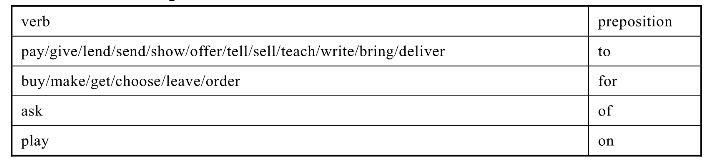
When exchanging the places of indirect.Object and direct.Object, you should plus to,for, of or on between them.
The sun gives us light and heat.(The sun gives light and heat to us.)
I will buy you a bicycle.( I will buy a bicycle for you.)
He asked me a question.(He asked a question of me.)
See the following table.
Types of Sentences
1.The Periodic Sentence
A periodic sentence is one in which the main thought is not completed until the very end of the sentence.Often this type of sentence is more effective than one in which the main thought is given first, followed by one or more modifying clauses or phrases.This is so because withholding the key word or words of the sentence until the end creates a sense of anticipation than a sentence with a loose construction.
Notice the difference between the loose and periodic constructions in the following examples:
Loose Construction: The history of English words is the history of our civilization in many ways.
Periodic Sentence: In many ways, the history of English words is the history of our civilization.
Loose Construction: There have been many great discoveries made by scientists in the twentieth century.
Periodic Sentence: Scientists in the twentieth century have been made many great discoveries.
2.The Short and Long Sentences
Short sentences can often be very powerful.Study the following famous short sentences,and see if you agree that each owns much of its power to its brevity and that more words would make them less effective.
Love conquers all.
War is all.
Nice guys finish last.
The following passage from a speech illustrates how effective a series of short sentences and other short structures-including sentence fragments-can be.
What treaty that the whites have kept has the red man broken? Not one.What treaty that the white men ever made with us have they kept? Not one.When I was a boy, the Sioux owned the world; the sun rose and set on their land; they set ten thousand men to battle.Where are the warriors today? Who slew them? Where are our lands? Who owns them?
Short sentences have their uses.They are easy to read.They are clear and effective.But too many short sentences exhaust the reader.They sound childish.
Peter and Carl walk to school.Bonnie follows them.Bonnie is Peter’s dog.She is a nice dog.She walks at Peter’s heels.She turns back at the butcher’s shop.Now Bonnie will try to find her friends.She may go home.
Peter and Carl walk to school and Bonnie follows them.Bonnie is Peter’s dog, and She is a nice dog.She walks at Peter’s heels, but she turns back at the butcher’s shop.Now Bonnie will try to find her friends, or she may go home.
As Peter and Carl walk to school, Peter’s nice dog, follows them, walking at Peter’s heels until she turns back at the butcher’s shop.Now, if she doesn’t find her friends, she may go home.
In contrast to short sentences, long sentences are particularly useful for presenting a set of complex, interlocking ideas.The following paragraph shows how a series of long sentences can be used effectively in this way.
It is particularly difficult to find good, cheap accommodation in big cities.What is more,public transport is sometimes crowded and dirty, particularly in the rush hour, and even the parks can become very crowed, especially on Sundays when it seems that every city-dweller is looking for some open space and green grass.Last of all, despite all the crowds, it is still possible to feel very lonely in a city.
In conclusion, I think that city life can be particularly appealing to young people, who like the excitement of the city and don’t mind the noise and pollution.However, many people,when they get older, and particularly when they have young children, often prefer the peace and fresh air of the countryside.
Alternating Short and Long Sentences
Although series of short and long sentences can both effective in individual situations,frequent alternation in sentence length characterizes much memorable writing.After one or more long sentences that express complex ideas or images, the pitch of a short sentence can be refreshing and arresting.Look at the following examples.
We are not so easily misled by vision.Most of the things before our eyes are plainly there, not mistakable for other things except for the illusions created by professional magicians and, sometimes, the look of the lights of downtown New York against a sky so black as to make it seem a near view of eternity.Our eyes are not easy to fool.
3.Simple, Compound, Complex and Compound-Complex Sentences
(1) The simple sentence.
A simple sentence contains only one independent clause and no dependent clause.
a.The mother is dressing her baby.
b.The party ended early.
c.Her speech and performance moved the audience.
d.He is reading and writing at the same time.
e.Mary, Bob, and Lynn lubricated my car, replaced the oil filter, and cleaned the spark plugs.
(2) The compound sentence.
A compound sentence is made up of two or more sentences, usually connected by a comma plus a joining word (and, but, for, or, nor, so, yet).
A compound sentence is used when you want to give equal weight to closely related ideas.The technique of showing that ideas have equal importance is called coordination.e.g.:
The heavy rain started suddenly, so we stopped planting our trees.
I had to give up running in the morning, for I had got a sore throat.
(3) The complex sentence.
A complex sentence is made up of a simple sentence ( a complete statement) and a statement that begins with a dependent word.A complex sentence is used when you want to emphasize one idea over another in a sentence.For example:
Because I forget the time, I missed the play.
The idea that the writer wishes to emphasize here—I missed the play—is expressed as a complete thought.The less important idea—Because I forget the time—is subordinated to the complete thought.The technique of giving one idea less emphasis than another is called subordination.For example:
I checked my money before I invited Tom for lunch.
(4) The compound-complex sentence.
The compound-complex sentence is made up of two (or more) simple sentences and one( or more) dependent statements.For example:
After I returned to school following a long illness, the math teacher gave me make-up work, but the history teacher made me drop her course.
General idea about coordination and subordination.
Coordination and subordination are ways of showing the exact relationship of ideas within a sentence.Through coordination we show that ideas are of equal importance.When we coordinate, we use the words such as and, but, for, or, nor, so yet.Through subordination we show that one idea is less important than the other.When we subordinate, we use dependent words like when, although, since, while, because and after.
Find out the sentence patterns.
1.Mr.Chen is my English teacher.
2.Tom does not study hard.
3.Where does he live?
4.God bless you!
5.I don’t know when to start.
6.A friend in need is a friend indeed.
7.He is a man of ability.
8.I received a letter written in English.
9.Spring does not come at the same time in every place.
10.He is anxious about your health.
11.Jack made me angry.
12.He taught me how to speak English.
13.I think it a good habit to get up early.
14.I believe his honesty./ I believe him honest.
15.She found her money stolen.
Rewrite the following sentences so that the final emphasis falls on the idea in the clause presented at the beginning of each sentence.
He felt that the world had come to an end when he wasn’t chosen for the football team.
It requires steady nerves to do the job safely.
The plane began to shake noticeably as soon as it lifted off the runway.
She filled a bucket with water to put off the fire.
Jane walked out of his life, bursting into tears as she left the room.
Combine the following pairs of simple sentences.Use a comma and a joining word (and, but, for, so) to connect each pair.
Example: I cleaned the spot on the kitchen floor.It still looked dirty.
I cleaned the spot on the kitchen floor, but it still looked dirty.
1.My son is studying computer science.My daughter is majoring in communication.
2.We are watering the trees.We don’t have any rain for a month.
3.The children started arguing.I made them turn off the TV.
4.At midnight my roommate closed her books.I studied until 2 a.m.
5.We must plan our family budget carefully.The price of food has risen recently.
Rewrite the following sentences, using subordination rather than coordination.Include a comma when a dependent statement starts a sentence.
Example:
The tape recorder was not working right, so I returned it to the store.
Because the tape recorder was not working right, I returned it to the store.
1.The muffler shop advertised same-day service, but my car wasn’t ready for three days.
2.The high-blood-pressure pills produced dangerous side effects, so the government banned them.
3.David lopped dead branches off the tree, and Michelle stacked them into piles on the ground below.
4.Diana wedged her handbag tightly under her arm, for she was afraid of muggers.
5.Richard counted the cash three times, but the total still didn’t tally with the amount on the register tape.