Unit One Meaning of Words
Words are units of expression which language users can intuitively recognize in their speech or writing.Words represent meaning.The problem is that words may represent several types of meaning simultaneously.Geoffery Leech, a world famous British linguist, defines seven types of meaning.They are denotative meaning, connotative meaning, affective meaning, collocative meaning, reflected meaning, social meaning and thematic meaning.
Denotation refers to the literal and primary meaning of a word-the definition we can find in a dictionary; connotation refers to the suggested or implied meaning of a word.Affective meaning is communicated when the feelings or attitudes are expressed in language,while collocative meaning consists of associations a word gets from those words that are often used together with it.Reflected meaning arises in words of multiple denotative meaning,when one sense of a word forms part of our response to another sense, social meaning is what a piece of language conveys about the social circumstances of its use, and thematic meaning is what is communicated by the way in which a speaker or writer organizes a message, in terms of ordering, focus, or emphasis.
In writing, words are the building blocks of writing; therefore, we need to have a good command of them.And choice of words is a very important issue in writing, so this unit focuses on choosing the correct word to express an idea, the appropriate word to fit the proper style of English, and the better word to express the writer’s feelings or attitudes concisely,precisely and effectively.
Read the following groups of words and find out their affective meanings.
1.economical, frugal, thrifty, mean, miserly, stingy
2.like, love, admire, adore, worship
3.collaborator, accomplice
4.statesman, politician
Explain the meaning of the following two sentences by looking closely at the denotative and connotative meanings of the italicized words.
1.In the West, every man was a man.
2.Anyway, she is a woman.
Refer to the dictionary to get the Chinese meanings of the collocations in the following sentences.
1.He spoke with a pronounce/thick French accent.
2.He gave us a glowing account of all that you had achieved over there.
3.We need to find a new site with ready access to the European motorway network.
4.This will probably be the crowning achievement of her career.
5.I don’t know him very well.He’s just a casual acquaintance.
6.We’re fighting for the outright abolition of the death penalty.
7.We need to take some decisive action before it is too late.
8.The little boy was chicken-hearted.
Correct the collocative mistakes in the following sentences.
1.I want to do contribution to my hometown.
2.He made a large mistake.
3.This country is on the rim of war.
4.I don’t like thick coffee.
5.The traffic in our city is crowded.
6.The price of car is expensive.
7.We students might learn more knowledge through practice.
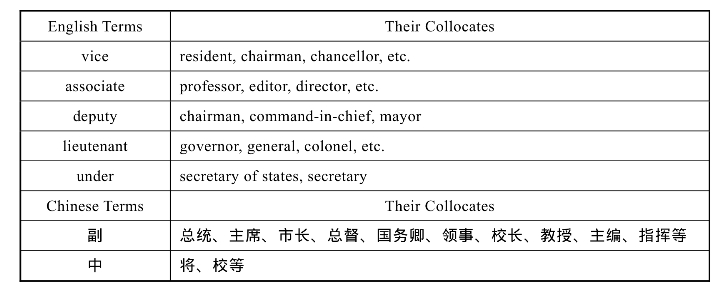
8.The vice professor gave us lots of advice on study.
Read the following two paragraphs and find out all the collocations of the words.
Paragraph 1
Devote some of your leisure, I repeat, to cultivating a love of reading good books.Fortunate indeed are those who contrive to make themselves genuine book lovers.For book lovers have some noteworthy advantages over other people.They need never know lonely hours so long as they have books around them, and the better the books the more delightful the company.From good books, moreover, they draw much besides entertainment.They gain mental food such as few companions can supply.Even while resting from their labors they are,through the books they read, equipping themselves to perform those labors more efficiently.This albeit they may not be deliberately reading to improve their mind.All unconsciously the ideas they derive from the printed pages are stored up, to be worked over by the imagination for their future profit.
Paragraph 2
Etiquette to society is what apparel is to the individual.Without apparel men would go in shameful nudity which would surely lead to the corruption of morals; and without etiquette society would be in a pitiable state and the necessary intercourse between its members would be interfered with by needless offences and troubles.If society were a train, the etiquette would be the rails along which only the train could rumble forth; if society were a state coach,the etiquette would be the wheels and axis on which only the coach could roll forward.The lack of proprieties would make the most intimate friends turn to be the most decided enemies and the friendly or allied countries declare war against each other.We can find many examples in the history of mankind.Therefore I advise you to stand on ceremony before anyone else and to take pains not to do anything against etiquette lest you give offences or make enemies.
Read the following two paragraphs and discuss the writer’s attitudes towards the main characters, then translate them into Chinese.
Paragraph 1
Mr.Bennet was so odd a mixture of quick parts, sarcastic humor, reserve and caprice,that the experience of three and twenty years had been insufficient to make his wife understand his character.Her mind was less difficult to develop.She was a woman of a mean understanding, little information, and uncertain temper.When she was discontented she fancied herself nervous.The business of her life was to get her daughters married; its solace was visiting and news.
Paragraph 2
He built America, –for what our Republic is today is largely due to the prudence, the forethought, the statesmanship, the enterprise, the wisdom, and the ability of Benjamin Franklin.He belongs to the world, but especially does he belong to America.As the nations honored him while living, so the Republic glorifies him when dead, and has enshrined him in the choicest of its niches-the one he regarded as the loftiest, –the hearts of the common people,from whom he had sprung and in their hearts Franklin will live forever.
Comparison of appellation of “fu” in English and Chinese.