Yijun Wang Jin Zhao
Institute of Vocational Teacher Education, Tongji University, Shanghai, China, wyjxgh@tongji.edu.cn zhjuini@163.com
Abstract
There exists a close relationship between vocational education and economic growth. This paper examines the influence of the scale, composition, and quality of vocational education are exerting on economic growth in China based on growth regression model and dynamic panel data from 2012 to 2013 by using GMM analysis. Results show that at the national level, the scale of vocational education has a positive effect on promoting economic growth. Meanwhile, there is an inverse U-shape effect of vocational education composition in whole education system. More importantly, the quality of vocational education has a significant effect on economic growth.
Key Words: vocational education; scale; composition; quality; economic growth
1 Introduction
With the fast development of Chinese economy since 21st century,demand for skilled talents from various industries is higher than ever. In 2004, the Department of Education of China proposed further enlarging the size of vocational education up to roughly be equal to the general education. Under the guidance of central government, local governments took measures to encourage and support the development of vocational education, which consequently, leads to its rapid expansion . Fig.1 shows the change in the number of students at secondary vocational school and general high school of China between 2012 and 2013. Generally, the size of vocational education increases with a faster speed than general education. This paper focuses on secondary vocational school because it constitutes the majority of Chinese vocational education from the aspect of scale.
Economic theory emphasizes the importance of human capital in promoting economic growth, while education is the first component of human capital. An abundance of empirical studies have found a positive relationship between growth and education (Barbara, John Van Reenen, 2000).
Since there exists a close relationship between vocational education and economic growth, is it good for the latter to expand the size of the former? What’s the suitable composition or structure of vocational education? In other words, is there a percentage of vocational education in all types of education, on which vocational education could contribute to the economic growth of society most effectively?

Fig.1 Students Number at Secondary Vocational Schools of China (Millions) Change scale of left axis Data source: China Statistical Yearbook
More importantly, after more than a decade’s rapid development, vocational education of China has gradually entered a new phase of quality improvement from previous scale expansion. At the same time, China is currently undergoing economic transformation and industry upgrading, which presents a higher requirement on the quality of skilled talent cultivation in vocational school. Accordingly, the quality of vocational education received quite a lot of attention. In recent years, more and more papers focus on the influence of education quality on economic growth,existing literatures reveal that the higher the education quality, the stronger positive influence on economic growth. The education quality appears to be of greater importance than education quantity (Hanushek&Kimko,2000). So what role can the quality of vocational education play in promoting economic growth?
This paper builds an economic growth model containing the influence of scale, composition and quality of vocational education on economic development, defined briefly as: scale (i.e. number of students), composition (makeup of whole education system), and quality (i.e. ratio of teacher to student). We used dynamic panel data on the provincial level, employing Generalized Methods of Moments(GMM) approach to study the influences of scale, composition, and quality of vocational education on economic growth.
2 Research Method and Model Construction
Theory of new economic growth emphasizes the endogenous determinant factors of economic growth, thus, human capital is considered an important input factor of production function. Based on Solow-Swan’s neoclassical growth theory, Bond, Hoeffle and Temple(2001) introduced human capital as a new variable, building a dynamic panel regression framework about economic growth, adopting investment, technology, population as well as lagged dependent variable(considering strong path dependency of economic growth) as independent variables. The growth equation we wish to estimate has the following form:
yit=γt+αyi,t-1+x'itβ+ηi+vitfor i=1,...,N and t =2,...,T. (1)
Where yi,t-1is one period lagged dependent variable, x'it represents a series of independent variables, γtand ηidenote individual effects and time effects respectively, which may also reflect region-specific and period-specific components of measurement errors, vitis the error term. Blundell and Bond (2000) consider a similar model without the time effects (γt).
This paper builds the following multiple regression equation based on above economic growth model to analysize the influence of the scale, the composition and the quality of vocational education on economic growth:
yit=β0+β1yi,t-1+β2Avenit+β3Vensit+β4Vens2it+β5Tsrit+z'itβz+ηi+ uit(2)
Main independent variables include the scale of vocational education Avenit, the composition of vocational education Vensit and the square of it Vens2it, the quality of vocational education Tsrit, one period lagged variable of economic growth yi,t−1, z'it is control variable. Subscripts i,t represent province and time, ηiis fixed effect of province, which keep unchanged with time, and uit is the error term.
Some econometric problems may arise from OLS (Ordinary Least Squares) estimation. The first one results from unobserved time invariant individual-specific effects (fixed effect), such as geography and demographics, which may be correlated with the explanatory variables. The correlation between the explanatory variables and fixed effect leads to the OLS estimator being biased and inconsistent. The second problem results from the presence of the lagged dependent variable and the potential endogeneity of explanatory variables. Since yi,t-1might be endogenous to the error terms through uit, a problem of endogeneity exists and it will therefore be inappropriate to estimate the above by OLS. Moreover, the indicators of vocational education might also be endogenous because of the two-way interaction between growth and education.
To solve these problems, Arellano and Bond (1991) propose the Generalized Methods of Moments (GMM) estimators, which take the first differences of Eq. (2) and then the lagged levels of the right-hand-side variables are used as instruments in the first- differenced equation.
Accounting for the possibility of the problems mentioned above, this paper uses the Generalized Methods of Moments (GMM) estimators to control endogeneity. Result is calculated through Stata 11.
3 Variable Identification
3.1 Independent Variables
3.1.1 The Scale of Vocational Education Avenit
This paper utilizes ratio of the size of vocational education students to that of their peers to measure the scale of vocational education (in logs to eliminate the heteroscedasticity). Variable Aven is expected positive. Because of the hysteresis effect of education to economy(Barro, 1991; Zhu Chenliang, 2011;Chen Zhongchang and Xie bo, 2013), lagged variables of the scale of vocational education, the composition of human capital and the quality of vocational education are adopted in the equation.
3.1.2 The Composition of Vocational Education Vensit and the Square of it Vens2it
Owing to marginal decreasing effect, the composition of vocational education in all types of education may have an inverse-U-shape effect on economic growth, which means there exists critical value of the composition of vocational education in whole education system that promote economic growth most efficiently. This variable is measured by ratio of vocational education graduates to high school graduates(containing general high school and vocational school). Meanwhile, the square of the composition of vocational education is introduced to investigate whether there is an inverse-U-shape effect that the composition of vocational education exerts on economic growth. Vens is expected positive, while Vens2 is negative.
3.1.3 The Quality of Vocational Education Tsrit
For vocational education, the ratio of teacher to student is a better proxy comparing to other indicators such as investment per student or performance. Here Tsritis in logs and is expected negative.
3.2 Dependent Variable Y
GDP Per Capita is often used to measure economic growth in literatures. This paper takes GDP Per Capita in log as dependent variable. At the same time, one period lagged dependent variable is also used as independent variable.
3.3 Control Variable
In order to get more precise estimation of independent variables, a control variable is necessary to be introduced. Following relevant literatures about economic growth(Barro, 1991; Liu , 2013), capital formation and foreign trade amount are used as control variable.
4 Descriptive Statistics Analysis
Data for 2002-2013 is obtained from China Statistical Yearbook and Education Statistical Yearbook covering 31 provinces throughout China. Tab.1 shows the descriptive statistics of the various variables.
Tab.1 Descriptive Statistics

5 Empirical Results
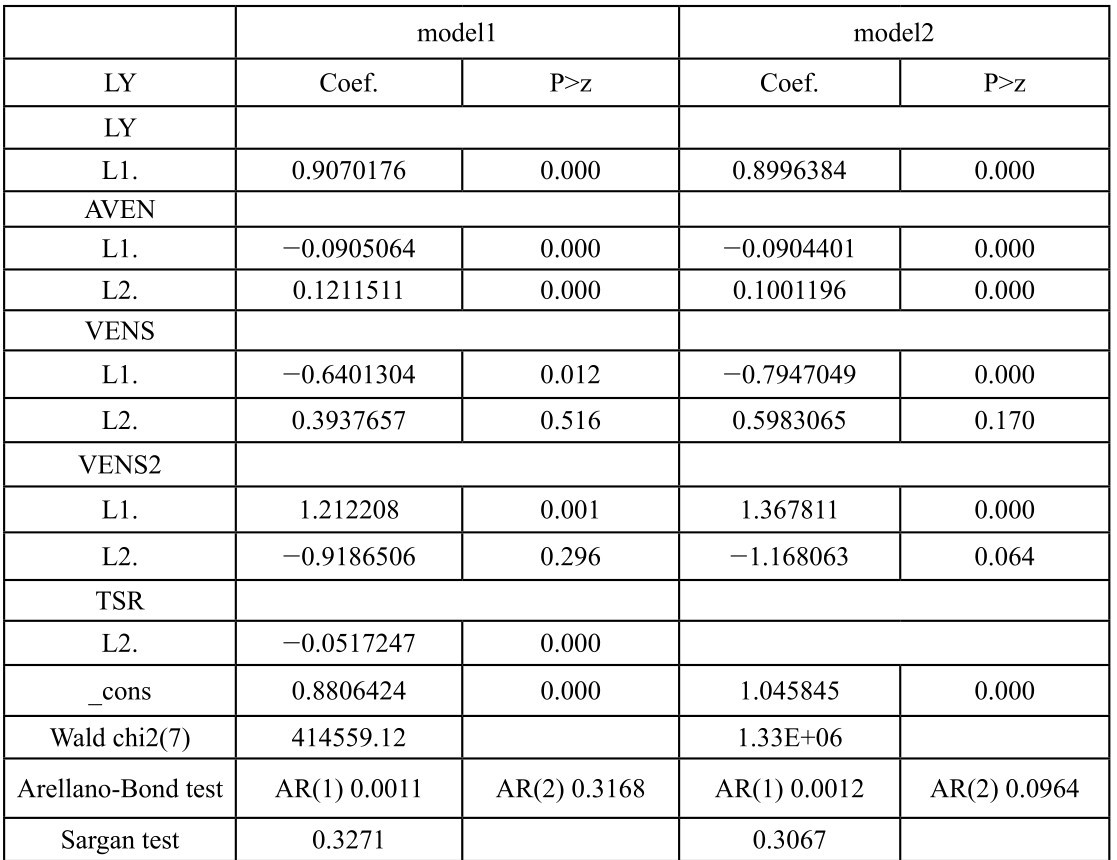
The results from estimating Eq.(2) are contained in Tab.2 which includes two models. In model 1, we investigate the impact of the scale and the composition of vocational education on economic growth. In order to inspect the influence of education quality issue on economic growth, model 2 introduces the quality of vocational education. To test the efficiency of instrumental variables, we conduct Sargan test to examine over-identifying restrictions in both models. P Value of Sargan test indicates the instrumental variables are acceptable. We also test autocorrelation in Eq.(2), there isn’t second autocorrelation but first autocorrelation. It shows that setting of this dynamic regression model is reasonable.
5.1 Influence of the Scale and the Composition of Vocational Education on Economic Growth
Expansion of the scale of vocational education can promote economic growth. Coefficient of the scale of vocational education is significant and positive, which conforms to expectation and verifies the rationality that in reality the scale (i.e. size) of vocational education is steadily increasing in recent years.
Generally, the composition of vocational education has an inverse-U-shape effect on economic growth. As shown in Tab.2, the coefficient of the composition of vocational education is positive, while its square is negative. Both coefficients are statistically significant, which accords with previous studies. The result implies that the composition of vocational education in all types of education is in favor of economic growth when it is kept at low levels, but turns negative once the vocational education composition exceeds a critical value. The estimated turning point occurs at an indicator value of approximately 0.36. As shown in Tab.1, the value of the composition of vocational education is 0.374, which is a little more than that turning point. Thus, on the whole, the composition of vocational education of China has reached the best point of promoting economic growth, and increasing the proportion of vocational education in whole education is no longer conducive to economic growth. Furthermore, empirical results show that there is hysteresis effect between both the scale and the composition of vocational education and economic growth.
The size of vocational education could be moderately expanded, while the composition of vocational education in whole education should be controlled. We can infer by combining above two points that reasonable expansion of the scale of vocational education has a positive effect on economic growth on the premise that vocational education is kept proportioned to the whole education system. From the time dimension, the percentages of vocational education in whole education of China between 2002-2013 are relatively low on both ends, and pretty high in the middle. Concretely, around 35% in both 2002 and 2013, quite close to the critical point, while higher in 2009 and 2010, close to the composition of general education. It should be noted that with economic transforming and upgrading of China, there is strong demand not only for a large amount of skilled labors but also high level R&D and technology talents. Hence, it’s vital to keep the balance of the composition of different types of education.
Tab.2 Effect of the composition and quality of vocational education on economic growth on national level
5.2 Vocational Educational Quality has a Significant Effect on Economic Growth
As shown in model 2 of Tab.2, coefficient of the quality of vocational educational is significant positive, which implies that the higher the ratio of teacher to student, the better quality of education and human capital, and sequentially promoting economic development, and vice versa. The result is consistent with Nikos Benos, Stefania Zotou(2014). During the period of 2002-2013, ratio of teacher to student in vocational education was at low level, which was sharply contrast to stable increasing of the ratio of teacher to student in general education. Encouragingly, the poor situation of low ratio of teacher to student in vocational education has been gradually improved in recent years, which is believed to promote the quality of vocational education. Like other variables, the quality of vocational education has also a hysteresis effect on economic growth.
It’s notable that once variable of vocational education is added to Eq(2), the coefficient of the scale of vocational education becomes insignificant and smaller, which implies that effect of expanding the scale of vocational education may be overestimated. The result informs that development model of vocational education should be transferred from expanding scale in the past long period of time to paying higher attention to quality improvement.
6 Conclusions
Our results suggest several implications. First, we discover the influence of education on economy is both seen in education quantity and quality. Existing papers emphasize the importance of the scale of education, while neglecting the function of the composition and the quality of education. Based on the economic growth regression framework, utilizing dynamic panel data on the province level, this paper employs GMM approach to analyze the influence that the scale, composition, and quality of vocational education have simultaneously been exerting on the economy over the past 10 years.
Second, statistical results show that the scale of vocational education has a significant and positive effect on economic growth, which mirrors the emphasis of government’s consistent policy of encouraging development vocational education. Meanwhile, it’s important to keep the right composition of vocational education in all types of education.
Finally, more urgently, vocational quality has a great influence on skilled talent training and economic growth. According to the demand of economic transition and vocational education development, the improvement of education quality should be on the agenda and be the central part of vocational education development.
References
Barbara, S., John Van R. 2000. The returns to education: A Review of the Macro-Economic Literature.A Report to the Df EE, November 2000.
Chen, Z. C., Xie, B
. 2013. Test on the Externality of Human Capital to the Total Factor Productivity Growth: Based on the Dynamic Panel Model from Provinces in China. Population & Economics (1): 68-75.
Hanushek, E. A., Wößmann, L.2010. Education and Economic Growth. In: Penelope Peterson, Eva Baker, Barry Mc Gaw, (Editors). International Encyclopedia of Education (2), 245-252.
Julian, R. B. 1999. Returns to Quality of Education. Economics of Education Series 1,June.
Liao, C. H. 2004. Researches on Regional Imbalance of Government Educational Expenditures. Economic Research (6):41-49.
Lin, Y. F., Jiang, Y. 2006. Economic Structure, Financial Structure, Bank Structure and Economic Development. Financial Research (1):7-22.
Liu, X. R., Zhan, L. F. 2013. The Impact of Investment in Education and its Structure on Economic Growth in China. Education and Economics (3):49-55.
Mankiw, N., Romer, D., Weil, D. A. 1992. A contribution to the empirics of economic growth. The quarterly journal of economics (107):407-437.
Mupimpila, C., Narayana, N. 2009. The role of vocational education and technical training in economic growth: a case of Botswana.International Journal of Education Economics and Development, 1(1): 3-13.Yao, X. G., Zhang, H. 2008. Educatiion,Human Capital and Regional Economic Difference. Economic Research (5): 47-57.
Nikos, B., Stefania Z. 2014. Education and Economic Growth: A Meta-Regression Analysis. World Development (64): 669–689.
Stephen, R. B., Anke, H. 2001. GMM Estimation Of Emipirical Growth Models,CERP Discussion Paper Series No. 3048, ISSN 0265-8003.
Vandenbussche, J., Aghion, P., Meghir, C. 2006. Growth, distance to frontier and composition of human capital[J. Journal of Economic Growth, 11, 97-127.
Zhang, C. G., Zhuang, L. H. 2011. The composition of human capital and economic growth: Evidence from China using dynamic panel data analysis .China Economic Review (22),165–171.
Zhu, C. L., Shi, P., Yue, H. Z. 2011. The Study on Bind of Human Capital,Human Capital Structure and Regional Economic Growth Efficiency.China Soft Science (2):110-119.