Jin Zhao
Institute of Vocational Education, Tongji University, Shanghai, PR China. Zj@tongji. edu.cn
Abstract
MOOC is considered as a heated topic recently. When undergoing a rapid development, it is at the same time confronted by the plight of high dropout rate and low pass rate. We regard understanding demand and promoting the high efficient matching between the demand and the supply as the key factors for the sustainable development of online education. The research based on the sharing economy and service management finds that due to the differences between the demand, supply and education types, there are also fundamental differences in the targets, boundary and developing routes of in- and outside school educations. Correspondingly, as for the official in-school education, its strategic importance lies in spreading the proper online courses to the under-developed areas, constructing the platform and flipped classroom that can promote the reputation and international competition.
Keywords: online education, sustainable development, demand-driven
1 Introduction
Recently, with the maturing of the internet and information technology, the online education, represented by MOOC (Massive Open Online Course), has developed rapidly. MOOC originated in Canada in 2008 and attracted widely attention because of the promotion from the famous universities (such as Harvard University and Stanford University) and enterprises (such as Coursera, Udacity and ed X), and it even becomes one of the most heated topics globally in education field (Terras, et al., 2015; Wang, et al., 2014). One of the well-known cases is that the MOOC course Introduction to Artificial Intelligence opened by Professor Sebastian Thrun and Peter Morvig from Stanford University gained 160,000 registered users from all over the world.
But on the other hand, the drop in the MOOC enthusiasm also has appeared. In 2013, a comment in New York Times, Frustration of the Free Open Online Courses, pointed out the high dropout rate, low pass rate and the rift in the School enterprise cooperation which provides foundation for MOOC. In China, the practice of MOOC is also confronted by many questions, such as the immature teaching mode, unclear profit-making approach, low graduation rate, lack of effective qualification and evaluation approaches. And all these factors lead to unsatisfying results (Zhai, e al., 2014; Yan, 2015). At the same time, the mentioned high drop-off rate and low pass rate are also the hidden worries for the development of online education. It is a question of educational and social significance to realize the sustainable development of online education.
Scholars are profoundly exploring into online education from various perspectives, and formed a research rush in 2014 which leads to a number of valuable research outcomes (Li, 2015; Shi et al., 2016). The current heated topics include: the application of online/MOOC in higher education, the relationship between online education and university education, the requirements on the teachers’ qualification, the design of the specific micro-courses, the innovation of the teaching mode, the technology and management innovation, and the comparison between the experience domestically and abroad (Zhao, et al., 2016). And among these topics, the focus lies on the development dilemma, reasons and the related policies (Teixeira et al., 2016; White et al., 2015).
2 Sharing Economy and Internet +: the New Challenges and Chances
2.1 Sharing Economy
The reason of introducing these two case is not to analyze the details in their development, instead, I want to enlighten a term: sharing economy.
Sharing economy was first mentioned as a term by Marcus Felson and Joe L.Spaeth in Community Structure and Collaborative Consumption: A Routine Activity Approach published in 1978. With the supply of the commodity tending to be saturated, a new type of economy derive - sharing economy, which has an indistinct boundary between the ownership and usage right.
Sharing economy means sharing the unused things with others to increase the utilization and get rewards. The idea of sharing economy is to own is not to have; the essence is the mutual aid and benefit.
The world largest renting car rental company Uber has no car; the world most popular company Facebook has no producer; the world most valuable retailer Alibaba has no inventory; the world largest accommodation service provider Airbnb has no real estate.
In the mature internet technology, the idea of sharing economy is showing breakthrough influence, the main characteristic is to build third party platform to connect the ultimate customers with the supplier on the basis of information technology.
Sharing economy is imposing revolutionary influence on our life. In most of the services that can be regarded as C2C type essentially, the internet is eliminating all the intermediate channel, including companies and supply chain. For example, most of the medical service (essentially, it is C2C of doctor-patient type), education and training service (essentially, it is C2C of teacher-student type), travel service (essentially, it is C2C of drive+ car- passengers type), and so on.
The valuable essence of sharing economy is to make direct and infinite supply possible for the demand. In another word, the supply is ubiquitous and readily available.
2.2 Internet+ Strategy in China
One of the reasons of the rapid development of sharing economy is the maturing of the internet technology and idea. And now, this development of internet technology is influencing all walks of life profoundly.
Under this underground, in March of 2015, Premier Li Keqiang proposed “Internet+” Plan in the Government Work Plan.
In another word, “internet +” is “internet + all walks of traditional industries”, but it’s not a simple adding up, instead, it is a profound combination between internet and traditional industries by using information communication technology and internet platform in order to create new development ecology. It represents a new social formation, that is, to play the internet’s optimizing and integrating role in allocating resources, to profoundly combine the novel outcome with all the fields in economy and society, to improve the creativity and productivity, and to build wider infrastructure based on the internet and
In recent years, “Internet+” has transformed many industries, such as the well-known e-commerce, internet finance, online travel, online film, online real estate.
Internet+ is keeping vitalizing the development, and generating new developing modes…even changing every individual’s life and thinking way.
Among all these field, education has tremendous possibility and potential to be transformed, and it is being changed by internet.
2.3 Consider Education in as New Perspective: Internet+ Education
The background above is implying that our team is considering education from a different perspective: sharing economy supported by internet.
Before the detailed discussion, let’s review the history and current situation of education and online education.
3 MOOC: Education+ Internet
3.1 What is Online Education?
Before talking about MOOC, it’s necessary to define the connotation of online education. To define is always a difficult thing, because it is closely related to the definer’s position and cognition. The online education we talk here applies the widest definition: the so-called online education, refers to the educating activities based on the internet and other related information technologies.
3.2 Case 3: The National Excellent Course Project of the Chinese Ministry of Education
In china, there is a national project which is similar to MOOC— The National Excellent Course Project, which is an important component part of higher institutions in the process of improving teaching quality and reforms in education and aims at building online courses to share the excellent education resources and improve teaching quality on the basis of the first-class faculty team, teaching contents, teaching approaches, teaching materials, teaching videos and so on.
This project began in 2003 and ended in 2010 with 5000 courses, and shared them national-widely through National Excellent Course Network. Our team applied for and was approved to build one course Logistics and Supply Chain Management in 2008. In the application process, we found that there were very strict requirements on the application and building of the excellent courses. So, we can be sure that the 5000 courses represent the highest teaching level of higher institutions at that time.
Nevertheless, the value of these 5000 courses were not reflected because of the low utilization. Based on our investigation, although a relatively small-scale one: only few students heard about it, let alone to use it. The situation is a little better for teachers.
In another word, this project ended in vain.
There are two reasons: the first one, there is no incentive to maintain and renew the courses. The second and the most important, most of the students have no motivation to continuously learn similar courses in their extracurricular time.
3.3 MOOC: The Origin and Characteristics
Meanwhile, MOOC is one of the representatives of online education. MOOC means massive open online course. It is an online course aimed at unlimited participation and open access via the web. In addition to traditional course materials such as filmed lectures, readings, and problem sets, many MOOCs provide interactive user forums to support community interactions among students, professors, and teaching assistants (TAs). MOOCs are a recent and widely researched development in distance education which were first introduced in 2008 and emerged as a popular mode of learning in 2012.
The year of 2012 is generally regarded as “the first year of MOOC”. In this year, American’s top universities began to build online platforms to provide free courses, especially the emergence of Coursera, Udacity and Edx highlighted MOOC a “phenomenon” world widely.
In china, besides these three platforms, the famous universities, such as Tsinghua University, Fudan University and Tongji University began to build MOOC.
We can draw the following conclusions according to the origin and development of MOOC:
(1) It mainly serves the higher education;
(2) Share and spread the excellent courses given by the distinguished teachers of the famous universities world widely on the basis of internet;
(3) Innovate the teaching mode based on the information technology and big data analysis.
Actually, except for the great fame and influence of the initiators, MOOC has no essentially difference between the early remote education and network education on the first and second points. The third one is the key difference between them, which is under investigation currently.
3.4 The Conclusion and Reflection of MOOC
(1) The imitators of MOOC are universities and official education, so it is based on the“education+ internet” perspective instead of the sharing economy and “internet+ education” perspective.
Internet is a teaching tool instead of an education tool.
(2) Because of this reason, it is seldom heard about “whether the school or university students need MOOC?”
It is seldom cared about whether school students have time, energy and desire to search for and learn the courses that them have already learned in schools or universities. It is mainly because the official education is a push-type of education.
But this question is so important!
The data from the three platform show that 65%~ 75% of the registers are the graduates having academic degree.
(3) The most critical question is how to prevent MOOC from ending in vain. In another word, how to realize the sustainable development of MOOC and online education?
Our research process and preliminary conclusion are as following:
4 The Analysis of Online Education’s Logics in Service Management Perspective
In the perspective of sharing economy and service management, we analyze the following logics of the sustainable development of online education.
(1) The core value of online education
Based on the internet, it serves every individual anytime everywhere, aims at sharing and spreading excellent education resources in order to promote the education equality.
(2) The basic questions of online education
Education, undoubtedly, is a kind of service.
From the service management perspective, in order to turn an ideal vision of online education into a solid practice, we take the following as the basic questions of online education:
Who are using online education? Why they use online education? What do they expect for online education (It’s online education instead of education)? What are the characteristics of their demand?
Who are supplying online education? Why they supply online education? How can they provide excellent online education resources?
How to realize the high efficient match between the demand and supply?
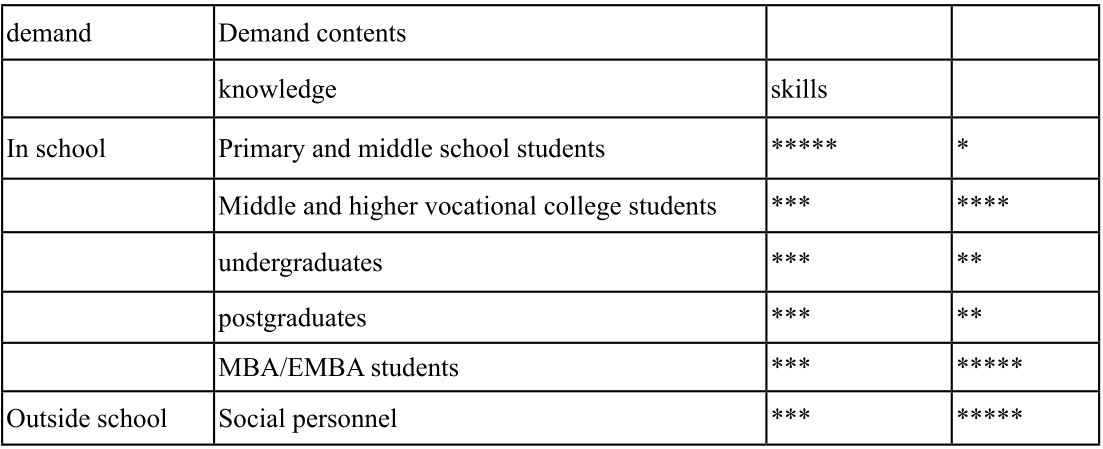
(3) The demand segment of education service (Tab.1).
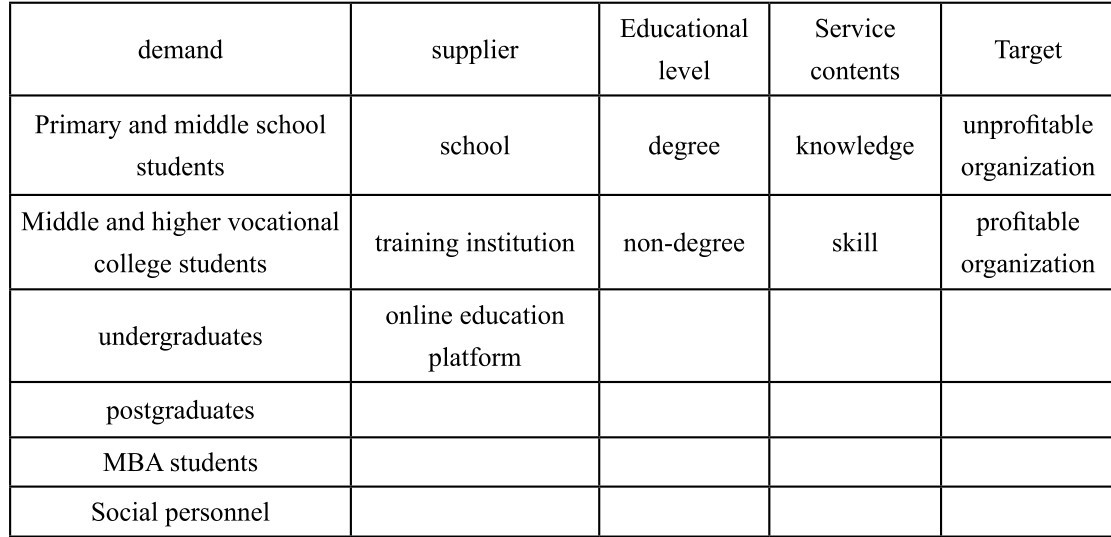
(4) The analysis of the components of the educational service (Tab.2).
Tab.1 The demand segment of education service
Tab.2 The components of the educational service
5 The Sustainable Development of in School Online Education: Flipped Classroom
5.1 The Reconsideration of School Education (Official Education)
Generally, we think it as the citizen’s right to accept official education. And on the other hand, the education is a way to acquire the viability, which makes the official education be citizen’s obligation because nobody will give up the basic official education.
If we reconsider the education from the customers’ value perspective, we’ll find that the essential difference between the official education and all the other types of education lies in its authority, which also endows the official education the absolute advantage.
With the official education experience and certificates, one can acquire social status, employment opportunities, viabilities and good peers’ resources.
Because of this core competition, the official education has other characteristics correspondingly:
Compulsory: a student has to learn what is required;
Entitling right: no certificate without passing the required examinations;
Knowledge: what is taught is mainly knowledge, but not working skills;
Systematicness and normalization.
5.2 Flipped Classroom: The Online Education in School is also a Part of School Education
Just as above, as for the official education, online education is a mode to improve the efficiency. As for how to share and spread the excellent recourses of online education and improve the teaching level and efficiency? Flipped classroom is considered as a valuable means, which calls for the support from the government.
The key points are as follows:
The selection and dynamic evaluation of excellent education resources;
The subsidiary and incentive from excellent teaching team;
The investment and construction of the infrastructure, network facility in classroom;
The targeted teaching plan design facing the flipped classroom;
Cultivation of students’ learning culture facing the flipped classroom;
And so on.
6 Conclusions
In the perspective of Service Management and Sharing Economy, we propose that, the core value of online education is to share and spread excellent teaching resources. Then we take one of two types of online education, official online education, as the research object and find that the official online education is one part of the office education, which need to be included in the official education system and take part in the exam and credit counting. Its importance lies in the flipped classroom (which is a good reflection of sharing economy). As for another type, the profit-making online education which focuses on the profit, we need to find the corresponding development strategy later.
References
Li, Y. 2015. Comments on current MOOC research in China. E-Education Research (7): 55-60.
Shi, X., Li, M. 2016. Research focuses on MOOC. Open education research, 22(1): 90-99.
Teixeira, A., Mota, J. 2016. A new competence-based approach for personalizing MOOCs in a mobile collaborative and networked environment. Ried-Revista Iberoamericana De Educacion A Distancia, 19(1): 143-160.
Terras, M., Ramsay, J. 2015. Massive open online courses (MOOCs): Insights and challenges from a psychological perspective. British Journal of Educational Technology, 46(3): 472-487.
Wang, Z., Chen, L., Zheng, Q. 2014. The research center of distance education. The research center of distance education (7):25-31.
White, S., Davis, H. 2015. MOOCs: What motivates the producers and participants? Computer supported education (10): 99-114.
Yang, M. 2015. Has the rush of MOOC dropped? Research in educational development (9): 19-25.
Zhai, X., Yuan, J. 2014. The development dilemma and policy research of mooc in chinese higher education. E-Education research (10): 97-103.
Zhao, J., Zhang, J. 2016. The Analysis of the core competition in official education under online education background. Tongji University, Research Report.