Sofie M. M. Loyens Remy M. J. P. Rikers
University College Roosevelt, the Netherlands
Abstract
This paper describes an interview study of conceptions of and approaches to teaching of secondary vocational school teachers in Chinese cultural background. Most of previous studies have focused on western higher education teachers’ conceptions of and approaches to teaching. Conceptions of teaching include transmitting information or organized knowledge and constructing or changing conceptions, while approaches to teaching are distinguished between content-centered and student-centered. Most studies found those teachers who regard teaching as transmitting information or organized knowledge should approach their teaching as content-centered while teachers who see teaching as helping student construct or change conceptions will approach teaching as student-centered.
This study interviewed 36 Chinese secondary vocational school teachers and found some special characteristics of conceptions of and approaches to teaching. The study also tried to investigate the relationship between teachers’ conceptions of and approaches to teaching. The results showed that although most of the teachers try to approach their teaching as student-centered, their conception of teaching is transmitting knowledge. Therefore, The relationship between conceptions of and approaches to teaching is more complex. Results also showed that Chinese secondary vocational school teachers did not regard student-centered approach to teaching as being absolutely better than content-centered one. The further analysis showed that teachers tried to adapt their teaching to the situation of students’ learning but they did not change their conceptions of teaching. This research has implications for teacher training. We should pay more emphasis on the conceptual change of the teachers rather than concrete teaching methods in teacher training.
During the last decades many researchers have been interested in approaches to teaching (Trigwell et al., 1994; Trigwell & Prosser, 1996; 2004; Gibbs & Coffey, 2004). But it is not enough to just know how teachers teach, it is also very important to know why teachers teach in their own way. There are all kinds of factors that influence teachers’ approaches to teaching, such as conceptions of teaching. Researchers try to describe the relationship between conceptions of and approaches to teaching (Murray & Macdonald, 1997; Lemberger et al., 1999; Park et al., 2010; Kember & Kwan, 2000). Therefore, more and more researches on conceptions of teaching emerged (Samuelowicz & Bain, 1992, 2001; Kember, 1997; Boulton-Lewiset al., 2001; Gao & Watkins, 2001, 2002; Kell & Jones, 2007).
In contrast to most studies in western culture and higher education, we interviewed Chinese secondary vocational school teachers and tried to describe their conceptions of and approaches to teaching and their relationship. Due to distinguished characteristics of vocational education, the vocational school teachers’ conceptions of and approaches to teaching should be different from that of high school teachers and university teachers. Furthermore, Chinese culture background should influence teachers’ conceptions of and approaches to teaching too.
1 The Unique Features of Chinese Secondary Vocational School Teachers
Several studies have been conducted with Chinese students’ conceptions of learning (Marton et al., 1997; Sachs & Chan, 2003; Li, 2002; Marton et al., 2005). However, research on conceptions of teaching and approaches to teaching of Chinese teachers is rather scarce, particularly of Chinese secondary vocational school teachers (Pratt et al., 1999; Gao & Watkins, 2002). One study that investigated Chinese secondary vocational school teachers found that most teachers were using traditional, teacher-centered teaching methods. However, they were also trying to incorporate student-centered teaching methods. Only a few teachers solely relied on one kind of teaching method. Results also revealed that students’ learning was an important factor that influenced their teaching approaches. For example, many teachers indicated that students’ ineffective learning constrained their teaching (Zhu & Zhang, 2013).
Difficulties in teaching in Chinese secondary vocational schools are related to the type of students (Zhu & Zhang, 2013). Chinese secondary school students have two options to continue studying after their graduation. One is studying in high school and another is secondary vocational school. In most cases, they prefer to study in high school so that they can prepare for the College Entrance Test and have the chance to study in universities. Only those students with low performance in secondary school will continue in secondary vocational school. The secondary vocational school students can continue studying in higher vocational school or find a job after graduation. Since most of the secondary vocational school students have experienced much failure in their previous education, they usually have a low learning motivation and ineffective learning approaches (Li & Xu, 2009). Compared to teaching in high school, teaching in secondary vocational school is therefore a very challenging and difficult job in China. They must motivate the students more carefully and make their course more interesting (Li & Xu, 2009). In fact, many teachers have experienced failure in their teaching and have low satisfactoriness for their job (Lan, 2010). Some researchers found that both the students and teachers in secondary vocational schools have learned helplessness in their learning and teaching (Kang & Qu, 2011). In order to solve these problems, reforms in curriculum and teaching have been conducted in Chinese secondary vocational education in recent years. More practice and less theory are emphasized in new curricula. Teachers are encouraged to teach in student-centered way (Zhuang, 2008). However, the educational reforms did not take into account teachers’ conceptions of teaching. As mentioned above, teachers’ approaches to teaching are strongly affected by their conceptions of teaching and fundamental changes to the quality of teaching unlikely happen without changes of teachers’ conceptions of teaching (Kember& Kwan, 2000). If we can not only investigating teachers’ approaches to teaching, but also taking into account their conceptions of teaching, changes in those teachers’ teaching methods will more likely to be effective.
1.1 Conceptions of and Approaches to Teaching
Several researchers have tried to map conceptions of and approaches to teaching and have come up with different categorizations (Kember,1997; Samuelowicz & Bain, 1992,2001). For example, Kember (1997) reviewed 13 articles on conceptions of teaching and proposed a categorization with two higher-level orientations: teacher-centered/content-oriented and student-centered/learning-oriented. Each orientation had two sub-categories. Teacher-centered orientation these subcategories were labeled imparting information and transmitting structured knowledge, while Student-centered orientation consists of the subcategories of facilitating understanding and conceptual change/intellectual development. Student-teacher interaction is considered as an intermediate conception, which is a transitional bridge between the teacher-centered and student-centered orientations.
In line with conceptions of teaching, different approaches to teaching have been distinguished as well. Trigwell, Prosser and Taylor (1994) came up with five qualitatively different approaches to teaching from their analyses of interview transcripts of 24 science teachers. In their study, teachers’ approaches to teaching were defined in terms of the strategies they adopt for their teaching as well as teachers’ intentions underlying these strategies.
Nevertheless, it is necessary to clarify what conceptions of and approaches to teaching exactly constitute and how they differ from each other. There is considerable overlap between the conceptions of teaching and approaches to teaching. For example, “teaching as helping students to change conceptions” is a kind of conception of teaching, while there is a student-focused strategy aimed at students changing their conceptions (Kember & Kwan, 2000). It seems that conceptions of teaching are similar to aims of teaching and is a part of approaches to teaching.
Moreover, teachers’ conceptions of ideal or good teaching and their conceptions of their own teaching were further distinguished (Parpala & Lindblom-Ylänne, 2007).
Similarly, Samuelowicz and Bain (1992) distinguished ‘ideal’ conceptions of teaching and ‘working’ conceptions of teaching. According to them, the aims of teaching expressed by teachers coincide with their ‘ideal’ conceptions of teaching, while their teaching practices reflect their ‘working’ conceptions of teaching.
In addition, the term “approaches to teaching” is also regarded as being ambiguous. According to Norton, Richardson, Hartley, Newstead and Mayes (2005), approaches to teaching can refer to teaching behavior that teachers value most. In this sense, approaches to teaching are closely linked with teachers’ conceptions of teaching. It can also refer to the behavior teachers adopt within the constraints of the curriculum, the institution or the students. In this sense, it is likely to be more closely aligned with teachers’ perceptions of the teaching environment than with their own conceptions of teaching.
Therefore, it is necessary to give more clear definition of conceptions of and approaches to teaching. A possible definition and hence distinction between conceptions of and approaches to teaching is given by Postareff and Lindblom- Ylänne (2008):“Approaches to teaching are strategies teachers adopt for their teaching, while conceptions of teaching are beliefs teachers have about teaching and which underlie the purpose and the strategies in teaching”. Another definition of conceptions of teaching is given by Kell and Jones (2007) who state that “conceptions of teaching refer to the specific meaning staffs attach to teaching, i.e. how they view the role and purpose of the teacher.”
In this study, we define conceptions of teaching as teachers´ ideas about good or ideal teaching, while approaches to teaching refer to teachers´ actual practices in their everyday teaching.
1.2 Relationships between Conceptions of and Approaches to Teaching
Researchers found that there is close relationship between conceptions of and approaches to teaching. For example, Kember and Kwan (2000) examined conceptions of teaching in relation to approaches to teaching as well as actual teaching methods. They distinguished teaching methods and approaches to teaching. Teaching methods refer to lecturing, class discussion, case studies, etc. Most teachers seemed to use a range of teaching methods and those did not seem to be determined by their conceptions of teaching. Teachers with a student-centered approach to teaching also use lecturing to cover subject matter. On the other hand, teachers with a transmitting approach to teaching did include some elements of class discussion in their teaching sessions as well. Research demonstrated that teachers who perceived teaching as transmitting knowledge were more likely to use content-centered approaches to teaching, while those who perceived teaching as facilitative tended to use learning-centered approaches (Kember & Kwan, 2000). Similarly, Trigwell, Prosser, and Taylor (1994) found that teachers who intended to transmit information adopted teacher-focused strategies, while others who believed in conceptual development or change adopted student-focused strategies. In sum, teachers’ approaches to teaching seem to be consistent with their conceptions of teaching (Trigwell & Prosser, 1996).
But there are also other arguments that teachers’ conceptions of teaching are not always consistent with their approaches to teaching. For example, Samuelwicz and Bain (1992) argued that teachers may not act according to their ideal conceptions of teaching,their teaching practice is more consistent with their working conceptions of teaching.
In addition, there are other factors that influence teachers’ approaches to teaching. Kember and Kwan (2000) also offered a model of the relationship between conceptions of teaching, approaches to teaching and learning outcomes. The model showed that the influential factors of teaching approaches include conceptions of teaching, student presage factors, curriculum design and institutional influence. Kember and Gow (1994) suggested that an individual’s teaching in practice is a balance between their own role beliefs and those of their department or teaching environment. Therefore, we propose that teachers’ teaching approaches should also be influenced by their perceptions of students’ learning, because their teaching should be adjusted to students’ learning. But there is very little literature on this topic.
1.3 Research Questions
Earlier studies on conceptions of and approaches to teaching are mainly focused on higher education teachers. In addition, very few studies have taken into account the cultural background in which teaching takes place as well as the influence that teachers’ perceptions of students’ learning can have on their approaches to teaching. The previous studies also lack their perceptions of students’ learning. In this study, we investigate teachers’ conceptions of and approaches to teaching as well as their perceptions of students’ learning in Chinese secondary vocational education. It is hypothesized that Chinese teachers will mainly hold traditional, teacher-centered conceptions of teaching. Furthermore, it is hypothesized that teachers perceive students’ learning as passive. Finally, it is hypothesized that Chinese teachers’ approaches to teaching are influenced by their conceptions of teaching as well as their perceptions of students’ learning.
2 Method
2.1 Participants
The participants of the present study were 36 teachers from five secondary vocational schools in Shanghai and two schools in Liuzhou, Guangxi. The age of those teachers ranged from 24 to 58 years old. 25 of those 36 teachers were female and 11 were male. Their subjects covered math, Chinese, English, psychology, electronics, mechanics, transportation,accounting, medicine, computer and drawing. There were varieties in terms of educational backgrounds and expertise level. Some teachers just graduated from universities while others will retire soon. Some had work experience in companies before becoming a teacher while others continuously worked as a teacher in school.
2.2 Interviews
The teachers were interviewed during 2008 and 2009. The principal of every school arranged some teachers as our participants. The interviews were done one by one. The interviews were recorded and transcribed. The open-ended questions allowed the teachers to talk about their view on students’ learning and their own teaching. The interviewers asked clarifying questions if the responses were not detailed enough or if something remained unclear to the interviewer. Each interview lasted between 45 to 60 minutes.
2.3 Data analysis
Analysis of the transcripts of the interview data was conducted with phenomenographic approach. As a qualitative research method, phenomenography aims to reveal the qualitatively different way in which people experience or conceptualize various phenomena in the world around them (Marton, 1981). Phenomenographers do not reveal how the world is objectively but manage to uncover people’s different understandings of specific phenomena and to sort them into conceptual categories. For example, they deal with people’s different understandings of the nature of force in physics or different understandings of learning and teaching in educational psychology. The research findings are categorizations of participants’ interview transcripts.
The primary interview transcripts of this study were in Chinese. The analysis of the interview transcripts was conducted by both the first and second authors. The first author read all the interview transcripts and extracted the parts which are relevant to the teachers’ views on students’ learning and their own teaching, and then considered the selected parts in every interview transcript, underlined the most important sentences, and marked some keywords that characterized the teachers’ view of students’ learning and teaching. By comparison of the underlined sentences and the keywords derived from the transcripts, the first author combined the sentences with similar meaning into one sentence and translated the sentences with different meanings into English. The second author analyzed the English sentences and got some categories independently.
The first author got 30 sentences with different meanings that were used to describe the teachers’ perceptions of students’ learning and divided them into two categories: teachers’ perceptions of students’ orientations to learning and approaches to learning. The second author categorized them into learning skill, motivation, class practice and self-regulated learning.
They discussed with each other about the results and found that most of the inconsistent categories are due to their different usages with similar meanings and contents, such as learning skill and learning approaches. Some of inconsistency comes from different meaning between English and Chinese, for example, the first author used responsibility which referred to moral duty to learn and took it as a characteristic of good students, while the second author thought it meant students had responsibility in learning and took it as a constructivist idea. They discussed once more and came to a consistent categorization finally.
3 Results
Teachers were encouraged to describe various aspects of students’ learning and their own teachings. The descriptions could be divided into three categories: teachers’ perceptions of students’ learning, teachers’ approaches to teaching and conceptions of teaching. In every part we try to classify their descriptions and give some quotations from the data. Finally, we can discuss some most important characteristics of and relationship between Chinese secondary vocational school teachers’ perceptions of students’ learning, conceptions of teaching and approaches to teaching.
3.1 Teachers’ perceptions of students’ learning
Former research indicated that damaging beliefs about teaching include seeing teaching as information transmission and believing that their teaching failures could be attributed to the negative behavior of the students (Kember, 1997). In our research however, we find teachers always complain about the negative learning behavior of students.
3.1.1 Students’ Learning Orientations
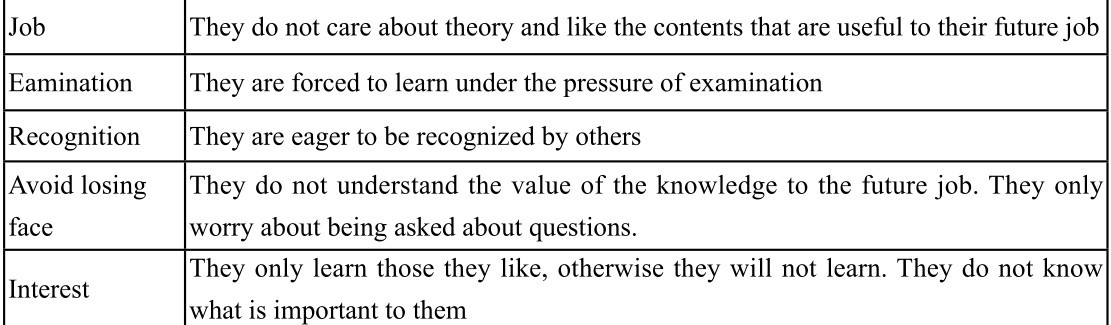
Most students are motivated to learn for the sake of future job, examination or recognition by others, so their learning orientations are very extrinsic. They also have strong motivation in avoiding failure. Their learning orientations are unclear and undirected. But
some teachers mentioned that the students only learn those they like. That seems to mean some students’ learning orientation is intrinsic, but unfortunately, most of the students have
no academic interest, they are only interested in playing and doing something. They are not interested in listening to the teachers’ lecture. The students do not like remembering. This kind of learning orientation is reasonable but the teachers do not understand. They think the students should listen carefully even though they have no interest in the content. Learning and listening carefully becomes the responsibility of the students, in spite of their interest (Tab.1).
Tab.1 The students’ learning orientations: Categories and examples
3.1.2 Students’ Learning Approaches
The teachers think the students learn passively. Likewise, even their understanding is passive. They only manage to meet the lowest requirement of the teachers. Their learning approach is very superficial. In fact some students’ learning approach is even worse than superficial because most students do not learn anything in the class. This kind of situation calls for teaching reform. But we can also find the students are willing to understand although they have little chance to do so in the class. They have bad learning skills, for example, they do not know how to write down notes. Are the students’ learning approaches the result of teacher-centered teaching or cause of teacher-centered teaching? Can the teachers change this kind of situation through improving their teaching approaches?
Chinese secondary vocational school teachers think their students have extrinsic learning orientations and passive learning approaches. This kind of negative perception of students learning gives rise to much challenge and pressure in teaching. Many teachers have negative attitude to their jobs and others are trying to develop various strategies to overcome the difficulties that they are facing. Then we can find how the teachers are trying to overcome their difficulties and achieve success in their teaching. The following are two quotations.
They do not know how to learn basically (fundamentally, generally). Many teachers require the students to take notes so that the students will follow their ideas (thoughts). But I do not think this is a good way. I ask some questions from their notes but the students cannot answer. I only ask the students to write down what they did not know before. But the students have no good habit and do not know how to take notes. They do not know what should and what should not write down. The students even cannot master the knowledge that I explain in class and let them practice for many times. It can only attribute their passive way of absorbing knowledge.
The students have problem in learning method and perseverance. They do not revise and complete assignment. They just copy. I ask them to correct the wrong place in their assignment. But they are too lazy to do it. They have no problem in intelligence but in learning methods.
The teachers also emphasize some important factors that influence the students’ learning, such as, have responsibility to their learning, be interested in learning, be confident in learning, be industrious, have positive attitude to learning, have volition and perseverance in learning, have requirement and expectations to themselves. Li (2003) described Chinese cultural model of learning as hao-xue-xin which means “heart and mind for wanting to learn”. In Chinese culture, we always emphasize the value of being industrious and being careful and serious in study. They think this kind of factors will influence the students’ learning approach. If they are industrious and have duty in study, their learning approach will be deep. The teachers think that the students do not learn well due to their lack of such characteristics, but not because of their intelligence. We can reason that the teachers have some special conceptions from this kind of descriptions that are different from the previous studies. For example, learning is a kind of duty for the students, that means despite the students have no interest in learning, they should study hard. We also find that the teachers are complaining about the students’ lack of such characteristics which leads to students’ failure in learning and teachers’ difficulty in teaching. The followings are two relevant quotations.
The key to students’ learning is not intelligence but will to learn.
The duty to learning is very important. We should cultivate their sense of duty. If they have no duty to learn, they won’t know how to learn.
The teachers also think that the students have low learning abilities for self-directed learning, but their self-directed learning will be improved dramatically after the students go to practical environment. Some teachers also mentioned that the students have low basic skills in reading, writing and calculating.
Entwistle & Walker (2000) distinguished three kinds of conceptions of teaching: teacher-centered, student-directing and student-centered. They described teacher-centered conception of teaching as follows. The image of the teacher is seen as an expert on subject matter, who imparts information to students. Teachers adopting this conception seemed to be less inclined to help and support students, and were some of the oldest and most experienced respondents. In the teacher-centered conception, students are expected to study hard. Teachers adopting this conception argue that if students cannot achieve satisfactory results, they probably lack motivation or capabilities (Entwistle & Walker, 2000).
We can refer that Chinese teachers may hold teacher-centered conception of teaching from their perceptions of students’ learning, they always complained that the students lack motivation or learning abilities which lead to their ineffective learning.
3.2 Teaching Approaches
As to conceptions of and approaches to teaching, the authors got 89 sentences with different meanings. They categorized them into three kinds of teaching strategies and several aspects of conceptions of teaching. The former includes motivational strategies, learning by doing, understanding and constructive strategies. The latter includes the purpose of teaching, the characteristics of teachers for good teaching, and Awareness of teaching effect or reflection on their teaching.
3.2.1 Motivating Strategies
The motivating strategies include content strategies, media strategies and teaching practice. The teachers choose the interesting content that attract the students and gave them some knowledge that is useful to their future job. Or the teachers will choose some special media to present the contents, such as animation and video. The teachers also tried to add their interaction with the students, make the teaching process novel and exciting. There are other psychological strategies including feedback; punishment and praise; achievement; goals. For example,
I let them know that they just lack of confidence. They can also learn well if they use their heart. I always praise them as soon as they succeed. I find encouragement is effective to the students.
I use some videos to create some situations that are better than lecture. They can absorb something during watch the video because it not too boring.
We should change our teaching approaches and pay more attention on communication with the students and give the students more practical information.
Teaching should be more relevant to the students’ life and their future job. Otherwise, the students will have no interest and teaching effect will be bad no matter how teachers teach.
3.2.2 Learning by Doing
Most of the teachers emphasize that doing; practicing and participating will make their teaching more successful. For example, the teachers let the students do role playing, take the students to the workplace, do some investigations and present the result, give the students more chance to operate the machine or other instruments, give them some cases, let them debate on some topics. They try to combine theoretical knowledge with practice and will increase the students’ practical skills. For example,
I have taught a course named supply chain management. The course is a little difficult to the students. I divided the students into four groups. First I asked the students to do some marketing investigation. Then I let them report the result of investigation. The new knowledge is introduced after their report and they are related.
We emphasize the operational ability with hand. We all recognize the importance of operation that will interest the students. We also use some instrument or experiment tool to let the students do something.
I can design some cases and let the students role-play. The students play the role of supplier, sales, bank staff and officer separately. They are very interested in it.
3.2.3 Understanding and Constructing
The teachers also emphasize some constructivist strategies, such as case studies, starting from the prior experience of the students, creating some concrete situations, giving more concrete examples to help the students understand the meaning. They try to help the students construct the meaning and facilitate the students’ understanding. For example,
The students have wrong conceptions of some accounting problem. I give them a simple problem. How to account the profit of a shop? Most of the students will use their income money minus cost. In fact this is wrong. After I told them they are wrong, they have interest to know why. Then I explain the accounting principle to them. They will be interested and understand better. If you explain them the conception directly, they will feel bored.
We can find that most teachers are trying to use learning-oriented teaching approaches to adapt the students’ learning status. Their teaching approaches are creative and constructivism.
3.3 Teachers’ Conceptions of Teaching
Much research found that each conception of teaching showed a different relationship between educator, students, content and in some cases the ideal to be taught and the context in which it was taught. Kember (1997) presented five dimensions that can be used to identify the five conceptions of teaching. The dimensions are teacher, teaching, student, content, and knowledge.
In our research, we did not address teachers’ conceptions of teaching directly but judged through some other dimensions of conceptions of teaching, such as teaching purposes, characteristics of teachers for good teaching, and meta-cognitive awareness of teaching.
3.3.1 The Purpose of Teaching
The purpose of teaching is the end or aim that steers teachers’ actions. It differs from intention (Trigwell & Prosser, 1996) in the sense that intention is about what teachers think and feel about teaching (Prosser & Trigwell, 1999). Purpose of teaching is understood as a broader concept including teachers’ intentions. Presumably, teachers’ underlying conceptions of teaching define teachers’ purposes of teaching.
In our research, we found most of the teachers emphasized that teaching means attracting the students to listen to the class and helping the student master knowledge. The students ask you questions after class, which means you have had a successful class. They do not think that teaching in vocational school is to help students construct understanding but train them to do something. For example,
What is most challenging in teaching? It is to let the students learn some knowledge, since the quality of the students is very bad. You can only find about 10 students learn hard in 50 students of a class. The rest 40 students will never listen to the class. It is a great success if you can let the rest 40 students listen to the class.
In this quotation we can find that the teacher’s conception of teaching is letting the students listen to the class and learn some knowledge. In fact the real challenge in teaching is to arouse the students’ interest. But the teachers always think that the students have duty and responsibility to learn even they have no interest.
3.3.2 The Characteristics of Good Teachers
Since there is gap between conceptions of teaching and approaches to teaching, we think that teachers’ characteristics (including skill, personality and capacity and so on) is a very important intermediate factor that influence the real effect of teaching. But in different kind of teaching approaches, there is different requirement to teachers. We can refer their conceptions of teaching through their descriptions of good teachers’ characteristics. We can find that most of the characteristics show teacher-centered conceptions of teaching. For example, be humorous; be familiar with content, praise and encouragement.
There is some cultural factor which causes the teachers emphasize that the personal characteristics play important role in teaching. In Confucius cultural background, teacher-centered teaching conceptions are deep-rooted. Even in constructivist teaching, they also emphasize the teachers’ role in teaching.
3.3.3 Awareness of Teaching Effect/ Pedagogical Awareness/ Meta-cognitive Awareness of Teaching/ Reflection on their Teaching
Postareff & Lindblom-Ylanne (2008) found that some teachers were very aware of their pedagogical skills and they had elaborated their conceptions of teaching and learning over a long period, but other teachers had not reflected on their teaching that much. They think this kind of difference is relevant to their conceptions of teaching. The former is learning focused and the latter is content focused.
In our research, we also find some teachers are reflecting on their own teaching. They think teaching approaches should be flexibly chosen according to different contents, students and situations. The best approach is the most effective one. They were also aware that there are some gaps between ideal conceptions of teaching and real effect of teaching. Some conditions will constrain the effect of teaching, such as students, instruments and their own teaching skills.
Their reflection shows that they do not think student-centered teaching is absolutely better than teacher-centered teaching. Teaching approaches should be chosen flexibly according to the content and students. Sometimes the teachers should change because if they always use one way to teach the students will feel bored. The effect of student-centered teaching approaches is also influenced by the students’ conceptions of learning and teaching. If the students are accustomed to listening and have no habit of learning by doing,the teaching effect will be bad. For example,
I will give them a topic to let them discuss, but I find that the discussion is always away from the topic. Then I try to give more lectures and only give 30 percent time to let them discuss. Some students think discussing process is too confusing and they can learn little during discussion.
I try all kinds of new approaches in teaching but I find that good approach doesn’t mean good effect. I realize that any approach should serve for the teaching effect.
The best teaching approach is most appropriate one. Every class is different. Teachers should change their approach according to the real situation.
The students are matured. If you ask them to role-play, a matured child will feel bored, it seems that this kind of activity is childish or foolish.
I give lecture with those contents that the students are interested in. The first-year students like some activities or play, but the third-year students won’t be interested in it. If you ask the third-year students to simulate a court in the class, the students will tell you that you are too stupid. As a teacher, we should change our teaching approach according to the students.
In these quotations we can understand Chinese teachers’ conceptions of teaching, which can be summarized by a Chinese proverb “there is teaching method but there is no absolutely effective method”.
3.4 The Relationship between Teachers’ Perceptions of Students’ Learning and Approaches to Teaching
In this research, we can find that the teachers are trying to adjust their approaches to teaching to their perceptions of students’ learning in many ways.
The students do not care about theory and like the contents that are useful to their future job, so the teachers try to teach practical contents relevant to future job. The students only learn those they are interested in. They do not know what is important to them. So the teachers try to communicate with the students and tell them the importance of learning. The students like to be relaxed. They do not like to use their brains but use their hands. The teachers always let the students practice in their teaching. They like to express their ideas but do not like to listen. So the teachers reduce their lecture and design some tasks to let the students participate in activities. The students have very little reading extent and their study focuses on the textbook, so the teachers told them where is important in the textbook. They only study the very narrow part, so the teachers pull out the emphasis and help the students understand them by cases and examples. The students do not like mechanically memorizing, the teachers try to let them understand so that they can remember something.
3.5 The Relationship between the Teachers’ Approaches to Teaching and their Conceptions of Teaching
If we compare the teachers’ approaches to teaching and conceptions of teaching and their perceptions of learning, we can find some interesting phenomena. Teachers’ approaches to teaching are adapted to their perceptions of students’ learning, but are not consistent with their conceptions of teaching. The teachers’ conceptions of teaching are transmitting knowledge and let the students remember something in every class, but their approaches to teaching are student-centered and constructive.
The teachers always combine their perceptions of students’ learning, conceptions of teaching and approaches to teaching. For example,
The students’ learning ability is weak, so we should not teach according to the textbook but explain the knowledge according to the fetcher of the students. A teacher who just graduated from university can give lecture but lack interaction with students and only focus on the content. Now we should have student-centered teaching and know the students’ reaction of the knowledge.
In this statement, the teacher combined the perceptions of students’ learning (their learning ability is low), conceptions of learning and teaching (learning is mastering knowledge and teaching is transmitting knowledge) and approaches to teaching (teach according to students’ characteristics, interaction with students and student-centered teaching). We can also find that the teacher has inconsistent conceptions of teaching and approaches to teaching in the statement.
4 Discussion
The present study investigated Chinese vocational teachers in conceptions of teaching, approaches to teaching and perceptions of students’ learning. The investigation showed very uniform results among teachers. Their conceptions of teaching are transmitting information or knowledge while their approaches to teaching are constructive. Their perceptions of students’ learning are very passive.
Cheng et al. (2009) investigated student-teachers’ conceptions of teaching through direct questions such as, which are the most common strategies that you will employ in teaching? What are your reasons or principles for choosing these strategies? What do you think are the best teaching strategies? The results showed that all expressed that they preferred strategies related to the student-centered approach. This is a very interesting phenomenon that deserves further discussion. There should be two kinds of conceptions of teaching. One is explicit and another is implicit. Explicit conceptions of teaching can be investigated through direct interview but implicit conceptions of teaching can only be reasoned from their other sources. Since modern learning theory and teaching have more and more influence on teachers and students, student-centered teaching has become a politically correct word in education. The traditional teacher-centered teaching has been criticized for so many years that most teachers and students will agree in student-centered teaching and be against teacher-centered teaching. But that does not mean teachers and students have implicit constructivist conceptions of teaching. We should distinguish implicit and explicit conceptions of teaching in the research. Previous studies did not seem to distinguish them. Most teachers will express constructivist conceptions of teaching when you ask them directly because constructivist conceptions of teaching have almost become a politically correct word in education while traditional conceptions of teaching is not so good. That does not mean everyone has understood or accepted the constructivist conceptions of teaching implicitly.
The problem is how implicit conceptions of teaching can be investigated. Kember (1997) offered some dimensions of conceptions of teaching. These dimensions include teacher, teaching, student, content and knowledge. We can infer their conceptions of teaching from their ideas on these dimensions. This will be better than directly asking them some questions such as, what is the best teaching strategy.
In our research we analyzed teachers’ conceptions of teaching through their ideas on characteristics of good teachers, purpose of teaching, and awareness of teaching effect. We found that Chinese vocational school teachers’ conceptions of teaching are not so clearly distinguished between transmitting knowledge and changing the students’ conceptions. Their teaching aims at not only transmitting knowledge, but also acquisition, construction and change of conceptions, but mostly aims at transmitting knowledge. They don’t think one is better than the other. They think teaching is successful only when it can achieve its aim. They don’t emphasize the conceptions of teaching but the teaching effect. They emphasize cultivate the students’ interest. The criterion of teaching effect includes not only explicit participation of students but also knowledge acquisition, conceptual construction and change. They think conceptual construction and change can also be achieved by teachers’ lecture. The key factor is the teachers’ teaching ability. Teaching approaches are various and can be chosen flexibly. This is very different from the research result in western countries. Many studies found that teachers’ conceptions of teaching are consistent to their approaches to teaching. They argued that student-centered approaches to teaching are better than teacher-centered teaching. We think our research disputed this dichotomy distinguish and described a more complex relation between conceptions of teaching and approaches to teaching and we think it is more closed to reality.
As to approaches to teaching, we should distinguish the ideal approaches to teaching (which means good even best teaching approaches to teaching, this term is highly relative to explicit conceptions of teaching) and everyday approaches to teaching (which means teaching approaches that are not so good but they are usually using). Sometimes teachers want to do better but there are some constrained conditions in reality including their own abilities and lack of instruments, they can only approach their teaching not so well. This term is more relevant to implicit conceptions of teaching. They are very different. Sometimes teachers’ response means ideal approaches to teaching while sometimes everyday approaches to teaching. The two approaches are easy to be confused in the research.
In our investigation, teachers’ approaches to teaching are not normal teaching approaches that they use in everyday class but some ideal approaches to teaching which they have ever used and find it most successful but can’t be used every day. We should also distinguish concrete teaching methods and higher-level teaching approaches. Teachers’ conceptions of teaching are not directly concluded from direct questions but reasoned from several factors, their purpose of teaching, their beliefs of characteristic of teachers for good teaching and their reflection on their teaching.
As to the relationship between conceptions of teaching and approaches to teaching, there are several kinks of situations. The first is transmitting information conception of teaching and teacher-centered approach to teaching. The second is conceptual change conception of teaching and student-centered approach to teaching. In these two cases, teachers’ implicit conceptions of teaching are consistent with their explicit conceptions of teaching. Or the research only investigated explicit conceptions of teaching and ideal approaches to teaching. The third is transmitting information conception of teaching and student-centered approach to teaching. The fourth is conceptual change conceptions of teaching and teacher-centered approach to teaching. In these two cases, teachers’ implicit conceptions of teaching are not consistent with theie explicit conceptions of teaching. Or the research investigated implicit conceptions of teaching and everyday/real approach to teaching.
Researches showed that students’ perceptions of learning environment will influence their learning approaches (Ozkal et al., 2009). Accordingly, teachers’ perceptions of teaching environment will also influence their teaching approaches. Students’ learning is a very important part of environment for teachers.
We can find a picture of two factors that influence the teachers’ approaches to teaching, one is explicit and another is implicit. The explicit factor is their perceptions of students’ learning. Their perceptions of students’ learning are extrinsic force of changing their teaching approach to adapt to the students’ learning. Besides, the familiar opinion that they hear from the training is also an explicit factor. In China, most researchers and teachers think that vocational education should be learning by doing and emphasize practice and training. Other factors will constrain their change in teaching approaches. These factors include teachers’ abilities and some objective conditions such as instrument. There is also an implicit factor that constrains their change, that is, teachers’ conceptions of teaching. In our research, we find that the change of approaches to teaching is prior to their change of conceptions of teaching, that is they have changed their approaches to teaching to adapt to the students’ learning but didn’t change their conceptions of teaching. It seems that the latter is more difficult to be changed than the former(Fig.1).

Fig.1 the factors that influence teachers’ approaches to teaching
We need to discuss the teachers’ decision of teaching approaches from multi-dimension which include their conceptions of learning and teaching, their perceptions of students’ learning and their working environment especially the teaching evaluation system, their own ability and the popular teaching theory in their society. Only from multi-dimension can we get a whole picture but not a simple dichotomy that seems pretty but far away for the reality.
This research introduced a new variable that is teachers’ perceptions of students’ learning and described the complex relationship between teaching approaches and conceptions of teaching and perceptions of students’ learning in a concrete cultural background. The generalization of the relationship deserves further discussion and research. Another value of this research is evaluating the teaching situation of Chinese vocational school from the teachers’ view and finding some problems and future direction. We think although Chinese vocational school teachers realize the importance of changing their teaching approaches but their conceptions of teaching should be improved so that their changing of approaches to teaching can be consistent to their conceptions of teaching. That is a very important task in teacher training.
In all, we can come to the following conclusion from the research,
Teachers teaching approaches are adaptive to their perceptions of students’ learning and other kinds of extrinsic and intrinsic conditions.
Teachers’ conceptions of teaching and approaches to teaching are not dualism but comprehensive. They don’t think student-centered approach is absolutely better than teacher-centered approach.
Teachers’ approaches to teaching are not simply consistent with their conceptions of teaching. Even teachers with transmitting knowledge conceptions of teaching can implement learning-centered teaching approaches under the pressure of the students’ learning. We can find that change of teachers’ conceptions of teaching is more difficult than change of their approaches to teaching. Teachers may change their approaches to teaching prior to their conceptions of teaching. But this kind of inconsistency is not good to the teachers. They should change their conceptions of teaching so that both can be consistent.
5 Limitation and prospect
This research focuses on the secondary vocational teachers, but didn’t research the students. The number of the subjects should be larger. The research scheme should be better by more directly asking the questions about the teachers’ view on learning and teaching. The future research should further explore the secondary school students’ conceptions of learning, approaches to learning and orientations of learning and their perceptions of good teaching through qualitative and quantities way. This kind of research will give us an overall view on the interaction relationship between the students and teachers in secondary vocational school. It will also help to complement the model of learning and teaching.
References
Boulton-Lewis, G. M., Smith, D. J. H., Mc Crindle, A. R., Burnett, P. C., Cambell, K. J. 2001. Secondary teachers’ conceptions of teaching and learning. Learning and Instruction, 11: 35-51.
Cheng, M. M. H., Chan, K. W., Tang, S. Y. F., Cheng, A. Y. N. 2009. Pre-service teacher education students’ epistemological beliefs and their conceptions of teaching. Teaching and Teacher Education, 25(2): 319-327.
Entwistle, N., Walker, P. 2000. Strategic alertness and expanded awareness within sophisticated conceptions of teaching. Instructional Science, 28(5): 335-361.
Gao, L., Watkins, D. A. 2002. Conceptions of teaching held by school science teachers in P.R. China: identification and cross-cultural comparisons. International Journal of Science Education, 24(1): 61-79.
Gao, L., Watkins, D. A. 2001. Identifying and assessing the conceptions of teaching of secondary school physics teachers in China. British Journal of Educational Psychology, 71: 443-469.
Gibbs, G., Coffey, S. 2004. The impact of training of university teachers on their teaching skills, their approach to teaching and the approach to learning of their students. Active Learning in Higher Education, 5(1): 87-100.
Kang, Y., Qu, Z. 2011. Zhiye yuanxiao jiaoshi gongzuo manyidu de diaocha yanjiu[Investigation on Vocatinal School Teachers’ Job Satisfaction]. Zhijiao Luntan[Vocational and Technical Education Forum], 31: 62-66.
Kell, C., Jones, L. 2007. Mapping placement educators’ conceptions of teaching. Physiotherapy, 93: 273-282.
Kember, D., Gow, L. 1994. Orientations to teaching and their effect on the quality of student learning. Journal of Higher Education, 65(1): 58-74.
Kember, D., Kwan, K. 2000. Lecturers’ approaches to teaching and their relationship to conceptions of good teaching. Instructional Science, 28: 469-490.
Kember, D. 1997. A reconceptualisation of the research into university academics’ conceptions of teaching. Learning and Instruction, 7(3): 255-275.
Lan, H. 2010. Zhongdeng zhiye xuxiao jiaoshi gongzuo manyidu de diaocha yanjiu[Investigation on Secondary vocational school teachers’ job satisfactions in Henan Province]. Zhiye Jishu Jiaoyu [Vocational and Technical Education], 25: 53-54.
Lemberger, J., Hewson, P. W., Park, H. 1999. Relationships between perspective secondary teachers’ classroom practice and their conceptions of biology and of teaching science. Science Education, 83(3): 347-372.
Li, J. 2003. U.S. and Chinese Cultural Beliefs About Learning. Journal of Educational Psychology, 95(2): 258-267.
Li, T., Xu, S. 2009. Zhongzhisheng xuexi dongji, xuexi celve ziwo tiaojie he guiyin fengge tedian yanjiu [Research on Characteristics of Learning Motivation, Self-regulation of Learning Strategies and Attribution Styles of Secondary Vocational School Students]. Zhiye Jishu Jiaoyu [Vocational and Technical Education], 30(1): 68-71.
Marton, F. 1981. Phenomenography—describing conceptions of the world around us. Instructional Science, 10: 177-200.
Marton, F., Watkins, D., Tang, C. 1997. Discontinuities and continuities in the experience of learning: An interview study of high school students in Hong Kong. Learning and Instruction, 7(1): 21-48.
Marton, F., Wen, Q., Wong, K. 2005. “Read a hundred times and the meaning will appear”: changes in Chinese university students’ views of the temporal structure of learning. Higher Education, 49(3): 289-318.
Murray, K., Macdonald, R. 1997. The disjunction between lecturers’ conceptions of teaching and their claimed educational practice. Higher Education, 33(3): 331-349.
Norton, L., Richardson, J. T. E., Newstead, S., Mayes, J. 2005. Teachers’ beliefs and intentions concerning teaching in higher education. Higher Education, 50(4): 537-571.
Ozkal, K., Tekkaya, C., Cakiroglu, J., Sungur, S. 2009. A conceptual model of relationships among constructivist learning environment perceptions, epistemological beliefs, and learning approaches. Learning and Individual Differences, 19(1): 71-79.
Park, H., Hewson, P. W., Lemberger, J., Marion, R. D. 2010. The interactions of conceptions of teaching science and environmental factors to produce praxis in three novice teachers of science. Research in Science Education, 40: 717-741.
Parpala, A., Lindblom-Ylänne, S. 2007. University teachers’ conceptions of good teaching in the units of high-quality education. Studies in Educational Evaluation, 33: 355-370.
Postareff, L., Lindblom-Ylänne, S. 2008. Variation in teachers’ descriptions of teaching: Broadening the understanding of teaching in higher education. Learning and Instruction, 18: 109-120.
Pratt, D. D., Kelly, M., Wong, W. S. S. 1999. Chinese conceptions of “effective teaching” in Hong Kong: towards culturally sensitive evaluation of teaching. International Journal of Life long Education, 18(4): 241-258.
Qu, Z., Zhang, F. 2005. Zhixiao xuesheng xuexi xianzhuang de diaocha yu sikao. [Investigation and Reflection on Vocatioanal School Students’ Learning Status]. Zhiye Jishu Jiaoyu [Vocational and Technical Education], 28: 32-34.
Sachs, J., Chan, C. 2003. Dual scaling analysis of Chinese students’ conceptions of learning. Educational Psychology, 23(2): 181-193.
Samuelowicz, K., Bain, J. 2001. Revisiting academics’ beliefs about teaching and learning. Higher Education, 41(3): 299-325.
Samuelowicz, K., Bain, J. 1992. Conceptions of teaching held by academic teachers. Higher Education, 24: 93-111.
Trigwell, K., Prosser, M. 1996. Congruence between intention and strategy in science teachers’ approaches to teaching. Higher Education, 32: 77-87.
Trigwell, K., Prosser, M., Taylor, P. 1994. Qualitative differences in approaches to teaching first year university science. Higher Education, 27: 75-84.
Zhu, X., Zhang, J. 2013. Kunhuo zhixiao jiaoshi ketang jiaoxue de wenti yu yinsu fenxi--jiyu zhagen lilun de yanjiu [Analysis on Problems in Classroom Teaching Nonplusing Vocational School Teachers and Their Impacting Factors—Based on Grounded Theory]. Zhiye Jishu Jiaoyu [Vocational and Technical Education], 34(7): 5-10.
Zhuang, X. 2008. Zhixiao xuesheng de xuexi guilv, xuexi yuanze he jiaoshi dui xuesheng de zhidao [Vocatinal school students’ learning rules and principles and the instruction of teachers]. Zhijiao Luntan [Vocational and Technical Education Forum], 14: 29-31.