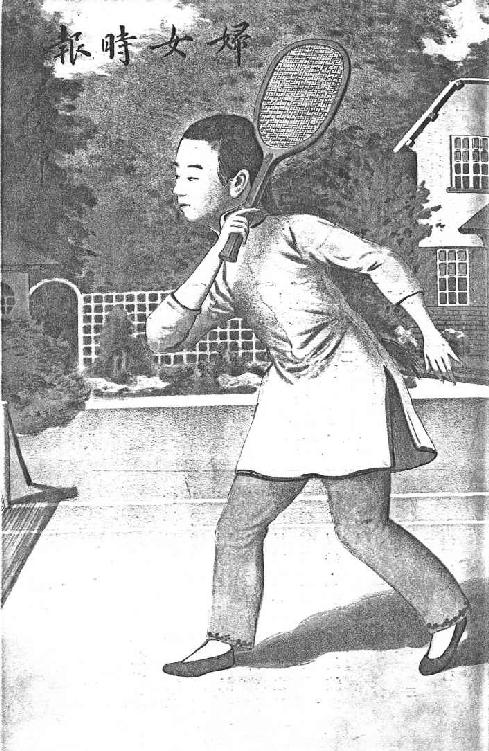
除教育和经济方面的成就外,美国妇女的生活方式也引起了关注。一篇名为《美国妇女杂谈》的文章涉及了这方面的重要话题。该文作者首先描述了美国尊重妇女的社会习俗。绅士会向女士举帽行礼,餐桌上妇女首先被服务,这些习俗与中国轻视妇女的传统形成了鲜明的对比。关于美国妇女的政治权利,文章指出,在很多州,妇女都有选举权,而她们往往并不行使这项权利。这部分的记述似乎显示出作者对中国妇女选举权的反对,但这并不是文章的重点。同介绍勃灵马尔女子大学的那篇文章类似,该文的作者对美国妇女的体育运动和健身有很深刻的印象。理想的美国新女子像男人一样健康,而非虚弱、无助。文章中还列举了美国妇女乐于参与的各项体育运动,并注意到富人们甚至建起了私人的网球场和游泳池。美国妇女既有闲暇也有零花钱的形象引导作者开始讨论妇女的阅读兴趣。文章调查了《妇女家庭报》(Ladies' Home Journal )和《妇女家庭之伴》(Woman's Home Companion )的主题,以及各类话题(如政治、教育、运动、艺术、家庭、缝纫、厨艺、小说等)所占的篇幅。就文学而言,作者断言,妇女是小说的主要消费者,因为男性通常都忙于工作而无暇阅读;相反,妇女做完家事之后则会有相当的空闲。因此,妇女的阅读倾向强烈地影响了新小说。“女子性柔”,妇女常常为悲惨的故事伤怀,因此,轻松的、幽默的小说更加流行(48)。
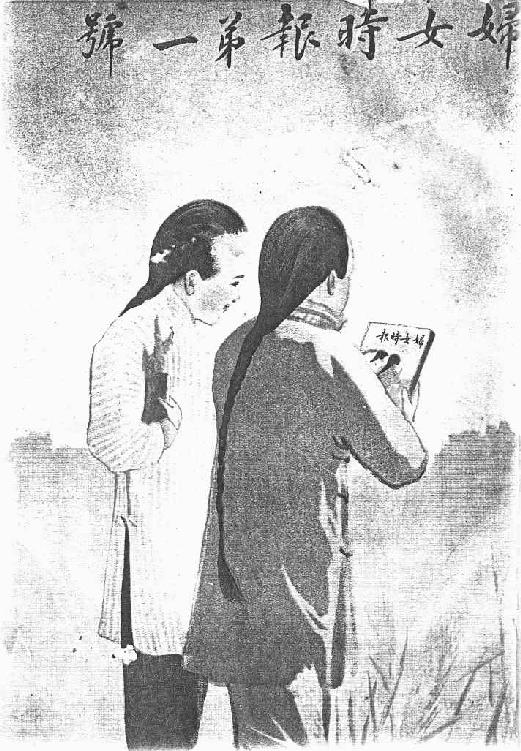
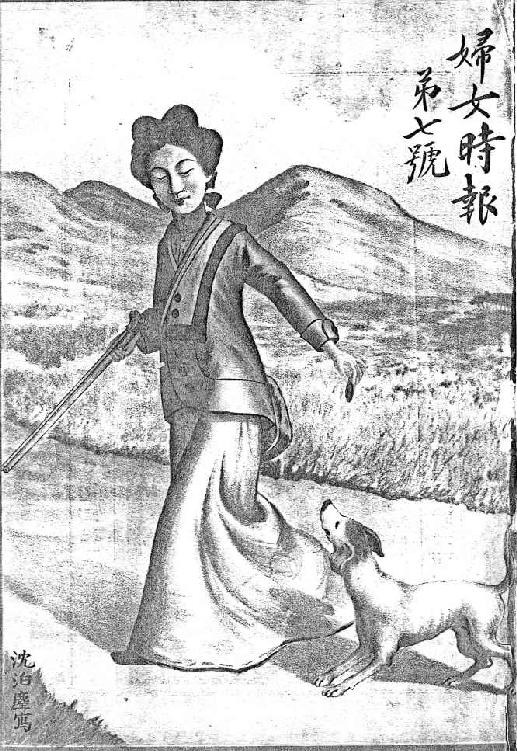
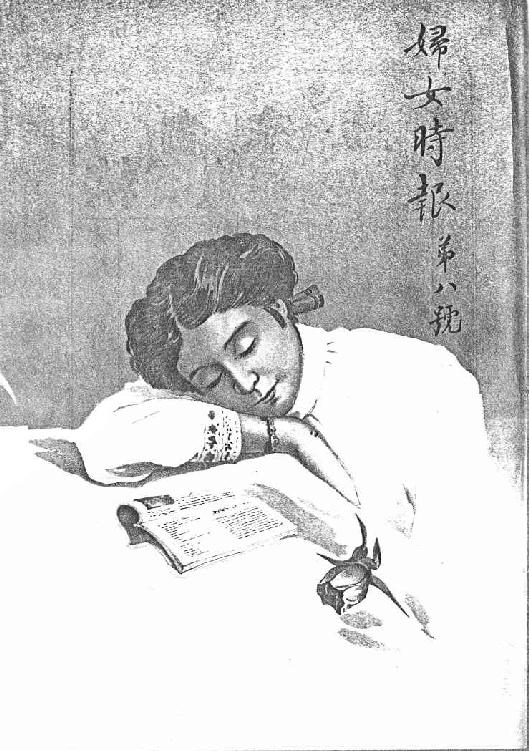
我们还可以思考这幅封面画的目标读者是谁,以及他们怎么理解画的意义。它的目标读者是女性吗?是要暗示该杂志是某类女性的必备读物吗?它是为了吸引男性读者的关注吗?是想要向他们普及妇女的阅读兴趣和思考关注吗?林培瑞指出,男性以屈尊俯就的姿态来观察“女学生”,认为她们“古怪和可笑”(61)。《妇女时报》第一期的封面就好像是对“女学生”的展示,而特别的是,在画中,妇女通过观察自身形象成为展示自身的共谋。这种解读或许过于当代,但英国艺术评论家约翰·伯格(John Berger)在《观看的方式》(Ways of Seeing )一书中对欧洲文艺复兴时期的绘画有过类似的论述。文艺复兴时期,有一种绘画专门表现裸女在镜前观看自己的身体。伯格认为画中女性的行为使她们自身成为“将自己作为景致对待的共谋”,从而加入“省视自己的观看者的行列中”(62)。与这个例子不同,在《妇女时报》中,性吸引的层面并没有得到直接的展现,得到凸显的是猎奇的心态。同时,也表现了妇女作为现代性的再表现对自身的反思。
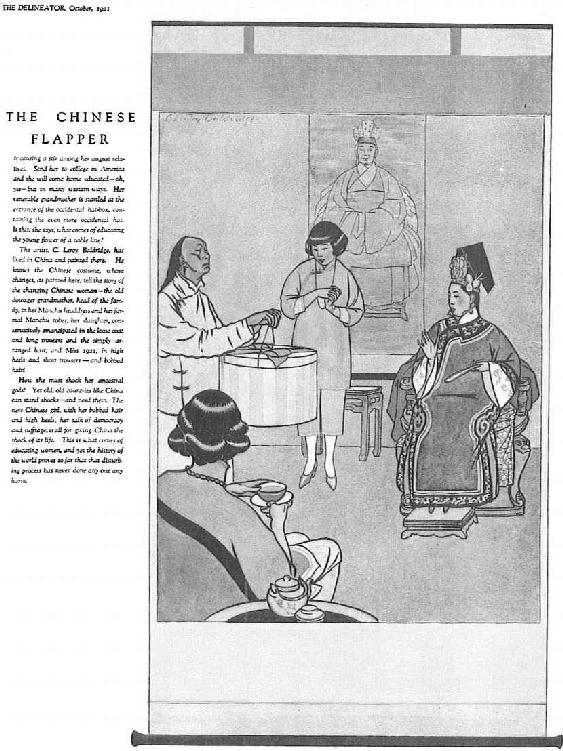
美国观察家对中国妇女活动者的描述充满了类似东方主义的异国情调。他们通常拿妇女激进分子同传统的中国女性进行比较,并以异域化的语言来加以表述。1913年传教士查尔斯·布恩(Charles Bone)在《独立者》(The Independent )上发表了题为《中国妇女之觉醒》(“The Awakening the Women of China”)的文章。文章以大量的篇幅描述了妇女所要遵守的古代习俗和儒家规范。在记述了传教士影响下妇女教育和医疗的进步后,布恩描写了中国妇女参加革命的惊人举动:
(4) 胡缨也有类似的观点:“译介”西方妇女的形象是一个创造的过程,不仅仅是传播西方文化,同时也是改造西方文化。参见Hu Ying,Tales of Translation:Composing the New Woman in China,1899-1918 ,Stanford:Stanford University Press,2000,pp.194-195。
(5) Ian Tyrrell在评价世纪之交的妇女基督教禁酒联合会时也运用了同样的逻辑:“我仍然认为应当把这些妇女称为女权主义者,只要读者能够理解本书中的女权主义与今天的女权主义不是一回事……我认为,女权主义是历史现象,它的意义随着年代的更替而更替,它并不是一组抽象的既定概念,更不是一种哲学的定位。”参见Ian Tyrrell,Woman's World,Woman's Empire:The Woman's Christian Temperance Union in International Perspective,1880-1930 ,Chapel Hill:University of North Carolina Press,1991,p.9。
(6) Frederick Cooper,Colonialism in Question:Theory,Knowledge,History ,Berkeley:University of California Press,2005,p.114.
(7) 新近的关于这种理解的研究,参见Michael Adas,Dominance by Design:Technological Imperatives and America's Civilizing Mission ,Cambridge:Harvard University Press,2006。因为Adas的论题是技术与经济的生产力,所以当他在批评美国“强加现代性”的行动时(见该书第5章),实际上批判了Walt W.Rostow等人支持的现代化理论。
(8) Rebecca E.Karl,Staging the World:Chinese Nationalism at the Turn of the Twentieth Century ,Durham:Duke University Press,2002.
(9) 中国近现代期刊出版的总体情况,参见Roswell Britton,The Chinese Periodical Press,1800-1912 ,Shanghai:Kelly&Walsh,1933,再版台北:成文出版社,1966年;Barbara Mittler,A Newspaper for China?Power,Identity,and Change in Shanghai's News Media,1872-1912 ,Cambridge:Harvard University Press,2004;Joan Judge,Print and Politics:“Shibao” and the Culture of Reform in Late Qing China,Stanford:Stanford University Press,1996;Christopher A.Reed,Gutenberg in Shanghai:Chinese Print Capitalism,1876-1937 ,Vancouver:University of British Columbia Press,2004。有关中国妇女期刊的研究很多都可以追溯到Jacqueline Nivard,“Evolution de la presse chinoise”,Études chinoises 5(1986),pp.157-183,以及Jacqueline Nivard,“Bibliographie de la presse féminine chinoise 1898-1949”,Études chinoises 5(1986),pp.185-236。亦参见Charlotte L.Beahan,“Feminism and Nationalism in the Chinese Women's Press,1902-1911”,Modern China 1(1975),pp.379-416;Jacqueline Nivard,“Women and the Women's Press:The Case of the Ladies' Journal(Funü zazhi )1915-1931”,Republican China 10(1984),pp.37-55;王政,Women in the Chinese Enlightenment:Oral and Textual Histories,Berkeley:University of California Press,1999,尤可参见第2章;Barbara Mittler,“Defy(N)ing Modernity:Women in Shanghai's Early News-Media(1872-1915)”,Jindai Zhongguo funü shi yanjiu 11(2003),pp.215-259;Yuxin Ma,“Nation,‘-Isms’ and Women's Media Public:Changes of Chinese Women's Press,1898-1937”,明尼苏达大学博士论文,2003年,以及《近代中国妇女史研究》第12卷,2004年,《妇女杂志》研究特刊。
(10) Hao Chang,“Intellectual Change and the Reform Movement,1890-8”,in John K.Fairbank and Liu,Kwang-Ching(eds.),The Cambridge History of China:Late Ch'ing1800-1911 ,vol.11,part 2,Cambridge:Cambridge University Press,1980,pp.274-338,hp.337.
(11) Benjamin Schwartz,In Search of Wealth and Power:Yen Fu and the West ,Cambridge:Harvard University Press,1964;Hao Chang,Liang Ch'i-ch'ao and Intellectual Transition in China,1890-1907 ,Cambridge:Harvard University Press,1971.
(12) E.Perry Link,Jr,Mandarin Ducks and Butterflies:Popular Fiction in Early Twentieth-Century Chinese Cities ,Berkeley:University of California Press,1981,pp.218-222.
(13) 有关中国的妇女运动,参见Charlotte L.Beahan,“The Women's Movement and Nationalism in Late Qing China”,哥伦比亚大学博士论文,1976年;Weikun Cheng,“Nationalists,Feminists,and Petty Urbanites:The Changing Image of Women in Early Twentieth-Century Beijing and Taipei”,约翰·霍浦金斯大学博士论文,1995年;Hue-ping Chin,“Refiguring Women:Discourse on Gender in China,1880-1919”,爱荷华大学博士论文,1995年。
(14) 江亢虎:《论中国研究》,上海:商务印书馆,1934年,第199页;此处转引自Beahan,“The Women's Movement and Nationalism”,p.48。
(16) Beahan,“The Women's Movement and Nationalism”,pp.59-60.
(17) Kwok Pui-Lan,Chinese Women and Christianity,1860-1927 ,Atlanta:Scholars Press,1992.
(18) Carol C.Chin,“Beneficent Imperialists:American Women Missionaries in China at the Turn of the Twentieth Century”,Diplomatic History 27(2003),pp.327-352.当然,中国向来有妇女担当作家、艺术家、教师的传统,参见Dorothy Ko,Teachers of the Inner Chambers:Women and Culture in Seventeenth-Century China ,Stanford:Stanford University Press,1994。
(19) Weili Ye,“‘Nü Liuxuesheng’:The Story of American-Educated Chinese Women,1880s-1920s”,Modern China 20(1994),pp.315-346.
(20) Beahan,“The Women's Movement and Nationalism”,p.149;Rong Tiesheng,“The Women's Movement in China before and after the 1911 Revolution”,Chinese Studies in History 16:3-4(1983),pp.159-200.
(22) Chang Yu-fa,“Women—A New Social Force”,Chinese Studies in History 11(1977-1978),pp.29-55.
(23) Paula Harrell,Sowing the Seeds of Change:Chinese Students,Japanese Teachers,1895-1905 ,Stanford:Stanford University Press,1992,p.73.亦参见Joan Judge,“Talent,Virtue,and the Nation:Chinese Nationalisms and Female Subjectivities in the Early Twentieth Century”,American Historical Review106(2001),pp.765-803。有关日本的妇女运动,参见Sharon L.Sievers,Flowers in Salt:The Beginnings of Feminist Consciousness in Modern Japan ,Stanford:Stanford University Press,1983;Laurel Rasplica Rodd,“Yosano Akiko and the Taisho Debate over the ‘New Woman’”,in Gail Lee Bernstein(eds.),Recreating Japanese Women,1600-1945 ,Berkeley:University of California Press,1991,pp.175-198。
(24) 《女报》,1903年,第7页;此处转引自Beahan,“Feminism and Nationalism in the Chinese Women's Press”,p.383。
(25) 炼石:《发刊词》,《女界》第1期,1907年2月5日,社论第1页。
(26) 有关美国选举权运动中的分歧,一项过去的但仍然有意义的研究参见Aileen S.Kraditor,The Ideas of the Woman Suffrage Movement,1890-1920 ,New York:Columbia University Press,1965。尤可参见第3章“The Two Major Types of Suffragist Argument”,该章论述了“权宜之计”和“自然权利”两种观点。
(27) Beahan,“Feminism and Nationalism in the Chinese Women's Press”;Beahan,“The Women's Movement and Nationalism”.
(28) Ho Chang,Liang Ch'i-ch'ao and Intellectual Transition ,pp.86-87.
(29) Linda K.Kerber,Women of the Republic:Intellect and Ideology in Revolutionary America ,Chapel Hill:University of North Carolina Press,1980,p.228;Linda K.Kerber,“The Republican Mother”,Linda K.Kerber&Jane DeHart-Mathews(eds.),Women's America:Refocusing the Past ,2nd ed.,New York:Oxford University Press,1987,pp.83-91.
(30) Yuxin Ma,“Nation,‘-Isms’ and Women's Media Public”.
(31) Joan Judge,“Talent,Virtue,and the Nation”.
(32) Peter Zarrow,“He Zhen and Anarcho-Feminism in China”,Journal of Asian Studies 47(1988),pp.796-813.
(33) 以下论述来源于Nivard,“Evolution de la Presse Chinoise” and Nivard,“Bibliographie de la Presse Féminine Chinoise”。亦参见Link,Mandarin Ducks and Butterflies ,pp.218-221,250-260。
(34) Nivard指出,例如,《妇女杂志》编辑朱胡彬夏名下的一些文章实际上由男性编辑王蕴章捉刀(见“Women and the Women's Press”,p.44)。这种在作者和读者中性别扮演的情形向这些文章的读者反应提出了一系列的问题,但这些问题已超越了本文论述的范围。
(35) 参见Mittler,“Defy(N)ing Modernity”,pp.215-217。
(36) Ho Chang,Liang Ch'i-ch'ao and Intellectual Transition ,p.150,n.2.在别的地方,张灏还曾论述“‘新’这个概念在‘新民’中应该作两个层次的理解:一方面,它表示对已有的最好的进行改良;另一方面,它也表示借鉴外部的经验对自身进行补足”(第224页)。这是一种很有吸引力的观点,但我比较犹豫能否把这种对“新”的理解迁移到梁启超之外的其他著作中。
(37) 有关翻译的误区——两种语言间语义和语境重要性的完全对等,参见Lydia H.Liu,Translingual Practice:Literature,National Culture,and Translated Modernity—China,1900-1937 ,Stanford:Stanford University Press,1995。
(38) 我没有掌握当时有关美国“New Women”问题的中文资料,但是考虑到我的资料库的不完全性,我并不能够十分肯定地论断在当时的中国对美国的“New Women”问题完全没有了解。有关19世纪末20世纪初美国的“New Women”形象,参见Martha Banta,Imaging American Women:Idea and Ideals in Cultural History ,New York:Columbia University Press,1987;Carolyn Kitch,The Girl on the Magazine Cover:The Origins of Visual Stereotypes in American Mass Media ,Chapel Hill:University of North Carolina Press,2001;Martha Patterson,“‘Survival of the Best Fitted’:Selling the American New Woman as Gibson Girl,1895-1910”,ATQ 9(1995),pp.73-87;Lynn D.Gordon,“The Gibson Girl Goes to College:Popular Culture and Women's Higher Education in the Progressive Era,1890-1920”,American Quarterly 39(1987),pp.211-230。
(39) Antonia Finnane,“What Should Chinese Women Wear?A National Problem”,Modern China 22(1996),pp.99-131,here p.101.Finnane指出了日本与中国的不同之处,在日本“文化史作为民族性”的问题“沉淀”为唯一的有说服力的象征——和服(第104页)。
(40) Mittler,“Defy(N)ing Modernity”,pp.217-218.尽管我没有对大众杂志里的男性形象进行过考察,但我的印象是,以“新男子”的形象来表征现代性是非常少见的。特定的男性照片,如校长、孙中山类的政治领袖,可能代表了从中式官服、长衫向西式着装的过渡,但并没有产生表征“新男子”这样一个类属的概念。类似的论述,参见Verity Wilson,“Dressing for Leadership in China:Wives and Husbands in an Age of Revolutions(1911-1976)”,Gender&History 14(2002),pp.608-628。
(58) Christopher A.Reed,“The Ambiguous Origins of Modern Consumer Patronage:Publishers and Readers in Late Nineteenth- and Early Twentieth-Century China”,会议论文,发表于亚洲学会年会,波士顿,1999年3月;亦参见Reed,Gutenberg in Shanghai 。
(59) Perry Link,Mandarin Ducks and Butterflies:Popular Fiction in Early Twentieth-century Chinese Cities ,Berkeley:University of California Press,1981,p.219,251.
(60) 在分析妇女杂志封面与插图的这一部分中,我在英文原文中有意识地运用了大量被动语态,如“was shown”“can be seen”以及“is viewed”。这样做的目的在于突出这些行为的对象的模糊性,即这些图画究竟在吸引谁的注意力,向谁展示。而从另一个方面讲,这些图画中的女性又都是被观赏的对象。观赏者既包括作为读者的我们自己,也包括当时的观看者。我们不清楚当时的观看者的组成,我们只能推测他们怎么来阅读和接受这些图画。
(61) Link,Mandarin Ducks and Butterflies ,p.218.
(62) John Berger,Ways of Seeing ,New York:Viking Press,1973,pp.50-51.
(63) 吉布森女是表现美国“新女子”的一种商业化方式。这一形象经由杂志插画家查里斯·丹纳·吉布森(Charles Dana Gibson,1867—1944)的设计而流行起来。参见Kitch,Girl on the Magazine Cover ;Banta,Imaging American Women 。
(64) Berger,Ways of Seeing ,p.50.
(65) Kitch,Girl on the Magazine Cover ,p.54.
(66) Finnane,“What Should Chinese Women Wear?”,pp.107-108.亦参见Valerie Steele and John S.Major,China Chic:East Meets West ,New Haven:Yale University Press,1999。
(67) 哈里森·费舍(Harrison Fisher,1875—1934)和霍华德·钱德拉·克里斯蒂(Howard Chandler Christy,1873—1952)都是吉布森的模仿者。吉布森女高大且具有贵族气质,而费舍女和克里斯蒂女则比较随性,她们通常被描画为在进行体育运动。参见Kitch,Girl on the Magazine Cover ,pp.14,29。
(68) Gordon,“The Gibson Girl Goes to College”,p.212.
(70) Aihwa Ong,“Anthropology,China and Modernities:The Geopolitics of Cultural Knowledge”,in Henrietta L.Moore(eds.),The Future of Anthropological Knowledge ,London:Routledge,1996,pp.60-92,hp.64.
(71) Rev.Charles Bone,“The Awakening of the Women of China”,The Independent 75(1913),pp.667-670,hp.669.
(72) “The Suffragettes of China”,Literary Digest ,Vol.44,Feb.3,1912,pp.239-242,hp.239.
(73) Soumay Tcheng(郑毓秀口述),Mrs John Van Vorst,“A Girl from China:The Story of a Young Woman Who Broke the Traditions of Centuries to Bring Freedom to Herself and Liberty to Her Native Land”,Good Housekeeping 81(Dec,1925),pp.14-15,188-211;“A Girl from China:The Dramatic Story of a Girl Who Risked Her Life to Free Her Country”,Good Housekeeping 81(Dec,1925),pp.72-73,159-180.
(74) Carrie Chapman Catt diaries,“China”,Papers of Carrie Chapman Catt,Library of Congress(缩微版)[以下简称Catt diaries],第1卷第2盒,第29—30页。亦参见Catt,“The New China:She Sits in the Gallery and Looks Down on China's Ten Women Legislators,Who Had Been Called A Myth”,The Woman's Journal 5,Oct,1912,p.314。The Woman's Journal 是由美国国家妇女参政权联盟在波士顿出版的期刊。
(75) Carrie Chapman Catt,“The Truth About Suffrage in China”,The Woman's Journal 16,Nov.,1912,pp.362-363.该文显示,作者对同盟会由倡导建立省议会到主张选举国会的发展历程比较了解。而在这一进程中,妇女是没有选举权的。
(77) Carrie Chapman Catt,“More About China”,The Woman's Journal Nov.2,1912,pp.346-347,这里为第346页。我在别处曾论述过,卡特及其他国际妇女参政权运动的领袖对中国的经验抱持着女权东方主义的态度。她们描述“东方”社会中妇女的生存状态,以作为西方社会应当努力改革,以在此方面保持优势的论据。在卡特对中国的描述中,虽然中国妇女不是典型的原始的、落后的“他者”的代表,但却因中国妇女运动的成果有可能超过西方,而对西方造成了威胁。Carol C.Chin,“The Chinese Women's Suffrage Movement in Transnational Context”,会议论文,发表于亚洲学会年会,旧金山,2006年4月6日。
(78) “The Chinese Banner”,Jus Suffragii 8,May 1,1914,p.103.