Old City God Temple and Yuyuan Garden: Shopping Area in the Old City 老城隍庙豫园:洋溢着老上海市井风情 的购物区
People all say that Shanghai is a paradise for shopping. Whatever a shopper might like, he or she can always find a place to satisfy his or her shopping desire.
The Yuyuan Garden Area is not only a famous scenic spot in Shanghai but also a good place for shopping. It is a place in which most of the special goods of Shanghai and of China converge. No matter whether you are a domestic tourist or a foreign guest, you can definitely find whatever suits you.
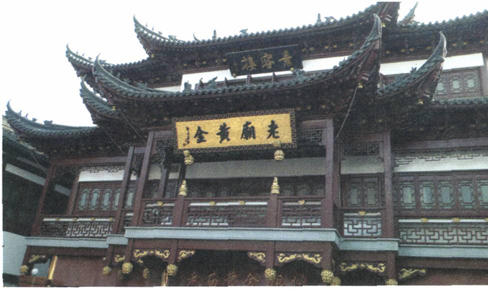
The Yuyuan Garden Area includes the renowned Yuyuan Garden as well as the Yuyuan Commercial City, City God Temple, Old Shanghai Street, Fuyou Road Small Goods Market, etc. Shanghai people habitually refer to this area as Old City God Temple. If you just go for eating, drinking, having fun, and shopping, you would generally claim to go around Old City God Temple. Only when you specifically go to the garden will you say that you go to Yuyuan Garden.
Old City God Temple: a paradise of snacks
The whole Yuyuan Commercial City consists of many small streets lined with shops. In the commercial city almost anything imaginable is available, including those flying in the sky and those swimming in the water. And the snacks here are exceptionally well known. If you spend a whole day walking around here, your hand and mouth would be busy all the time. Besides the conventional snacks, you can also find some seasonal dim sum.
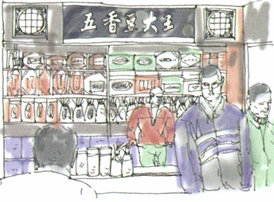
The most famous is, of course, the five-flavored creamy broad beans. Shanghai people likes to tell visitors, "Those that have not eaten such beans cannot be considered as having been to Shanghai." The golden plate of Shanghai Five-flavored Creamy Beans attracts the eyeballs of tourists every day.
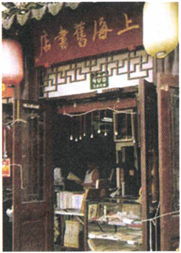
Hundred-year-old shop near Old City God Temple
Another special product of Shanghai is the pear syrup candy. It is said that the candy was first concocted by Wei Zheng, Prime Minister of the early Tang Dynasty, over 1,300 years ago.
Shortly after the founding of the People's Republic of China in 1949, the pear syrup candy shops in City God Temple merged into Shanghai Pear Syrup Candy Shop, which made great improvement of the product in terms of production, variety, and packaging. At present, there are two types of pear syrup candies: medicinal and catering. The medicinal pear syrup candy can relieve cough and asthma as well as whetting up appetite. It is made by mixing and cooking traditional Chinese medicine and sugar. The catering pear syrup candy, with dozens of kinds, is made with the addition of rose, osmanthus, and various nuts. Shanghai City God Temple Pear Syrup Candy is famous for its excellent quality at home and abroad.
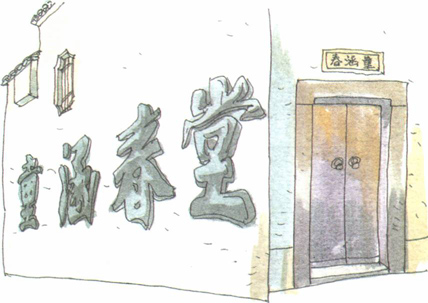
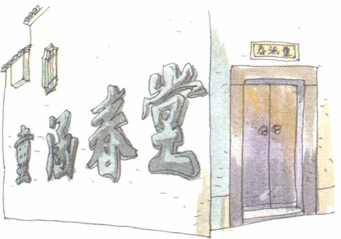
Yuyuan Commercial City has quite a number of old shops. Yuyuan Tonghanchun is the first garden-style traditional Chinese pharmacy. With a corridor, a courtyard, terraces and pavilions, the pharmacy leaves a new impression on people. Above the gate on the golden horizontal board are four black Chinese characters Tong Han Chun Tang, meaning Tonghanchun Pharmacy, the handwriting by Lu Run, a Zhuangyuan during the reign of Emperor Guangxu of the Qing Dynasty.
Tonghanchun Pharmacy hasundergone a tortuous developmental process. TongShanchang, the founder of the pharmacy, secured his foothold with Taiyi Baozhen Ointment and then opened up a new prospect with Ginseng Zaizao Pills, thus establishing a prosperous business. At the beginning of the 20th century, however, the Tongs almost headed for bankruptcy because of business failures. And until 1933, the family had to sell out part of their shares. According to the asset assessment at that time, the brand name Tonghanchun Tang is valued at 80% of the total shares.
Yuyuan Commercial City: a world of miscellaneous goods
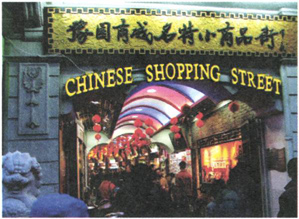
What attracts most foreign tourists is probably the strong Chinese flavor. On the side of the well-known Yuyuan Garden is a narrow by-street lined with buildings of the Ming and Qing Dynasty style. Scores of old-brand shops stretch out in rows. With shop flags fluttering in the wind, all the shops tell people exactly what goods they specialize in. Here you will find Scissor King, Button King, Ribbon King, Stick King, Chopstick King, Angling Apparatus King, etc. Needless to say, this is a kingdom of miscellaneous goods.
With traditional featured shops of Shanghai City God Temple converging here, this street fully reflects the special business features, i.e. small, local, special, famous, and outstanding. Dozens of city or district featured shops line the street with more than ten thousand goods. Here can be found not only old-brand shops with a long history, such as Wangdalong, Liyunge, etc. but also nationally unique shops with a history of about half a century, such as Chopsticks Shop, Stick Shop, Bottle Plug Shop, etc. At every temple fair, people of all walks of life, men and women, old and young, flock here, eating, drinking, and shopping. Sometimes, they might buy gifts for relatives and friends. The whole place is a scene of arich nation and happy people. On the occasion of the SpringFestival and holidays, lots of large red Chinese knots arehanging up.
Yuyuan Commercial City is a good place to purchase gold jewelry. Chinese people cherish a special liking for gold and silver ornaments. Gold and platinum are bright in color, indicating wealth and happiness; silver can test out a number of toxins. Both gold and silver are inflation-proof and even rise in value. To date, on the occasion when young people get married, new babies are born, or elderly people celebrate their birthdays, people will purposely buy some gold or platinum jewelry to add some more happiness. On the outskirts of the commercial city, there are several jewelry shops, bustling with people.
Shanghai people prefer to go outside the commercial city for shopping. Fuyou Road on the north is a street full of miscellaneous goods shops quite well known all over the country, and it is by no means less bustling than the inside of the commercial city. Various articles from toys to jewels and from car models to homeappliances could be found here. The girls that are crazy about new styles would like going there. It is very interesting for them to fish treasures in a sea of goods.
The past and the present of Old Shanghai Street
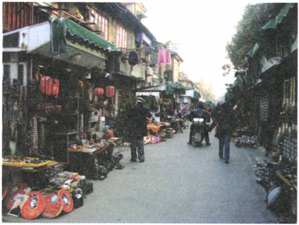
If Fuyou Road is too noisy for your taste, then the Middle Fangbang Road might be the right one for you. It is an old Shanghai Street rich in the Ming and Qing Dynasty flavor. Just walking there would make you experience another atmosphere of the city.
Fangbang, meaning Fang Creek, was originally a waterway that ran from west to east through the old city. The banks on both sides of the creek were the origin of the old city. In the 10th year (1077) of the Xining Period of the North Song Dynasty, Shanghai wine magistrate had an office along Fang Creek to collect wine tax. During the Xianchun Period of the South Song Dynasty, Shanghai Town was established here, taking up the area on both sides of the creek. Special offices were set up to administrate overseas trade, warehouses were built to examine the imported and exported goods, storehouses were constructed for rice and wine, and officials were appointed for social security. Besides, there were also Taoist temples, City God Temple, private schools, a government office, etc. After some exploitation and construction, Shanghai Town began to prosper. As was described by Tang Shicuo, a man of letters at the end of the Song Dynasty and the beginning of the Yuan Dynasty, Shanghai Town, which is the present-day Old Shanghai Street, was already a large town with a lot of boats and vehicles and rows of shops. In the next 200 years, it became a prosperous town with a large population; therefore, in the 28th year (1291) of the Zhiyuan Period of the Yuan Dynasty, it was promoted to Shanghai County. And in the Ming Dynasty, Shanghai had grown into a well-known city in Southeast China.
The commerce of Shanghai originated from Little East Gate at the east end of Fangbang Road. This area is linked with the docks and wharfs by the side of the Huangpu River. So far it is pretty difficult to find out the names of the shops in the Yuan and Ming Dynasties. In the 34th year (1908) during the reign of Emperor Guangxu of the Qing Dynasty, shops such as Tonghanchun Pharmacy, Fengdatong Sauce Shop, Laotianbao Jewelry Shop, Yedachang Confectionery, and Xiedaxiang, Baodaxiang, and Xindaxiang Cotton Cloth Shops began their business here one after another. Moreover, a number of the earliest money shops, gold shops, silver shops, wine shops, teahouses, theaters, and firms converged here. Fangbang Road has accumulated the over-700-year local commercial culture of Shanghai.
The reconstructed Old Shanghai Street is 825 m long, and is divided into the east section and the west section with Guanyi Street in between. In the old days, Guanyi Street was lined with an official courier station as well as hotels and lodges. The west section mainly consists of buildings imitating the Ming and Qing Dynasty architecture while the east section maintains the characteristics of civil residences at the end of the Qing Dynasty and at the beginning of the Republic of China. The restoration enables the old street to go back to the end of the Ming Dynasty and the beginning of the Qing Dynasty. Old Shanghai Street with a history of 700 years has revealed the shifts in history and culture, and is also the first street in Shanghai that is rich in national traditions and cultural charms.
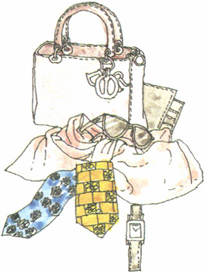
In the Old Street, not only are the buildings elegantly attractive, but the shops are also competitive in terms of specialty and uniqueness. Those that love Chinese garments must be enchanted by the Old Street, in which there are many tailors'for Chinese garments. What's more, the prices here are lower than their counterparts in other streets. Clothes and shoes for men and women, adults and children are available. While shopping, you could also find such accessories as embroidered pearl handbags, round fans, folded fans, hand-painted parasols, pseudo-antique jewelry, jewelry boxes, tissue-paper boxes, gift chopsticks, etc. that are typically of Chinese characteristics.
In the Old Street there are many Chinese national handicraft products, such as writing brushes, gourds, abacuses, calligraphy and painting, lanterns, kites, tea sets, knives and swords, and whatsoever; almost everything that is seen in old movies and described in novels can be found here. Besides the traditional goods, clothes and accessories as well as handicraft products of the Zang people from Xizang and other minority nationalities are also for sale here. Those tapestries of exquisite craftsmanship and brilliant colors often make the tourists reluctant to leave.
In addition to the old goods, the Old Street is also decorated in the Ming and Qing Dynasty style. Hanging under the eaves of the shops are red lanterns, the Chinese characters on the plates above the door frames are read from right to left, and yellow wine flags are fluttering against the wind, on which are written Book, Rice, Wine, Tea, and other Chinese characters; therefore, people can immediately tell the items the shops sell. Some of the shops have both Chinese and English written on the wine flags, and some even have Japanese added. Quite a few shop assistants can speak a little English, which reflects one of the facets that the street has been internationalized and commercialized.
The charms of the Old City are fully manifested in Yuyuan Commercial City and Shanghai Old Street, which make up a small area. However, this area has recorded the thriving prosperity of Shanghai and will make the prosperity continue.
Dongtai Road: Nostalgic Mood in a By-road 东台路:上海古玩市场的怀旧情结
It is said that quite a number of Shanghai tour guides published abroad have mentioned three spots people must visit in Shanghai. They are the Bund, Yuyuan Garden, and Dongtai Road. Why does this small roadvery inconspicuous in the Map of Shanghai enjoy such a high prestige at home and abroad? Come and walk around if you have time, and most probably you will also like it.
The love for the antiques
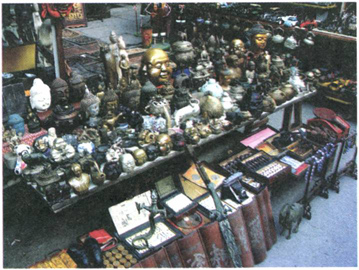
The Antique Market of Dongtai Road is located at the mouth of Dongtai Road and Liuhe Road in Luwan District. It is actually a featured trading market for old handicraft works. As soon as you approach the bustling road, you will see a towering superb arch, on which is a horizontal board with the Chinese characters Dong Tai Lu Gu Wan Shi Chang, meaning Dongtai Road Antique Market, inscribed by Liu Danzhai, a renowned Chinese calligrapher and painter. As a matter of fact, the whole market is slightly over 200 m long. However, shops of ancient Chinese architectural style are all along the street. Even though most of them trade ceramics, copperware, tinware, jade articles, bamboo articles, wood articles, the four treasures in a traditional Chinese study, calligraphy and painting, and other handicraft works, each shop has its own style and characteristics in decoration and the articles it sells.
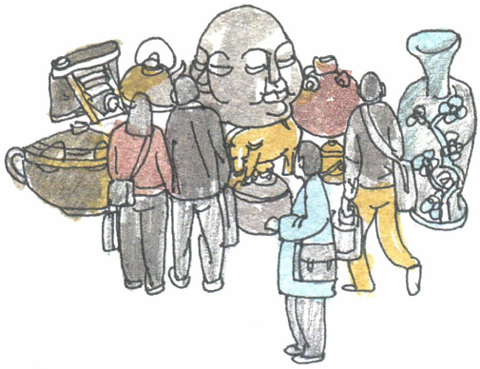
The street was originally a cricket market. Chinese people have had a long history in cricket fighting. From monarchs and high officials to ordinary people, almost everybody enjoys watching the warfare between the tiny insects. Therefore, some people specialize in doing business related to crickets: trading the winning generals and selling special jars for crickets, etc. Later on, probably in the process of doing the trading of cricket vessels, some invaluable antiques were discovered from time to time; thus, the cricket market gradually turned into an antique trading place. Some visitors are frequent customers that cherish a real liking for antiques or enjoy collections, and other visitors are mere tourists. If you happen not to be expert at antiques, it does not really matter, for the collection of antique in itself is special expertise. To tourists, the real fun lies in enjoying such an unusual culture. In the collection field in China, there is a special term, i.e. acquiring what other people have overlooked. Only those who are very observant and expert at finding something special or have experienced ups and downs could discover real treasures. The process from discovery to acquirement is, indeed, very meaningful and a fun process.
There are many stories regarding acquiring treasures. The owner of one antique shop was asked to appraise an antique that the client had recently acquired. The shop owner recognized at first glance that it was duplication; certainly of no value. However, just as he was about to leave, he noticed a pile of broken flower pots and trashes in the courtyard. He gave them a quick glimpse and then said, "You'd better sell the trashes under the eaves. They are by no means good-looking." Without thinking, the client said, "They are all trashes. If you like, take them away." Consequently, the shop owner took them out of the courtyard and sold everything except a very ordinary-looking porcelain vase. After a meticulous appraisal, he found, to his great joy, it was a genuine invaluable antique. He was a man of keen observation.
For many years, the antique market in Dongtai Road has experienced a lot of ups and downs. In the present-day shops, both the owners and the frequent customers are more often than not master-hands in the trade of antiques. Jiayi Yixing Clay Handicrafts Shop specializes in the trade of Yixing clay teapots. The owner of the shop is said to be the first private boss that has sponsored a display and sale of Yixing clay teapots in a large international hotel. Huayi Tu is a manufacturing shop with its workshop in its rear; the Bird Cage King, which sells a variety of bird cages; the Three-inch Lotus Shoes, which sells only ancient Chinese shoes; and shops that exclusively sell works of calligraphy and painting and that sell only carved wooden articles. Thanks to the leading role that such shops take, Dongtai Road could enjoy its prosperity today.
Nostalgic Old Shanghai
In addition to the major goods like ceramics, bronze wares, tin wares, jade articles, bamboo articles, wooden articles, traditional four treasures in a Chinese study, artworks of calligraphy and painting, etc., some old goods of last century or even older can be found here. For example, bamboo bird cages of traditional Chinese style, ancient coins with rust stains, and the 1930s' calendars that obviously represent old Shanghai style can be discovered here. In the 1920s and 30s, the most up-to-date fashion for Shanghai women was the slightly permed curly hair, two arched eyebrows as thin as willow leaves, and the traditional cheongsams without sleeves so that their smooth arms were exposed. Movie stars in Shanghai all followed this fashion. Like their counterparts today, they were the representatives of the vogue of the times. As a result, their photos were usually printed on the calendars. In those years, such calendars in the home would have been considered as the most fashionable decoration.
Besides, you could come across many special articles that were the classical representatives of one time or another in China, which have rarely been kept in ordinary urban families. It is next to impossible to trace out the sources of such articles. In the 1960s and 70s, China underwent a political movement. During those abnormal years, the antiques, decorative ornaments, or even slightly fashionable daily necessities that many families had valuably treasured or used were forbidden in actual use or for mere decoration, and even confiscated or destroyed. Consequently, the articles that had escaped the destruction in those years and can be seen in the markets nowadays are real curios. Most probably there is an unforgettable tale in each of them! The shop owners engage themselves exclusively in collecting and trading such old articles. For instance, old phonographs, electric fans, radios, cigarette lighters, etc. produced 40 years ago or even earlier probably stopped working long ago. However, history and life have bestowed them with positions and significance then, and they look exceptionally interesting and even valuable.
When looking at such articles, you might feel unfamiliar or even strange; therefore, you would take a close and careful scrutiny at them with curiosity. That's OK! Let some of the things that belong to memory be kept in memory! There are people that appreciate them and cherish them; then, they will give such articles a new position. In case a customer actually wants to buy something, the buyer and the seller could negotiate over the price. When they finally reach a compromise, the buyer would take home the treasure, feeling as happy as a lark deep in his heart.
Shanghai Confucian Temple Book Fair: Used Books in Shanghai 文庙书市:上海旧书淘宝
Today's Shanghai Confucian Temple Book Fair is more an amusing tradition in Chinese culture and history than a mere platform where book lovers exchange ideas and do studies.
Historical anecdotes
If you are observant enough, you will find that the process thatthe frequent visitors pick books is a uniquely special scene. For this process there is one word in the Shanghai dialect, i.e., Tao, in the meaning of carefully identifying, patiently choosing, and painstakingly hunting for treasures. Not only can rare books be considered as treasures; to the book lovers, all the books that they want are treasures. They would go through all the bookstands, searching for the books on display. Of course, the skill of Tao cannot be acquired in one day or two. Some people would stay in the market with snacks or even a boxed meal for a whole day. Like the people that pan for gold, book hunters enjoy the pleasure and fun that some people can not understand.
Shanghai Confucian Temple Book Fair
Shanghai Confucian Temple, located in the old city of Huangpu District, was built in the Yuan Dynasty (1294 AD) and the only temple in the city center of Shanghai where Confucius, the cultural sage in Chinese history, was offered sacrifices. And it was also the only sacred school in Shanghai during the Chinese feudal times over 100 years ago. At that time, the most fundamental imperial competitive examinations were held here every year. And the chosen candidates were termed as Xiucai, who were entitled to a higher-level examination. Xiucai was only a title, which enjoyed very high respect among ordinary people in ancient China. Therefore, Confucian Temple is both a temple for Confucius and a county school, which was supposed to be the highest school in Shanghai then. It is quite common that the temple and the school were combined. Shanghai Confucian Temple was renovated in the Qing Dynasty (1855 AD), about 150 years ago.
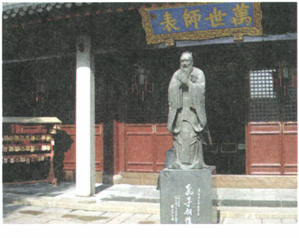
On the days when the book fair is open, Confucius is looking square at the crowds of people with smiles. Even under the eaves along the houses on both sides are bookstands with lots of people coming and going all the time.
Business hours: 9:00 - 16:00 every Sunday
A stroll in the book fair
A brief history of Shanghai Confucian Temple
The major architecture of Shanghai Confucian Temple is the Dacheng Palace. Right beneath the upper eaves is the vertical board with three Chinese characters, Da Cheng Dian, meaning Dacheng Palace, in a vertical order. It is said that the characters were the handwriting by Emperor Yongzheng of the Qing Dynasty. On the horizontal board beneath the lower eaves are the four Chinese characters, Wan Shi Shi Biao, meaning a teacher for thousands of generations, with which people have been eulogizing Confucius. On the pedestal in front of the palace erects the bronze statue of Confucius. Further forward on the right of the statue is a Dacheng Bell cast in the modern times, which is 1.1 m in diameter and 1.5 tons in weight. When struck, the bell resonates and echoes for almost three minutes. The two bell ears bear the pierced sculpture of dragon patterns, and carved on the waist of the bell are the pictures of Confucius' tours.
The outermost entrance of Shanghai Confucian Temple is the Lingxing Entrance, which consists of one major gate and two side gates. The stone arch gate frames are of ancient Chinese architecture. In front of the gates, there are two mighty stone lions and six stone blocks, leaving people a deep impression of dignity. The major gate is the traditional half-open fencelike wooden door, through which from the outside can be seen the majestic Dacheng Gate. This gate is painted red and conventionally closed fast, but opened only for the arrival of emperors and highest local officials.
Walking out of Dacheng Palace and making a left turn, you will find a different world in the courtyard. Separated from the book fair by a wall, there is the grand and towering Zunjing Building, which used to be the earliest national library in Shanghai. Built in the Ming Dynasty, it was once the bibliotheca of the imperial family. The Zunjing Building, simple and elegant, bright and colorful, has been rendered into other uses today. Displayed on the corridor around the building are dozens of grotesque and august stones. A quiet and comfortable Grand View Garden of grotesque stones, making a sharp contrast with the noisy book fair outside, is silently narrating the vicissitudes Shanghai Confucian Temple has experienced.
Fun in hunting for books
Shanghai Confucian Temple Book Fair is open only on Sundays. If you pay a visit to the temple on the day when the market is open, you will definitely derive a lot of fun.
What is most extraordinary in the fair is that some rare books from home and abroad might show up from time to time. Most of the shop owners keep mute about the sources of such books and their relationship with the former owners of the books. If they should chance upon an old book, they would not let it go hastily, because such a book usually exceeds its par value and is most likely to be collected as antique. As some veteran experts say, many good books were originally in the possession of wealthy people of letters. However, due to the vicissitudes of time, family declining, or descendants disliking old books or failing to realize the value of old books, such books were sold. Passing through different hands, such books would sooner or later be recognized by knowing people who would buy and collect them at all costs. That's why some experts and scholars that specialize in culture and history can usually run into new findings here.
It seems that the place with the most cultural ambience in a city ought to be where there are many books. The bookstores in Shanghai are by no means few: Shanghai Book City, China Science and Technology Book Company, Ancient Book Store, Foreign Language Book Store, etc. in Fuzhou Road, and Xinhua Book Store in East Nanjing Road is said to be the No. 1 among all the book stores in Shanghai. Nevertheless, if you'd like to enjoy a real taste of traditional Chinese culture in a book market, you must go to Shanghai Confucian Temple Book Fair. A visit to a book fair may probably give you some unexpected harvest and fun.
On one side of Lingxing Entrance is the ticketing office. Going through one of the side gates and then through Dacheng Gate, you will, all of a sudden, see a bright open space. The book fair is set on the brick square of over 1,000 m2 between Dacheng Gate and Dacheng Palace. It has formed a shipshape order after years of business. The closer to the Dacheng Gate, the more customers the bookstands could serve. The permanent stands usually have rare books from different historical periods. Many of the stand owners have been engaged in this business for years. They carefully wrap up their rare books with plastic sheets, but do not mark out the prices. They would patiently wait for really understanding customers. After much bargaining and reaching a price, they would then make a deal. Generally, the rare books are not supposed to be unwrapped before the deal is made. And the price is, more often than not, not negotiable, thus not too much bargaining. If you happen to be a novice or a new visitor, you could just go around and get to know each stand, and finally decide on what to buy and how much to pay.
Books normally found in bookstores are available here. However, as it is a book fair, such books are heavily discounted. The most popular books are the out-of-print books of some times. Such books include the thread-bound books from the Qing Dynasty to the early years of the Republic of China, old books and maps, a variety of books, newspapers and magazines from the Cultural Revolution period in the 1960s and 70s, and the picture books published a long time ago.
As an old Chinese saying goes, there is food, wealth, and beauty in books. Its literal meaning is that reading books can bring about great wealth and long-dreamt happiness. Therefore, in the Chinese culture and history for thousands of years, the respect for book-reading and knowledge is almost sacred.
Address: No. 215, Wenmiao Road, Huangpu District
Shanghai Museum of Handicrafts and Fine Arts: Treasure House for Exquisite Artworks 上海工艺美术博物馆:艺术精品收藏宝地
With a sense of opening up and extensively absorbing the essence of various handicrafts, the modern and contemporary handicrafts and fine arts in Shanghai have formed an evident local style, and become one important component part of Shanghai local culture. For the purpose of expanding the traditional spirit of excellent national culture, Shanghai Museum of Handicrafts and Fine Arts collects and exhibits the works of modern and contemporary handicrafts and fine arts in Shanghai, reflecting the cultural background of the development of Shanghai handicrafts and fine arts as well as demostrating the production that reveals the heritage of various professional techniques and skills. Every visitor can get acquainted with the Shanghai style of handicrafts and fine arts, and meanwhile could experience in person, appreciate, and find out the traditional handicraft expertise that is on the edge of extinction.
Small White House in Shanghai
The museum is located in a garden villa in Fenyang Road. The garden is verdant with grass and trees, offering a very quiet environment. The main building, built in 1905, is a small white mansion of French renaissance style. Because of its resemblance to the White House in Washington, D.C. of the United States, it is referred to as Small White House in Shanghai. This garden villa is not only beautiful in architecture but also has quite a number of historical stories in itself. Right after the completion of construction, it was the residence of Director of the Municipal Administration of French Concession. After the Anti-Japanese War, WHO of the United Nations was once set up here. After the founding of the People's Republic of China, Marshal Chen Yi, the first Mayor of Shanghai, took it as his administrative office. Later on it became the office of the Sino-Soviet Friendship Association. From 1960, Shanghai Research Institute of Handicrafts and Fine Arts, the predecessor of Shanghai Museum of Handicrafts and Fine Arts, was located in this building.
Shanghai Research Institute of Handicrafts and Fine Arts, founded in 1956, has established 18 professions including bamboo carving, ink slab carving, fine carving, porcelain carving, little leaf box wood carving, jade carving, ivory carving, embroidery, paper cutting, plastic mask making, color lantern making, etc. It has a group of veteran artists and professional technicians of traditional handicrafts. As one of the earliest tourist sites that were open to foreigners, it has received leaders of Central Committee of CPC and the Central Government and foreign heads of state, totaling almost 100, as well as thousands and thousands of domestic and overseas tourists, thus of very high reputation all over the world.
Artworks by masters for collection and appreciation
Sponsored by Shanghai Municipal Government and directed by Shanghai Cultural Relics Management Committee, Shanghai Museum of Handicrafts and Fine Arts was founded in May 2002. Based on the original Shanghai Research Institute of Handicrafts and Fine Arts, the museum has collected more excellent artworks and accepted donations. It has set up comprehensive handicraft works hall, carved artworks hall, knitting and embroidery hall, and folk handicraft works hall. It has consistently displayed the exquisite handicraft and fine art works that have been produced since liberation in 1949, and several hundred works by the masters of Shanghai from the 1930s up to now. There are about 10 workshops where the traditional handicraft skills can be performed, including jade carving, lacquer ware making, embroidery, paper cutting, plastic mask making, color lantern making, etc. Besides, there is a multifunctional exhibition hall, where special exhibitions of artworks and handicraft works from home and abroad are held from time to time. And there is a souvenir and handicraft shop carrying about one thousand items for sale.
Displayed in the comprehensive handicrafts hall are some gold and silver wares of Shanghai style, ornamental handicrafts, carved mahogany handicrafts, screens inlaid with lacquer wares. Many of these items are either prize-winning pieces or special handicrafts of Shanghai that have almost gone extinct. In the carved artworks hall, there are the posthumous works by Chen Duanyou and Zhang Jing'an, two renowned ink slab carvers, and the representative works by their students. Also displayed are the works by Zhi Ci'an and Xu Subai, two famous bamboo carvers; the posthumous works by Xue Foying, a distinguished fine carver, and the representative works by his children and students; the posthumous works by Yang Weiyi, an illustrious porcelain carver, and the representative works by his students; the works by Xu Baoqing, a reputed little leaf box wood carver, and the representative works by his students; and the large wood carving May 30th Storm. All these works, bearing very strong Shanghai characteristics, are more than 50 years old. There are also quite a few exquisite works of jade carving and ivory carving, for example, the ivory carving Thousand-hand Avalokiteśvara, ivory fine carving Fish Scenery by Xu Wanfu, a noted ivory carver, etc. In the knitting and embroidery hall, the woolen embroidery The Portrait of Dr. Sun Yatsen by Gao Wanxiu, who is the late handicraft and fine art master in China, is exhibited. And also on display is the woolen embroidery The Sistine Madonna by Liu Peizhen in collaboration with her five sisters. This artwork was produced in 1956 and participated in Leipzig World Expo in 1957. It is one of the very few existing woolen embroidered portraits of early times. The opera costumes designed by Xie Xingsheng, a handcraft and fine art master in China, and the original drafts of the opera costumes he designed for Beijing Opera master Zhou Xinfang and others are also exhibited here. Especially the opera crown made up of the feathers of river kingfishers is exceptionally valuable and is one of the very few feathered head wears that are already several dozen years old. And on display in the hall are also the posthumous works and the book Woolen Thread Knitting Skills by Feng Qiuping and Huang Peiying, well known woolen knitters in the 1930s, as well as the photos of Zhou Xuan, Wang Danfeng and others wearing the woolen sweaters they had knitted. From the exhibits the visitors can not only appreciate the superior skills but also get to know the fashion trends in the 1930s and 40s. In addition, quite a number of artworks of Shanghai needle embroidery and machine embroidery in the 1970s can be found here. In the folk handicraft works hall are exhibited the posthumous works by Wang Zigan, a paper cutting expert, and the exquisite works donated by Lin Ximing and Ruan Sidi, two famous paper cutters. Of different styles, they have been the representatives of three major genres of paper cutting in Shanghai. After watching their works, the audiences could get to identify their respective uniqueness and elegance. There are other exhibits in this hall, such as the posthumous works by Zhao Runming, a famous dough-modeling master, such as his Zhong Kui's Sister Getting Married, The Longevity God, etc. and the posthumous works by He Guangming, a lantern king in south China, such as his The Rooster Lantern, etc. All these works are of a history of dozens of years. Faded in color as they are, they still look attractive to the visitors. In the hall are also shown the works by these masters' students that are handicraft experts of a new generation. They have made great efforts to inherit and expand the traditional handicrafts and fine arts, taking over the excellent traditional handicraft skills.
Ever since it was open to the public, the multifunctional hall have held exhibitions of not only the handicraft works of Shanghai and personal works but also the exquisite artworks from other provinces and cities, normally once a month. Many of these high standard exhibitions enjoyed admiration from visitors. For example, the Exhibition of Spring Festival Pictures showed some 100 original Spring Festival pictures from the end of the Qing Dynasty to the early years after liberation. The First China Teapots Appraisal Exhibition displayed quite a number of teapots from Yixing, Changxing, Wuxi, Changzhou, Shanghai, and other places, which won very favorable comments by Zhang Wenbin, the director of China Museum Association. And Guizhou Miao National Handicraft Works Exhibition, the First Shanghai Handicraft Works and Fine Art Works Appraisal Exhibition, and others have all enjoyed positive comments from the audiences.
The souvenir shop also have a great many wonderful articles, souvenirs, and old handicraft works of the late Qing Dynasty and the early Republic of China, which the visitors like to buy.
Address: No. 79, Fenyang Road, Shanghai
Telephone: 021-64314074
Tang Garment Shop: Embodiment of Wonderful Chinese Charms 唐装商店:包容着美妙的中国神韵
Most probably, you still remember APEC 2002 in Shanghai. The heads of state were all wearing traditional Chinese garments and made a group pose. Very impressive, aren't they? What they wore is Tang garment.
Actually, the term Tang garment does not refer to the clothes of the Tang Dynasty, but stands for the traditional Chinese clothes. The advent of the term seems to have a touch of internationalization.
Just a few years ago, the movie The Prime of Life, directed by Wang Jiawei, shook the world for the beauty and charm of the Chinese women. The heroine wore 20 to 30 cheongsams of different styles in a variety of situations. Along with the gentle and melancholy melodies, she slightly swayed her waist, expressing the romantic but sad love nonverbally. As one of the traditional attires for Chinese females, cheongsam leaves the whole world an impression of surprising beauty. The Tang garment made today has undergone some innovative changes in cutting and material pattern in comparison with the traditional clothes. For both Chinese and foreigners, it could be considered as keeping up with fashion to have a Tang garment of one's own today!
Today's Tang Garment
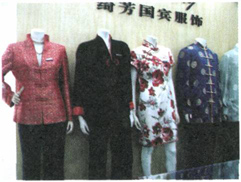
Although today's Tang garment has been renovated, it has taken advantage of the 3D cutting of the Western suits and, consequently, become better looking and more fashionable on the basis of maintaining the beauty of tradition and nationality.
Let's have some examples. The Chinese clothes nowadays are seldom made with the adoption of sleeves as a continuation of the body, because by so doing the lines of the shoulder part will drop so that this part of the garment will slump, not in agreement with aesthetics of modern fashion. Moreover, it is rather complicated to cut that kind of clothes. The ancient Chinese clothes did not have curves at the waist; therefore, women wearing that kind of clothes would lack the line of beauty. The renovated garment similar to exquisitely made Western dresses for females can show the beautiful shape of a woman. And as for the cheongsam, the splits on both sides of the skirt part of a traditional cheongsam used to be pretty high. Although people today are more open-minded, the women wearing cheongsams are, after all, different in terms of social positions and environments. As many of them are office employees, in order to follow the proper office attire the splits are relatively low.
At present, the outer material is no longer limited to silk only. Tang garment made of leather has made its debut in the market, and is getting popular among the fashionable young people. The combination of real leather and Tang garment not only maintains the original charms such as grace, gorgeousness, elegance, and casualness but is also stiff, smooth and imposing.
Modern Tang garment is no longer only suitable for ceremonies and festivals, but also in life and work.
Choice of Tang garment
The heads of state that participated in APEC and the world famous players of 2005 Shanghai Master Cup Tennis Tournament have made Tang garment more and more elegant and exquisite. In Shanghai, the capital of fashion in China today, it is very easy to choose a favorite and suitable Tang garment.
It is a must for you to go to Shanghai Silk Mansion, which has ten chain shops in Shanghai and is a famous silk shop in China. It boasts the most complete, most numerous, and best materials for Tang garment and offers the most meticulous and high-quality services. They took over the task of making the Tang garment for all the heads of state that participated in APEC that year. In each of the chain shops, you will see the photos showing that the celebrities and royal members of different countries have patronized this shop. You could enjoy the service of having your own Tang garment custom made. And if you'd like to bring back home one Tang garment for your relative or friend, who happens not to be on the spot for measurement, the professional tailors in the shop can still make nice and fit garment if only you could tell them the sizes.
Of course, when you take a walk in the lanes and streets that are permeated with cultural ambience and artistic sentiments in Shanghai, you are often likely to chance upon some small fashion shops that sell ready made Tang garment. Such privately owned shops usually have some unique fashion items. The originality in Tang garment is more boldly demonstrated here. The primitive Chinese legends and the totems of all nationalities are the sources of creative inspiration. The enthusiastic shop keeper will tell you that the lotus flowers embroidered on the garment implying lifelong harmony, indicating a good marriage, and that the lively carps embroidered on the garment expressing the idea of fishes every year, meaning a plentiful life with savings every year. All these embody happiness and luck.
If you have been to the cities and provinces where Chinese minorities live or got informed of some rituals and customs of local people in different parts of China, you must have seen many national clothes and ornaments of different styles. After all, China has 56 ethnic groups! One of the most fashionable Tang garments today is the well-known cheongsam, the dress for women of Man nationality. As the Man imperial family consisted of 8 tribes, each with a flag of a specific color as a tribal symbol, the people of Man nationality were referred to as flag people. Therefore, the robe worn by Man women was called flag robe, i.e. cheongsam. For a long time even after the Qing Dynasty, Chinese women took cheongsam as their major garment. It is evidently manifested in the movie The Prime of Life. This far-reaching impact has a lot to do with the ups and downs of the Qing Dynasty, the last feudal dynasty of China.
From 1644 to 1911, the history of China was in the hands of the Man people. As they propped up in the vast grassland, their attires greatly met with the needs of hunting and going to battles. For example, the front part of the coat was loose and large with no collar attached to the coat. Instead, they put on an extra cape collar. The sleeves were very tight, and the cuffs are in the shape of half a circle like the hoof of a horse if looked at from the side. Consequently, such sleeves acquired a special term, i.e. horse-hoof sleeve, and was also called arrow sleeve. This resulted from the fact that the Man people were good at galloping horses on the grassland and fond of sports like arrow shooting, etc.
After the Man nationality unified China, the palace attire for the imperial family became more and more luxurious and magnificent. The shell is normally made by a variety of silk, and are various patterns embroidered with golden, silver, and colorful silk threads. For instance, Dragon, an animal only in legends, was the symbol of the emperor; therefore, only on the clothes and utensils for the emperor could carry the image of a dragon. Likewise, Phoenix was the symbol of the queen. Other people, officials or civilians, could only use pine trees, tortoises, and cranes that stand for longevity, and bats that symbolize fortune and luck.
After the 1911 Revolution that succeeded in overthrowing the feudal dynasty, people entirely gave up the complicated Man attire and, instead, put on the simple long robes and short coats that Han people in the Ming Dynasty wore. Some began to wear Western coats or the Zhongshan suits that represented the revolutionary spirit. Chinese short coats and Zhongshan suits remained to be the mainstream of male clothes in China even up to the end of last century. However, the Chinese women still suffered from the traditional feudal suppression in terms of clothes. In those years, women that dared to put on the Western dresses with arms and legs bare would be thought of as unprincipled and indecent. The Chinese women were very smart. They constantly made changes to the basic fashions of cheongsam, and gradually exposed their arms and legs, hence making cheongsam the female attire that was characteristic of Chinese tradition and elegant in style. No matter whether at home or in a social setting, cheongsam was appropriate, and it showed the female line of beauty. Even after the founding of New China and today, cheongsam is always a favorite for women.
Blue Flower Print Fabric: Natural Beauty of River-and-lake Re gion South of the Changjiang River 蓝印花布:江南水乡的美丽、天然
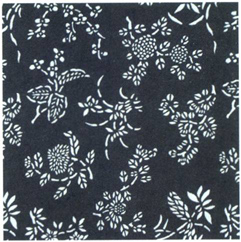
The blue flower print fabric reflects the special flavor of the water-and-river region south of the Changjiang River in China. It has now been made use of by quite a few famous fashion designers.
The handmade fabric is on the basis of traditional folk craft manufacturing in China. It is also named "indigo print" or "herbal print", which is so called in Japan. As European and American did not know its origin, they also called it "indigo print" or "Japan blue". Although it is not as colorful and magnificent as silk, its art accomplishment is by no means less glorious. It is unique and popular among the masses of Chinese laboring people of many generations in China. The fabric is dyed from natural plants. And it conveys the simple beauty of traditional Chinese folk art, pure and elegant, giving people a lot of meaningful afterthoughts.
A long history
While touring in Shanghai, you will probably realize that the most obvious feature is to appreciate the cultural spirit of receptiveness. If you'd like to know more about the fabric, we cannot but mention its actual history.
As early as the Qin and Han Dynasties, when neither was the paper making invented, nor was the cotton planting skill introduced into China, people could only carve floral patterns on both sides of wooden boards and then put hemp and silk fabrics between the boards for dying. The cloth produced in this way could be said to be the beginning of the blue flower print fabric. Cai Lun invented papermaking. In the 7th century, cotton planting was introduced into China from India. In the 13th century, Huang Daopo imparted the technology of cotton weaving to the peasants in the region south of the Changjiang River. And finally in the Ming and Qing Dynasties, the handmade blue flower fabric began to have its own manufacturing techniques and unique style. At that time, the weather and geographical environment in Chongde, which is today's Tongxiang, were very favorable for the growth of bluegrass, or meadow grass; therefore, the growing of this kind of grass was very common in the local countryside. And the folk textile technology was quite advanced. In those years, professional dying workshops for blue print fabric were seen almost everywhere.
The fabric has got a long history in China, especially in the region south of the Changjiang River, and Shanghai, the hometown of Huang Daopo. She is the pioneer of Chinese textile industry. Many Chinese people certainly cherish an intense and lingering sentiment about this cloth. For instance, on Changle Road there is the Museum of Chinese Blue Flower Paint Fabric, a simple and elegant museum of folk collection, which is open to all visitors free of charge. After a walk along a meandering path, you will go into an unusual showroom of home style. You will feel as if you were in a world of blue-and-white cloth: a bed, a round table, and wooden round stools of Chinese style, the blue-and-white artworks are naturally exhibited on everything. In another showroom, you will find a genuine weaving machine and several blue-and-white porcelain wares on the show tables. Both are similar not only in color and style but also in value and quality as art works.
More information
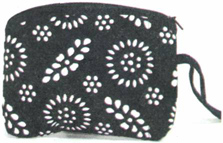
In the large and small markets of tourist products, you will readily find special goods made of this cloth; things from traditional household products and a variety of clothes to small toys, ornaments, and even the small compacts that ladies carry along can all be made of or decorated with this type of cloth. Moreover, there are some special places in Shanghai that are worth visiting. For example, the above-mentioned Museum of Chinese Blue-and-white Cloth is a place that focuses on showing the folk blue-and-white cloth. Besides the various and diversified exhibits on display, there is a section especially for the sale of products. The staff members in charge of reception will enthusiastically tell you all you want to know about this cloth. As a matter of fact, this special museum was founded by Kubomasa, a Japanese lady that cherishes a strong love of Chinese folk art, in collaboration with Shanghai Textile Import and Export Co. Ltd. The lady is said to fly from Japan to Shanghai two or three times every year. She is really a qualified envoy of Sino-Japanese cultural exchanges.
Besides, there are stores selling a variety of clothes made by this type of fabric in East Jinling Road, Huashan Road, and Wenchang Road. The clothes are usually embroidered with traditional patterns that originate from Chinese legends and stories. Wearing them, you will immediately become someone with traditional Chinese style.
Indeed, the beautiful legend has gradually passed the manufacturing craft down from generation to generation, and fully demonstrated its unique charm, i.e. naturalness. Main dyestuff is the bluegrass; in the formal manufacturing process, however, soybeans and cooked tung oil are indispensable raw materials.
The manufacturing of the fabric is not very complicated, but quite particular, consisting of four phases. The first phase is related to the pattern designing and plate making, i.e. using dots, lines and planes to form some concrete patterns, on the basis of which plates are made, polished with cooked tung oil, and then dried.
In the second phase, lime and soybean powder are mixed with water to make some paste, which would be applied onto the fabrics. Such fabrics must be dried in a cool place for 7 days.
In the third phase, the dyeing liquid that has been made out of the pigment of the bluegrass is used to dye the fabrics several times in the room temperature. Generally, light color fabric needs to be dyed 3 to 4 times, the medium color 7 to 8 times, and the dark color over 10 times. It is said that the skills in this phase are most difficult to master, because the color of the natural dyestuff is subjected to the influences of many factors. For instance, in case of overcast or rainy days, the dyed fabrics might be uneven in coloring.
In the last phase, the dyed fabric must be dried in the sun or over a fire. Then the paste on the cloth must be scraped off. And finally the cloth must be rinsed in the running water.
After getting dried, the cloth is ready to be used. The bluegrass contains some elements of traditional Chinese medicines! Therefore, it produces the effect of health protection, evaporation, sweat absorption, and insect repelling. When wearing it, you would feel as if you had returned to the Nature where our ancestors lived. This is something that can not be substituted by any industrial product.
Shanghai Museum of Blue-and White Cloth
Address: No. 24, Lane 637, Changle Road
Telephone: 021-54037947,18821083509
Business hours: 9:00 - 17:00
Chinaware Market: Chinese Chinaware Culture 瓷器市场:瓷器故乡中国的瓷文化
In English, China and china are the same word. To the Westerners, chinaware is rightfully the representative of China. Indeed, China is the hometown of chinaware! In 1298, Marco Polo, a merchant from Venice, unfolded the surprising beauty and wealth to the Europeans for the first time in his travels, thus helping chinaware go out to the world. According to records, about 500 years later, a French missionary who had lived in China for 7 years introduced the manufacturing technology of chinaware to Europe. As a result, many European countries including France, Britain, Spain, and Italy began to produce chinaware of their own.
Like all great inventions in history, the invention of chinaware was a result of gradual exploration by the primitive Chinese people in their labor. Along with the development of chinaware manufacturing technology, many beautiful tales have been spread among ordinary people ever since the ancient times. Every exquisite piece of chinaware is an artwork of life, narrating the thousand-year-old brilliant glory of the old oriental country.
A brief history of chinaware
The beautiful legend happened in Jingde Town, Jiangxi Province. The best chinaware comes from Jingde Town, which is referred to as the capital of chinaware. Actually, chinaware evolved from ceramics. The primitive chinaware can be traced back to over 3,000 years ago. And China's chinaware, in a real sense, originated in the East Han Dynasty (25-220 AD). At that time, the aristocrats in China took exquisite handicraft works as symbols of wealth, which were even buried with the dead in the tomb. From many of the unearthed cultural relics today, it is found chinaware had been made in different historical periods. And quite a number of the chinaware articles have revealed to us the early development of chinaware manufacturing technology.
The best-known period of chinaware in China is the Tang Dynasty, when the chinaware manufacturing technology and artistic creation reached high maturity. Together with the developmental progress in social economy and the exchange and merging of national cultures, China's chinaware manufacturing technology gradually spread to Japan and Persia, and even, so to speak, enlightened and influenced the development of ceramic technology in Africa. It is said that after the Tang Dynasty tri-color glazed chinaware spread to Japan, Japanese craftsmen copied chinaware and produced the famous Nara tri-color glazed chinaware. In the 8th to 9th century AD, Persian craftsmen copied the Tang Dynasty tri-color glazed chinaware and produced the resplendent multi-colored glazed pottery, called Persian tri-color glazed chinaware. And later on, even the Persian blue-and-white chinaware, a type of transparent glaze blue pottery, was also an imitation of Chinese blue-and-white chinaware pottery. At the ruins of the largest ceramic manufacturing center of ancient Egypt, in the southern suburban area of Cairo, have been unearthed approximately 0.7 million fragments of ceramics, about 80% of which were imitation of Chinese ceramics.
In the Song Dynasty of China, famous chinaware and wellknown kilns were scattered in almost half of the country; therefore, it could be said that Chinese chinaware reached its peak of prosperity then. At that time, the Jun Kiln, Ge Kiln, Guan Kiln, and Ding Kiln were referred to as Five Famous Kilns. In the Yuan Dynasty, the blue-and-white chinaware of Jingde Town was already the representative of chinaware. The blue-and-white chinawares are glazed with a transparent glaze. The blue decoration is painted onto the body of the chinaware before glazing. After the decoration has been applied, the pieces are glazed and fired. Equally famous as the blue-and-white chinawares are the blue-and-white small wares, light-colored wares, and color-glazed wares, each different from the others and uniquely exquisite.
Culture of chinaware
The beauty of chinaware lies not only superficially, for chinaware itself is an art. Its beauty embodies Chinese folk culture. The floral patterns on the wares extensively reflect the social life, ways of living, and aesthetic standards of the Chinese people. From the ancient times to the present times, the patterns expressing joy and happiness have always been the important theme of ceramic arts and a basic cultural characteristic.
For instance, it is often found that the surface of chinaware is drawn with all kinds of flower and grass. As is known in China, peony is the king of all flowers, symbolizing wealth, ranking and prosperity; orchid predicts wealth and ranking in the future generations as well as a growing family. As for the animals, dragon and phoenix represent hierarchy and auspiciousness, and lion that stands for a scholarly family is a token of good education and social grade. There could be a long list of such symbols. The advent of such symbolic implications was closely related to the primitive belief that reflects the ancient people's worship of nature. The Chinese Confucian philosophy paid special attention to the integration of heaven and man, believing that the relationship between man and nature was not that of opposition, but that of harmony. The implication that people bestow on all the beings in nature is the best reflection of such a harmonious relationship.
In China, after the appearance of genuine chinaware, it was endowed with a new use, i.e. as a musical instrument, besides its use as life tools and handicraft ornaments. As a story goes in history, there was once a county magistrate in the Tang Dynasty, who loved music very much. And he was particularly good at distinguishing the different sounds from various chinaware cups, large and small, when they were struck. He often performed in public, striking teacups with chopsticks which formed a complete set of musical notes. He could even play a variety of pleasant melodies. Such performances were quite popular in the Tang Dynasty, too.When people sing praises of chinaware, they tend to use such phrases: white as jade, reflective as a mirror, thin as paper, and resonant as a chime stone.
Choice of chinaware
Thanks to its own value and long history, chinaware is the most ideal investment that a collector of antiques makes. For example, the Butler Family, the reputed collector of chinaware in Great Britain, collected the Jingde chinaware of the 17th century, and every piece of the collection is a rare curio even in China.
If you'd like to buy antique chinaware, then the skill to identify the time of production is a profound knowledge. Some modern forgeries are not only exact duplications of the original but also of the exact weight. To determine if an antique chinaware is genuine, you are supposed to build up a lot of personal experience through reading relevant books and participating in the preparatory show at important auction companies to frequently learn from experts and professionals. And sometimes it is fun to buy something that incurs controversy.
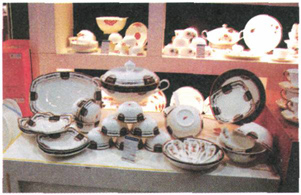
In Shanghai Museum, there is a special exhibition of chinaware and a high-grade chinaware shop as well. The chinaware sold in the shop are genuine of high quality; however, the prices are comparatively high. In the tourist souvenir shop in West Nanjing Road, ordinary chinaware products as reminding articles are available.
Shimen Road: Boutique Shops for Clothes and Ac cessories 石门路:服饰小店的淘淘乐
In the map of Shanghai, Shimen Road is a pretty long road from north to south. However, the best section of the road from West Nanjing Road to Weihai Road gathers small shops for clothes and accessories. With its own specialty goods, every shop magnetizes customers. As a result, a good many tourists, Chinese and foreign, would deliberately go out of their way to Shimen No. 1 Road, when going shopping in Nanjing Road. After a careful selection, they could usually reap a considerable harvest without having spent too much money.
At the intersection of Shimen No. l Road and West Nanjing Road converges several garment shops with unique style. ES is the brand of ETAM sportswear. From the decorations on the windows to the interior of the shop, there is a feeling of relaxation and casualness. With the blue sky, white sails and green trees as the background, the casual wear such as T-shirts and shorts is generally light in color, thus giving people a feeling of coolness in summer. The shop also sells children's clothes. The brand Ella Benny sounds foreign; however, what is sold here is cheongsam and some other Chinese clothes. And here one can also find the Sesion Clothing Shop and the Three Gun Underwear Shop.
Coming to Wujiang Road, you will find the shops here are even smaller. And they are categorized in terms of function. Hongxiang, an old shop in Shanghai, specializes in male trousers. Both Sasa and Shanghai Story sell scarves and capes; however, the difference lies in the fact that the former is prone to classical traditions and pays special attention to materials and making while the latter is quite trendy in fashion and style, laying emphasis on color and model. Therefore, you could come and purchase on the basis of your own age, character, temperament, and profession. At the turn of seasons, both shops would have great promotions. Special priced goods are piled on the cart, veteran customers and passers-by are crowding the place. Hengsheng, the name of a shop, indicates a sense of an old shop. It is a special shop for furs. The overcoats and vests are all genuine goods at a fair price. The animals of the furs range from mink, raccoon dog, hare, etc., and the colors include black, white, red, purple, etc. There are garments of one color or multi-color. And it is said that the price here is lower than half of the market price. The sheepskin slippers are the red-hot sellers of the shop because of their soft and comfortable feel. Sizes range from 34 to 44, for men, women, and children. Besides, Hengsheng also sells special products such as handicraft leather vests and handknitted sweaters, which are highly welcomed by foreigners.
Among so many shops full of colorful clothes, one is conspicuous. Ouweitaini sells only black and white clothes. However, each combination of the two colors conveys creativity. And we cannot help admiring the designers' inspiration and perspective. In addition to clothes, there are also black-andwhite shoes and belts for sale. Any customer with a purchase exceeding RMB 2,800 yuan at Ouweitaini is entitled to a VIP card. Quite a few white-collar women or females related to design professions frequently patronize this shop. Ouweitaini has set up branch shops in Huaihai Road, Maoming Road, and Fuzhou Road.
On Shimen No. 1 Road close to Weihai Road there is a fashion boutique shop named Xuan, meaning dazzling splendor. Though looking quite common from outside and inside in terms of decoration, the goods in the shop are as thrilling and exciting as the name of the shop. There is a complete series of cheongsam: long-sleeved, medium-sleeved, short-sleeved, and even sleeveless. There are a large variety of scarves in terms of material and style: pure silk with embroidery, handembroidered, pure silk with hand-drawn paintings, pure silk with in-laid golden threads, etc., and in terms of size and model: large square scarf, long scarf, and small square scarf. Of course, the price varies. The shop assistants can teach you how to wear the scarves in various patterns. The shop also carries quite a lot of jewelry and small gifts, many of which were brought back from abroad by the shop owner. For example, the jewelry boxes and bracelets from India, the color-drawn purses and dolls wearing national costumes from Korea, the mahogany chopsticks from Thailand, etc. Such small articles enjoy a warm welcome, and especially, the tourists from Southeast Asia cherish an ardent liking for them.
Chinese Medicine Market: Magical Medicine from the Nature 中医药市场:源自自然的神奇医药
If it is true that long time ago, China appeared rich and mysterious to the world, then it is also true that traditional Chinese medical science and Chinese medicine have added more color to this impression. From mythology and legend to folk tales, and from emperors, generals and ministers to civilians as well, traditional Chinese medical science and Chinese medicine is a treasure in itself. Even today, in which modern sciences are thriving, it is still full of youthful vitality.
Shanghai Museum of Traditional Chinese Medicine
If you'd like to know more about the magical Chinese medicine, you must go to Shanghai Museum of Traditional Chinese Medicine. What is displayed here is by no means a short history of development shown in some traditional Chinese pharmacy. It is a large-scale museum with a collection of 5,000-year traditional Chinese medicine. It collects over 14,000 precious cultural relics of traditional Chinese medicine from the Stone Age to the modern and contemporary times. You could appreciate the process of the traditional Chinese medicine from birth to maturity and from advent to prosperity.
It is probably beyond your imagination that the most valuable relic of the museum is a small bronze statue of a human being that is likely to escape people's notice. In 1774, Emperor Qianlong of the Qing Dynasty bestowed over 10 small bronze statues of human beings on the officials that had participated in the compilation of a set of medical books. This one is the only one that has survived; therefore, it is invaluable. The earliest cultural relics the museum has collected are the stone needles and bone needles of the New Stone Age. It is said that they were the most primitive medical instruments, as old as the 5,000-year Chinese history.
You will also come to know that in addition to herbal medicines, Chinese doctors began to perform surgical operations a long time ago. The set of the surgical instruments of the Southern and Northern Dynasties, which were unearthed in Xinxiang, Henan Province, is sound evidence. Among the collections, several incospicuous orange pills are actually the far-famed Longevity Pills unearthed from the tomb of Wang Xizi's sister, a great calligrapher of the Jin Dynasty. Ancient people cherished a persistent dream of immortality; consequently, a good many people died young because they had taken the wrong medicine. Nonetheless, the traditional Chinese medicine did, indeed, grow up on such fundamental practices. As the legend goes, the Chinese god of medicine traveled over mountains and across rivers and tasted hundreds of herbs with the intention to hunt for good medicines to cure diseases and relieve poisons. Unfortunately, however, he died of some poisonous herbs. The medical book, On Medical Herbs, he left behind is the earliest medical academic book still surviving in China.
In the theme hall of the traditional Chinese medical science and teaching, you could have a chance to be a traditional Chinese doctor. What is the normal pulse? What is the slippery pulse? And what diseases in the body do different pulse conditions indicate? And different pulse conditions are directly revealed in terms of the pulse skills: watching, smelling, asking, and pulse feeling. How mysterious, after all, are acupuncture and massage in traditional Chinese medical science? The ingenious combination of traditional science and modern technology will offer you an out-and-out explanation.
Traditional Chinese medicine is also called national medicine. The earliest pharmacy was founded in 1668, which was said to be set up by a doctor specializing in curing injuries, fractures, contusions, and strains. The most obvious characteristic of a traditional pharmacy is the combination of making diagnosis and dispensing medicine. More often than not, the front of the house was where medicines were sold while the inner or upstairs room was where the doctor diagnosed and prescribed. So, as a matter of fact, a traditional pharmacy was also a hospital.
To date, the four best-known traditional Chinese pharmacies in Shanghai are all over 100 years old. They are Huqingyu, Tonghanchun, Caitongde, and Leiyunshang. They were all named after the founders. Even today, they are still the indispensable part of the life of local civilians. And many interesting tales spread far and wide among the local people.
Leiyunshang Pharmacy
Leiyunshang Pharmacy is the oldest among the four traditional Chinese pharmacies. Lei Yunshang, its founder, lived a life full of frustrations; nevertheless, he persisted in running his business with a rigorous and painstaking attitude. His efforts resulted in the creation of several effective medicinal pills. Through the endeavor by generations of the Lei's family, Leiyunshang has been world famous for its choice of really good medicinal materials and its meticulous making of medicine.
Take for example chrysanthemum morifolium or hardy garden mum, a very common medicinal material. The chrysanthemums to be used are to be picked at the time when the morning dew has just evaporated because of the morning sunshine. It is truthfully a matter of scholarship. If picked before the dews are dried up, the flowers with water soaked will turn gray after manufacturing; if picked after being scotched by the sun, the fragrance of the material will be gone. The invention of some well-known medicine is actually a historical story. In the years of Emperor Guangxu of the Qing Dynasty, cholera broke out and became rampant in the area of Suzhou. Leiyunshang timely developed a new medicine, whose effective power reached 90%. That's why this medicine was called a panacea. In the time of the Qing Dynasty, some Chinese people began to travel abroad. As they were living a very hard life with very little medical care, they would buy a lot of medicines from Leiyunshang before leaving their hometowns. Because of the effective power of the medicines, many overseas Chinese, seamen, and Japanese customers also came to buy medicines at Leiyunshang.
The four traditional Chinese pharmacies of Shanghai have respectively set up several branch pharmacies. In the area of Jing'an Temple and Paramount, there is a pharmacy, Leiyunshang Medicine City, the largest pharmacy in Shanghai. In the pharmacy can still be seen, even today, the old photo of the first Leiyunshang Pharmacy in 1862. It was set up by LeiYunshang's descendents in Shanghai City God Temple. Because of the lapse of years, this photo is actually a duplicate. In the 1920s, Leiyunshang Pharmacy began to put up shop signs in Chinese, Japanese and English. Quite a few social celebrities at that time inscribed for Leiyunshang, including Lin Seng, Zhang Xueliang, Yu Youren, Qian Dajun, etc., which fully demonstrates its prestige in Shanghai. These precious inscriptions are kept intact in the pharmacy.
Huqingyu Pharmacy
The founder of Huqingyu Pharmacy was Hu Xueyan, a red top merchant during the reign of Emperor Tongzhi of the Qing Dynasty. In 2006, a serial TV play about this reputed historical figure was shown in China. Why was he called a red top merchant? Hu Xueyan could be regarded as the No. 1 wealthy and powerful person in China at that time. His property was related to money shops, pawnshops, silk, tea, and even munitions. He made so great contributions to the imperial court that he was conferred the position of a Second Rank official, which was considered a quite high government official. On the top of his official headwear was a red coral, a token of his rank as an official of the Qing Dynasty. And also because of Hu's contributions to the country, the emperor best owed a yellow mandarin jacket on him. In China at that time, yellow was the color exclusive for the emperor. It was a greatest honor if the emperor would bestow a yellow mandarin jacket! As a merchant that had an official headwear and a yellow mandarin jacket, Hu Xueyan could be said to be the most successful merchant in the Chinese history.
Actually, in the beginning Hu Xueyan was only an apprentice in a money shop, and knew nothing about medicine. Then why was he devoted to the career of medicine when he was at the peak of his business? As an old Chinese saying goes, "If one cannot be a high official, he can be a good doctor." In traditional Chinese concepts, medical practitioners were of a prestigiously high position in society. With a benevolent mind, salvation of all the sufferers in the world from diseases and ailments is both a virtue of the doctor and the lofty ideal of Hu Xueyan. The name of the pharmacy, Huqingyu Tang, came from a couplet at the main gate, meaning that anyone that does more good deeds will derive more joy and happiness.
Because of the urban construction, Hugingyu Pharmacy in Shanghai today was moved from its original site and settled down at No. 620, Middle Xizang Road. And in recent years, it has established branch pharmacies at No. 370, Xinzha Road and No. 614, Zaozhuang Road, Jinyang Neighborhood, Pudong Area. It sells special medicines such as wild ginseng, American ginseng, Korean ginseng, pilose sika deer horn, a variety of traditional Chinese patent medicine and raw materials, all kinds of nutrients, health foods, tonic ointments and wines, and medical apparatuses as well. Some of its brand medicines can produce nutritious and invirating function or special curing effect for asthma and cough. It is said that, to strengthen the medical effect, a special medicine is made only with a spade made of silver and a pot made of gold, and that another medicine to cure a kind of epidemic disease is to be made on condition that the workers involved must take a bath the day before. Such ways of production seem mysterious and incomprehensible; actually, however, they embody the profound secret of traditional Chinese medicine.
Tonghanchun Pharmacy
Tonghanchun Tang in Shanghai is a pharmacy with a history of 200 years. With its advent during the reign (1783) of Emperor Qianlong of the Qing Dynasty, it was originally named Zhuhanchun Tang, meaning Zhuhanchun Pharmacy. It was later changed into Tonghanchun, because a merchant by the name of Tong Shanchang from Ningbo took over the pharmacy. The pharmacy persisted that only quality materials should be selected for every prescription. The excellent business tradition has made it highly reputed at home and abroad. Branches have been set up in Shanghai, Nanjing and other places.
What is theatrical is that the valuable shop sign Tong Han Chun has got a story behind it. The four Chinese characters Tong Han Chun Tang on the horizontal board were the inscriptions by Lu Runyang, a Zhuangyuan during the reign (at the beginning of the 20th century) of Emperor Guangxu of the Qing Dynasty. At the time of its 6th manager, the pharmacy fell into a financial abyss for various reasons and had to sell out part of its shares. After an inventory of the whole pharmacy, its total value amounted to 1.46 million taels of silver. However, the immaterial assets of only the shop sign cost 1.2 million taels of silver. During the Cultural Revolution in the 1960s and 70s, this invaluable shop sign was cast into a garbage heap. Fortunately, a veteran client by the family name of Wu accidentally saw it and took it home and hid it underneath his bed. A few years later, it was brought back to light again.
Tonghanchun has a special traditional Chinese medicine. It is said that the making of a small pill calls for 59 medicinal materials and undergoes over 100 stages of production within 14 production links, strictly abiding by the ancient prescription. As a legend goes, in the 1920s and 30s, both the horse riders and their horses in Shanghai Race Course took these pills before participating in the races. The horse riders were in high spirits, galloping their horses forward, while the horses dashed forward like lightening.
At present, when you take a walk in Shanghai Old City God Temple, you will see a classical-looking Tonghanchun Pharmacy, with bright yellow external walls. And the golden-Chinese-character shop sign is exceptionally conspicuous in the light of the large red lanterns. The first floor sells all kinds of medicine, including Western medicine. In the ingenious arrangement of the traditional Chinese windows, tables and chairs as well as the pseudo-sandalwood vessels, you could not help feeling as if you were in the old times. On the second floor, you will see the medicine boxes and the medicine drawers with the eye-catching red labels on which are written the names of various ointments. The long corridor is a small museum of traditional Chinese medicine with the brief history of Tonghanchun on display. On the third floor is the clinic of the senior traditional Chinese doctors. After the patient goes through the simple procedure of registration and waiting, the doctor will diagnose him or her by means of watching, smelling, asking, and pulse feeling.
Caitongde Pharmacy
Of the four traditional Chinese pharmacies, Caitongde was the last founded. Counting from the day when it was moved from Wuhan to Shanghai, it is of a history of over 100 years. The exquisite pattern, on which were printed deer, crane, lingzhi mushroom, medicinal gourd, and the god of longevity, indicating a sense of relevance between man and heaven, was born in 1882. It is hanging high right at the center of the front hall, telling people the formal founding of Caitongde after Cai Meiqing, a cloth merchant from Ningbo, moved it from Hankou to Shanghai. At that time, it was only a small family workshop making medicine. In those days, the front part of the shop was selling ginseng and sika deer horn, pills and ointments, medicinal wines and raw medicinal materials, while the rear of the shop was used for preparing different medicines.
According to legend, the key product of Caitongde was the tiger-bone-papaya wine, which was very rare and no longer produced, because the tiger is a rare animal under national protection. However, the nutritious medicines, such as Healthy Children's Cake, are very popular among ordinary people. Healthy Children's Cake is said to be able to whet up appetites and help grow up, and to cure children of all kinds of ailments.
Today, when you step into Caitongde Pharmacy located on the Pedestrian Street of Nanjing Road, you will feel, amidst the light medicinal aroma, the ancient flavor and modern elegance of the pharmacy. The classical architectural style is a symbol of image for a traditional Chinese pharmacy. The spacious design of the multi-story pharmacy is an exclusive feature of Caitongde Pharmacy. The Chinese character Cai as the brand not only ascertains the identity and honor of this pharmacy but also turns out to be the most famous brand of all the traditional Chinese pharmacies in Shanghai.
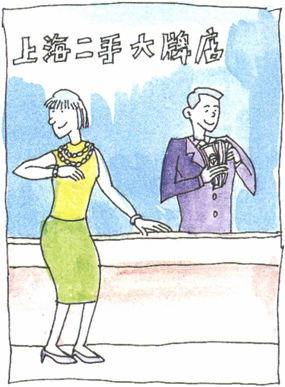
In this city there is a group of people that are different from others. Their eyes are sparkling with craftiness. They are always hunting for something that they love but other people hardly ever pay attention to. They cherish a secretive love of the second-hand goods. Looking for children's picture books at the second-hand book stalls in the Confucian Temple, seeking a used computer at a worthwhile price in the heaps of electronic products in Jiujiang Road, or surfing the Google website for a second-hand mobile phone still of good quality.
The joy of a second-hand life is diversified and secretive. Sometimes, the search for a second-hand product does not result from needs but from a sort of obsession. With a second-hand object in hand, such people enjoy a sense of history and experience that can never be duplicated. Some of them live such a life merely because of their interest in collection, and they would feel satisfied when they take out their collections for appreciation from time to time. Some of them might be touched for some details; for example, some design has only one model, and what is available can be nothing but second-hand. Still some of them adopt the attitude of taking the second-hand object as something acquired from others, and they remodel the old object, making it different from the original.
This kind of second-hand life, in which such people always follow a certain clue to find something they need, certainly lacks individuality, but it helps us to retrieve a sense of belonging, a sense of delight in artful manipulation, and a sense of satisfaction in keeping pace with the trend. Moreover, by copying a kind of life that arouses admiration, we find it easier for us to be a bird of the same feather and to show off our own individuality.
It is the second-hand sub-cultural phenomenon cultivated by the idol culture of Hong Kong that the wind coat worn by an F4 member could be sold at a price of RMB 1,500 yuan, and people even have to queue for the chance to buy one. In Tokyo, Japan, larger second-hand shops have become the trend of consumption. The second-hand Nike shoes, flared trousers and fancy shirts, and others are openly playing up the nostalgic trend. In the radical society in which more and more disposable objects are being used and anything of value can be fabricated within a split of a second, second hand has begun to be a fashion in life. Of course, the purchase of something new that is of good quality but at a low price gets the upper hand in second-hand consumption psychologically. However, to find out the sense of a story, a legend, and a time that the second-hand clothes carry is what arouses responses among the consumers.
Nowadays, we no longer have to save money on food and expenses so that we could fly to Hong Kong for second-hand products. And second-hand shops of famous brands are no longer the exclusive opportunities in Hong Kong, Macao, or foreign countries, for they are already within easy reach in our life. The advent of second-hand shops of famous brands helps young fashionable people easily go beyond the price barrier. However, it takes time for the beginners to get used to buying something that others have used.
Milan Shop: the best-known second-hand shop in Shanghai
Milan Shop, located on Xinle Road, exclusively does second-hand trade. Less than 20 m2 in size, but the store is packed with top brand bags that all women dream of: LV, Gucci, Channel, Hermes, CD, Fendi, Coach, Prada, Dunhill, Plaget, Constantin, Givenchy, just to name a few. On the shelf behind the counter, there is a small selection of top brand shoes for sale. The shop owner promises that all the products here are genuine, and offers receipts for all the products sold. What's more, he claims that Milan Shop is the only formal second-hand brand shop with a special business license in China, at least up to now.
Of all the brands for sale, LV is most popular, then Gucci, Chanel, Dior, Hermes, Prada, Fendi, Burberry and more.
It is easy to imagine that it is next to impossible to run such a shop without abundant funds and customer base. Unlike Hong Kong, where buying second-hand bags has already been a vogue, it takes time for the shop to accumulate customers in Shanghai. What a courageous move the owner took to set up this shop. As the shop assistants told us, they are always very busy with customers. Most buyers are white collars, beautiful girls, and wealthy ladies, and most of the traders are the star hostesses from Hong Kong, Taiwan and Mainland China. They usually use a bag just a few times, and then they would either sell it or substitute it for a new one. The shop charges a commission of 15% of the final price. According to the shop owner, the shop has already acquired a fixed group of customers; moreover, a good many tourists from other places have also come to the shop out of admiration, and some of them have become frequent customers.
This shop also buys second-hand bags of LV, Gucci, Chanel and other top brands. For the limited edition or good-quality bags, the price is negotiable. The accounts are all settled in cash so as to be convenient for those that are badly in need of money. And the shop owner seeks everywhere in the world for choice bags and new models; therefore, not only could new arrivals of the season be found, but those that the factories have stopped producing or that even the exclusive shops have sold out might be chanced upon. The shop can even search for any model requested. All this is done without any extra charge.
At present, Milan Shop has three branches in Shanghai with ten thousand products for consumers to choose.
Address: No. 26 Xinle Road (near Shaanxi Road)
Telephone: 021-54033136
Business hours: 12:00 - 22:00 all the year round
Juxiange: the earliest second-hand shop for brand name products in China
In the shop, hardly 30 m2, world top brand second-hand handbags, satchels, and knapsacks are exhibited on a whole wall. Self-made tags are used to indicate the brand, price, and quality. Compared with the original exorbitant prices, the discounted prices here are more acceptable. The Chanel bag from last season sells here at a price of RMB 5000 yuan, and a Ferragamo bag still 90% new sells only at a price of RMB 3000 yuan. If you are lucky enough you might chance upon a purse only at the price of several hundred yuan.
As was introduced, the owner of Juxiange was originally engaged in the agency services in China for several top brands. Because he realized the potential opportunity in the second-hand market, he whimsically decided to open this shop. The purchase and sale of second-hand watches is one of the major businesses in this shop. Here, if you spend just 20000 to 30000 yuan, you could buy the world top ten brand watches such as Earl, AP, Constantine, etc, whose original price could be over 100000 yuan. As for watches of Longines, Rolex, Omega, etc., the price is normally 40% to 60% of the original. Of course, they are 70% to 80% new, but their models are still quite up-to-date or unseen in Shanghai. These watches in the second-hand market were brought back directly from abroad. Nowadays, quite a few people tend to frequently change their watches, just as some people change their mobile phones. Consequently, most of the brand watches in the second-hand market are quite good. At present, this shop is the only maintenance center in Shanghai authorized by LVMH (Moët Hennessy·Louis Vuitton).
Address: Room S239, Hong Kong Square (South Building), at No. 283, Middle Huaihai Road
Telephone: 021-63906143
Cycle: emphasis on ingenuity of designing notions
The store Cycle was opened by A Mao and his friends. Although the two-story shop is not spacious, the luxury goods in the shop windows are enough to stop time from moving on. LV, Gucci, Dior, Chloé, Chanel, Hermès, etc. bags are second-hand, but they are all top brand genuine products.
The shop owner, A Mao, said, "I lived in Paris a long time ago. Most second-hand clothes are originated from Paris, where there are many second-hand shops or commission shops, mainly on the left side of Boulevard Saint-Germain. Later on I went to Hong Kong. On Granville Road of Tsim Sha Tsui, Garden Street of Mong Kok, Pedoer Street of Central District, and Windsor House of Causeway Bay, there are all kinds of second-hand shops. I could easily spend hours strolling in such shops. As everything is different, there is no difference in color, model, size, or season. You might bump into a limited edition antique bag or a bag once used by a celebrity. At that time I was thinking of opening a second-hand shop in Shanghai."
The small Cycle lays little emphasis on how new the second-hand luxury goods are, but a lot of emphasis on the ingenuity of the designing notions. A Mao once said that when they were collecting goods, they laid particular emphasis on minute exquisiteness. And in the process of cleaning, they did their utmost to maintain the original texture and designing beauty. Once, the most important treasure of Cycle Shop was an LV cosmetics case, which was later on bought by a collector. At present, the most valuable object in the shop is an LV antique leather suitcase that was collected in Hong Kong, at least 20 years ago.
Address: No. 4, Lane 131, South Maoming Road (near Middle Huaihai Road)
What's Up: home of all classical Levi's products
What's Up is a shop opened by Jaco, an independent Artist from Taiwan. With a profound background in advertisement and interior decoration, rich traveling experience over 20 countries, and persistence in quality and detail, he has introduced the purest American casual style to the young people in Shanghai. Goods in this shop are renewed fast, and every week sees new arrivals.
It is the only clothing shop in Shanghai that sells second-hand Levi's. Of all the goods in What's Up, 99% come from the United States. All of the second-hand Levi's jeans were meticulously selected and sterilized. Most of the classical Levi's models can be found here, including the well-known but out-of-stock jeans of 017, 015, and 001. The vogue of second-hand Levi's that has lasted in Europe and America for dozens of years has finally shown up in Shanghai.
What's Up also sells street style clothes and accessories, and most of them were brought over from the United States, Japan, and Taiwan. For example, the original Emily the Strange is also available. The coats and bags sell around 200 yuan each, and socks at 70 yuan for two pairs, very reasonable prices. At first, What's Up was located on Changle Road. As most of the customers did not quite understand why the owner should persist in quality and they were bent on low prices, the owner moved his shop two years ago to Taikang Road, an art street with a relatively strong art atmosphere. He would rather sacrifice the number of customers as long as he has a good time while doing business.
Guide to second-hand shops
Jugeng second-hand shop
Mr. Chen, owner of the shop, once studied overseas in Japan, and was working part-time in a local second-hand shop. He acquired the ability to tell the genuine from the fake and accumulated some experience of operating a second-hand shop. The shop mainly deals with second-hand top brand accessories and watches; in addition, it sells fashion accessories from Japan.
Address: No. 137 Jinxian Road (near Maoming Road)
Telephone: 021-62534003
Research Institute
As a substantial shop for CRW, E-culture Communication Co. Ltd., the Research Institute has obtained a very high fame among local young people. Compared with traditional second-hand shops, the Research Institute has got some famous brands and designers' brands that trendy people run after. And the prices are more readily acceptable to the public. Mr. Zhang, the owner, explained, "This shop is a continuation to our web station. We aim not at profits but at providing a platform of exchange for our friends that love fashion culture."
Address: No. 266 Julu Road
French Station
The small shop came into business not long ago, but it has already acquired some fame in Shanghai. Half of the goods in the shop are consigned by customers with the shop taking a commission, and the other half are the bags that the owner has collected from different sources. It is possible to come across some rare models that disappeared in the market a long time ago. The goods here are renewed very fast. If you go there often, you will most likely meet with pleasant surprises.