Paramount: Nostalgic Dancing Hall Renowned in Southeast Asia 百乐门:闻名东南亚的怀旧舞厅
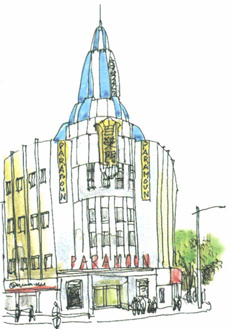
If you'd like to look for a road in Shanghai that is both filled with fashionable sentiments and nostalgic feelings, many people would probably suggest Yuyuan Road. For many people who have ever lived in Shanghai, the bustling Jing'an Temple and Yuyuan Road form an interesting area. At dusk, one can walk along Yuyuan Road, appreciating the old Westernstyle houses on both sides, and seeking the old times. The most interesting spot of the area is the Paramount. Here the first jazz band in Shanghai performed, the wedding ceremony of General Claire Lee Chennault and Anna Chan happened here, Charlie Spencer Chaplin Jr. and Xu Zhimo were once here as well.
The illustrious No. 1 Music Hall in the Far East
The Paramount is located at the core of the fashion circle in the Jing'an Temple, surrounded by Jiuguang Department Store, Meitaiheng, Gerry Center, International Lido Mansion, City Aviation Building, Portman, Meritus Hotel and Resort, Tongren Road, Julu Road, etc. Immediately coming out from the Jing'an Temple Station of Metro Line 2, you come to the subsicled plaza with a musical fountain, and the dazzling neon lights from the Japanese Udon noodles and Korean BBQ restaurants are competing for your eyeballs. However, when you cast your glance at the opposite of the road, you will see the graceful and magnificent Paramount and the palace-like Jing'an Temple are gazing at each other.
In 1929, Dahua Hotel on Gordon Road (today's Jiangning Road) went out of business, so did the dancing hall operated by the hotel. Since then the west section of Shanghai, the so-called Aristocratic Zone, no longer had a high end entertainment place. In 1932, Gu Liancheng, a Chinese merchant, invested 0.7 million taels of silver for the purchase of the land on which Paramount Hall was to be constructed. It was named Bai Le Men, rhyming with Paramount in pronunciation. Externally, the building adopted the American modern Art-Deco architectural style. The building looks so towering and magnificent, that it demonstrates the new technical renovation in industry has helped reach new architectural heights by continually conquering gravitation, and shows the human spirit and strength continually transcending the nature. Such buildings as Park Hotel, Sassoon House, Wukang Building (formerly Normandy Mansion), and some of the high-class apartment buildings in Hengshan Road are all typical examples of Art-Deco style, which was very popular in Shanghai in the 1930s. The former Paramount, designed by architect Yang Ximiao, was referred to as No. 1 Music Hall in the Far East. The building has three stories. On the first floor there are the kitchen and the lobby. On the second floor are the extremely modern dancing floor and the banquet hall. A large quantity of nickel, crystal, and white wood were used for decoration. The spiral staircase made of white marble leads to the large dancing hall, which has a dancing floor of over 500 m2. The floor is supported with automobile steel plates so that people would have a feeling of rocking while dancing. And on the outskirts of the large dancing floor are randomly partitioned small floors either for practicing dancing or for rendezvous. And on the balcony there is a transparent dancing floor with glass flooring. About one thousand people can dance at the same time. The whole building is equipped with air conditioning and luxury furnishings. The third floor is a hotel. At the top of the building there is a cylindrical steel-and-glass tower. When the dancer was about to leave, the waiter could flash out the number of the car plate so that the chauffeur could see in the distance and drive the car to the entrance. After the completion of the construction, the dancing hall was once entrusted to a Frenchman to run the business. On account of the contract, the manager of Paramount could make his income on the basis of the number of dancers. Consequently, the Frenchman made it a rule that all dancers must come with their own partners. Moreover, the charges were exorbitantly high. As a result, Paramount suffered from a great financial loss. Before long, the Frenchman was fired. Other people were hired and dancing girls were recruited publicly. At that time, the monthly income for the dancing girls amounted from 3,000 to 6,000 yuan, ten times more of an ordinary clerk. With its magnificent and majestic interior decorations, beautiful and dazzling lights, and first-class jazz band and popular dancing girls, Paramount attracted countless social celebrities.
On the Christmas Eve of 1934, Sassoon, the real estate tycoon, came to Paramount out of admiration. In 1936, Charlie Chaplin, the great comedian, and his wife came to Shanghai for the January 28 Soldiers Memorial Conference. Although they stayed only for one day, he still made the time to dance at Paramount. In 1937, to raise funds for the construction of wards in Hongqiao Convalescence Institute, a grand banquet dance was held in Paramount, which was a great hit at that time because more than 1,400 domestic and foreign guests were present. In 1947, Jimmy King and his band played Jazz and Hawaiian music, making a great success overnight and winning immediate reputation. It was the first Chinese band that had ever played in a high-class dance hall. By then, Paramount had already become the most prestigious deluxe dance hall and gradually became the symbol for Shanghai's high society.
Debut of New Paramount
Right at the beginning of the 21st century, Mr. Zhao Shichong, a merchant from Taiwan with a sharp eye for discovering treasures, invested RMB 25 million yuan to restore Paramount, attempting to retrieve the bygone grace of Paramount. The present-day Paramount consists of four stories with a floor space of over 3,000 m2. Gold and milky white are the major colors for the interior decoration, the lobby, doors and windows, and ceilings are covered with exquisite carvings, and meanwhile a large quantity of glass material is used. The former Paramount adopted a sharp linear sense, making the whole building simple and grand. The designers of the new Paramount added Baroque romance and complexity so as to make this 1930s building more brilliant in the mind of the contemporary people.
While making renovation to the original ornamental style, the designers made efforts to restore the structural layout of the former Paramount. The tower at the top of the building still flashes out various numbers with countless bulbs, reminding people of the scene when the customers summoned their cars at night. And the circular corridor on the second floor was reconstructed at the original position; however, considering the weight sustaining capacity of the whole building, the designers narrowed the corridor from 4.2 m to 2.2 m. Some guests are not keen on dancing, but fond of the ambience and being wallflowers holding a cup of wine sitting in one corner of the corridor and watching.
The former Paramount was one of the origins of jazz and ballroom dance in old Shanghai. Of course, the renovated Paramount has laid much emphasis on the dancing floor. The highly reputed dancing floor is part of the classical dancing hall on the second floor. It is a 500 m2 large dancing hall, with the shockproof steel plates as support underneath the floor. That's why the dancers enjoy a slight feeling of floating while dancing. With the intention to retrieve the original style, the dancing hall uses five huge crystal chandeliers instead of the modern lighting tools, such as laser lights, computer lights,ete.
When lights are turned on with the approach of the night, Paramount and night Shanghai come to life at the same time. The carpet is soft red with green and golden patterns, the transparent colored glass palm trees and rockery fountains, the seats by the carved railings, the golden glass revolving doors, the cloth bags embroidered with golden threads on the walls, the huge golden green sculpture on the ceiling, the French armchairs with their backs and arms painted golden, the goldenedged plates, and the napkins bound with golden ribbons, all these make it a golden world of entertainment. The photos of old Shanghai on the walls, the nostalgic walls reflected with the beautiful stars of Shanghai, and the nostalgic armchairs with leopard skin patterns under the purple lights, all these make a different world of nostalgia. Whenever the professional dancing girls in cheongsam softly come up with a typicall smile on their faces, probably everybody would be at a loss about his own whereabouts.
Rosy dreams of dancing
It is said that the bar tenders on the second floor dancing hall are some very experienced Laokele. With white hair and elegant manners, they introduce the way to taste beverage and narrate beverage culture while serving the guests. At dusk, dancing on the spring floor are middle-aged women in beautiful clothes and the specially invited professional dancers. Wearing simple silk blouse, dark color skirts, and pearl necklaces, the ladies look concentrated and intoxicated. They are reliving the bygone dreams, aren't they? The second-floor dancing hall has also introduced the rhythm system to charge the dancers. At night, when the 100 professional female dancers are shuttling on the dance floor along with the rhythm lights, the guests are very clear with the cost. Even those unable to dance can enjoy the accompaniment of the professional dancer.
The third floor is a piano association sponsored by a reputed artist from Taiwan. The fashion atmosphere it possesses makes it entirely different from the classical dancing hall. However, what makes the Paramount bar uniquely distinctive from others is its transparent dancing floor, the center of which, about 150 m2 in size, is crystal-clear and translucent. Like the spring dancing floor, the golden-light transparent dancing floor was also one of the magic weapons that made Paramount popular in Shanghai in those years. After the playing of some vibrant music, there would be very soft and slow dancing music. The mirage light would shed on the glass flooring on one side of the bar; meanwhile, underneath the floor would be turned on the focusing lights, on and off alternately. In the golden rays, there are 12 thousand red roses spread under the floor. As for those that are not fond of dancing, they can come to the piano association on the third floor, singing one or two songs and drinking wine, a sure way to spend a really unforgettably joyful night.
The fourth floor is similar to the second floor in decorative style: combination of Chinese and Western style and integration of magnificence and luxury. At the entrance are two long wooden racks with wines, from the imported Hennessy, Rémy Martin, Martell to domestic Changyu, Dynasty, Great Wall, etc. Ever since the end of last year, a performance named 1930 Shanghai Gorgeous Singing and Dancing Show has made a great success for Night Shanghai. This has built up Shanghai, a true nightless city with singing and dancing, culture, recreation, and atmosphere. Tourists that cherish a love for Shanghai could come and seek their dream here with a nostalgic feeling. They could enjoy all kinds of songs and music such as Night Shanghai; Four Seasons; Rose, Rose, I Love You; Shangri-La, etc. Every item of the program is a perfect combination of sensual stimulation and sense of beauty in dancing. Dancers are chosen from one in 10 thousand; therefore, they are all top dancers in terms of dancing skills. They usually start with the classical jazz songs and dances of old Shanghai, present to the audience tango, Latin, audition, and up-to-date R & B, fully stirring up the on-the-spot atmosphere and kindling up the whole night Shanghai. Meanwhile, comedian performances are presented during the intervals between two dances, thus adding romance and humor to the hilarious night and making it extremely relaxing. The world has entered into a new century; however, the bygone prosperity and fashion have become the eternal theme of Shanghai, a metropolis of charm. Paramount some people enjoy in retrospect and some others encounter in movies and novels. At present, we could just take a slow walk in the soft breeze to the dancing hall, where we can genuinely undergo all the experiences in and out.
Telephones: 021-62498866
Open hours for tea and dance (on the second and third floors): 13:00-17:00
Cashbox Party World Co., Ltd: Kara Is Always OK 钱柜:卡拉总是OK
When we talk about KTV in Shanghai, our first choice is Cashbox, which boasts the most complete set of songs, the best acoustic facilities, and the most comfortable environment. It also provides a buffet; therefore, you could sing to your heart's content while enjoying delicacies. Cashbox can be said to be a super paradise for visual, acoustic and palatable pleasures.
Cashbox Party World Co., Ltd has three shops in Shanghai, in Huangpu, Jing'an, and Luwan Districts respectively. The Luwan shop is most worth mentioning, because if you'd like to go there, you will have to go through Yandang Road. Built in the 1920s, Yandang Road was originally called Junying Road, and later renamed to Hualong Road. On both sides of the road are mainly civil residences. At the north end are Peiwen Apartment and Yongye Building built in the 1920s; in the middle is the Chinese Vocational Education Society founded by Huang Yanpei and moved to Yandang Road in the 1920s and 30s; and at the south end are modern architectures such as Yandang Mansion in 1983 and Jie'erjing Sichuan Restaurant built. In the vicinity there are a large number of historical and cultural sites, for example, the Former Residence of Dr. Sun Yetsan at No. 7, Xiangshan Road; the Science Hall at No. 47, Nanchang Road; General Zhou's Mansion at No. 73, Sinan Road; etc. Further southward along Yandang Road, you will get to the Cashbox in Fuxing Park.
The Cashbox in Fuxing Park, which is quite nostalgic for the large number of French parasol trees, is similar to an exquisite woman hidden deep in her abode, quiet and reserved, but seemingly casual yet imposing, a romantic spot on the noisy Huaihai Road.
If you go there at night, while waiting in the lobby and looking out of the windows, you will notice the quiet night scenery of Fuxing Park with trees rustling in the darkness seems so quiet and ordinary, spacious and dear, and in the distance a long queue of taxis is waiting for guests. Going around the densely planted trees in Fuxing Park, you can go to the nearby bars, such as Languifang, Park97, etc, where there is a dassling scene of lights as well as singing and dancing.
The lobby of the Cashbox is elegantly and soberly decorated, much in the way of a hotel and by no means imposing. The reception area is usually crowded with customers. The highclass service and the appropriate price are really appealing to all customers. A large variety of food served at the buffet center is hygienic and palatable, almost reaching the standards of a five-star hotel. Of all the delicacies, some typical Chinese cuisine can help the customers enjoy the out-and-out Chinese gourmet culture, while other foods could allow the foreign friends to taste the best of all specialties when they are having a wonderful time here. As some are in the habit of drinking wines and liquors, they could easily get access to a variety of genuine mellow foreign products. In Cashbox, you can enjoy not only delicious food and beverage but also your own gustatory and acoustic party time to your heart's content. The private rooms have special features. In addition to ordinary private KTV rooms, there are some party rooms that are amusingly furnished. The medium-sized party rooms are installed with not only a large screen but also a bar on one side with an independent screen for placing orders of songs. The Cashbox in Luwan District sets up a super deluxe Presidential Hall, for which a reservation must be made 8 to 14 days in advance. Almost every private room in this Cashbox has a private bathroom.
In the party room, the singer must stay in the Singing Area on one side of the large screen. Here is a high chair for you, and opposite to you is a small screen. And above your head there are three speakers. Besides, there are several microphones for you to choose for your performance. Then and there, you are the master of the party. To be sweet or forceful, it's all up to you. Such an atmosphere will definitely help you derive a singing experience beyond your own self.
Tender service
Singing in Cashbox will give a sort of comfort that you can hardly get elsewhere, and the price here is reasonable. "If you'd like to sing, go to Cashbox" has long been a fashionable casual life in Shanghai and Beijing. And nowadays, the Cashbox in Guangzhou, Hangzhou, and Xi'an are all similarly popular.
Cashbox has long been a decent recreational and meeting place for people of all walks of life. Actually, customers come to Cashbox at different periods of time. For example, students and retired families usually come during the daytime; and white collars and party goers mainly come during the noontime and in the evening. In accordance with different times, some preferential activities are designed for the customers to choose on the basis of their consumptive ability. On the Valentine's Day of some year, Cashbox launched "99 yuan Valentine's Day Set Meal", which includes a pot of hot milk tea, a basket of fried chickens, a portion of strawberry yogurt and a two-heart balloon and a photo of romantic lovers.
What impresses you most is the attention the attendants pay to you. For example, when you come out of your private room, probably thinking whether you would take something to eat or go to the washroom, at least two attendants would approach you, asking, "Could I help you?"
In addition, services such as depositing wines, ordering cakes, recording singing on the spot, screening greetings and songs, taking Polaroid photos, etc. all indicate Cashbox's emphasis on details in service.
Spacious private rooms of all sizes, fashionable, dynamical and deluxe decorations; ornamental wall paintings in different styles matching the colorful lighting, and intense ambience tend to make the customers reluctant to leave. The advanced computer song-ordering system, first-class audiovisual facilities, perfect services, various delicacies, and favorable prices will help you get great enjoyment of five-star entertainment in a world of happiness.
Once a female movie star said that when she was working in Shanghai, she loved to go to Cashbox at mid-night to sing a few songs, even though her voice is by no means beautiful, and then go to Languifang for a few drinks. Leaning against the iron railings around the flowerbeds, looking at the passersby in the nighttime, and holding a bottle of Tsingtao Beer, you could also feel the wonder of the night and its colors.
Different people would have different notions about relaxation, which might be intense or gradual, dazzlingly bright or softly gloomy. To the hard working people, Cashbox is either the relaxing self-indulgence in the spaciousness or the casualness, elegance, egoism, etc. veiled behind the bright yellow lighting.
Shanghai Circus World: ERA Trip, Unforgettable Night 上海马戏城:杂技艺术“梦幻时空”
Do you like watching circus performance? In China, there is a more traditional term for circus, i. e. acrobatics. The thrilling items are the stunts by acrobats. The beautiful, graceful and breath-taking performance has had a history of more than 1000 years in China.
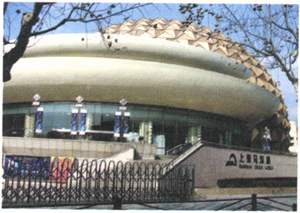
If you ever visit Shanghai, you should never miss Shanghai Circus World. The China Acrobatics Stage, referred to as No. 1 Circus World in China, integrates circus, acrobatics, magic, pet club, as well as casualness, shopping, food and beverage, hence an entirely new cultural and recreational place. The Circus World presents wonderful performance every day, and from time to time many well-known overseas circuses come here to stage their performance.
Unique Chinese acrobatics
Acrobatics in China originates in Baixi, meaning a variety of performance, including music, dancing, and others in ancient China. With the expansion of the performing arts over the time, the number of categories is growing as well. Gradually there were acrobatics, magic, singing and dancing, quyi, opera, etc., respectively independent of each other. And on the basis of the programs, acrobatics can be classified into stage acrobatics, high-in-the-air acrobatics, magic and conjuring, animal training, circus, comic performance, etc.
From 770 BC to 221 BC, China was in the years of turbulence when many small kingdoms were fighting and merging. With the ambition to seize the power to unify China, every kingdom was recruiting talented people. The definition of talent was rather extensive and amusing. Besides those that were profoundly knowledgeable and peerlessly militant, people that were extremely eloquent, good at mimicking a variety of sounds, with extraordinary strength, or unique skill were all considered talented. Not only did they make great contributions to their respective monarchs, but some of them were also written into the annals of history. Quite a few were actually the pioneers of the acrobatics in China.
In the feudal times in China, acrobatics was taken as an important means to show off the power of a kingdom. There was once a time when a variety of performance was staged simultaneously and the king rejoiced with his people. After thousands of years' sedimentation, the ancient acrobatics in China has accumulated several hundred performing forms. The techniques were mainly passed from the masters to their apprentices. To date, a large number of acrobats come from acrobatic families. It is impossible for anyone to master the superb skills without the conscientious training and exclusive teaching. Therefore, this has added mystery to acrobatics.
During the last century, Shanghai has grown into the largest commercial city in China. Acrobats from different places flocked into this city to make a living. Since then Shanghai has become the headquarters of acrobatics in China. Several acrobatic troupes of Shanghai have been awarded the international prize of Golden Clown for balancing bowls and other programs.
An unforgettable night of acrobatics
Shanghai Circus World presents ERA-Intersection of Time, a Multimedia Theatrical Spectacular show every evening. ERA is a multimedia odyssey with the combination of sound, light, electricity, and multimedia stage designing, integrating dancing, Chinese gongfu, music and other art elements. The show demonstrates the excellence and difficulty of traditional Chinese acrobatic arts, and reveals the in-depth cultural humor from time to time. The theater can seat over 1600 people, and spectators from all over the world are deeply magnetized by its charm every day. Ever since September 27,2005, when the troupe made its debut, the program has reached the highest number of continuous stage performances and made the highest one-day performance income in Shanghai. This record has exceeded the Broadway operas Cats and The Phantom of the Opera, both of which made a sensational success in Shanghai as well.
The theme of the show is about time, history and culture.
The show starts with a group of beautiful girls dressed in ancient Chinese maidens' garments dancing into the traditional Chinese music, with the dream-like natural scenery, i. e. water flowing under a small bridge and frosty twilight going across the skies. Before long, the girls are performing the most classical Chinese acrobatic program: Pyramid. With a few ordinary chairs as props, they demonstrate the most harmonious beauty of female gracefulness and male robustness. You cannot stop feeling nervous for them and, meanwhile, admire them.
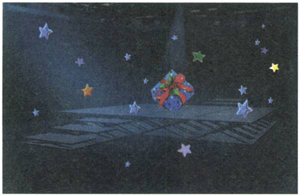
While you are still in the after-thoughts of the previous section, you might find the stage has become the outer space. In the boundless darkness, there is a beautiful planet in the distance. On the stage, however, there is another planet. The acrobats are walking slowly onto the surface of the planet, holding delicate props in hand. In a dream-like space, they are performing the plate spinning. With very gentle steps, they appear as if they were really walking in space. The slim iron sticks in the hands of the acrobats are holding up exquisite porcelain. The porcelain plates are turning around at a very fast speed, leaving the spectators the impression that the planet itself is not stationary. Nevertheless, the breath-taking quickness forms a sharp contrast against the leisurely even slowness, thus helping you enjoy the splendor of Chinese acrobatics just in the mixture of motion and motionlessness.
ERA-Intersection of Time offers many more admirable items that are full of surprise, stimulation, romance, and unexpectedness. For example, in the most dazzling item, the ERA Flying Motorcycles, eight motorcycles are racing like flying comets in a spherical iron cage of only a 10-meter diameter. The spectators can hardly distinguish the men from the motorcycles, only seeing the eight light circles made by the orbits of the motorcycle lights. Amidst the light circles, the motorcycles are rapidly changing their driving directions. It is said that the most romantic item is performed by two acrobats that are supposed to be lovers. By means of two hanging silk ribbons, they perform a variety of graceful but dangerous stunts high above the stage. The name of the item is ERA Love. The two acrobats present a perfect combination of power and beauty as if they were actually lovers.
Shanghai Circus World
Address: No. 2266 Gonghexin Road
Telephone: 021-66527750 021-66522395
Shanghai Conservatory of Music: Enjoying the Music in the World-famous Hall 上海音乐学院:在世界著名艺术殿堂里欣赏音乐
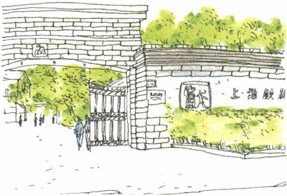
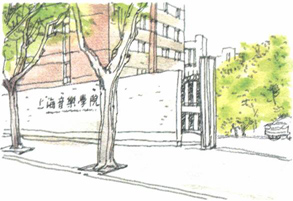
When you turn to Fenyang Road from the bustling Middle Huaihai Road, you will find musical notations everywhere and many musical instrument shops. The sound of piano playing is floating in the air. And you will encounter people carrying violins, accordions, pipa, or other musical instruments. The large compound under the thick shades of French parasol trees is Shanghai Conservatory of Music. It is believed that, this conservatory ranks No. 2 together with London Royal Conservatory of Music, next only to New York Julia Academy of Music.
As soon as you step into the conservatory, an old Westernstyle house will catch your sight. It is the administration building of Shanghai Conservatory of Music. This pseudothree-story building of Northern European style looks rather solid. The roof is laid with dark red tiles, the double folded roof façade is quite steep, the two-slope dormer is rarely seen, the French window on the first floor is semi-circular, and the second floor of the main side of the building is an open corridor. The stucco wall indicates the vicissitudes of history. It used to be the Russian Jews club in the 1930s. In those years, the club founder, also the Director of the club board, Bloch, a Russian Jewish manufacturer, sponsored a Thursday party every week, and he also hosted a group of literature.
Another building of Shanghai Jewish Club has become the auditorium of Shanghai Conservatory of Music. After the renovation in 2003, it turned out to be the Grof3er Saal of Shanghai, i. e. He Luting Concert Hall of Shanghai Conservatory of Music. This building of American cottage style is also a pseudo-three-story building. The snow-white walls prop up a gradual four-slope roof, on which are shelter-like dormers, and on the side is the protruding semi-circular room. There is a balcony, and the rails look like treasure jars.
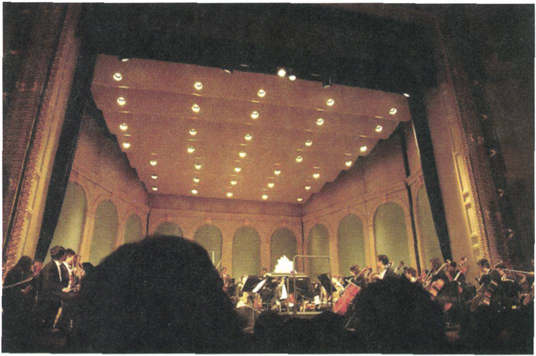
He Luting Concert Hall, with a total floor space of 4357 m2 and a stage space of 125 m2, has enough space for three orchestras and a capacity of 744 seats. Its architecture and sound effect are based on the three best concert halls that have the best sound effect in the world, namely the Groer Saal of Vienna, Symphony Hall of Boston Symphony Orchestra, and Concertgebouw. The stage is of a rectagular shape, and the stage space and the audience space are merged together. With neither curtain nor columns, the performance relies on natural acoustic effect. In the construction of the hall, a large variety of special technology and new materials were used, thus reaching the international A standard as Reverb Mid of 1.8 second.
At 7:15 p. m. every Sunday, concerts are held in He Luting Concert Hall, such as Sunday Concert, Graduation Solo Concert by students of Shanghai Conservatory of Music, and Chorus Concert by universities from other countries. The price of the admission tickets ranges from 5 to 10 yuan. Up to now, the Sunday Concert has already been staged over 500 times, and is still going on.
Shanghai Concert Hall: Classical Garden of Music 上海音乐厅:百年经典音乐家园
Shanghai Concert Hall is a dear homestead to enjoy music. She is like an old friend of yours, who is profound in emotion and rich in feeling.
The first fashionable cinema specially for showing foreign movies
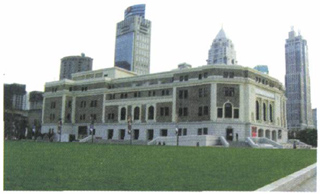
In 1930, Nanjing Theater, large in size and advanced in facilities, was set up in Avenue Edward Ⅶ, which is East Yan'an Road today. It is the predecessor of Shanghai Concert Hall. Nanjing Theater was designed by the famous architectural designers Fan Wenzhao and Zhao Chen. And it is one of the few Western classical buildings designed by Chinese architects that still exist in Shanghai. In July 1991, Shanghai Concert Hall was listed as Heritage Architecture under protection.
Nanjing Theater was constructed during the golden times of Shanghai, when the internationalization of economy made Shanghai a city of fashion. The unveiling performance at Nanjing Theater was the musical Broadway produced by Universal Studios of the United States. Moreover, it was the first theater that specialized in showing foreign movies. Even up to 1950, it played fashionable movies, songs and dances, and operas. In 1949, it was renamedBeijing Cinema, and was still showing movies by Fox and MGM.
Shanghai's Opéra de Paris
In 1959, Beijing Cinema was chosen as a theater for professional music performance because of its unique architectural structure that can produce excellent natural acoustic effect. Then it was officially renamed Shanghai Concert Hall, thus reputed as Shanghai's Opéra de Paris.
Ever since, the performing history of this concert hall is like a long flowing river. In 1959, the concert hall held a violin solo concert by a Russian violinist; in 1993, the Philadelphia Orchestra of the United States held a chamber music concert here; in 1995, Isaac Stern, a great violinist, held a concert here in collaboration with Shanghai Broadcast Philharmonic Orchestra; in 1997, Pinchas Zukerman, a noted violinist, held a solo concert; and such musicians as Salvatore Accardo, Fu Chong, Lin Zhaoliang, Alicia de Larrocha, Yin Chengzong and others have played their musical notes here. For several generations, Shanghai Concert Hall has accumulated a lot of musical emotions.
Miracle of the horizontal movement of the concert hall
In August 2002, a farewell concert, Goodbye, My Love, was held in Shanghai Concert Hall. And then, the concert hall spent RMB 120 million yuan on the reconstruction of the hall, which is referred to as a creative work in the history of Chinese architecture, i. e. the horizontal movement of the whole building: the hall that weighs 5650 tons was elevated 1.5 m, then moved 66.46 in horizontally southeastward, and then elevated another 1.88 m. This 66-meter journey of music lasted two whole years.
In October 2004, the renovation of the new Shanghai Concert Hall was completed. Like a young lady from a wealthy family, standing quietly deep in the garden and wearing white and light coffee garments, she looks pure and pristine. Either with the blue sky and white clouds in the background or veiled behind the transparent lighting at dusk, she is by no means imposing or self-showing, but instead sheds soft beams of light and emits rhythmic sentiments of poetry.
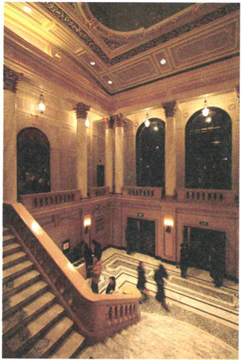
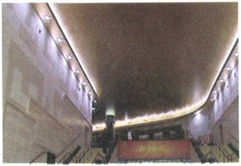
The simple 3D classical structuralism design by Mr. Fan Wenzhao were fully enhanced. The four Ionic columns form three shrines and three vault-shaped windows high above the front entrance. Interiorly, there are columns of Baroque style architecture, Spanish style molds, and pseudo-Roman style shaddock doors and windows, and in the lobby are Roman style corridor columns, spiral staircases, and a vault ceiling, with a variety of decorations. Sea blue and majestic gold are the major colors, solemnly elegant and gently glamorous. Yet the concert hall and the music played in it are surprisingly unified.
The area of the new concert hall is 12000 m2, more than four times of the original 2555 m2, which includes the newly-built stalls, dressing rooms, offices, and the canteen on the fourth floor. The new hall has 1273 seats, 151 more than the original concert hall; the seats have been replaced into Europeanstyle metal upholstered chairs. The frame-like stage has a depth of 13 m, 5 m more than the original. On the stage there is a Steinway D-274 grand piano. What is worth special mention is that the performance hall of Shanghai Concert Hall had long been famous for its acoustic effect; after renovation, however, the acoustic effect of the performance hall is even better, with reverberation time reaching 1.83 seconds, which is very rare for a hall with over 1000 seats.
Eternal glory to Shanghai Concert Hall
Royal Philharmonic Orchestra was the first to congratulate the new Shanghai Concert Hall. At 7:30 p. m., October 1, 2004, Glinka's Prelude to Russian and Ludmilla sounded in the new hall. From then on, the new Shanghai Concert Hall began to play its own prelude.
"I could hardly imagine how I would feel if I step once more into that familiar but strange entrance. I expected to feel a sense of strangeness; however, when I did stride into the entrance, I felt the happiness of reunion with an old friend," said a veteran spectator, who made such a description when he reentered the hall on October 1, 2004.Probably he could be a representative of many music fans in Shanghai.
The programs during the reopening period were really dazzling. Following the Royal Philharmonic Orchestra is the African-Latin Jazz Band of Lincoln Center, Italian International Orchestra, Arturo Toscanini Philharmonic Orchestra, international piano series including Murray Perahia, Boris Berezvosky, Arcadi Volodos, etc. and Chinese musicians' series, etc. The new hall has shown a great difference from the former ones in editing and introduction. It is tniely an elegant professional performing place for classical music.
Some of the performances staged after the reopening of the new concert hall including Song Siheng's Piano Solo Concert, Hilary Hahn's Violin Solo Concert, Jiang Jianhua's Erhu Concert, San Francisco Boys' Chorus Concert, Royal Liverpool Philharmonic Orchestra, the Kremlin Presidential Orchestra. Yo-Yo Ma's Concert of Bach's cello suites, Bavarian Broadcast Symphony Orchestra, Vienna Johann Strauss Orchestra New Year Concert are also planning to stage their performance here.
At present, symphony, chamber music, singing concert, jazz, Chinese folk music, and even Flamenco have all staged performance in Shanghai Concert Hall.
Recalling opening ceremony of Nanjing Theater in 1930 and thinking of the performance of various art styles in the new concert hall, you would probably sigh over the vicissitudes of history and time. However, today's Shanghai Concert Hall has totally merged itself in the literary image of Shanghai as a whole.
Address: No. 88. Middle Jinling Road
Hotline about programs: 021-63855933
Ticketing telephone: 021-53866666
Shanghai Grand Theater: Perfect Combination of First-class Architecture and Majestic Performance 上海大剧院:一流建筑和 恢宏演出完美结合
Shanghai Grand Theater in Shanghai is like Sydney Opera House in Sydney and Opera de Paris Bastile in Paris. Sydney Opera House has a first-class architecture, but is not a first-class theater, and Opera de Paris Bastile is a first-class theater, but might not be a first-class architecture while Shanghai Grand Theater is a perfect combination of a first-class architecture and a first-class theater.
Shanghai's Crystal Palace
From the very beginning, Shanghai Grand Theater has been the pride of Shanghai people. Located in the center of Shanghai at People's Square, it has become another landmark of the city, making the People's Square true to the name of a political and cultural center.
Out of the many design proposals of the theater, the one that was finally chosen was by the French Charpentier Architectural Designing Company. It is said that Mr. Charpentier originally intended to erect an architecture that can represent the newest designing concept in such a 21st-century international metropolis as Shanghai.
The theater was completed in three years. The upside-down arc glass roof spreads out its transparent wings, as if intending to soar into the gray skies in the rainy summer season. Looking through the semi-transparent glass walls, you will see the vertical weight sustaining steel cables. Facing the square, waterfalls flow down the spacious stairs like a curtain. When night approaches, the huge chanderliers, named the Blue Danube, hanging on the columns inside the lobby, are switched on, shedding crystal bright light, and the Greek crystal white marble floor, the colossal white marble columns and the rhythmic staircases on both sides reflect sacred light, making the Grand Theater look like a gigantic crystal palace.
Bright and illuminating, pure and pristine, the design of the theater follows the new Minimalist architecture trend, merging the Eastern charms and the Western ideas. In Shanghai Grand Theater we can see Mr. Charpentier's emphatic expression.
Interior audio-visual effect still advanced in 50 years
As a modernized colossal building, Shanghai Grand Theater claims that its external architectural design will remain as world trends for the next 50 years. In the process of designing, however, the internal audio-visual effect received meticulous attention at the sacrifice of all costs.Shanghai Grand Theater covers a total area of 21664 m2, with a total floor space of 62803 m2 and a total height of 40 m, altogether 10 stories. The size of the stages is the largest in Asia, with the major stage of 718 m2, back stage of 368 m2, and two side stages of 270 m2 each. The professional American JBL facilities were used as the acoustic system; and for the lighting system, the top-notch products of Belgian ADB Company were opted for. Besides, the employment of architectural designing structure and of acoustic simulation and other advanced scientific and technical equipment enabled the acoustic effect to reach the leading standards in the world. The Grand Theater has three theaters, large, medium, and small, so as to meet with the needs of different performing tasks. As a whole, the theater has a capacity of 2500 seats, including the boxes. The lobby of the theater is 2000 m2. And on the roof there is a multifunctional hall of 1600 m2.
Grand repertoire
To describe Shanghai Grand Theater, we can hardly avoid using such adjectives as magnificent, elegant, noble, grand, imposing, etc., which can also be used for the programs performed here.
The performances staged here must embody artistic, classical, or international reputation. All the programs, from the unveiling performance of Swan Lake to the recent serial programs of the French Cultural Year, must abide by one of the three qualities.
Ballet
On August 27, 1998, the ballet Swan Lake was staged on the unveiling day of Shanghai Grand Theater. Ever since, Swan Lake and The Nutcracker at the anniversary in August and on the Christmas Eve have become a tradition in Shanghai Grand Theater. To date, quite a number of ballet ensembles, domestic and overseas, have made the request to perform these two ballets on these two occasions. As a matter of fact, out of the top ten ballet ensembles in the world, nine have already performed in Shanghai Grand Theater, including Royal Danish Ballet, which performed in May 2000 the three-act romantic ballet, Napoli, demonstrating the essence of Danish-school ballet; Mariinsky Theatre Ballet Ensemble, which performed Swan Lake in October 1999; the Dance Paris Opera Ballet, which performed classical French romantic ballet Giselle; Royal Ballet, which performed Romeo and Juliet and The Wayward Daughter; Cuban National Ballet Ensemble; American Grand Theater Ballet Ensemble; Australian Ballet Ensemble; the National Ballet of China; and Moscow Grand Theater Ballet.
Opera
Shortly after the completion of Shanghai Grand Theater, the first opera performed here was Aida. During the performance, the magnificent stage setting enabled the brilliance and misery of Aida to be thoroughly expressed. After that, three other operas have made their debut in China: French Faust, German The Flying Dutchman, and Russian Onegin.
Another grand event shortly after Shanghai Grand Theater was unveiled was the Carreras Concert. And then, in January 2001, José Plácido Domingo Embil at the age of 60 fulfilled his first concert in the 21st century here in Shanghai Grand Theater. The songs he sang included selections, Late at Night and Don't be Afraid of Me, from Opera Othello. In the same year, Luciano Pavarotti, already in his sixties, also sang in Shanghai Grand Theater. And until then, the three great tenors of the world had all performed on the stage of Shanghai Grand Theater.
Musical play
Three classical musical plays Les Misérables, Cats, and The Phantom of the Opera have left behind their prints in Shanghai Grand Theater. The original Broadway version of Les Misérables was introduced into China for the first time. Cats was running for 53 sessions. The Phantom of the Opera, which was also performed in China for the first time, was such a great success that it was running for three months, and 1,000 shows. Andrew Lloyd Webber, composer of the musical play, came in person to Shanghai Grand Theater to extend his congratulations. In addition, the theater has also staged the Broadway musical play The Sound of Music (the first performance in Asia) and Lion King.
Chinese opera and modern play
On August 13, 1999, the new version of the Yueju Opera, The Dream in the Red Chamber, was so grand that it was considered a breakthrough at the time. The Beijing Opera, Chinese Concubine, relived the prosperous Tang Dynasty in Shanghai Grand Theater. The renowned Kunju Opera, Peony Pavilion, was also performed here. The sponsor-in-chief of Peony Pavilion was Mr. Bai Xianyong, a distinguished master of Kunju Opera, professor of University of California of the United States, contemporary Chinese writer, and son of senior KMT General Bai Chongxi.
As for modern plays, one of China's best modern drama troupes, Beijing People's Art Theater performed their representative plays, Antiques, Thunderstorm, Teahouse, and No. 1 Building in the World here.
Special performance
The performances staged here are all first class. In addition to the classical performances, from time to time, there might be a special show.
In April 2005, Jin Xing Dancing Troupe performed Carmina Burana here. The play absorbed all the elements of oratorio, orchestra, and dancing. The design of the advertising poster indicated that the play, with Jin Xing at the top of the cast, merged oriental elements into the simple but forceful modern dance. The Jin Xing Dancing Troupe enjoyed warm welcome as usual. And their performance here was actually a rehearsal for their performing tour in France. Besides, the 12 Girls Band was also playing here in 2004. The band had aroused high popularity and severe criticism at the same time in China.
Though not a theater with a long history, maybe that's why Shanghai Grand Theater is even more suitable for international performances or performances of novelty.
Address: No. 300, People's Avenue
Telephone: 021-63868686
Theater Avenue: Shanghai Theater Academy and Shanghai Modern Drama Art Center 戏剧大道:上海戏剧学院和 上海话剧艺术中心
In the area that starts from West Yan'an Road in the north, goes through Huashan Road and Changle Road, and reaches Anfu Road in the south converges many of the most important art colleges and troupes, including Shanghai Theater Academy, Shanghai Modern Drama Center, China Welfare Institute Children's Theater, etc. With about 10 theaters, this area is termed as Theater Avenue. In some people's opinion, this is also the most elegent street with garden houses everywhere, and the wood dormers. The former residences of Chinese cultural elites Ba Jin, Huang Zuolin, Xiong Foxi, Zhou Xuan, Xu Zhimo, etc. are all located here.
Walking along the Theater Avenue, visiting the old buildings of Shanghai Theater Academy, and then enjoying a play in the Experimental Theater and Black Box might be a most nostalgic and most artistic life.
Shanghai Theater Academy: always a seat waiting for you
"When night falls, there is always a seat in one of the theaters waiting for you ..." said one of the presidents of Shanghai Theater Academy.
Watching plays in a building with history
Shanghai Theater Academy has five theaters.
Going into the academy through the East Gate, you will see the Experimental Theater on your left. Built in the 1980s, this theater has many special functions that other theaters are not equipped with. It has a special stage design, and the whole stage is composed of 1.5 m2 boards. From the stage curtain to the backdrop, there are three longitudinal passages and the boards above the backdrop can be opened. There is a horizontal passage 7.5 m away from the stage curtain, and the boards under can also be opened. The hydraulic lift under the stage can satisfy all the requests to make changes on the stage. The stage has got the longest longitudinal depth of 27 m in Shanghai. On the second floor there is a drawing hall of the same size as the stage, which is connected to the first floor with electric apparatuses. Besides, on both sides of the main stage, there are two very spacious side stages. The theater has a total capacity of over 1,000 spectators. The Experimental Theater usually stages grand plays. Many internationally famous performing companies such as Tokyo Orchestra, Royal Shakespeare Company, North Korean Sea of Blood Song and Dance Troupe, Korean National Dance Ensemble, etc. and many other international troupes have performed here.
Walking along the main road on the campus, there is a European style building on the left. This is Xiong Foxi Building, built in the 1920s. Mr. Xiong Foxi was the first president of Shanghai Theater Academy. The campus used to be a German country club, and Xiong Foxi Building is also part of the club. This building is going to be transformed into Modern Drama Museum. The New Experimental Space, located behind Xiong Foxi Building, was the ballroom of the country club and once served as a movie theater and the recording room of Central Movie Company. It is said that Zhang Ailing was married here. And now it has been rendered into a small Freedom Theater.
Further forward from Xiong Foxi Building is the classroom building, i. e. the well-known Red Building, which was designed by Soviet specialists and built in 1956. With a zigzag interior structure and a bright and dim space, this building appears somewhat mysterious.
The renowned Black Box, a drama laboratory, is on the fourth floor of Red Building. It was added in 1993 when the building was undergoing a functional renovation. It was designed and built for performing meditative and creative works.
On the fourth floor of Red Building, there is also the East Rehearsal Hall, which is mainly used for the first and second year students to give their report performance.
Opposite to the Red Building is the Small Theater built in the 1950s.
Lovely performance
The performance available to the public in Shanghai Theater Academy falls mainly into three categories: the annual performance by Performing Department and Directing Department, the irregular but highly frequent report performance by various departments, and the exchange performance by overseas groups.
The middle and the end of the year are the seasons that Performing Department and Directing Department give their performance. The school will put up huge posters at the entrance on Yan'an Road and sell tickets to the public, usually 50 yuan each. You could also surf the school website for shows and schedules. The performance is usually staged at the Experimental Theater.
Report performance is part of the teaching syllabus at Shanghai Theater Academy. After successfully completing their course studies, students will perform short plays or excerpts from operas to participate in the school report performance. They often put up self-made posters in Red Building, dormitories, canteens, etc. about two weeks prior to the performance. They usually perform either in Black Box or in East Rehearsal Hall. Such performance is free of charge. If you go there about half an hour earlier, you are likely to get a good seat.
The exchange performance is staged often by overseas performing companies or theater disciplines from foreign universities that have close relationship with Shanghai Theater Academy. Such performance is usually followed by a series of lectures and seminars running for several days. These performances are not to be missed, because the school often invites international masters for academic exchanges. For example, in 2004, the school invited Richard Schechner, Chinese Kunju Master Bai Xianyong, and an Italian dancing master.
Shanghai Theater Academy holds an International Small Theater Drama Festival once every two years. It is believed that such a festival brings about the best performance of modern drama, because many professional performing companies in the world will come and perform. There are a large variety of unique performing styles: the pioneering, the traditional, the trendy, and the retrospective.
Shanghai Modern Drama Art Center: various theaters
Shanghai Modern Drama Art Center is a European-style building full of art atmosphere. The red exterior of the elegant building harmoniously matches with the white dome. The relief sculpture of Muse holding sword and shield at the top of the building enhances the cultural ambience.
The present art center was merged of Shanghai People's Art Theater and Shanghai Youth Modern Drama Theater 11 years ago. Both theaters were founded 50 years ago by the then most famous dramatists Xia Yan, Huang Zuolin and Xiong Foxi. As China is not a country with a long history of modern drama, these two theaters can be thought of as very senior.
Shanghai Modern Drama Art Center has three theaters. In the past 10 years, more than 100 performances adapted from Western classical works, modern and contemporary Western works and Chinese works have been staged here. Even traditional Japanese operas have been performed here.
Performance of modern drama in a quiet neighborhood
The art center building is so simple that it might appear to people unimpressive at the first sight. Anfu Road, where the center is located, endows the center with a lot of dramatization. Anfu Road, somewhat narrow and sparse with vehicles and people, is flanked by garden houses and French parasol trees. In the vicinity, there are galleries, cafes, bars, Western restaurants, lifestyle art shops, and a camphor tree garden, for you to enjoy after the drama.
When you get acquainted with the art center, you will cherish a profound emotion about the building and the place. Its simple appearance is compatible with its dramatic ambience. It is a place to stage first class modern drama. What's even rare is that there is no offensive advertising.
Art Theater: the best place for stage plays
The Art Theater on the first floor of Shanghai Modern Drama Art Center is supposed to be one of the best performing places for stage drama in Shanghai. The frame-like stage and the 530 seats are the best in terms of size and layout for drama performance, especially for comparatively large-scale performance. For example, the two plays, adapted from the representative novels Song of Longtime Grudges and The Rouge of the North by Zhang Ailing, an illustrious female writer in Shanghai in the 1930s, were dramatized and revised by a contemporary female writer and performed by the actors and actresses of the art center. The plays revived a genuine Shanghai flavor.
In 2004, the Art Theater staged Waiting for Godot performed by Irish Dublin Gate Theater, and the modern version of Othello by the British Along With You Theater. British Royal Shakespeare Company also performed Merchant of Venice, in which all the dialogs come from the original play by Shakespeare.
Good Time and Beautiful Scene is another very interesting play staged in the Art Theater. The play tells a story about the oldest Chinese opera, the Kunju Opera. The playwright is a Chinese, but the director and stage designer were Russians.
Drama salon: an advanced small theater
Another theater of Shanghai Modern Drama Art Center is Drama Salon, one of the most advanced small theaters in China. The 450 m2 theater was designed all black, so it is called Black Box. Its stage can be arranged into a variety of forms: one side, two sides, three sides and a central stage in accordance with the needs of the performance. The moveable partitions all around the theater could be arranged into passages according to needs, and the moveable seats can be freely grouped together also according to the special needs of the play. There is no clear demarcation between the audience and the stage. Sitting on the comfortable seats, the spectators can easily be merged into the play. The British small theater modern play Shylock, Merchant of Venice was performed here.
D6 Space: a free theater
D6 Space in the art center is a relatively free theater. It is said to be free because this theater, covering an area of almost 500 m2, is completely open, approximately 300 spectator seats can be freely arrayed, and the central stage can also be freely arranged. With a very close distance between the audience and the performers, the spectators can enjoy the direct interaction with the performers. Therefore, D6 Space usually stages modern-genre plays, experimental plays, and multimedia operas, laying emphasis on creativity and originality. The Irish Dublin Tap Dancing Ensemble performed the modern dance Mermaid here.
Shanghai Modern Drama Art Center would sometimes stage new international modern plays. For example, it staged Three Black Stories, which was first staged during the Edinburgh Art Festival and awarded the prize of Whole Drama of Britain in 2000. It was performed by the British 0 Theatrical Company, with bizarre acoustics, noisy comic plots, and large sections of dancing.
Most of the performance in Shanghai Modern Drama Art Center provides English captions for Chinese dialogues or Chinese captions for English dialogues. And after the performance every evening, an exchange meeting is held.
Shanghai Theater Academy
Address: No. 630, Huashan Road, Shanghai
Telephone: 021-62488077 021-62498259 021-62493681
Shanghai Modern Drama Art Center
Address: No. 288, Anfu Road
Ticketing telephone: 021-64730123 021-64734567
Information telephone: 021-64334546
Old Cinemas: Old-fashioned but Noble in Style 老电影院:老派的高贵格调
The motion picture industry has had a history of 100 years in China. The hundred-year-old movies in China cannot be talked about without mentioning the cinemas in China. In 1889, movies began to be publicly shown in China, actually starting from a private garden in Shanghai. In 1906, China's first cinema was built in Shanghai. Ever after, cinemas business was prospering, and going to the cinema became the most fashionable consumption. 50 years ago, almost every Hollywood company had office in Shanghai. The motion picture industry began its rapid progress in Shanghai.
At that time, people of letters in Shanghai all liked to go to the cinema. In the diaries, essays, and novels, they left their recollections of the old cinemas. These plots make up the life scenes in Shanghai, forming the important parts of Old Shanghai Stories. Books about old Shanghai are mentioning the cinemas. Those that have never been to an old cinema might find it hard to derive the interest of repercussion and imagination and even find it difficult to understand why the seemingly childish movies had enjoyed wild craze in those days.
Most of the movies produced in the 1920s and 30s were destroyed by the Japanese invaders during World War Ⅱ. The existing old cinemas are the remains of the history and culture of Shanghai. They witnessed glory, and many of them have been listed as heritage architecture under protection. The old cinemas of different styles indicate the booming in the motion picture industry at that time. In order to meet with the needs of different audiences and their changing desires, the cinemas presented various styles and sought after novelty and uniqueness. They did not have the uniformity that can be found in the chain cinemas. Some of the old cinemas still maintain their artistic arch entrances, bright and smooth marble floors, renaissance style cafes, spiral staircases, ushers, torch lights, etc. Compared with the interior decorations, the exterior of such old cinemas are less ruined. No matter whether their outer appearances are magnificent or old, you might realize a kind of historical sedimentation from the details that are still kept intact.
The old cinemas, very fashionable in the old days, such as The Grand Cinema, Cathay Theater, etc., were by no means accessible to the poor people; however, they are now available to all. Most of the old cinemas are also equipped with several halls. They might have surround stereo effect and have had acoustic facilities renewed to the up-to-date models. Nevertheless, their prices are about half of those in the new movie theaters. Moreover, they also put forward complimentary movies, and sponsor movie exhibitions that new movie theaters do not care to do. Come here to watch a movie and enjoy the special ambience of the old cinemas.
Old classical cinemas
The Grand Cinema: No. 1 Cinema in the Far East
(No. 216, West Nanjing Road)
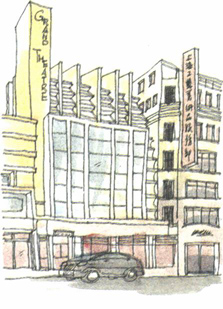
After its reconstruction in 1933, the Grand Cinema with a creamy sail as its facade was the best and largest cinema in Shanghai then. It was always envied for its box office. In front of the Grand Cinema at that time, there were three large fountains, and the steps were draped with silk carpets. Only the wealthy could go to the Grand Cinema. They would be escorted by beautiful Russian girls. And there was a band composed of European and American musicians. It was said that the tailors of the most famous female garment shops in Shanghai often went to the Grand Cinema to observe the fashion trends.
The Grand Cinema was the first cinema that was equipped with wide screen and stereo in China. It witnessed the glory of being No. 1 in box office for 11 years all over China. Its box office in 1994 reached RMB 13 million yuan, at least 10 times if calculated on the basis of the present currency value. Although several foreign-invested cinemas in Shanghai have got the upper hand nowadays, its bearings as No. 1 Cinema in the Far East are still obviously borne out on Nanjing Road, the No. 1 Street in China.
Going into this ordinary-looking cinema, you will be amazed at such an elegant, spacious and grand art space. The streamlined arc curves surround the whole ceiling of the cinema, the roof is a three-leveled lotus flower, and the Italian marble blocks were laid in abstract patterns, romantic and poetic. The deluxe hall can seat 1554 people. The audience lounge is comfortable, spacious, and bright. Although quite a number of adjustments in the interior structure were made in the two renovations, the special service counter for the audience and even the lost-and-found counter are still maintained.
Hengshan Cinema: Lovers' Cinema
(No. 838, Hengshan Road)
Hengshan Cinema has long been famous as Garden Cinema in Shanghai. It is located on Hengshan Road, adjacent to Xujiahui Commercial City and Xujiahui Park. With a favorable geographical location and a quiet section within a bustling commercial area, it is really an ideal cinema for lovers. The atmosphere of Hengshan Cinema perfectly matches the relaxing ambience of the entire Hengshan Road area. It has grayish white walls and a triangular pointed roof. When you walk into the cinema, you would feel as if you entered a garden house. You will see the large posters of beautiful female movie stars either hidden behind creeping plants or hanging on the clothes hangers. You can go shopping in Xujiahui during the daytime, watch a movie here at the nighttime, and then have a stroll in the Xujiahui Park across the street.
Hengshan Cinema was completed and began its business in January 1952. Its name was handwritten by Chen Yi, who was the first Mayor of Shanghai and one of the ten marshals of China. The cinema has three projection halls. Hengshan Hall is the largest hall that can seat 896 people. The comfortable seats are arranged in layers, so every seat can have a complete view. Huiyan Hall is set up with 52 pairs (104 seats) of upholstered chairs; it is the first deluxe mini-cinema in Shanghai. Huayuan Hall integrates a glass house, a garden, a cafe, and a cinema. Equipped with 52 of the new comfortable sofas, this hall can be reserved by individuals.
The cinema is very nice to their customers. Spectators are allowed to bring food and drinks. The prices for the new movies are only half of those in other large cinemas. It also runs special cartoon movies for children, and Suzhou story telling and ballad singing for elderly people and fans.
Suzhou story telling and ballad singing is the most elegant art of talking and singing. It is performed in the softly spoken Suzhou dialect. It used to be performed in teahouses or professional story-telling theaters. Although there are still a large number of audiences, the performing space has drastically shrunk due to lack of profit. The show is on every morning, and the price is only RMB 5 yuan with a free cup of tea. And most of the performers are distinguished artists.
Cathay Theater: Aristocratic Civilians
(No. 870, Middle Huaihai Road)
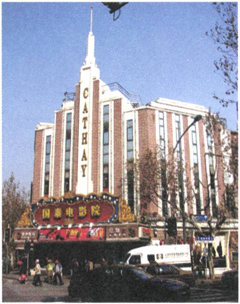
At the fashionable intersection of Middle Huaihai Road and Maoming Road stands the imposing Cathay Theater. It has crimson brick walls with white linings between bricks, and a tall, narrow and pointed roof. And its architectural style matches the adjacent Jinjiang Hotel and other nearby buildings. It is part of the Jinjiang Group.
With an aristocratic status, Cathay Theater made its advent on Huaihai Road on January 1, 1932. The advertisement carried on Shanghai Journal on that day was "Gorgeous and magnificent as the No. 1 cinema in Shanghai, exquisite and comfortable as an integration of modern sciences." Mr. Jiang, already in his sixties, recalled, "In my childhood, it was unusual and grand to go to Cathay Theater. I would also be properly dressed. The ticket price was four times that of other cinemas."
After renovation in 2003, the auditorium was divided into three small terraced halls that blend the classical with the modern. Although its facilities are incomparable with those imported, its low prices and ten sets of the ivy tables in the corridor are appealing. Once a week, it puts out a specially low-priced morning show.
Huangpu Theater: Singing March of the Volunteers
(No. 780, East Beijing Road)
Located at the intersection of Guizhou Road and East Beijing Road, Huangpu Theater, though inconspicuous, bears special significance to the Chinese people. March of the Volunteers, the national anthem, was first sung publicly here. This old theater, already over 70 years of age, is now surrounded by mechanical and hardware shops, looking somewhat lonely.
Huangpu Theater was originally named Jincheng Grand Theater, which was unveiled on February 1, 1934. Before liberation, it mainly showed domestic movies. On May 24, 1935, the domestic movie, Sons and Daughters in a Time of Storm, made its debut here. Its theme song, March of the Volunteers, later on became the national anthem of the People's Republic of China. On April 22, 1999, Wenhui Daily carried an article entitled The National Anthem Was First Sung Here. To date, the then newspaper advertisement announcing the movie, Sons and Daughters in a Time of Storm, is still posted in the lobby. And there is a bronze plate on which are inscribed Educational Base for Patriotism.
In 1958, when this cinema was to be transformed into a special theater for Huaiju Opera and Huju Opera, Premier Zhou Enlai was invited to inscribe for the theater. He made the suggestion that the theater be renamed Huangpu Theater. As soon as you step through the entrance, you will feel the special ambience of an old cinema. The spiral staircases on both sides, the candle chandelier in the middle, and the colored glass windows all look extremely tasteful, and on the walls around can be found the narration of the history of Huangpu Theater. The lobby on the first floor is connected with the mechanical and hardware shops on both sides. The ticketing office is still using the old plate for movie titles, on which are written the number of the showings of the movies and the prices. And the lower part of the windows for the ticketing office is mounted with the church-style small blue and green pieces of glass.
Xinguang Cinema: Special Cinema for Internal Movies
(No. 586, Ningbo Road)
Xinguang Cinema, located on Ningbo Road close to the Pedestrian Street of East Nanjing Road, was completed in November 1930. Originally named Xinguang Grand Theater, it is of Gothic style in architecture with meticulous decorations. Up to now, Xinguang Cinema still keeps the photograph when it began its business. These are the oldest photographs of a cinema in Shanghai. Operas have also been performed in Xinguang. In the 1930s, when Charlie Chaplin came to Shanghai, Mei Lanfang, master of Bejing Opera, invited and accompanied him to the luxurious Xinguang Theater to enjoy the Beijing Opera, Famen Temple, with Ma Lianliang as the chief performer.
In the 1980s and 90s, Xinguang Cinema was most popular in Shanghai, for it exclusively showed the so-called internal movies, for which tickets were very difficult to obtain. (Internal movies are usually imported movies not supposed to be shown in public in China.) Before the major renovation at the end of the 1990s, the layout of Xinguang Cinema was very similar to Shanghai Concert Hall. The auditorium on the first floor and the upper circle on the second floor can seat 1200 people. There is a beautiful staircase in front of the broad entrance. Inside the entrance is a very spacious lobby. The two circular European staircases on both sides are of smooth arc-shape design. Above head is a large chandelier, and under foot is the white-and-black marble floor. All the walls are ornamented with sculpted shrines, and all the doorframes are mounted with complicated sculpted floral patterns. At the end of the 1990s, no more internal movies were shown; as a result, the number of audiences dropped drastically. In order to survive, Xinguang was compelled to reduce its large auditorium into small halls. And it also rented quite a part of its space along the road to hotels. Its past glory is gone forever. However, as an old cinema, Xinguang still maintains its bearing and sustainability.
Lyceum Theater: Artistic Old Theater
(No. 57, Maoming Road)
Quietly sitting on South Maoming Road, Lyceum Theater looks at the Jinjiang Hotel on the opposite side of the road. It appears somewhat reserved but gentle.
Lyceum Theater began its business at the end of 1931. Of a glass-and-concrete structure, it is a heritage architectural building in Shanghai. Its building style is entirely of modern architecture, similar to Xinguang Theater. The two digits, 5 and 7, on the round plates and the ornamental props with softly linear sculpted flowers protrude from the front wall. Below the golden strokes of the Chinese name is its English counterpart LYCEUM THEATRE. Attached to the windows are three unconventional small balconies, above which is a relatively large rectangular balcony. The lobby was designed like an elegant home, with light-colored floor and two oil paintings on the wall. Between the two paintings is a narrow ornamental table, on which is a vase with bright-colored dry flowers. There are two small round tables surrounded by three sofas of classical style. It looks like a deluxe reception chamber.
Lyceum Theater used to be the theater for Overseas British Amateur Drama Club, which showed films to the public. In 1950, it was renamed Shanghai Art Theater, which also showed films. And now it has resumed its original name. In general, it stages plays, and only shows cartoon films during the Cartoon Cultural Art Activities of Shanghai International Art Festival.



 er Saal of Vienna, Symphony Hall of Boston Symphony Orchestra, and Concertgebouw. The stage is of a rectagular shape, and the stage space and the audience space are merged together. With neither curtain nor columns, the performance relies on natural acoustic effect. In the construction of the hall, a large variety of special technology and new materials were used, thus reaching the international A standard as Reverb Mid of 1.8 second.