Xintiandi: Western Fashion in Old Streets 新天地:老街坊的欧风时尚
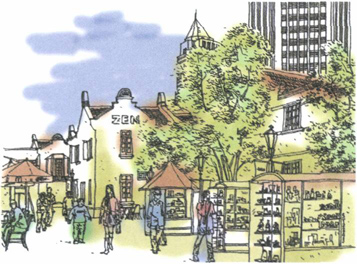
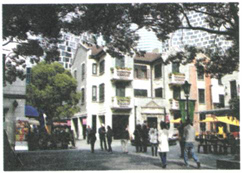
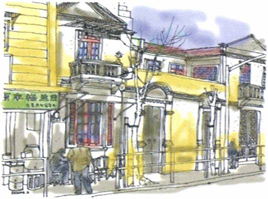
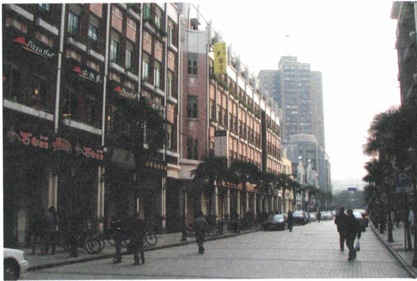
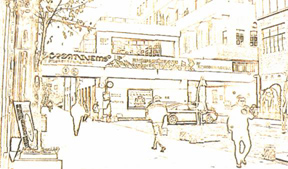
The most typical old residence in Shanghai is the lanes of the stone-gate residential houses, which are the simple two-story buildings with stone gates in rows. Among such old residential houses, there is a most up-to-date fashion and entertainment place named Xintiandi. With its time span from the past to the present, Xintiandi is fascinating and attractive. She has not only the implicit and elegant manners of the ladies from noble families of old Shanghai but also the mysterious and enchanting charm of the modern-time cosmopolitan women. At night, the moonlight trickles down gracefully onto the stone-gate residential houses, which look quiet and dignified. At a time like this, some whispers or charming smiles from the ladies in light red dresses at the dinner party come to you. At this, therefore, you cannot help lingering here, can you? Today, yesterday and tomorrow meet together in Xintiandi. Xintiandi covers an area of 30,000 m2, with a floor space of 60,000 m2. It is the top-ranking fashionable consumption area rich in historical and cultural style. One of its typical features is the merging of Chinese and Western styles and the combination of the old and the new.
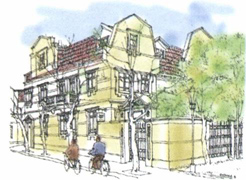
The external appearance of the stone-gate buildings at Xintiandi is basically the same as before, with the brick walls and roof tiles kept intact. But along with the living tempo and emotional demands of the urban people in the 21st century, its interior has been completely renovated and endowed with diversified functions including catering, business, culture, entertainment, commerce, exhibition, etc. All the previous walls between houses have been removed. The Europeanstyle fireplaces and sofas are next to the traditional Chinesestyle square tables for eight people and fauteuils; bars and cafes are adjacent to teahouses and Chinese restaurants; on the walls are hanging the modern oil paintings, while on the floor stands the old phonograph; outside the gate is the glamorous and graceful lane of stone-gate houses, while inside is the exquisite and delicate modern life. There is a sharp contrast everywhere; however, anything and everything is so appropriate and harmonious.
Moreover, the comfort and convenience of the 21st century can be found in the lanes of stone-gate houses at Xintiandi. They are equipped with elevators, central air-conditioning, and the Internet. By surfing on the Internet, tourists can very quickly check the prices of the commodities of all shops, the menus of the restaurants and bars, and even the movies that are on in the movie theater. They can either place an order for seats or enjoy the cultural performances held in the open-air square or restaurants at Xintiandi on the Internet. Xintiandi has already become the best place for Chinese or overseas visitors to go and experience the historical culture and modern life of Shanghai. Meanwhile, it is also the gathering place for those fashionable people who pay much attention to the quality and exquisite spice of life.
The construction of Xintiandi started at the beginning of 1999. Even before the scaffolding was completely dismantled, stars, artists, entrepreneurs, and bankers from every corner of the world, as well as the diplomats stationed in Shanghai, had kept coming to this place. Very much impressed by its glamour, they could hardly tear themselves away. Besides, many fashion and cultural activities, such as international fashion model competitions, fashion shows and film press briefings, etc. have made their debut here.
With Xingye Road as the demarcation line, Xintiandi is divided into Southern Block and Northern Block. Northern Block has preserved most of the stone-gate residential houses, which serve as bars of various styles, theme restaurants, art galleries, the museum of stone-gate houses, etc. Southern Block is mainly composed of modern buildings including a lot of leisure and entertainment places such as auditorium, cinema, theme restaurant, apartment hotel, etc.
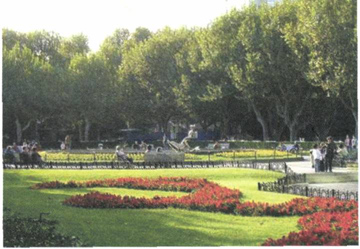
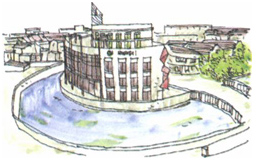
The artificial lake and green land of Taiping Bridge nearby is another fashion and leisure area promoted after the completion of Xintiandi. On the lake, limpid wavelets stretch out shiningly. Strolling under the shade of trees along the lake and enjoying the caressing by the soft breeze has become a new attraction for both Chinese and foreigners after they come to Xintiandi. It is worth mentioning that the passersby's safety and ecological balance of the lake had been taken into consideration as it was constructed in such a bustling area; therefore, facilities of epidemic prevention system and water self-purification system were installed in the lake area. Since its completion in 2001, the water here has maintained the national quality standard of surface water.
Different from the pureness and comfort in the daytime, the artificial lake of Taiping Bridge is resplendent and magnificent at night. The Yulan Island at the center of the lake turns to be a water stage, where all kinds of thrilling parties held here have launched several on-the-lake fashion whirlwinds in Shanghai. It has held three countdown parties on the New Year Eve. From the Railway Cold Fireworks in 2003, Multimedia Waterscape Fireworks in 2004 to the Fire Dance Theme in 2005, it offered new surprises year after year. On the eve when Shanghai said goodbye to "SARS", there was floating a "Heart of Love" board composed of 10,000 candles on the artificial lake. And on the lawn by the lake were the words of "Final Farewell to SARS" in both Chinese and English also made up of candles. Both expressed people's beautiful wishes. Ricky Mart, king of Latin songs, selected here for the performance of his first famous song The Cup of Life in Shanghai; Lucky Strike Bar Honda held the F1 celebration here. Its three-dimensional screen of a racing car model, 14.5 meters high, greatly surprised the world; in the opening ceremony of Shanghai International Fashion Culture Festival of 2004, the sponsor moved the T-stage from the pedestrian street of Xintiandi to the lake center for the first time; and in May, 2005, Financial Times invited CEOs of 400 world famous brands on luxurious products and held a welcome party on the lake. A welcome party that interlinked time and space was held on the lake. The old furniture, rickshaws and image ambassadors of Xintiandi in cheongsams seemed to take the time back to the 1930s.
Located by the artificial lake of Taiping Bridge, the Enterprise World building is made of rare cloud stone and granite. It is one of the new Grade-A office buildings in Shanghai. At present, many of the world top 500 companies have secured a foothold here. On the first and second floor of the building is the business center selling choicest goods. It consists of Singapore Luxury SPA, Banyan Tree Gallery franchise boutique shop, Z. Bigatti franchise store selling the most costly skin care products in the world, Biche De Bere clothing and accessories store with the products made by French designers, Shanghai flagship store of BMW lifestyle, flagship store of Ports 1961, and CitiGold Center, etc. All are aimed at highend consumers.
Hengshan Road: Long Leisure Corridor under Parasol Trees 衡山路:梧桐树下的休闲长廊
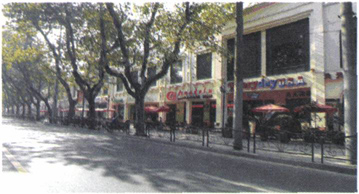
Hengshan Road, reputed as No. 1 Street for leisure and entertainment in Shanghai, is better known for the aged French parasol trees on both sides of the road. On a sunny day, when you walk along the 2.3-km-long road, stepping on the shadows of the tree leaves, you might see a corner of an old building behind the verdant trees. It is the best time for you to imagine about the old Shanghai.
Under the moonlight, after leaving the dimly lit Xujiahui Park or garden-like Hengshan Cinema, you can go northward along Hengshan Road. Here you will find a variety of music restaurants, Chinese and western restaurants, bars, teahouses, discos, etc. and the quiet Community Church. This is the most active and popular section of Hengshan Road at night; as a result, traffic jams occur almost every night. Further northward, there are many restaurants, bars and cafes nested in the garden houses amidst the parasol trees.The thick and densely planted French parasol trees brought out the charm and glamor of the street and the old houses.
Historical recollections
Hengshan Road Community starts at Xujiahui. It is the core section of the Historical and Cultural Protection Area of Hengshan Road and Fuxing Road, which is one of the 12 historical and cultural protection areas in Shanghai. It embodies the historical happenings of recent China.
The construction of Hengshan Road began in 1892, when the French Concession had already expanded several times. In 1922, the street was named Avenue Petain. Only when the concession was confiscated, was the name changed into Hengshan Road. On both sides of the road, in the deep lanes, and in the short by-roads there are over 1,100 garden houses in different styles. These houses are of Spanish, British, country villa, pseudo-classic styles in terms of architecture, forming a residential atmosphere in a tranquil environment. Almost all of them were sold to the Chinese after World War Ⅱ. In addition to the garden houses, this area has the largest number of modern apartments in Shanghai. In the first half of the 20th century, there occurred many anecdotes of many legendary people on Hengshan Road.
The hundred-year-old Hengshan Road still maintains the European feeling from the first half of last century. Today, on Hengshan Road, the traditional and the modern, the classical and the fashionable, are seamlessly blended.
Xujiahui, the starting point of Hengshan Road
Different historical and cultural features are embodied amidst the European atmosphere along Hengshan Road. The southern section used to be the settlement of the French Catholics. The middle section was once the settlement of the overseas American Christians (Protestants). In 1913, after Russia was defeated in the Japanese-Russian War, Russian immigrants flocked to Hengshan Road, Huaihai Road, etc. in the French Concession. They had left behind many remnants of Russian culture in the northern section of Hengshan Road.
Xujiahui is the starting point of Hengshan Road at the southern end. In those years, the authority of the French Concession constructed Hengshan Road to connect Xujiahui and Huaihai Road under the pretext of protecting the Cathedral at Xujiahui. This area offered the most spacious horizon of the historical and cultural features with the vast stretches of green land, and the theme of the area became religion and public servicing.
When talking about Xujiahui, we have to mention the interchange of Eastern and Western culture and the effect of Catholicism in Shanghai. On the southwest side of the Xujiahui Cathedral is Guangqi Park, at No. 17 Nandan Road, where Xu Guangqi's Tomb and Museum is located. The name of Xujiahui is closely related to him. Xu Guangqi was a high official in the Ming Dynasty who actively advocated western science and technology, and he was also the first person to introduce Christian culture into China. Besides the ornamental columns, archs, stone-carved men and horses, which are frequently seen in front of ancient Chinese tombs, there is a stone cross in front of the dome-shaped tomb. And carved on the tomb tablet are writings of Tomb of Xu Guangqi of the Ming Dynasty, inscripted by Su Buqing. The museum used to be an old residential house, which is already over 500 years old.
The Xujiahui Cathedral at No. 158 Puxi Road is best known all over the world as the symbol of the historical architectures of Xujiahui. This building in imitation of French medieval Gothic style was constructed in 1910, and it enjoys a reputation of No. 1 Cathedral in the Far East. Behind the large meadow stands the cathedral with two bell towers facing each other northward and southward.
The five-story white building at No. 201 North Caoxi Road, directly opposite the cathedral, is a restaurant special for its local cuisine. And it is now called Old Shanghai Railway Station. The construction of this European-style building began in 1923. It used to be the Lady Chapel, which was equally well known as the cathedral; however, it was the nursery of the chapel that brought scandals for Santa Marie. The spacious lobby under a vault ceiling, wooden tables and chairs, and dim lights all represent the imported sentiments of the old fashionable Shanghai. The locomotive in the garden and the two old compartments on the second floor are conspicuous. It is said that one compartment was custom-made in Germany by Empress Dowager Cixi and that the other was a gift for Song Qingling, a leader of the People's Republic of China, by the Soviet Union. Both have now been transformed into small dining rooms.
The yesterday and today of the old garden houses
Many of the restaurants in the old garden houses along Hengshan Road are well known for their unique tastes and rich flavors.
Walk further northward along Hengshan Road, and you will see Xujiahui Park, in which small rivers meander and green trees make pleasant shades. In the park quietly stands the Pathé Red Building, No. 811, Hengshan Road. Its construction began in 1921, and was later purchased by EMI Britain. In the 1930s, almost all the stars in Shanghai came to this building at one time or another. After 1949, China Record Company was born here, and the little Red Building became the source of Chinese records. Although it is now a first-class Italian restaurant, the internal furnishings of the past are stll being kept, such as old radios and telephones. And on the walls are hanging the movie stars' photos that have already gone yellow. The second floor used to be the office and rooms for the singers to take a rest in. It was here that Nie E composed the National Anthem of the People's Republic of China, March of the Volunteers. And it was on this recording machine, still kept up to now, that the voices of many famous performers of China were reserved on the records.
Leaving the little Red Building behind, you will find more and more garden houses and old apartments. In them many foreigners once lived, singing and dancing almost every night.
Hengshan Hotel stands at the intersection of Hengshan Road and several other roads, at No. 534, Hengshan Road. It used to be the well-known Picardie Apartment, behind which is the oldest tennis court in Shanghai. Further forward you come to West Lake Apartment at No. 303 to No 307, Hengshan Road, which used to be Washington Apartment. The plate of Shanghai Heritage Architecture on its gate reveals its long history. The Community Church, which is of Gothic style, at No. 53, Hengshan Road, is the major religious place for foreign Christians in Shanghai. The thick green ivy plants clinging to its external red-brick walls show its long history and religious profundity. On holidays the singing by the choir can always be heard. Opposite, part of Shanghai American School along the road has now been rendered into Diplomat Circle. Bars, teahouses, and restaurants converge in this section of the road. And traffic jams often occur here in the nighttime as well as the daytime.
In the triangular area at the intersection of the northern section of Hengshan Road and Huaihai Road is the concentration of foreign consulates and garden houses. In the past, this place witnessed frequent heavy traffic and gatherings of social celebrities. In the 1920s and 30s, hearsay and anecdotes about VIPs of the Republic of China often spread in these houses. At the center of the intersection of Dongping Road, Yueyang Road, Fenyang Road, and Taojiang Road is erected the bronze bust of Pushkin, a great Russian writer.
Hengshan Road is affiliated with a feeder road, Dongping Road. In its vicinity there are a dozen garden villas, which used to be the residences of modern celebrities. However, they are now bars and restaurants of different kinds. At No. 1, Dongping Road, is the Xi's Garden Restaurant, which used to be the residence of Mr. Xi, the Director of the Central Bank of KMT Government. The restaurant is famous for its Suzhou and Huaiyang cuisines. This garden residence of Spanish style began its construction in 1913. It enjoys favorably natural surroundings and boasts elegant and luxurious interior decorations.
At No. 11, Dongping Road, is located the well-known Sasha Restaurant. On the first floor of the restaurant is the British bar, on the second floor is the western restaurant, and on the third floor can be held parties and press conferences for products. Besides, there is a large beautiful garden. The enthusiastic attendants speak idiomatic and rhythmic English. This building used to be the residence of Song Ziwen, a VIP during the time of the Republic of China. Its construction beginning in 1936, the villa is of exotically Dutch style. The old fireplace and the worn-out sofas will, all of a sudden, make you feel as if you were a guest in the old Shanghai villa back in the 1920s and 30s. Its tranquil environment, European and American flavor, and open kitchen have attracted many domestic and foreign visitors.
In No. 9, Dongping Road, are several garden residences of French style, and one of them was bought and presented to Song Meiling as a marriage gift by Song Ziwen. Its roof is laid with the dark red French flat tiles spread out like fish scales. The walls are inlaid with black, white or yellow pebbles and covered with vines whose color changes with the seasons. You would feel as if you were entering a building in a fairy tale. The building that was once the "Love Nest" for Chiang Kai-shek, Chairman of KMT, and his wife Song Meiling has now become the practice hall and classrooms for the young musicians of the middle school and primary school affiliated to Shanghai Conservatory of Music. The small western-style building next to the residence that used to be the residence of Chiang Kai-shek has now been transformed into a European restaurant. Many movies stars have been to this restaurant out of their curiosity.
The building at No. 79, Fenyang Road, the former residence of the director of the Municipal Administration of French Concession, is now the site for Shanghai Arts and Crafts Academy and Shanghai Arts and Crafts Museum. Built in 1905, the deluxe garden residence of French renaissance style was once reputed as Small White House. The museum has received heads of state of many countries and social celebrities, such as U. S. President Ronald Reagan, UK Prime Minister Edward Heath, etc. Thanks to its luxurious and majestic nature, the movie The Song Sisters was also filmed here.
The building at No. 150, Fenyang Road, used to be the private garden of Speelman, an adventurer of French nationality. Built in 1920, it is of typical French renaissance architectural style. In front of the castle-like janitor's room a drive leads to the depth of camphor and cedar trees. On the north side of the fountain pond quietly stands a grayish white building, which was the former residence of the senior KMT General Bai Chongxi, hence often referred to as the Bais' Abode. Later on, it was the site of Shanghai Academy of Painting and Shanghai Yueju Opera Troupe. Now it has become Japanese Restaurant Ambrosia, and next to it is Paulaner Brauhaus Restaurant.
The restaurant at No. 158, Fenyang Road, is called Peace Mansion because several private rooms are named after the winners of the Nobel Peace Prize. The Shanghai flavor food served here is exquisite and delicious. However, most people might not have had the idea that Dai Li, the chief of KMT secret agents and a butcher whose hands were dripping with revolutionaries' blood, used to live here.
In addition, among some other famous villas in the neighborhood are the former residence of Sheng Chongyi, which is now the official mansion of the Japanese Consulate General at No. 1517, Middle Huaihai Road; the former residence of Rong Hongyuan, which is now the U. S Consulate General in Shanghai at No. 1649, Middle Huaihai Road; and the former residence of the wealthy merchant Tang Xinghai, a Western European style garden villa, which is the official mansion of French Consulate General in Shanghai at No. 1431, Middle Huaihai Road near Urumqi Road.
Now great changes have taken place in this area, but people will always keep its history deep in their mind.
Flowing elements of fashion life
On both sides of Hengshan Road are opened scores of large and small bars, teahouses, cafes, discotheques, featured shops, a bowling room, a tennis court, an indoor golf club, and other leisure and entertainment places.
Bars
The ingenious combination of European flavors and nostalgic sentiments is a prominent feature of Shanghai bars on Hengshan Road. When night falls, the neon lights along Hengshan Road are colorfully sparkling and the bars are crowded with people. The bars here are different in style and size, but all precise and unique in decoration. There are the British-flavored Sasha's Bar, the American-style Bobon Street Bar, the gentle and nostalgic Old Times, the Irish-style O'Malley's Pub, the Chinese-and-Western-style La Villa Rouge Bar, the pioneering fashionable True Love Bar, and the amiable and friendly Fafa Bar. They are all seemingly imposing, but actually inviting. Besides the urban fashion atmosphere and nostalgic sentiment, you could feel the romantic tenderness in full agreement with the style of the entire Hengshan Road.
Cafes
A graceful street in the shade of green trees, together with elegant cafes, looks like an oil painting full of poetic romance. Guests at Keven Cafe & Restaurant at the mouth of West Jianguo Road could savor coffee, listen to light music, and enjoy the outdoor scenery through the large down-to-the-floor windows. It is similar to the small cafes along the streets in Europe in that it is friendly, natural, cozy and somewhat reserved. Camphor Garden Café is so named because of the tall thick camphor tree that has pierced the wall. It is unique in flavor; furthermore, those that love this café say that it is the best café in Shanghai.
Teahouses
It has already become a new social trend to go and appreciate a sip of tea in the teahouses on Hengshan Road. My Humble Teahouse at No. 10, Hengshan Road, is a very popular teahouse. The next-door Gengduyuan Teahouse is of antique Chinese style and offers large seats, thus most suitable for drinking tea and doing some reading. To go into Tun Yun Teahouse, you would first walk through a long passage covered by bamboos. Inside are displayed all kinds of simple and elegant tea sets. Not only is it serene in environment but it also has a complete variety of teas. The Scholar Teahouse also deals in tea business. It was once the residence of Kong Xiangxi, a VIP in the financial field during the period of the Republic of China. In front of the teahouse is a creek with flowing water as well as a path laid with stone plates. The first floor and the second floor are dissimilar in decoration and in taste.
Duolun Road: Former Residences of Social Celebrities 多伦路:昔日名人汇聚的“海上旧里”
Athough some of the streets in Shanghai are quite small, they have witnessed many talented people with heart-stirring incidents in history.
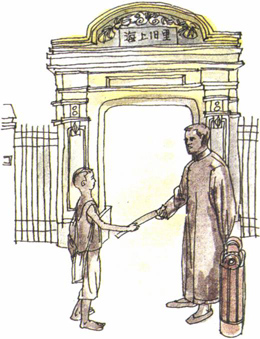
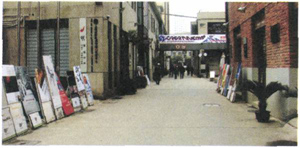
This 550-meter-long Duolun Road is in L shape, and both ends meet with the commercial street of North Sichuan Road. The east end is located between Duolun Commercial Mansion and Fashion Commercial Mansion, and on the north side, it ends at the northernmost part of North Sichuan Road. This short road left a significant page in the history of recent Chinese culture, and to date it still keeps the former residences and cultural relics of several cultural celebrities of China. Along this road there are some 20 European-style and Islamic-flavor villas as well as the stone-gate houses that have been preserved. This is the most typical civil residence in Shanghai. At the entrance of the road there is a newly erected arch, and carved on it are four Chinese characters, Hai Shang Jiu Li, meaning Former Lane in Shanghai.
Cultural celebrities: next-door neighbors
In the 1920s and 30s, the Chinese New Culture Movement was emerging, but suffered ruthless suppression by the ruling clique. The unique social environment and economic position of Shanghai attracted the then renowned progressive cultural people. Among them, more than 30 people had lived, or worked in Duolun Road. Their names are still living in people's mind, like Lu Xun, Guo Moruo, Mao Dun, Ye Shengtao, Qu Qiubai, Feng Xuefeng, Rou Shi, Ding Ling, Shen Yimo, the Japanese friend Uqiyama Kanzo and others.
Take a walk along Duolun Road, and you will find bronze statues of these people. Mr. Lu Xun, the master writer of China, is wearing a long gown and sitting in his ivy armchair, smoking and talking with young people. His tightly knitted eyebrows fully reveal his worry and anxiety. And the vacant chair on the opposite side seems to be waiting for you to join in. Mr. Shen Yimo, a great calligrapher, is wearing a pair of thick spectacles, and there is an opened book by his side. Miss Ding Ling, a young writer then, is sitting on a large suitcase with some melancholy on her face. All these statues revive their bygone countenances.
It is a unique cultural phenomenon that these celebrities lived as next-door neighbors in Jingyun Li and Lane 201. Jingyun Li linking East Hengbang Road is a cluster of old brick-and-wood stone-gate houses built at the beginning of the 20th century. It was once referred to as No. 1 Lane of Shanghai. Walking into the lane, you will see old people sitting in front of their gates and sorting out vegetables. However, when you take a close look at the house number plates, you will discover many memorial plates: At No. 11 once lived Mao Dun, Feng Xuefeng, and Ye Shengtao; at No. 23 once lived Lu Xun and Rou Shi; etc. The residents of Jingyun Li are very proud of that period of history and often they would let the tourists go inside and take a look.
No. 2, Lane 201, Duolun Road, is the former site of the League of Left-wing Writers in China. With Lu Xun as its pioneer, the League was developing rapidly. This three-story westernstyle building used to be University of Chinese Arts, initially founded by Chen Wangdao and others. On March 2, 1930, the League of Left-wing Writers in China held its founding congress here. In the next 7 years, Left League trained a large number of young people of letters. With over 480 members and about 100 works, it left behind a glorious chapter in the history of Chinese revolution and literature. On Duolun Road, there is a sculpture of Rou Shi and Five Left League Martyrs, who were arrested and executed by KMT at the end of 1931. The scultpture reminds us of the harsh environment for cultural celebrities in those years.
Taking a seat in a café or teahouse in Duolun Road and looking out at the pebble road, you might image the cultural celebrities that were faithful to their belief and tried to arouse the masses of people with their ink and brushes.
Some of the historical buildings in Duolun Road were destroyed. For example, the café where the Left League writers used to gather was dismantled and transformed into a commercial mansion.
Lanes of stone-gate houses side by side with the villas
In the short Duolun Road, the luxurious villas of the former high officials and wealthy merchants existed together with the old stone-gate houses for ordinary people.
There are over 20 villas scattered along the road, that are of British, French, Japanese, Dutch, Spanish style, as well as of Islamic and Chinese-and-Western style; moreover, Hongde Tang, a Christian church, is in the style of a Chinese palace. Three of the buildings are under municipal protection. The building at No. 250, Duolun Road is an abode of North African and Spanish Islamic style. It was built in 1924, and was the former residence of Kong Xiangxi, husband of Song Ailing, the eldest of the famous three sisters of the Song Family. Unfortunately, most of these villas of the then noble families became either civil residences shared by several families or occupied by government departments. Only very few of them are open to the public right now.
The house at No. 93, Duolun Road, built in 1920, used to be the private abode of a comprador. Wang Zhaoshi, a democrat and one of the 7 gentlemen, once lived here. And now it has been rendered into 1920 Café. Although the house has lost its brilliance, it still maintains some traces of luxury in many details. Some people, stepping into the café, might wonder if they have entered a world of chinaware by mistake. Once it got another name, i. e. Deyi Ceramic Exhibition Hall. The coffee wares displayed here are all made in Jingdezhen. And there is a kind of coffee by the name of 1920.
The house at No. 35, Lane 203, North Sichuan Road, is Jinquan Numismatics Museum. It is the largest museum of ancient coins in Asia as well as the largest exhibition hall in Duolun Road so far. Coins of past dynasties, from the early Qin Dynasty (over 200 BC) to the Republic of China (the early 20th century) are on display. And the building was once the Tang Abode, the former residence of Tang Enbo, the most incompetent general of KMT.
No. 210, Duolun Road, once the mansion for General Bai Chongxi of KMT, is now Navy 411 Hospital. No. 215, a garden villa of Spanish architectural style, is now the Oriental Zili Continuing School.
In the vicinity of these luxurious houses are clusters of lanes of typical stone-gate houses. Jingyun Li is a lane of old stonegate houses built at the beginning of the 20th century, while the some 300 houses in Yongan Li are newer style stone-gate buildings built later on. In the past hundred years, people of Shanghai have been living in such environments from generation to generation. On sunny days, old people would sit on the benches having chitchat, with a purple ceramic teapot in hand. And housewives, coming back from the food market, might talk about the household stuff.
Left behind on Duolun Road are the footprints of the historical and cultural changes in the city of Shanghai. It is said that a survey about cultural relics was carried out in Duolun Road 10 years ago. And it was found that almost every existing building has got a long story to tell. Therefore, Duolun Road symbolizes a hundred-year-old Shanghai.
A place of nostalgic and cultural leisure
At present, Duolun Road is referred to as a Street of Cultural Celebrities; the street has undergone transformation with even more culture influence.
Along Duolun Road there are dozens of folk museums, collection halls, and exhibition halls, for example, the Collection Hall of Mao Zedong Badges, Collection Hall of Newspapers, Collection Hall of Old Furniture, etc. Only in the old stonegate house opposite the Numismatic Museum are there six folk collection halls: Tourist Souvenirs, Bookplates, Nanjing Clocks, Chopsticks, Grotesque Rocks, and Ceramics. They have collected quite a number of precious items. No. 81, Duolun Road is a peculiar collection hall that has collected a variety of old maps, coins and banknotes, newspapers, relics of the Cultural Revolution, Mao Zedong Badges, etc. A branch of the Shanghai Cultural Relics Store has been stationed at No. 145, Duolun Road, adding a strong cultural ambience to the road and making it a well known street of antiques.
A number of leisure places are also along the road, like Old Film Café, Shangeng Club, Minren Chayi House, Xianheng Restaurant, etc.Old Film Café, at No. 123, Duolun Road, is an exquisitely built three-story Japanese style building. In summer, the external walls are covered with ivy plants. Inside, the café is decorated with a large number of fashionable ornaments of the 1920s and 30s. On the first floor, more than 100 old films, even including the early silent ones, are being shown consecutively. On the second floor, there is the special reading room for the old film salon. Immersed in the old melodies, you could hear the rustling of the film projector made in Germany in the 1920s and watch the stories of the old times on the screen.
Xianheng Restaurant at No. 22, Duolun Road, tends to remind people of the scenes in Lu Xun's works.
Shangeng Club at No. 240, Duolun Road, is a garden restaurant with live music, which mainly serves Western food. Diners can enjoy their food in the accompaniment of live piano, violin, saxophone, flute, and other instruments every day from afternoon to early next morning.
The Museum of Modern Fine Arts at No. 27, Duolun Road, is a place where you can appreciate the trendy arts of contemporary China.
Yandang Road: Casual Snacks under the Eaves 雁荡路:在上海屋檐下随意小酌
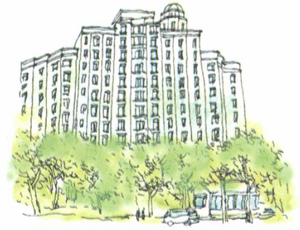
Yandang Road is in the mid-section of Middle Huaihai Road. Compared with the nearly 1,000-meter long Nanjing Road lined with lots of large commercial buildings and hotels, Yandang Road can be considered only a miniature street. The street is laid with colorful bricks, and with apartment buildings on both sides, the street feels so cozy and relaxing.
Restaurants on the first floors of the apartment buildings
Around the purple magnolia tree at the intersection of Yandang Road and Middle Huaihai Road stands an ice cream vending minibus throughout the seasons. The ice-cream cone sells 5 yuan in a peak season and 3 yuan in a slack season. There is also one ice cream shop, La Perla. Its handmade Italian icecream tastes soft and refreshing. If you order an RMB 80 yuan set meal for two people, you could enjoy ice cream to your heart's content. However, you have to finish the one in your hand before ordering another one.
In the street, there are a large number of restaurants, opened mainly on the ground and second floors of the apartment buildings. Among them are Italian Da Marco, Xinyun Cafe, Pizza Hut, Japanese Meiji Curry, and Australian Ali Baba as well. The featured product Kebeb of Ali Baba looks like the chicken roll of KFC, and comes with three different fillings of mutton, beef and chicken and several sauces for your choice. The milk toast rolls are children's favorite. No. 69, Yandang Road, is a steak house with a beautiful number plate at the gate. On the balcony, you can overlook the Frenchstyle Fuxing Park.
Of course, most of the restaurants here are Chinese restaurants. The pork chop and glutinous rice flour cake of Xian De Lai has a good reputation; Guilin rice noodles are very popular; the noodles with peanut butter and the beef soup of Wei Xiang Zhai, which are the two certified snacks by China Restaurant Association, sell at the price of only 6.60 yuan. If you like to have the topping and the noodles separate, you can tell the waiter to have the noodles "cross the bridge" first; Cuihua Family Jiaozi Restaurant is rich in flavor from northeast China; the bird's nest and Chinese brown frogs of Sea Tortoise Restaurant are nutritious for health and beneficial to facial beauty.
In addition to the restaurants, there are a number of other shops, such as Shanghai Watch & Clock Shop, Nu Skin Beauty Parlor, JDC Fashion Clothes, Caoyi Chinese Clothing, New Concept Cloth Garments, etc. In Caoyi Chinese Clothing, there are a large variety of fashionable cheongsams and other Chinese clothes; many foreigners have patronized it out of admiration. And it is said that many films have taken snapshots in this shop. And at the intersection of Yandang Road and Nanchang Road, the windows of the Wedding Gown Shop have often made passersby stop and look. After all, the models are always eye-catching. The shop sells many traditional Chinese marriage articles, which are pleasant and appealing.
At the weekends or on holidays, there are often various theme activities being held here, such as World Food Festival, Clothing Exhibition Week, etc.
Old houses with a strong cultural atmosphere
The buildings in Yandang Road are pretty old. Compared with those noisy leisure restaurants, they are very quiet as if they didn't care too much about whether those flaring shops would derive more attention from passersby. The building of No. 80, Yandang Road, is the former site of National Association of Vocational Education of China. Today, quite a few signboards of different units are hanging at the gate of this lattice building. Among them, the signboard for National Association of Vocational Education of China is the only one to have been handwritten. On the top of the gate you will also see various horizontal boards writing from right to left.
The decoration on the external walls of the building beside Xian Zong Lin Teahouse is very beautiful. There are five small floral circles at the top, which is linked with two dangling circles, and at the base there is another one large circle and four small circles.
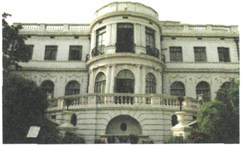
Shanghai Science Hall is located at the intersection of Yandang Road and Nanchang Road. Its main building is of French style and was built in 1918 with a spacious cloister and a large lawn. Many outstanding scholars and specialists, including the Nobel Price winners Derek Barton, Chen-Ning Franklin Yang, Tsung-Dao Lee, Samuel Chao Chung Ting, Yuan Tseh Lee; Taylor Wang, the first Chinese scientist that entered the outer space; Sergei Korolev, father of the Soviet rockets; and others, delivered academic lectures on the platform here. It's best to come here at dusk when the sun is setting at the corners of its eaves, for it looks majestic and magnificent.
A place of amusement in the park
Yandang Road ends at Fuxing Park and Cashbox KTV, which demonstrate their charm and glamour respectively, one in the morning with people dancing and the other in the evening with people singing.
Fuxing Park is a relatively well-preserved French-style garden, with French flowerbeds, rose gardens, and seethrough fence walls. Though not large in area, it has got quite a number of old, thick and tall trees. It is the first park in Shanghai that initiated urban plaza cultural activities. The recreational activities launched by the masses, such as Friendship Dancing Corner and Opera Corner, are still thriving. And the English Corner is a place where the locals can enjoy free language interactions with foreigners. Now the park is open to the public for free.
Cashbox KTV, Park97, and Guandii are the three recreational leisure places dotted on the edges of the park. By means of the favorable environment of the French-style Park, these three places symbolize a combination of nature and fashion. Cashbox KTV is the most famous karaoke place in Shanghai. For its high quality sound effect and up-to-date lists of songs, of which there are exclusive lists of English and Japanese songs, it has become a popular location for get-together and other social activities.
Small Bars on Maoming Road: the Deeper the Night, the Mellower the Wine 茂名路小酒吧:夜越深沉酒越醇
Maoming Road crosses the west section of Middle Huaihai Road, and is divided into North Maoming Road and South Maoming Road with Middle Yan'an Road as the demarcation. On the west side of South Maoming Road is the Culture Square, which used to be the largest theatre in Shanghai. On the east side is Ruijin Hotel, one of the favorite hotels of Chairman Mao Zedong when he stayed in Shanghai. In its south at the mouth of Yongjia Road, there is a newly built high-rise commercial building. It is said that Maoming Road is the only area in Luwan District without civil residences. And its location in the city center fully justifies its overriding reputation. Before the founding of the People's Republic of China, South Maoming Road was part of French concession. Today, it has become one of the well known bar streets in Shanghai. When night falls, the road begins to come to life. A row of bars and discotheques renders South Maoming Road into a place of charming night.
Bewitching Music and Exotic Charm for Eyes and Ears
This street gathers more than 20 bars and discotheques, attracting foreigners that are crazy about heavy metal and rock music. The DKD in No. 174, Maoming Road, is a famous music bar of hippie style. Its owner graduated from the Architecture Department of the University of Auckland. His professional architectural concept and rich imagination render DKD in a mixture of cool and sexy appeal. The red curtain flows like a waterfall and is twisted in an exotic shape, producing a strong visual impact and an infinite space for imagination. When the lights turn dim, the old film projector will show the black-and-white film on the three screens above the bar. The hazy and indistinctive light will plunge your thoughts into a mysterious and unfamiliar space. It conforms to the implication of the name Decadence Kills Depression.
Blues & Jazz is a theme music bar. The owner opened it because of his love for jazz. Blues & Jazz is very low-profiled. Every night, there are jazz band performances, and almost all the performers are young people in pursuit of a jazz dream. It is said that Babyface at No. 180, South Maoming Road, is a well-known concentration camp of handsome boys and beautiful girls in Shanghai. The bar is often overcrowded with people. The foreman may say to you seemingly in a jest, "Do you have a reservation? If not, you may just go inside to see if there is any vacant seat!" Therefore, Babyface is also comically referred to as the cruelest bar in Shanghai by the coteries. The owner opened his first Babyface in Guangzhou and then expanded his business to Shenzhen and Shanghai. The bar often invites the overseas top-notch DJs, and its red-blue-yellow tone has a typical atmosphere of New York bars.
On the second floor of Jinjiang Hotel at No. 52, South Maoming Road, there is a bar rich in Indian style, and all waiters are from Bombay. Therefore, you might see something very interesting, i. e. when the bartenders are pouring wine for the guest, the mustaches of the guys will flicker with their smiles.
Elegant Charm of Shanghai Nostalgia
Besides the exotic bars rich in an international flavor, there are also some local nostalgic bars on South Maoming Road, such as Dong Hai Tang at No. 180. Mr. Xu, its owner, cherishes a strong love for the early Western furniture and top-ranking paintings. The house is full of old furniture, old books, antiques, and old paintings. If you were there, you might feel as if you were in a living room of a very wealthy family in Shanghai. There is also a fireplace from the 1920s, 2.6 meters in height. In winter, a real fire will be kindled, producing a feeling of home away from home. Therefore, Dong Hai Tang is more like a living room bar, where scholars and people of letters as well as white-collars gather for chitchat.
Shanghai Time is another nostalgic theme bar on the street. The stone sculpture at the entrance and the wood texture offer a sense of time transmigration. In addition, a big clock tends to remind you to forget the exact time. The window seats are good for people watching through the window. The attendants inside are wearing ancient-style uniforms with black cloth shoes, thus making no noise while walking.
After crossing Huaihai Road, you will see a restaurant bar named Old Night Shanghai. The external wall of the bar often attracts countless passersby for a series of colorful drawings of the scenes of old Shanghai: A lady in cheongsam is seated in the rickshaw; a foreign beauty is showing half of her face from behind the gate on a black-and-white poster; and a man wearing a hat is lighting his cigarette under a street light ... The drawings are beautiful with vivid image bearings.
Opposite Old Night Shanghai is the Garden Hotel. It is said that on the third floor, there is the largest semi-circle bar terrace in Shanghai. The leisure combination of one round table and three backrest chairs are on the terrace overlooking the grand garden. You can also stand by the handrail to enjoy a panoramic view of the night scenery of bustling Huaihai Road.
Taikang Road: Art Paradise in Old Lanes 泰康路:老弄堂里的新潮艺风
Taikang Road, which joins Xujiahui Road at one end and Ruijin No. 2 Road at the other, used to be an ordinary residential quarter. With the exception of a bustling morning because of the road market, this road, basically an area of old houses, is relatively desolate. Great changes in Taikang Road began in the 1990s. Along with the massive renovation of the old city, the residential houses in old lanes could hardly escape the disaster of being completely exterminated. Right at this crucial moment, the intervening by the Yilufa Culture Development Company entirely altered the destiny of part of the old lanes in Taikang Road. Today's Taikang Road can be referred to as a fashion road rich in an artistic atmosphere. And the Visual Creative Designing Base in Taikang Road is said to be the largest visual creative designing base in Shanghai.
Ambience of the road
The inhabitants in some of the residential houses in Taikang Road still maintain their former living style. In the narrow `lanes can be seen the busyness of the young and the casualness of the old.
After a walk in the residential quarter, you will see some shops engaged in the trade of handicraft and art products. Shunji Culture and Art Center at No. 15-17, Taikang Road, does the business of handicraft fine arts, production and trade of painting and calligraphy, and scheming of art activities, etc. It has sponsored several exhibitions of paintings, handicraft works, and personal collections. And it is the first auction agency for art works in Taikang Road. Yidian Gallery at No. 25B, Taikang Road, is mainly engaged in visual art works, as well as in graphic design, scheming of large art activities, public relations in exhibition, designing and planning of environmental arts, etc. And it has held exhibitions of theme art works.
Drawing as an art is not limited to such galleries as Back to the Visual, Heaven of Arts and Painting & Calligraphy Shop in Taikang Road. In a garment shop by the name of Jiejuner, crystal powder color painting has been done on the Meisslie handbags and wallets. Small as it is, it is a specially authorized shop of Hong Kong Meisslie. The 168 Bar Restaurant sometimes holds fashion shows. It is rare and fantastic to enjoy the cheesecake and pumpkin soup and watch the show on the T stage at the same time.
Mr. Zheng Wei, a well-known ceramics artist of Hong Kong, set up Letian Ceramics Hall on the second floor of Lane 220, Taikang Road, in which exchanges in the international ceramic field are carried out. In the simple classical architectural structure with a strong sense of sedimentation and a sharp contrast of bright colors, you can learn the ceramic manufacture. On the first floor under the Ceramics Hall is Zizai Artworks. Mr. Zhang, the owner of the shop, has been doing indoor sculpture for over 10 years. His works are of eastern and western style, and he uses bamboos, tree roots, and many other materials for his sculpture. Some of the items for sale in Ruorilang used to be the exhibits in the Museum of South-Central University for Nationalities, including the batik cloth and jewelries of Miao Nationality, shawls of Naxi Nationality, and bright-color leather paintings of Yunnan, which will greatly amaze the visitors. Besides, the shop assistants of minority nationalities, male and female, are all friendly and good-looking. The artificial flowers made of resin in the Crystal Flower Shop have a kind of glittering and translucent beauty. In addition to the variety of indoor ornaments, the shop also sells practical ready-made articles, such as brooches, cell phone straps, etc. Tourists can also spend one hour on DIY. Moreover, Stone Age Shop is a paradise for the stone art lovers.
In Lane 248 there is an array of typical Shanghai stone-gate houses, in which are the jewelry shop characteristic of exotic scenery, the wood sculpture workshop, and the art studio entitled There, which specializes in the trade of traditional Chinese handicraft works. Next to it is an ancient-flavored teahouse, small but exquisite. Close to the mouth of the lane is a clothing shop, in which all the fashions, full of oriental features, are bright in color and resplendent in style.
The antique shop in front of the Taikang Road Market is attractive to countless collectors of antiques. Hengsheng Camera Shop is a magnet to the people that cherish a craze for the collection of cameras.
A walk in Tianzifang
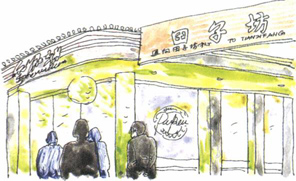
Today, the best-known lane in Taikang Road is Tianzifang. Looked at from the outside, the entrance of the lane is quite small; however, the inside is pretty spacious, a lane in the shape of a gourd. In the 1930s to 80s, it underwent a glorious industrial period. Yet, it was a typical cluster of lane factories embedded in the city center, composed of five factories: Shanghai Food Machinery Factory, Shanghai Clock Plastic Accessory Factory, etc. In the 1990s, because of a series of causes, such old factories were gradually ousted from the historical stage, leaving behind only some 20000 m2 of old workshops that had experienced the vicissitudes of time and consequently leading to the formation of today's unique grade and style.
In 1997, Chen Yifei, the late famous Chinese artist, initiated the construction of his studio in the deserted workshop in Tianzifang. From then on, Tianzifang gradually began an out-and-out transformation, creating the productive features mainly on the basis of indoor decorations, visual arts, and arts and crafts. An Italian artist once said that doing artistic creation in the ambience of Taikang Road can further realize the combination of the history and the future, and the blending of the eastern and western cultures.
This lane, which used to be Lane 210, Taikang Road, has got a horizontal board with three Chinese characters, Tian Zi Fang, at the entrance, which were inscribed by Huang Yongyu, a famous Chinese painter. As a legend goes, once upon a time in China, there was a painter by the name of Tian Zifang. Although he did not leave any masterpiece as legacy, he was publicly recognized as the founder of Chinese painting. In order to memorize him, Huang Yongyu named this lane after him although the last character differs in form but sounds the same.
Stepping into Tianzifang, you will immediately catch sight of a Red Door. On the external wall painted red, you will see a memorable plate, which indicates that this is the former site of Shanghai Tianchu MSG Factory built in 1936. At present, however, it is a salon. Lily, the owner, and her studio are pretty. The paintings she sells are all works by her friends. Besides, there are many beautiful lamps.
Going further forward, you will run into Jin Fen Shi Jia, meaning Noble Family, a typical tailor's shop for cheongsams, in which scarves, bags, and accessories are sold in addition to traditional Chinese clothes. The designer of this shop is an expert in fabrics and tailoring. He can custom-make in accordance with the customer's disposition and figure; moreover, the shop can have the clothes made within 24 hours and delivered to the customer, if needed.
In Tianzifang can still be found many traces of old factories. The number plates, old and new, are seen side by side. On the ceilings of the industrial buildings are hanging a lot of machines whose names we don't know. On the wall of the first floor are mounted a few distorting mirrors. What's most interesting is that the doors of the washrooms are transformed into the security doors at the airport.
In his lifetime, Chen Yifei foraged quite a number of old things in the second-hand shops. His studio conveys the architectural features of the simple and primitive, the dignified and imposing. The fireplace, refrigerator, radio, sofa, and other old furniture are so arranged as to display a sense of old Shanghai in the 1930s. The fireplace in the sitting room is not merely a decoration, but can also really be used for kindling a fire in. Chen Yifei established four creative studios: ceramics, oil painting, fashion, and photography. Whether such nostalgic things as children's bike, old-fashioned sewing machine, chandelier, and bird cage in the studios are silently recalling the owner that had passed away not too long ago remains a riddle.
Erdongqiang Art Center integrates various art forms including decoration, drawing and painting, photography, and music, etc. It is said that the hoisting machine on the roof beam can still work. The out-dated projector on the bar and several old typewriters below the black-and-white photos on the wall are intoxicating to many tourists. Old machinery is of remarkable appreciation value. And an opera concert is held here once a month.
Hari Rabu is a franchise shop selling decoration lamps from fragrance of Thailand sandalwood, you will find straw-hat lamps along the aisle unbelievably beautiful. The shop owner is a Japanese man by the name of Gao Shan, who is very much fond of traveling, especially in Southeast Asia. Therefore, most of the products in his shop are collected from Thailand, Indonesia, Vietnam, India, Nepal, and Cambodia. Amusingly, not a single Japanese product can be found in this shop.
All the bags sold in I. F. F., a franchise bag shop, are designed in the United States and made in China. Besides, the shop sells some Italian accessories. The owner is a blonde foreign woman. Very interestingly, she describes all her bags with the word cute.
Lane 210, Taikang Road, is a meanderingly zigzag lane, on one side of which can be seen several residential houses. What used to be civil houses and deserted factories has been changed into an array of shops engaged in the business of artworks, and unusually flavored cafes and restaurants as well.
In the depth of Tianzifang there is a spacious courtyard, which is termed as Siheyuan in Tianzifang, meaning a compound with houses around a courtyard in Tianzifang. The number plate on the courtyard wall is No. 7, Lane 210, which used to be the workshop of Shanghai Paper Cup Factory. Around the courtyard are a number of clothes and adornments shops and cafes. Below the tall tree right at the center of the courtyard are set different kinds of tables and chairs. Very often some carefree people are seated in the courtyard, chatting and drinking coffee. UPS Café is run by a group of young people that share a love for coffee. It mainly sells Italian coffees. The cake maker can work out wonderful patterns, a heart or a leaf, with chocolate powder on Cappuccinos according to the customer's request or his own mood on that particular day.
Many, many tourists are attracted to Tianzifang, among whom are countless designers and artists.
Moganshan Road: Left Bank of Suzhou Creek 莫干山路:苏州河边的“左岸”
Backed by inland shipping, the area along the Suzhou Creek used to be one of the leading industrial belts in Shanghai. The Suzhou Creek makes a sharp turn at Moganshan Road, thus making this section a peninsula surrounded by water on three sides. The family industries of the largest national capitalists, the Rongs and the Suns, used to converge here. It is just the rows and rows of old warehouses and workshops that gave birth to modern Chinese industrial civilization.
Today, some modern artists have taken a fancy to these industrial relics. The fact that the riversides of the Suzhou Creek, together with Moganshan Road, have been the convergence place for arts has got a great reputation far and wide. The vacancy of the old warehouses and workshops happens to be in consistence with the free and natural elements of Eastern culture. The huge space happens to be able to satisfy the requirements of modern artists seeking for the visual effect of larger sizes. Therefore, they would be aware of the effect of The historical factory area of Moganshan Road is one of the symbols and representatives of the developmental prosperity of the national industry in Shanghai and even in China, and is an important part in the corridor of modern cultural heritage of the Suzhou Creek. The existing industrial relics including the manufacturing workshops, warehouses, managers' offices, workers' dormitory, as well as docks, cargo transmission facilities, have formed a complete industrial production system, vividly reflecting the styles and features of modern industrial production in China. Furthermore, it is one place with the relatively best-preserved and most complete modern industrial heritage of Shanghai and China.
The former Shanghai Flour Mill at No. 120, Moganshan Road, grew from the Fufeng Flour Mill of the Suns and Fuxin Flour Mill of the Rongs. Fufeng Flour Mill was the first machining flour mill founded and run by the national capitalist in Shanghai in 1900. It was jointly invested in 1900 by the descendants and relatives of Sun Jianai, Zhuangyuan in the Qing Dynasty and teacher of Emperor Guangxu. And, it had a cylindrical granary of relatively high automation built in the 1930s, which could contain 22,000-ton wheat. Therefore, it became a flour mill, largest in scale and most up-to-date in facility in the Far East. Fuxin Flour Mill was founded by the Rong's brothers in 1923. And its No. 2, No. 4 and No. 8 branches, completed one after another after 1914 and arrayed horizontally, were reputed as the crown among similar mills because of the magnificent architecture and large scale. Today, the buildings at No. 120, Moganshan Road, have been listed as heritage architecture by the government. It has not only the decoration of Baroque frontispiece pattern but also the artwork displayed in the exhibition hall while working at their creation. The well-designed architecture, together with the well-preserved ventilation facilities and drainage pipes, has accumulated the profundity of history, making everyone involved in the building able to cherish a sense of the imprint of the industrial age and consequently accept the elements and inspiration of some information. As a result, they are touched and inspired.
As the left bank of the Seine in Shanghai, Moganshan Road is glowing in artistic beauty.
The Corridor of Modern Cultural Heritage
The peninsula, with an area of less than 0.22 km2, has a coastline of around 1.3 km. From the late 1800s to the early 1930s, which was the flourishing period of the national industries in Shanghai, along the axis of the Suzhou Creek and the Huangpu River, both sides of Moganshan Road became an industrial manufacturing area with a high concentration of factories of the largest scale. Here are assembled Fufeng Flour Mill, the first factory of national capital established and put into production in 1900; Fuxin Flour Mill, the largest flour mill in China; and Shenxin No. 9 Textile Mill, the largest textile enterprise in China that integrated textile machinery, cotton yarn and fabric production, and fabric printing and dyeing. The three factories were independent of and cooperative with each other. They took the lead in cooperation among modern enterprises in Shanghai by means of Xinhe Cotton Yarn Mill, Xinfu Printing and Dyeing Factory and Xinyi Machinery Factory.the Chinese-style courtyard. With the classical moon-shape gate moved into the modern company, and even the debris that fail to veil its bygone grace and beauty, as well as the huge slogans and wild flowers on the walls, the old building seems to be much quieter.
M50 Warehouse of Arts
Art lovers can go to M50 Creative Garden at No. 50, Moganshan Road, to appreciate the paintings, clothes, household articles, and art designs from over 100 artists of 16 different regions and countries. All the workshops and galleries, large and small, in the Creative Garden are open to the public.
The Chunming Industrial Park at No. 50, Moganshan Road, the former site of Shanghai Chunming Woolen Mill, covers an area of 34.45 mu with a floor space of 40000 m2. It has more than 50 various industrial buildings from the 1930s to 1990s, and is the only preserved national textile enterprises by the Suzhou Creek. In May 2000, Xue Song, a painter, was the first artist to come and get stationed in this area of old factories. Today, No. 50, Moganshan Road, has turned to be a renowned group of art warehouses in Shanghai, which has attracted many studios, galleries, and architects' agencies of local Chinese and overseas artists including those from England, France, Italy, Switzerland, Israel, Canada and Norway, and agencies of graphics designing, film and television production, environment designing, and artworks (jewelry) designing. Every time when exhibitions are held, every corner of Moganshan Road will be crammed with cars. The ever-empty industrial park is suddenly packed with jostling crowds, as if a resplendent Cinderella ball were being held under a starry night sky.
The ShanghART Gallery founded by Lorenz Helbing, a Swiss, and Biz Art Center by Davide Quadrio, an Italian, have won some reputation in the world. Located on the fourth floor of Building 7, Biz Art Center is actually jointly opened by two foreigners living in Shanghai, David Quadrios and Katelijn Verstraete, who have had more than ten years' experience in the culture and art field of China. The art center consists of two parts: Business and Art, which are dependent on and independent of each other. From tenancy, purchase and sale, and appraisal of artworks to organization of arts exhibition and performing activities, from designing and printing of picture albums, invitations, and posters to oral interpretation and written translation of French, English, Italian, Chinese, German, and Dutch, Biz Art has been actively engaged in such fields as easel painting (calligraphy and paintings on silk, etc.), photography, sculpture, oil painting on canvas and mixed media, etc. Located in the former boiler room in Building 16, Shanghai ART Gallery was founded by Lorenz, a Swiss, which was the first modern art gallery in Shanghai. Its exhibition hall on the first floor is named H Space, which has introduced many well-known modern artists and rising stars with potential talents born after the 1980s in China by the way of personal exhibitions. On its second floor, there are some artists' studios and warehouses.
Half-scale Music on the first floor of Building 11 is the only exhibition hall of acoustical arts. On the walls of the exhibition hall are displayed the classified CDs; on both sides of the hall are separately put Chinese zither, Guqin, and modern stereo; in the middle are set some tables and chairs, with many music magazines and weiqi chess on the table. It is linked up with the adjoining Half-scale Canopy, which is a small salon, with a bar and some tea seats. Even when no concert is held, it is still an artistic enjoyment for you to be seated there. If it happens to be raining, you may hear raindrops beating the transparent canopy, a kind of Music of the Nature.
Shanghai Artdeco Warehouse is located on the first floor of Building 7. Aotu is the transliteration of Artdeco into Chinese. In the warehouse are displayed some old furniture of modern times and paintings of contemporary artists. The furniture that is already quite old was collected by one couple who cherish a sort of liking in this field, including an oldfashioned organ, a table electric fan that roars while working, an old copper mirror, and an out-of-date barber's chair, etc. On its second floor is one more exhibition hall smaller in size. Besides some old furniture, there are also placed some modern artworks. For example, the series of Paper and Fire employs two opposite elements: paper and fire. The burnt paper in different shapes is put on the white wooden table, symbolizing the collision between black and white, and between life and death. Some art parties are held here from time to time.
The IFA Village copies the French Creation Village wholesale in Shanghai. Every month, artists from top technical schools of France come here to exhibit their artworks and introduce their profession as well. This is a place for get-togethers and grand ceremonies. The hall of the grand ceremony provides an 800 m2 space for exhibition and creation and is permeated with artistic and fashionable atmosphere. It is also the meeting place for artists, reporters, and people from political, economic and financial circles. No matter whether they are Chinese, French, or European, the painters, sculptors, and photographers are all regularly invited to come to IFA to interact with audiences, conveying their attention to the current society and their various understandings of beauty by means of the subtle emotions and profound thoughts in their works of arts. In the cozy and peaceful atmosphere, they introduce their works to the audiences, and narrate and impart their techniques to those that are keen on learning creation and realizing their own ideals. Here can also be found some topquality handmade fashions. The flagship store of LH shows the public the masterpieces by the two distinguished designers, Lexoanet and Hemant.
"Sauntering along the Suzhou Creek, we can see in the 150-year-old camphor trees and around 100-year-old workshops that the modern arts and designing workshops are about to emerge. Walking here and looking around, we derive a feeling of the crossing of time and space," one visitor gave such a comment, "and it corresponds to the Shanghai in my imagination that reveals its history."
Having Fun at Various Shopping Centers in Shanghai by Taking Metro 乘地铁:风雪无阻穿行大型商业休闲中心
In the city center of Shanghai, traffic jams occur very often. Therefore, Metro has become the fastest and most convenient means of transport.
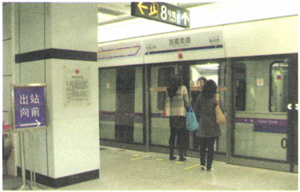
Up to now, Shanghai has had, already in operation, nine Metro lines, which criss-cross a large number of the most bustling areas in both Pudong and Puxi. And in the vicinity of many of the Metro stations converge a large variety of entertainment, sightseeing, shopping, and food and beverage places. In the surroundings of some Metro stations are large commercial and leisure centers. As a result, Metro has also become the means of transport to link the resources of tourism and leisure and to rapidly change the leisure places. In 2009, the second term of Metro Line 8, Metro Line 7, the second term of Metro Line 9, and the first term of the north section of Metro Line 11 began their operation.
Many foreign and Chinese people, who are living in Shanghai, frequently take advantage of Metro, within some 10 to 30 minutes, to leave the aroma of coffee for the fragrant fresh air in the verdant parks, to stop their casual stroll so as to experience the thrilling descent from the 70-meter-high platform, or to come to a quiet street, after doing shopping in the bustling commercial streets, to sit down and enjoy some snacks or to drink some coffee and do some reading. Would you like to have a try with such convenience? Then, you'd better travel along the Metro lines and try to get acquainted with the everchanging city of Shanghai.
Metro Line 1 starts at Xinzhuang Station and goes to Shanghai Railway Station. Along the way, it passes the suburban outerring tree belts; Shanghai's first shopping mall — Friendship South Shopping Mall; Shanghai's first large-scale amusement park — Jinjiang Park; the newly-built South Shanghai Railway Station, where passengers can interchange to Metro Line 3; Shanghai Indoor Stadium, where passengers can interchange to Metro Line 4; Shanghai Stadium and Shanghai Tourist Bus Center; Xujiahui, the most bustling new commercial area in Shanghai; Hengshan Road Station and Changshu Road Station, between which are a few leisure streets, a favorite for both Chinese and foreigners; South Shaanxi Road Station and South Huangpi Road Station, between which is the commercial street along Huaihai Road; People's Square Station, the commercial intersection of Nanjing Road and Xizang Road, where passengers can interchange to Metro Line 2 and Line 8; and further northward after Shanghai Railway Station, Daning Road Station, near which is located Shanghai Circus World.
Metro Line 2 begins at Songhong Road and goes toward Pudong. Along the way, it passes Zhongshan Park Station, where passengers can interchange to Metro Line 3 and Line 4; Jing'an Temple Commercial Area; Shimen No. 1 Road Station, around which are the commercial street in West Nanjing Road, the leisure street in Wujiang Road and Qinghai Road, and the Antique Market; People's Park Station and Middle Henan Road Station, between which is the Pedestrian Street in Nanjing Road; the Riverside Sightseeing Area at Lujiazui after going through underneath the Huangpu River; Century Avenue Station, where passengers can interchange to Metro Line 4 and Line 6, near Shanghai New Commercial City; Shanghai Museum of Science and Technology Station; Century Avenue Station; Longyang Road Station, where passengers can interchange to the Maglev train to directly reach Shanghai Pudong International Airport; and the terminal, Zhangjiang Hi-tech Zone.
The urban light-rail transport has stringed many stadiums and gymnasiums such as Hongkou Football Stadium, the Rockclimbing Hall, tennis courts, bowling stadiums, archery bars, etc.; countless bars, cafes, western restaurants, Chinese restaurants, gourmet cities, and other places of various delicacies; libraries, cinemas, and other cultural places; vast patches of public green land; stone-gate residential houses and newstyle garden houses, historical relics and former residences of celebrities, churches and temples, and other historical and architectural sites.
Lianhua Road Station (Metro Line 1)
Walking out of the station and crossing the overpass, you will immediately catch sight of the large-scale shopping and leisure center, the shopping mall that was earliest introduced into Shanghai, with a total floor space of 90000 m2. In the lobby on the first floor are set a fountain, trees, and chairs. On the first and fourth floors there are over 100 brand shops selling clothes and shoes, cosmetics, jewelry, watches and clocks, glasses, sports and tourism articles, toys, etc., and Carrefour Supermarket as well. As for food and beverage, there are Chinese and western snacks in the gourmet street on the first floor and Chinese and Japanese restaurants on the fifth floor. In the commercial city, there are bookstores, galleries, beauty parlors, wedding studios, photo shops, laundries, flower shops, pharmacies, travel agencies, banks, post offices, and whatsoever. In the bowling stadium, billiard room, ping-pong hall, and children's paradise, both children and their parents can do exercises. And Harvest Friendship Cinema will enable you to watch the up-to-date movies produced in China and foreign countries even if you are traveling in Shanghai.
Shanghai Indoor Stadium Station (Metro Line 1 and 9)
Shanghai Indoor Stadium and Shanghai Stadium form the largest public center that integrates physical training, entertainment, food and beverage, and shopping. Shanghai Stadium with a capacity of 80000 spectators is the largest football field in Shanghai. At present, what is accessible to the public includes the badminton field in which is set the archery facilities, the indoor badminton hall, the illuminated tennis courts, the indoor swimming pool, and the squash hall in which are also set chess and playing card tables and pingpong tables. Young people that are fond of adventures will fall in love with the Extreme Sports Center, where they could enjoy bungee jumping from a height of 72 meters, swinging high in the sky, rock climbing, roll-skating, or skateboarding. Beneath No. 5 Staircases of the stadium is Shanghai Tourism Bus Center, where many tempting bus lines have been set up. For the One-day Tour in Shanghai, there are several bus lines to choose, for example, lines to Zhujiajiao, Zhouzhuang, Tongli, Xitang, Luzhi, etc., which are all ancient towns rich in traditional Chinese flavor.
Xujiahui Station (Metro Line 1 and 9)
Xujiahui Commercial Circle is, in the true sense of the term, a circular commercial street. Many large department stores such as Orient Shopping Center, Grand Gateway Plaza, Pacific Department Store, Shanghai No. 6 Department Store, Huijin Department Store, etc., and Metro City and Pacific Computer Plaza as well form a tight ring. In addition, there are two more floors of Metro Commercial City underground. Such a high density of commercial business is very rare all over the world. The Metro exits lead directly to the first floor of all these commercial buildings. Grand Gateway Plaza boasts the largest floor space of business in Shanghai. Sauntering through the well-decorated and -arranged shops, you would feel as if you were walking in an indoor street market. On the top two floors are the gourmet city, bookstore, nightclub, and Yonghua Cinema. Grand Gateway Plaza, Pacific Department Store, and Huijin Department Store all have large supermarkets in the basement. The reputation of enjoying foods in Xujiahui exceeds that of those gourmet streets. Besides the food-and-beverage areas in all the buildings, the Hongji Leisure Square adjacent to Grand Gateway Plaza is a large square rich in delicacies. Among all the streets radiating from the commercial circle, Tianyaqiao Road is also a street that provides a rich variety of nice foods. Those that are fond of cultural leisure would prefer to go to Metro City, where the consumption is based on fashion culture. There could be found the largest retail shop for video products in Shanghai, sports article shop, book city, etc. in addition to a large discothéque, a 24-lane bowling hall, and the multi-theater Kodak Cinema. On both sides of the commercial circle, on the left the towering red Cathedral of Xujiahui, which is well known in the Far East, stands amidst a vast piece of green grass, and on the right is located Xujiahui Park, in which there are flowing water, big trees, flowers and grass.
South Shaanxi Road Station and South Huangpi Road Station (Metro Line 1)
Between these two stations is the commercial street of Middle Huaihai Road, along which can be found Lane Crawford, Olive des Olive, Pacific Department Store, and many other stores; luxurious hotel-style apartments with swimming pools and tennis courts, the revolving restaurant at the top of an over-190-meter-tall building; Shangxianfang, an old-style residential lane in Shanghai; Yandang Road, a pedestrian and gourmet street; Maoming Road, a street lined with fashion and accessory stores; Xingye Road, in which is located the Shanghai Site of the 1st Congress of the Communist Party of China; Xiangshan Road, in which is located the Former Residence of Dr. Sun Yatsen; Sinan Road, in which is located the Former Residence of Zhou Enlai; Gaolan Road, in which is located the Former Residence of Zhang Xueliang; etc.
People's Square Station (Metro Line 1, Line 2, Line 8)
The People's Square is the pivot of Shanghai center, so the distance between Shanghai center and any other place starts here. To the north and east of the square is the golden commercial section that is located at the intersection of Nanjing Road and Middle Xizang Road. Both in the past and at present, the People's Square together with its surroundings is the classical center for shopping and leisure in Shanghai. Looking around, you will see the best-known No. 1 Department Store and New World Mansion in China's No. 1 Commercial Street; the largest labyrinth-like underground commercial city beneath; the New World Radisson Hotel, Pacific Hotel, which is a historical architecture, Park Hotel, SEGA World Entertainment Center, Grand Cinema, IMAX Cinema; the Gourmet City in New World Mansion, the Underground Gourmet City, and the Gourmet Street in Huanghe Road. And around the People Square there are Shanghai Museum, which is rich in the collections of bronze vessels; Shanghai Grand Theater, which boasts fist-class sound effect; and Shanghai Urban Planning Exhibition Center, where people could enjoy tea or coffee in Shanghai Street in the 1930s. This part is obviously richer in an atmosphere of culture, entertainment and leisure than other commercial centers in Shanghai. The new Shanghai Museum of Fine Arts was renovated on the basis of the former Shanghai Library. The simple contour, gray base, and black inlaid material form a unique architectural characteristic beyond description.
Zhongshan Park Station (Metro Line 2, Line 3, and Line 4)
Zhongshan Park used to be the largest urban park in Shanghai. In recent years, Cloud Nine Shopping Mall, which has a floor space of 320, 000 m2, the large indoor Rose Workshop Commercial Street, New World Xinning Shopping Center, Printemps Department Store Paris, Milan Underground Fashion Square, etc. right in front of the park have been turning into a center of business and commercial service as well as cultural leisure and entertainment. Besides, the historical buildings on Yuyuan Road, also in front of the park, are a representative mixture of noble garden residences and civilian residential quarters for intellectuals. Interestingly, there used to be a blend of cheap food stands and expensive cafes in this part of Shanghai.
Shimen No. 1 Road Station (Metro Line 2)
Coming out from this station, you will find Wujiang Road, which is characteristic of food and beverage. The shops that provide Chinese and foreign foods are not large in space, but rather exquisite. Around the big tree at the center of the street are placed a circle of chairs for people to take a short rest. And the small square at the center has become an English corner every Saturday evening. Leaving Wujiang Road behind, you will come to the leisure street on Qinghai Road, on one side of which are restaurants, the grotesque stone and curio market, and the philately company. Another Metro exit is at the commercial street of Nanjing road, which is parallel with Wujiang Road. A five-minute walk leads you to such luxurious consumptive places as Meilongzhen Plaza, CITIC Pacific, Plaza 66, and Shanghai Center.
Lujiazui Station (Metro Line 2)
Lujiazui is the best section of Pudong. Right at the Metro exit are located the Oriental Pearl TV and Radio Tower, the Super Brand Mall — the largest shopping mall in China, and the largest Gourmet City in Pudong. The Super Brand Mall has a total floor space of 240000 m2, about 20000 m2 on each floor. From the first floor to fourth floor are the fashion shopping area, in which are shops of famous brands at home and abroad. On the fifth and sixth floors converge quite a few gourmet plazas of various tastes, Chinese and foreign. Some restaurants are so designed as to be in the form of open-air restaurants. Suzhou Street on the seventh floor displays traditional handicraft works. On the eighth floor are the nightclubs, the Internet bars, and the cinema city. In the basement there is a large supermarket. On every floor there are cafes and teahouses, including the British Rose Teahouse. From some of the restaurants, teahouses, and cafes you can overlook the Huangpu River. The Super Brand Mall, Shangri-La Hotel, and Aurora International Mansion are adjacent to Riverside Avenue. When night falls, the color lights along Riverside Avenue and in the huge fountain will emit dazzling rays. In the restaurants, such as Paulaner Brauhaus, Starbucks, Haagen-Dazs, Red Dot, RBT, etc., people of different races and colors are having a hearty time, drinking coffee and beer, listening to beautiful music and dancing merry dances, until late night.
Century Avenue Station (Metro Line 2, Line 4, and Line 6)
Near this Metro exit is New Shanghai Commercial City, the shopping and leisure center in Pudong New Area. Consisting of two squares, south and west, this center integrates shopping, tour, food and beverage, entertainment, exhibition, trade, business, and hotel services. The shopping building, consisting of Time Square, Nextage, Zhongrong International Commercial City, Xinmei Twin Towers, etc., covers a commercial floor space of 188000 m2. Its prominent feature is its variety of brands and diversity of cuisines. The cultural leisure street, basically composed of Sanxin World, Huacheng Mansion — Pudong International Food City, Pacific Digital Square, etc., has a commercial floor space of 57000 m2, with 73 brand shops of entertainment, food and beverage, as well as 22 retail shops of digital products. Pudong International Food City, located in Zhangyang Road, is a comprehensive gourmet plaza, where there are both numerous delicious snacks and different casual and formal meals. And in Dongfang Road and Weifang Road nearby are located many restaurants, such as Novotel Atlantis Shanghai, Shanghai Mansion, Purple Mountain Hotel, just to name a few.
Shanghai Museum of Science and Technology Station (Metro Line 2)
The aboveground of Shanghai Museum of Science and Technology Station is Century Square, the largest open-air square in Shanghai, which borders Century Park, the largest green ecological park in Asia on the east, Century Avenue, the best landscaping road in China on the west, Shanghai Museum of Science and Technology on the south, and Oriental Center of Culture and Art on the north. The underground lobby of the station divides A.P Plaza, the most spacious underground commercial market, into two squares: South Square and North Square.
A.P Plaza is the market that over 600 shops from the internationally known Xiangyang Road Market moved into. And then quite a number of special shops from South Shaanxi Road, Changle Road, South Maoming Road, and Shimen No. 1 Road flocked here. There are some 1000 shops here. About 60% of the customers are overseas tourists. What deserves special mention is that the Market Management has run some English training, with the intention to help the shop owners better communicate with foreign customers. It is by no means uncommon that shop owners can do business in simple fluent English.
It is not a common practice here to mark the goods with clear prices. After the customers make their selections, the shop owner would punch the keys of a calculator to show a price that might be twice of the real price. After some bargaining, they would usually reach a price satisfactory to both sides.
Fashion and novelty is a special feature in A.P Plaza. There is a whole array of goods, from colorful children clothes to trendy clothes and accessories that fashionable people like, from fashionable bags beautiful ladies are hunting to casual shoes and hats white-collar gentlemen are crazy about. A variety of fashionable and special products can be found here, such as French Fantasy Clothes, RRM Clothes, Amylin's Pearls, Easydragon Life Style and Gifts, just to name a few.
Quite a few tailors' are located here. The customers could make a choice of the fabrics and then place an order of custom-made clothes, which will be delivered to the customer's homes when made.
Here are also some shops selling small articles rich in Chinese flavor, such as chopsticks and bamboo chips on which ancient Chinese did their writing. Because of the Olympic Games in Beijing, foreigners became fond of such Chinese objects; therefore, the business is pretty good. Another example is Amylin's Pearls. In this shop are many photos of the first wives of many foreign countries as well as of other celebrities. The pearl articles are all so meticulously designed that they appeal to customers.
Different kinds of foods are served here: KFC, Japanese cuisine, Brazilian roast food, Xinjiang snacks, etc. sufficient to satisfy the customers' needs. Jinjiang Latin Restaurant is a typical restaurant of Latin American style. Most of the diners here are foreigners. And the food served here is of western style, along with genuine Latin American dressings. Performances are staged here, without too much noise, though.
In A. P Plaza, you'll have to exert some energy if you'd like to elbow your way from end to end. After spending one or two hours, you might still be unwilling to leave, even though you might have already made many good buys.
Wujiaochang Station (Metro Line 10)
Wujiaochang used to be the converging point of Handan Road, Siping Road, Xingaying Road, and Songhu Road, thus becoming a major commercial center in the northeast of Shanghai. Along with the construction of Metro Line 10, Wujiaochang has now become a five-story commercial Xintiandi, aboveground and underground.
Coming out from the Metro exit, you will come to the underground pedestrian street on basement floor 1. The street is parallel with Metro Line 10. The exit at the other end stretches to the next station of Metro Line 10, i. e. Jiangwan Stadium Station. Because of Fudan University, Tongji University, and University of Finance and Economics in the vicinity of Wujiaochang, the 500000-m2 pedestrian street mainly meets with the shopping needs of the students.
The floor above the pedestrian street is the passage for underground motor vehicles. One more floor above is the subsided square of Wujiaochang, which is connected to every radiating road. Above the subsided square, the newly designed circular greening enables the intersection full of life.
The overpass of Shanghai Middle Ring Road at Wujiaochang Center has a huge color-egg structure, which is the top landmark in this cubic Xintiandi.
The newly built commercial mansions at the corners of the five roads at Wujiaochang are different in size, the smallest 40,000 m2 and the largest Wanda Plaza nearly 300000 m2. The five-star hotel at the corner of Xiangying Road is very eye-catching. All the road corners are very fashionable, full of modern ambience. The Atlantic City and the Oriental Shipping Center here are by no means second to those in Nanjing Road and Xujiahui in terms of decoration and ornamentation.
The brand new Wujiaochang, a huge new Xintiandi, is within easy reach as long as you manage to hop on Metro.
Enjoy Tea at Old Teahouses: Not Merely for Tranquility 专挑有历史的店来品茶: 不仅仅是图清净
It is said that "There are two advantages to be a Chinese: one is to be able to read The Dream in the Red Chamber, and the other is to enjoy the Chinese tea culture." Tea is a national beverage and a popular drink for the Chinese people. Therefore, the complicated everyday life is summarized into seven daily items, namely charcoal, rice, cooking oil, salt, soybean sauce, vinegar, and tea.
It is said that tea was discovered by the god of agriculture when he tasted hundreds of herbs. A verdant leaf, which was presented to him, was savored by his palate and finally settled down in his drinking cup. Along with the development of the tea culture for thousands of years in China, listening to story telling and watching operas has long been part of Chinese people's life.Old teahouses, which have displayed unprecedented charm, add some sentimental interest to the present-day people. However, old people often prefer the open-air teahouse in the park, where several bosom friends would gather and talk while drinking a pot of hot tea. Young people frequently find themselves in the fashionable teahouse, where they would order a cup of green tea or black tea and have a wonderfully leisure time with the accompaniment of pop songs, fashion magazines, and talk about the bygone days.
Nevertheless, the best place to appreciate the charm of tea culture is in a traditional Chinese teahouse. Tea culture is naturally embodied, crude and elegant. In the simple drinking of tea, people can realize self-cultivation.
Old Shanghai Teahouse: a combination of teahouse and museum
In Old Shanghai Street, there is an Old Shanghai Teahouse like a typical teahouse from the 1930s, which combines nostalgia and leisure life. As a customer said, "When visiting Shanghai, it would be a lifelong regret if you didn't come to the Old Shanghai Teahouse. However, those who have been to the Old Shanghai Teahouse would sigh with emotions for life." Such emotions could be appreciated only by those that have been to the Old Shanghai Teahouse.
The Old Shanghai Teahouse used to be a small museum, with private collections like refrigerators, sewing machines, drama posters, book covers, etc. from the 1930s and 40s. Tables and chairs were placed along the corridor by the windows for the visitors to have a short rest over a cup of tea. Gradually, it is referred to as a teahouse, and its fame as a teahouse spreads far and wide. Consequently, the owner decided to make a perfect combination of museum and teahouse by enriching refreshments and periodically changing the exhibits.
After stepping into the teahouse, you will find people sipping teas on the left and the articles are displayed on the right. Standing by the window, you will realize that you're at the intersection of reality and history: historical sediments inside and realistic hustle and bustle outside. There is a large array of exhibits in the teahouse: from outdated telephones, electric fans, milk bottles to staples, blood pressure meters, Fahrenheit thermometers, and police clubs, car plates, door plates, and even the checks from the Citi Bank as well. And even the physical exercise apparatuses like dumbbells and hand clasps, the three-inch leather shoes worn on rainy days, and the ashtrays you might use for smoking, and all the teapots for tea-making are all the old articles of the 1930s. What's more, you could not help breaking into smiles at the wooden yo-yos and small billiard tables that are full of juvenile fun.
And in the teahouse there is a guest book that is filled with fun and emotions. People from different countries share the same feelings and same liking of the same article.
This teahouse provides a variety of tea, such as black tea, green tea, special tea, fruit tea, Chinese tea, and coffee and all kinds of snacks as well. Sipping the tea and enjoying its light aroma, I felt I was back to the 1930s. With melodious music floating into my ears, I saw two old men with white beard playing traditional Chinese music. One was playing cimbalom and the other with erhu, completely indulged in the music they were playing with eyes closed. After talking with the owner, I got to know that the two performers had been playing here once a week for eight years, ever since the teahouse began its business. If you'd like to enjoy tea, to visit the museum, and to listen to the traditional Chinese music, it's best to visit the teahouse from 2 to 4 p. m. on Saturday or Sunday.
Lake Pavilion Teahouse: Shanghai's Oldest Teahouse
The Lake Pavilion Teahouse is the oldest teahouse in Shanghai, already over 150 years old. One of the scenes of Yuyuna Garden, it was originally built by Pan Yunduan, a high official in Sichuan during the Jiajing Period of the Ming Dynasty. In the 49th year (1784 AD) of Emperor Qianlong of the Qing Dynasty, cloth merchants raised funds for the reconstruction of the pavilion. In the 5th year (1855 AD) of Emperor Xianfeng, a teahouse by the name of Wanzaixuan was set up here. And at present, the old name, the Lake Pavilion, has been resumed.
The Lake Pavilion Teahouse can seat about 200 people. Simplicity and elegance are typical characteristics of traditions of China. A large variety of teas are served here. After being clarified and mineralized, the water for the tea is pristine and mellow. The interior decoration of the teahouse is of ancient style. The tea sets and the long-spout copper teapot as well as the superb tea-making skills of the waiters are all of traditional Chinese features. The camellia tea here is unique: the female tea tender takes out an ordinary-looking balled tea, puts it into a glass, and pours hot water consecutively three times. The ball begins to bulge, and in dozens of seconds several golden camellia would jump out of the ball. Upon seeing the sudden advent of the bright flowers in the glass, tourists would burst into shouts of amazement.
Sitting by the window of the teahouse, you will have a distant view of the Oriental Pearl Tower and the zigzag bridge down below. Outside is a confused noise of voices while inside the teahouse, the closeness of the seat arrangements can hardly be found in any other teahouse of the city. However, such an arrangement is quite impressively interesting.
The teahouse has its own professional performing team to present the tea art. And on every Monday afternoon, the tea drinkers could also enjoy the beautiful music played by the stringed instruments in south China. It is amazing and amusing to enjoy tea, music, and scenery at the same time.
This is an old teahouse hidden in the bustling center of the city, but it has a nice but thought-provoking name — Gu Yuan, meaning a garden of the past. The owner of the garden is the 53rd-generation decedent of Guo Ziyi, a military general of the Tang Dynasty. It is named after the Guyuan Garden in Beijing in the Hongwu Period of the Ming Dynasty and many remains were moved from Shanxi. As a result, it is referred to as Shanghai Folk Forbidden City. Everything here, such as the awesome ancient wooden gates, the peeled horizontal board over the gate, the libraries, etc. produces an impacting effect on visitors. Hanging on the fence are an array of red lanterns with the verdant garden as the background. Looking inside, you will see old pavilions, old houses, gardens, pebbled paths, etc.
The small courtyard, permeated with a strong flavor of the ancient times, makes the tourists feel as if they had entered the tunnel of time. The high quality furnishings are simple and classic: The carved mahogany window sills are used as decoration, the gods of wood carving are lifelike, the totems of the Bronze Age serve as decorating items, the black ceramic jars are used for fruit peels, the copper bells are used to summon the attendants, and even the restrooms are well decorated. Once you are here, you would feel relaxed and comfortable.
The tea menu is written on a fan. The largest variety of tealeaves is puer tea. Puer tea can be aged. Forbidden City has some tea that has been stored over 180 years. The puer tea in this teahouse has been stored for 16 to 100 years, which is said to have the effect of preventing cancer, reducing weight, reinforcing strength, and adding beauty. Among the puer teas, the 90-year-old Palace puer sells at a price of more than RMB 10,000 yuan for 10 grams. The teahouse holds lectures of puer tea every Saturday and offers some gracious performance of tea arts.
Besides, the teahouse provides other kinds of quality tea, with each kind producing a special medical effect. And the snacks sold here are quality products as well.
This is a teahouse that specializes in puer tea. The construction of the building began in 1933. As it was a masterpiece of a French designer, it is of typical Western style. It is said that this house used to be the residence of a high KMT official. The staircases and furniture still remain as they were many years ago. Two tall magnolia trees occupy the stylish small yard.
The teahouse has three floors with 17 private rooms, some are decorated in Chinese style and some in Western style, each named after the well-known tea hills in Yunnan. Teacakes produced in respective hills are hanging on the walls in each room. Of the variety of puer teas in the market at present, those that have been stored for over 60 years are quite precious; however, some of the puer in this teahouse are already 100 years old. And displayed in the cupboard on the other side of the room are dozens of puertea produced in the 1950s and early 1960s.
Savoring the age-old puer tea, listening to the music from the old phonograph, and looking at the waitress dressed in Qipao passing by, you might feel as if you were in the old times.
Address: No. 25 Lane 388 South Xiangyang Road (near Yongjia Road)