1
上海欢迎您系列·英文版(套装书全4册)
1.1.9.6 Shanghai Garden Houses and Villas 上海老洋房别墅

Shanghai Garden Houses and Villas 上海老洋房别墅

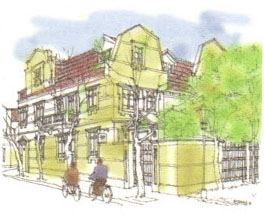
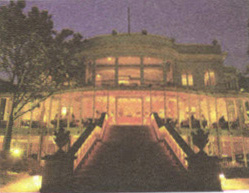
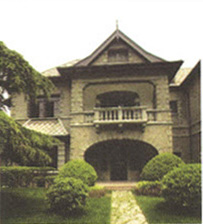
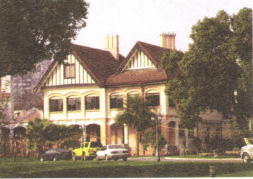
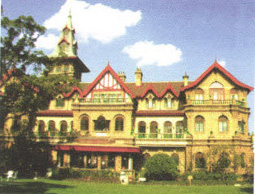
Shanghai is a city referred to as the World Architecture Exposition. The old western style houses, unique in style and dotted in different parts of the city, form bright scenic sights. These residence houses are representative of important buildings in contemporary and modern history of Shanghai. The fact that Shanghai used to be the Paris in the East and the paradise for foreign adventurers made the western multi-story houses and villas a combination of eastern and western cultures. The architectural styles include Greek-Roman classical style, Gothic style, Baroque style, Renaissance style, etc., merging the artistic essences of the Chinese and western architectures. On May 24, 2004, Shanghai Cultural Relic Management Committee opened 23 historical and cultural buildings to the public free of charge for one day on the occasion of the Publicity Week of May 18 International Museum Day. Up to 2008, there were almost 90 historical buildings periodically open to the public.


Most of the old western houses are located in Xuhui District, Changning District, Luwan District, and Jing'an District. And in Fenyang Road, Taiyuan Road, Yuyuan Road, Wukang Road, Hunan Road, Sinan Road, Changle Road, Huashan Road, Xingguo Road, Maoming Road, etc. are the sections where the old western houses are clustered. Among so many old western houses, the most classical ten houses and villas each bear a not too well-known story.


Zhang Xueliang's Mansion
(No.1, Gaolan Road, Shanghai)

The house at No.1, Gaolan Road is a Spanish-style three-story garden house, adjacent to the Fuxing Park. The external walls are yellowish white. At the entrance is the protruding two-story building. The first floor is a porch, and the part in the west is rectangular in shape. The south of the first floor is a corridor, and on the second floor there is a balcony. The whole floor space of the main building is about 800 m2. The first floor of the main building has a hall, where the guests were catered. The reception room is on the second floor, and the bedroom is on the third floor. The third floor is a Spanish suite with a Spanish double bed, a duplicate of the original bed now. Outside the suite is a 20-m2 balcony. In front of the house is a large garden, about 1,000 m2 in size, which is named Diyuan Garden. Camphor, cedar, Chinese wistaria, magnolia, osmanthus trees, as well as other plants are planted in the garden. The lawn is of the Manila style. In the garden there are a few swings that can seat several people. Rue Corneille, which is Gaolan Road today, used to be a pretty short road, along which large French parasol trees are planted on the pavements, providing good shade in the summer time. With a park nearby, it is very quiet here.


After 1949, this house was once the offices of Association of Industry and Commerce and China Democratic National Construction Association of Luwan District. Between 1992 and 1994 the house underwent an overhaul, and it is now under protection as a historical heritage building. Currently it is the reception house for Shanghai Real Estate Bureau. And the halls in the house are named Jingxue Hall, Muliang Hall, Yiqing Hall, and Shaoshuai Hall respectively. Hanging on the walls of the halls are the photos of Zhang Xueliang and Zhao Yidi, and Zhang's original handwriting.


Wang's Mansion
(No.31, Lane 1136, Yuyuan Road)

The mansion was completed in 1934. The whole villa is a four-story building of steel and concrete structure in the style of an Italian Gothic castle. It covers an area of 10.78 mu and the main building has a floor space of 2,158.8 m2. There were altogether 32 halls and rooms, which were all decorated in the traditional oriental style. And to the south of the main building there is a 1.3-hectare garden and lawn. In the garden there were verdant trees and a green lawn with a pond, small bridges, rockeries, and flowerbeds. The flowers in the garden were blossoming all the year round. At that time, it was a very luxurious house in Shanghai.


In 1939, Shanghai was under the control by Japanese invaders, Wang Jingwei took over the house and made it Shanghai Liaison Office of his puppet regime. On March 30, 1940, Nanjing Puppet National Government was formally set up. And Wang Jingwei took this house as his temporary dwelling place in Shanghai. As a result, it was named Wang's Mansion. In that period of time, the vicinity of Yuyuan Road was heavily guarded, at the important intersections were set up fortifications, and armored vehicles patrolled here 24 hours a day.


Bai's Mansion
(No.150, Fenyang Road)

Bai's Mansion became world famous because Bai Chongxi and Bai Xianyong, father and son, once lived here. People habitually refer to this house as Bai's Mansion.


After 1949, Shanghai Municipal Government took over this garden house to be used as Shanghai Art Academy and Shanghai Shaoxing Opera.


At present, this imposing grayish white garden house has been turned into a deluxe roast meat restaurant. For its wonderful and quality services, this restaurant welcomes large numbers of gourmets from home and abroad. The former residence of a KMT general is still a place where celebrities gather together.


Former Residence of Sir Elly Kadoorie
(No.64, West Yan'an Road)

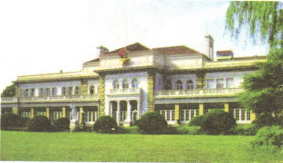
This is where the current Shanghai Children's Palace is. Once it was the residence of Elly Kadoorie, a British Jew.


Elly Kadoorie began his business in Hong Kong with only $500. Later on, he became a top-notch entrepreneur in Shanghai and Hong Kong.


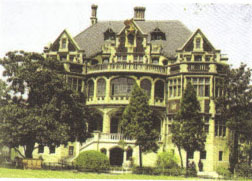
The residence of Kadoorie is imposingly superb. With an area of 14,000 m2 in Shanghai, where the land is so scarce, the building is matchlessly unique. The spacious lawn enables people to have an enjoyable perspective. The grand garden house is symmetrical, and its floor space amounts to 3,300 m2. Overwhelmingly beautiful, it looks like a royal palace.


The Former Residence of Jiang Jieshi and Song Meiling
(No.9, Dongping Road)

This house was the temporary dwelling villa for Jiang Jieshi and Song Meiling in Shanghai, which Jiang Jieshi called Ai Lu, meaning Love Villa.


This French-style garden house, located at No.9, Route Francis Gamier, which is today's Dongping Road, in the French Concession, was the wedding abode of Jiang Jieshi and Song Meiling when they got married in Shanghai.


The whole residence consists of a main building and two subordinate buildings. Attached to the main building on both sides, the subordinate buildings were the dwelling places and offices for bodyguards and security people. The main building faces south and consists of three units, east, west and middle, each different in modeling.


Sassoon's Villa
(No.2409, Hongqiao Road)

Located in the west suburb of Shanghai, Sassoon's Villa was the private villa owned by Sassoon, a British Jew, and a real estate tycoon in Shanghai. In the 1930s, he had real estates all over Shanghai.


In 1930, Dazhong Industrial Corporation bought 60 mu of land in the west suburb of Shanghai and appointed Palmer & Turner Group to design, construct and decorate the building in the style of a British country villa. The whole building has a floor space of about 900 m2 and covers an area of 1,225.44 m2. Sassoon spared no expense, imported oak and other materials from Britain; consequently, the construction price was 317 silver dollar/m2, the highest in Shanghai at the time.


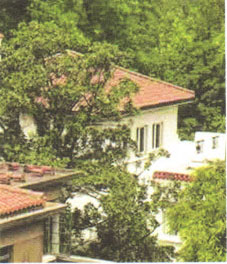
The ground floor of the building is of brick-and-wood structure. The external walls are red bricks. The steep roof is laid with red tiles, looking quite elegant.


The villa faces south. At the south entrance there is a large platform. The corridor inside the entrance leads to the first-floor hall, which is at least 200 m2. The middle part and the west part have only one story, with the study room, the sitting room, and the dining room. The east part has two stories and on the second floor is Sassoon's bedroom, all the furniture was made of oak and teakwood, and the exquisite building hardware was all handmade. Other subordinate housing is all behind the villa. The villa is surrounded by trees and lawns. Besides the large number of cypress trees, there are cedar, camphor and other trees. The layout of the villa is of the typical British style.


Xingguo Hotel
(No.72, Xingguo Road)

The villas of Xingguo Hotel, built in the 1920s and 1930s, cover an area of 105,600 m2 with a total floor space of over 20,000 m2. Green coverage reaches 90%. In the hotel, there are more than 6,000 trees, 20 of them over 100 years old, and especially two straight king pines famous in the region south of the Changjiang River. There are also the camphor trees, gingko trees, golden citrus trees and torreya trees.


The 30 villas here are with French, British, German, American, Spanish, and Canadian architectural flavors. In front of each building there are flower beds and lawns. Tranquil in the surroundings and elegant in landscaping, the villas of different styles are immersed in green trees and beautiful flowers, thus making stylishly unique garden houses. The villas, invested and constructed by an American real estate company, served as the office buildings of foreign firms and residences of bureaucatic capitalists. And Building No.1 was the residence of the Taipan of Swire Pacific Limited.


The palladio-style classic architecture was built in 1934 and designed by the famous Scottish architect Sir Clough Williams-Ellis. It has a building area of 1,647 m2. The main and side buildings are arranged in parallel. Two-story brick buildings are symmetrically lined on both sides. To suit the need of social and commercial gathering, the building was designed with public spacing in mind.


Donghu Hotel
(No.70, Donghu Road)

Donghu Hotel is located at the corner of Middle Huaihai Road and Donghu Road. As Donghu Road was once named Route Doumer, people of Shanghai refer to the hotel as Doumer Garden.


Buildings No.1 and No.2, built in 1934, are five-story garden houses. It was once the residence of Du Yuesheng, who used to be a big shot in Shanghai. It has also been used as Sino-French Bank, Bank of Communications, and the Consulate General of the United States.


Building No.3, built in 1940, is a four-story apartment building, consisting of eight 3-bedroom apartments.


Buildings No.4 and No.5, built in the 1930s, are four-story apartment buildings.


Building No.7 is located at No.7, Donghu Road, close to Middle Huaihai Road. This garden house was built by a British Jew R. M. Joseph, the owner of a British firm, in 1925. When the Pacific War broke out on December 7, 1941, he was sent to the concentration camp by the Japanese army. And this beautiful residence was occupied by the Japanese officers. After the victory of the Anti-Japanese War, Joseph disappeared; and the Chinese government took it over and rented it to the U.S. army stationed in Shanghai. In the 1950s, the Soviet Business Office in Shanghai was set up here.


Moller Villa
(At the corner of Middle Yan'an Road and South Shaanxi Road)

In the bustling South Shaanxi Road in the city proper of Shanghai, there is an old garden house, simple but elegant, with a pointed roof and of the Norwegian architectural style. Shanghai people refer to it as Moller Villa.


The villa, made up of 4 houses, was completed in 1936. It occupies a land of 77000 m2 with construction area of 9,855 m2. These 2-story brick-wood houses form an L shape.


The external of the villa is of Norwegian style, while in front of the traditional Chinese gate, there are two stone lions. The high walls surrounding the garden are laid with fire-resistant bricks. And the roof is thatched with greenish yellow Chinese glazed tiles. In the corridors inside the building can be seen niches for the statues of Buddha almost everywhere. The interior decorations of the main building are meticulously exquisite, with beautiful patterns carved everywhere. The vaults inside are mounted with colorful glasses, and the turret points of various heights form a mysterious contour, looking like a mysterious northern European village.


Most probably because the family made a fortune out of shipping, Moller decorated the interior of the villa in the dream very much like a luxurious liner. The woodcarvings are all a fleet of ships on the sea, such as the helm, the anchor, seaweeds, sea waves, the sunrise on the sea, the beacon on the sea, the operations on the sea, etc. Even the floor is made up of thin slices of wood in the patterns of seaweeds and kelp. The thinnest slices of wood are but a few millimeters wide.


The flower garden was set to the south of the main building. The pavements around the garden were laid with colorful bricks. In the garden are planted cypress, cedar and other precious trees and flowers. In the middle is a lawn, on which was erected a bronze horse. In order to make the garden more beautiful and also to be able to appreciate flowers from inside the house, there is a flower-watching house, which used to be equipped with heating. The carvings indoors are exquisitely beautiful, and the ground is laid with colorful glazed tiles.


Shortly after the completion of the villa, the Anti-Japanese War broke out. In 1941, the Mollers were driven into a concentration camp, leaving the castle in the dream behind. The villa became a club for the Japanese invaders. After the victory of the war, it became a KMT institution.


In 1949, the villa became the office of Shanghai Municipal Committee of the Communist Youth League of China. In 1989, Moller Villa was listed in the first group of Shanghai Heritage of Modern Architectures. In 2001, it was subjected to the management by Hengshan (Group) Company, one of Shanghai's large tourism groups, and transformed into a small boutique hotel. And in May 2002, it was open to the public and was renamed Moller Villa of Hengshan Hotel.


Dingxiang Garden
(No.849, Huashan Road)

Dingxiang Garden, located on Huashan Road, is one of the most prestigious and best-preserved garden houses in Shanghai. Its prestige comes not only from the architecture but also from the legendary feature of the owner.


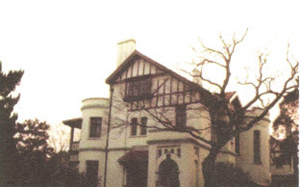
It was said that Li Hongzhang, the Northern Minister of the Qing Dynasty entrusted Sheng Xuanhuai to buy a house. Sheng abided by this order, bought 2.67 hectares of land on Avenue Haig, which is Huashan Road today, and built a villa with a large western garden. As the hostess was named Dingxiang, the place was called Dingxiang Garden.


Another story goes like this: Dingxiang Garden was the former residence of Li Maijing, the youngest son of Li Hongzhang. As lots of clove bushes, which is named Dingxiang in Chinese, were planted in the garden, thus people called the place Dingxiang Garden.


Buildings No.1 and No.3 were built in 1862; by the way, Building No.2 was built in the 1950s. They were the first British-style villas that Isaiah Rogers, a famous American architect, designed in Shanghai. He was one of the pioneers of modern architecture.


In Building No.1, the three main rooms, the dining room and the living room, on the first floor face south, while the rooms facing north are the kitchen, storeroom, and servants' room. There are three main rooms on the second floor. The room in the middle with a protruding balcony is the bedroom, flanked by the study and the reception room. In front of this building cloves are planted. Building No.3 is the library, in front of which are planted camphor trees.


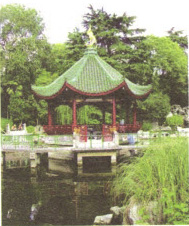
In the south of Dingxiang Garden, there is a flower garden. Among the buildings meanders an over-100-m dragon wall, with 18 ups and downs. Behind the gate, referred to as the Dragon Gate, is a path laid with pebbles. In the garden there is a lake with a zigzag bridge, and a pavilion at the center of the lake. With a phoenix at the top of the pavilion, it is thus called Phoenix Pavilion. By the side of the lake there is a stone boat. With green trees, flowerbeds, and rockeries, it is an early garden that integrated the Chinese and western styles.


Dingxiang Garden changed hands many times, but it has always been private residence. After 1949, Shanghai Municipal Government listed it as one of the first units of cultural relics under municipal protection, and had it repaired quite a few times.


In the mid-1980s, the departments concerned restored the two buildings, and began to do business independently. During the summer season, Dingxiang Garden opens as a night garden, an ideal place for drinks and relaxation at night.