6.3 Basic Issues in Inventory Valuation
Because goods sold or used during an accounting period seldom correspond exactly to the goods bought or produced during that period,the physical inventory either increases or decreases from the beginning to the end of the period.In addition to changes in inventory quantity,the cost of the items could change during a period.Accounting for these increases or decreases requires that the cost of all the goods available for sale or use be allocated between the goods that were sold or used and those that are still on hand.The cost of goods available for sale or use is the sum of (1)the cost of the goods on hand at the beginning of the period and(2)the cost of the goods acquired or produced during the period.Inventory accounting involves the determination of each of the items listed above,but the focus is generally on the valuation of the ending inventory.The valuation of inventories can be a complex process that requires determination of:(1)the physical goods or items to be included in inventory;(2)the cost to be included in inventory,and(3)the cost flow assumption to be adopted.
6.3.1Physical Goods to Be Included in Inventory
Technically,purchases should be recorded when legal title to the goods passes to the buyer.General practice,however,is to record acquisitions when the goods are received,because it is difficult for the buyer to determine the exact time of legal passage of title for every purchase and because no material error is likely to result from such a practice if it is consistently applied.
6.3.2Costs to Be Included in Inventory
One of the most important problems in dealing with inventories concerns the amount at which the inventory should be carried in the accounts and stated in the accounting reports.Inventories,like other assets,are generally accounted for on a basis of cost.Costs included in inventory are product costs,period costs and manufacturing costs.
Product costs.Product costs are those costs that“attach”to the inventory and considered to be a part of the total inventory valuation.Product costs include freight and hauling charges on goods purchased,other direct costs of acquisition,and labor and other production costs incurred in processing the goods up to the time of sale.
Period costs.Selling expense and,under ordinary circumstances,general and administration expenses are not considered to be directly related to the acquisition or production of goods.Such costs are period costs rather than product costs.
Manufacturing costs.A business that manufactures goods utilizes three inventory accounts:raw materials,work in process,and finished goods.Work in process and finished goods include raw material,direct labor,and manufacturing overhead costs.Manufacturing overhead costs include all manufacturing costs except direct material and direct labor.Items included in manufacturing overhead are indirect material,indirect labor,and such items as depreciation,taxes,insurance,heat and electricity incurred in the manufacturing process.
6.3.3Cost Flow Methods of Inventory Valuation
Cost flow methods of inventory valuation generally used are specific identification,FIFO,average cost and LIFO.
Specific identification.Specific identification calls for identifying each item sold and item in inventory.The costs of the specific items sold are included in the cost of goods sold,while the costs of specific items on hand are included in the inventory.This method may be used only in instances where it is practical to identify specific items and their costs from the different purchases made.Any goods on hand may then be identified as quantities remaining from specific purchases,and the invoice cost of each lot or item may be separately determined.Obviously this method has a very limited application in most instances,because of the impossibility or impracticability of segregating specific items as coming from separate purchases.It can be successfully applied,however,in situations where a relatively small number of costly,easily distinguishable items are handled.In the retail trade this includes some types of jewelry,fur coats,automobiles,and some furniture and appliances.
FIFO.Under the FIFO method,costs are allocated between inventories on hand and goods sold on the assumption that goods are sold in the order in which they are purchased;in other words,the first goods purchased are the first used(in a manufacturing concern)or sold(in a merchandising).The cost of inventory remaining would therefore come from the most recent purchases.
Average cost.As the name implies,the average cost method prices items in the inventory on the basis of the average cost of all similar goods available during the period.If perpetual inventory records are not kept,the cost of the inventory is computed only at the end of the period.The average cost method is often referred to as the weighted-average method.
LIFO.The LIFO method allocates costs on the assumption that the cost of the most recent purchases is matched against revenue.Therefore,determination of ending inventory valuation is based on the assumption of“first-in,still-here”(FISH).
Words&Expressions
6.1
inventory存货
classification分类,分级
significant有意义的,重要的
asset资产
enterprise企业
measurement计量
disclosure披露
manufacturing制造业的
appropriately适当地
revenue收入
determination决定
consequently从而,因此
particularly尤其
materially物质上
income statement损益表
the balance sheet资产负债表
specifically特别地
exclude排除
normally一般地
await等候
final disposition最终处置
6.2
perpetual永恒的,终身的
periodic inventory system定期盘存制
inventory account存货账户
sold account销售账户
accumulate累计
issuance发布;发出
the ending inventory amount期末存货价值
acquisition获得,获得物
adjust调整
close out清算
the net purchase购货成本
deduct减掉
6.3
correspond to与……一致
the physical inventory物质存货清单
in addition to此外,加上
allocate分派,分配
be still on hand仍旧在手头上
the sum of总数
involve牵涉
the items listed above以上所列出的条目
a complex process一个复杂的过程
the cost flow assumption成本流假设
adopt采纳
technically理论上
legal title法定所有权
general practice实际工作中
legal passage所有权发生转移
material error重要错误
result from源于
consistently一贯地
concern关于
the accounting reports会计报告
product cost生产成本
period cost期间成本
manufacturing cost制造成本
the total inventory valuation总存货计价
freight货物,货运,装货,运送
hauling用力拖拉
incur招致
up to达到
under ordinary circumstances在一般情况下
rather than而不是
utilize利用
work in process在产品
overhead按人头的
direct material and direct labor直接材料和直接劳动力
depreciation贬值
specific identification具体识别
call for要求
instance事例
identify specific items确认/识别特别的条目
the invoice cost发票价格(成本)
limited application应用面窄
in most instances在多数情况下
impossibility不可能的事
impracticability无法实施、不能实施的事
segregating隔离
distinguishable可区别的,可辨识的
fur coats毛衫,皮衣
appliance用具,器具
on the assumption that以……为假设
the most recent purchases最近的购买
average cost平均成本
perpetual inventory records永续盘存记录
be often referred to as经常被称作
the weighted-average method加权平均法
assumption假设
be matched against与……相一致
first-in,still-here(FISH)先收进的后发出
Notes
1.For manufacturing and retail businesses,the sale of inventory at a price greater than total cost is the primary source of income;matching inventory cost appropriately against revenue is necessary for the determination of net income.对于制造业和零售业的企业来说,将存货以高于总成本的价格销售是企业收入的主要来源,将存货成本与销售收入相匹配是决定净收入的必要步骤。该句为分号连接的并列句,两个句子均为主系表结构。第一个分句的主语为the sale of inventory;第二个分句的主语为matchingagainst revenue,两个is之后的部分均为表语。
2.Assets are specifically excluded from inventory because they are not normally sold in the course of business including such items as plant and equipment awaiting final disposition.将其他资产与存货区别开来是因为其他资产(包括待处理的厂房和机器设备)在正常的生产经营过程中并不用于销售。该句为主从复合句。主句为主谓状结构,其中,主语为assets,谓语为are specifically excluded,状语为from inventory。由because引导的是原因状语从句,从句中的介词短语including such items as为该从句的状语。
3.At the end of the accounting period the inventory account must be adjusted by closing out the beginning inventory amount and recording the ending inventory amount.在会计期末通过清算期初存货数量和记录期末存货数量来调整存货账户。该句为简单句,属主谓宾结构。主语为the inventory account,谓语为must be adjusted by,后面的closing out与recording均作by的宾语;句首的介词短语at the end of为时间状语。
4.Because goods sold or used during an accounting period seldom correspond exactly to the goods bought or produced during that period,the physical inventory either increases or decreases from the beginning to the end of the period.因为在某个会计期间销售或使用的存货与该会计期间购买或生产的存货不存在一一对应关系,期末存货与期初存货相比或者增加或者减少。该句为复合句。because引导原因状语从句,goods为其主语,seldom correspond exactly to为谓语,the goods为宾语。两个goods分别由两个过去分词作定语的短语,即sold or used during an accounting period与bought or produced during that period来修饰。
5.Accounting for these increases or decreases requires that the cost of all the goods available for sale or use be allocated between the goods that were sold or used and those that are still on hand.要反映存货成本的增加或减少需要将所有可供销售或使用的存货成本在期末存货与发出存货之间进行分配。该句为主从复合句。主句的主语为accounting,谓语动词为requires,宾语由that引导的从句来担任。由require引导的宾语从句一般使用“should+动词原形”的虚拟语气,should又往往省略,故宾语从句的谓语为be allocated;在宾语从句中,又带有两个由关系代词that引导的定语从句,即that were sold or used以及that are still on hand,分别修饰goods和those。
6.Inventory accounting involves the determination of each of the items listed above,but the focus is generally on the valuation of the ending inventory.存货会计包括前面两点,但其重点是期末存货的计价。这是由but连接的并列句,在第一个分句中,listed above是过去分词短语作定语,修饰items。
7.Product costs include freight and hauling charges on goods purchased,other direct costs of acquisition,and labor and other production costs incurred in processing the goods up to the time of sale.生产成本包括购买货物时的运输费用、其他直接购货费用、发生在生产过程中的工资费用和其他生产费用。该句为简单句,主语为product costs,谓语为include,三个并列宾语成分一起作include的宾语。
8.This method may be used only in instances where it is practical to identify specific items and their costs from the different purchases made.个别计价法只适用于易于辨别不同购买来源的购买批次和购买成本。该句为主从复合句。主句为主谓状结构。主语为this method,谓语为may be used,状语为only in instances在状语中,又带有一个由关系副词引导的定语从句,修饰instances。定语从句中最后的单词made是过去分词作后置定语,修饰前面的purchases。
9.It can be successfully applied,however,in situations wherea relatively small number of costly,easily distinguishable items are handled.个别计价法可成功适用于存货品种数量不多、单位成本较高、容易识别的成本计价。该句为主从复合句。主句为It can be successfully applied in situations由关系副词where引导的定语从句修饰前面的先行词situations。主句的主语it指上文提到的内容。
10.If perpetual inventory records are not kept,the cost of the inventory is computed only at the end of the period.如果不是使用永续盘存记录,存货成本只在会计期末计算。该句为主从复合句。由if引导的是条件状语从句,主句为主谓状结构,主语为the cost of the inventory,谓语为is computed,状语为only at the end of the period.
11.The LIFO method allocates costs on the assumption that the cost of the most recent purchases is matched against revenue.后进先出法在将最近购买存货的成本与收入相匹配的假设下分配成本。该句为主从复合句。主句的主语是the LIFO method,谓语为allocates,宾语为costs,状语为on the assumption that the cost of the most在该状语从句中,that引导的从句为同位语从句,解释说明assumption的内容。
Exercises
Section 1:Know the Concepts
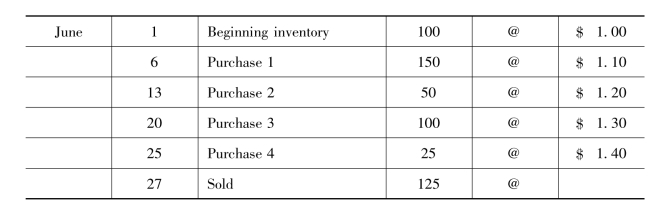
1.According to the following information,use weighted-average method and the ending inventory should be_______.

2.Using the information from question 1,the LIFO method,the cost assigned to the ending inventory is_______.
3.If merchandise inventory is being valued at cost and the price level is steadily rising,the method of costing that will yield the higher net income is ( ).
A.LIFO
B.FIFO
C.Average
D.Periodic
4.Translate the following terms into Chinese.
(1)FIFO
(2)periodic inventory method
(3)LIFO
(4)perpetual inventory method
(5)weighted average method
Section 2:Practical Application
1.The following information was obtained from the Able Trading Co.during the current accounting period:
Purchases 500 units at$6.50,240 units at$5.90,370 units at$6.10,and 320 units at$6.00.
Ending merchandise inventory physical count—290 units.
Determine:
(1)The average cost per unit.
(2)The cost assigned to the ending inventory.
(3)The cost of goods sold.
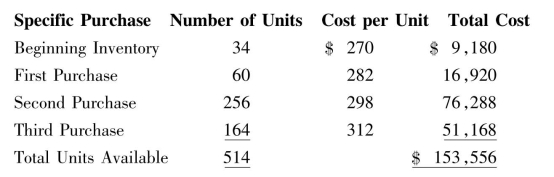
2.Casey Electronics'ending inventory consists of 182 Model M43 CD players acquired through various purchases,as follows:

The 514 units available for sale,and 182 units are still on hand.Under the periodic inventory system,if Casey Electronics may choose any one of the three following methods of recording the total cost of the 182 units in the ending inventory of CD players:
(1)WEIGHTED-AVERAGE-COST METHOD
(2)FIFO
(3)LIFO
Determine the total cost of the 182 units in the ending inventory.
课文翻译