1.3.9
第九课 法律文书的翻译 Lesson 9 Translation of Litigation and...
第九课 法律文书的翻译 Lesson 9 Translation of Litigation and Court Documents
从广义上讲,“法律文书”是指司法机关、当事人及其代理人在诉讼活动中根据法律法规所使用的各类文书的总称。在我国,常见的“法律文书”包括起诉意见书、起诉书、公诉意见书、不起诉决定书、判决书、刑事附带民事判决书、刑事裁定书、刑事自诉状、刑事上诉状、刑事申诉状、辩护词、民事起诉状、民事反诉状、民事上诉状、民事答辩状、民事调解书、行政起诉状、行政答辩状、辩护词、代理词、传票及仲裁文书等等。在英美国家,常见的“法律文书”包括complaint(民事起诉状)、indictment(刑事起诉书)、answer(答辩状)、summons(传票)、proof of service(送达证明)、Power of Attorney(授权委托书)、civil judgment(民事判决书)、criminal judgment(刑事判决书)等等。由于法律体系和法律文化的差异,我国的法律文书和英美国家的法律文书在格式、表达及内容方面存在着不少差异。
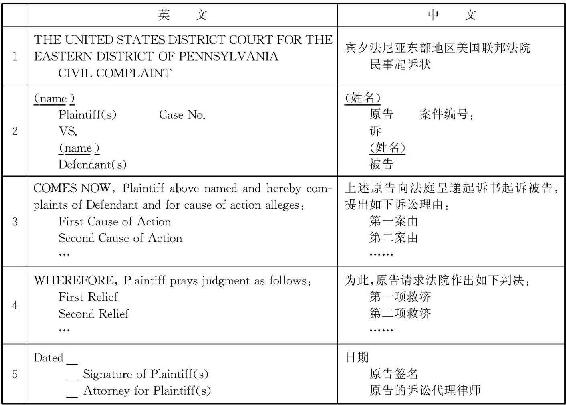
当事人及律师制作的民事起诉法律文书通常称为“民事起诉状”,一般要包括原告、被告、案由、请求事项、事实和理由等内容。美国的民事起诉状一般要包括plaintiff(原告)、defendant(被告)、jurisdiction(管辖权)、statement of claim(事实简述)、nature of suit(诉讼的性质)、relief(救济)等内容。(1)具体如下:
1.关于custody。在《布莱克法律词典》中,对custody提出了三种解释:(1)The care and control of a thing or person for inspection, preservation, or security. (2)The care, control, and maintenance of a child awarded by a court to a responsible adult.(3)The detention of a person by virtue of lawful process or authority.(5) 这三项解释可依次译为“保管”、“监护”和“拘留”。“in custody”(被监禁)是指对自由的限制,即可指实际关押在监狱的状态,也可指因缓刑(probation)、假释(parole)和取保(bail bond)、个人具结悔过(personal recognizance)而被有条件释放的状态。
2.关于“confinement”。该术语具有“监禁、拘留、关押”的意思。(6)《布莱克法律词典》也将该术语解释为:The act of imprisoning or restraining someone; the state of being imprisoned or restrained. (7)因此,criminal confinement可以表示“刑事拘留”,或者“羁押”的意思。
3.关于“imprisonment”。该术语具有“监禁、拘押;限制人身自由”的意思。(8)《布莱克法律词典》也将该术语解释为:The act of confining a person, esp. in a prison; the state of being confined.(9)在该辞典的解释中,“imprisonment”比较强调“在监狱中监禁”。而“刑事拘留”或者“羁押”并不是在监狱中监禁的。因此,“imprisonment”和“刑事拘留”的法律功能并不对等。
《布莱克法律词典》将“detention”解释为:The act or fact of holding a person in custody; confinement or compulsory delay;(11)据该词典,“detention”分三种:(1)investigative detention(侦查阶段拘留):The holding of a suspect without formal arrest during the investigation of the suspect's participation in a crime。(2)pretrial detention(审前拘留):The holding of a defendant before trial on criminal charges either because the established bail could not be posted or because release was denied。(3)preventive detention(预防性拘留):Confinement imposed usu.on a criminal defendant who has threatened to escape, poses a risk of harm, or has otherwise violated the law while awaiting trial, or on a mentally ill person who may cause harm。
例1:The Defendant denies the allegations in Paragraph 1 of Plaintiff's Complaint. The Defendant alleges that after the Defendant refused to ship the Goods under the Contract, it is unreasonable that the Plaintiff compensated his buyer to avoid legal disputes and mitigate losses. (被告否认原告起诉书第1段的主张。被告认为,在被告拒绝交付合同项下的货物之后,为了避免法律纠纷的发生和损失的扩大,原告对其买方作出补偿的行为是不合理的。)
上述例子是被告否认原告的主张,在中文的答辩状中,也有类似的表述。比如,我们认为:该案与本公司无关,请法院依法撤销原告对我方的诉讼请求。(We believe that this case is of no relevance of our company and pray that the plaintiff's claims against our company should be dismissed.)
例2:The Defendant admits that the Plaintiff does not know the business of the Defendant which is a German company and the contract with his buyer, thus he cannot foresee the losses aroused. (被告承认,原告对被告德国公司所进行的业务并不了解,同时,其对被告与其买方达成的合同并不知情,从而不能预见在这方面发生的损失。)
在美国,根据联邦及大多数州的民事诉讼规则,所有的肯定性答辩都必须答辩状中提出,且被告对其所提之事负有证明责任。这些事由包括和解和清偿(accord and satisfaction)、自担风险(assumption of risk)、混合过失(contributory negligence)、胁迫(duress)、时效(prescription)、不容否认(estoppel)等。在刑事诉讼中,构成肯定性答辩的事由包括精神失常(insanity)、醉态(intoxication)、自卫(self-defense)、无意识行为(automatism)、不在犯罪现场(alibi)、受胁迫(duress)等。(14)
美国法院的判决书一般包括案件名称、法院和判决日期、案情事实、原告方的诉求、此案先前已经过的审判程序和前审的判决结果、双方各自的辩论观点、现在的待解决问题、本案法官的推理、本案所确立的法律原则、法官的附带评论,等等。有的案件还会附上异议法官的意见(dissenting opinion or dissent)。除了案件名称、法院和判决日期等格式性的部分外,剩余部分一般都属于“法官意见”。
例如Kristin A.Greenawalt v.Indiana Department of Corrections, William K.Kromann, and Kathy J.Lisby缩减为Greenawalt v.Indiana Dept.of Corrections;United States of America v.Tommie T.Childs缩减为U.S.v.Childs。(16)
2.关于法官意见
法官意见是一份判决书的主体部分。法官一般会严谨而简明地表明其决定,例如:
例1:This court has jurisdiction over the subject matter and all necessary parties are properly before this court.(本院对争议事项具有管辖权,并且所有需要出庭的当事人均已出庭。)
例2:For above reasons, the jury instructions here were flawed in important respects. The judgment of the Court of Appeals is reversed, and the case is remanded for further proceedings consistent with this opinion.(基于上述理由,陪审团的指示在重要问题上存在缺陷。撤销上诉法院的判决,并将案件发回,请根据本意见进行进一步审理。)
例3:As to Interest claimed by the Plaintiff, the Court dismisses this claim of the Plaintiff because the Plaintiff does not bring forward a specific figure and provide related evidence.
关于原告所主张的利息,鉴于原告并没有提出具体的数额和提供相关的证据,本院不予支持。
例4:According to the Article 74 of the CISG, the Plaintiff is entitled to recover the difference between the sales price and the resale price. Pursuant to the evidence provided by the Plaintiff, the Court decides that the loss of profit (USD70,000) claimed by the Plaintiff should be supported.(根据《联合国国际货物买卖合同公约》第74条,原告有权就合同价与转售价之间差价要求获得赔偿。根据原告提供的证据,本法院认为,原告主张的利润损失70,000美元应获得支持。)
例1:原告A公司与被告B公司损害赔偿纠纷一案,本院受理后,依法组成合议庭,公开开庭进行了审理。上述公司的法定代表人及委托代理人到庭参加诉讼,本案现已审理结束。(The Plaintiff Co.A allegedly suffered damages due to Defendant Co.B and thus the case was brought before this Court. This Court formed a panel in accordance with the applicable law and heard the case in open court. The legal representatives and the authorized legal counsels of the above companies appeared in the Court and the case has been decided.)
例2:依据本案的事实和应适用于本案的法律,现作出判决如下:
(一)被告向原告赔偿原告蒙受的利润损失1000美元;
(二)被告向原告赔偿原告因补偿买方而蒙受的损失4000美元;
(三)驳回原告的其他诉讼请求。
(Pursuant to the facts and the applicable law of this case, the Court hereby makes the following decisions:
1. The Defendant compensates the Plaintiff USD1,000 for the loss of profit;
2. The Defendant compensates the Plaintiff USD4,000 for the loss in compensating the Buyer;
3. All other claims of the Plaintiff are dismissed.)
例3:如不服本判决,可在判决书送达之日起十五日内,向本院递交上诉状,并按对方当事人的人数提出副本,上诉至北京市第一中级人民法院。(Any Party dissatisfied with this Judgment shall appeal to the First Branch of Beijing Municipal People's Court via this Court within 15 days form the service of this Judgment in the number of copies corresponding to the number of opposing party.)
Few areas of the law of contracts have undergone such radical changes in the nineteenth and twentieth centuries as has the law governing duress. In Blackstone's time relief from an agreement on grounds of duress was a (1) only if it was coerced by actual (not threatened) imprisonment or fear of loss of life or limb. “A fear of battery ... is no (2); neither is the fear of having one's house burned, or one's goods taken away or destroyed;” he wrote, “because in these cases, should the (3)be performed, a man may have satisfaction by recovering equivalent (4): but no suitable atonement can be made for the loss of life, or limb.” Today the general rule is that any (5)act or threat which overcomes the free will of a party (6)duress. This simple statement of the law conceals a number of questions, particularly as to the meaning of “free will” and “wrongful”.
2.请为下列术语选择合适的英文释义。
A. criminal-justice system
B. capacity defense
C. due process
D. degree of crime
E. duress
A. A defense based on the defendant's inability to be held accountable for an illegal act or the plaintiff's inability to prosecute a lawsuit (as/when the plaintiff was a corporation, but has lost its corporate charter.)
B. A division or classification of a single crime into several grades of guilt, according to the circumstances surrounding the crime's commission, such as aggravating factors present or the type of injury suffered.
C. The conduct of legal proceedings according to established rules and principles for the protection and enforcement of private rights, including notice and the right to a fair hearing before a tribunal with the power to decide the case.
D. Strictly, the physical confinement of a person or the detention of a contracting party's property. In the field of torts, duress is considered a species of fraud in which compulsion takes the place of deceit in causing injury.
E. The collective institutions through which an accused offender passes until the accusations have been disposed of or the assessed punishment concluded.
(1)As a separate affirmative defense to all purported claims for relief, Defendants allege that Plaintiff's claims under Complaint are barred by the equitable doctrine of laches(17).
(2)I am over the age of eighteen, suffer on legal disabilities, have personal knowledge of the facts set forth below, and am competent to testify.
(3)The Tribunal finds that the quantity of the Goods under the Contact is 4,000mts according to Clauses 3 and 4 of the Contract. The Tribunal decides that the tolerance allowed by Clause 4 and Clause 5 of the Contract is only applied to the Goods actually shipped. The Respondent did not deliver the Goods according to the Contract, so the tolerance of the Contract is not applied and the damages should be assessed on the basis of 4,000mts.
(4)If the defendant does not accept this judgment, he may, within 10 days between the second and tenth day from the day after receiving this Judgment, appeal either through this court or directly appeal to the High People's Court of Shanghai. A written appeal should be submitted with one original and two copies.
(13) A defendant's assertion of facts and arguments that, if true, will defeat the plaintiff's or prosecution's claim, even if all the allegations in the complaint are true. Bryan A.Garner: Black's Law Dictionary (8th Edition), Thomson Reuters, 2009, p.1268.