1.2.11
Lesson 11 Law of the World Trade Organization 第十一课...
Lesson 11 Law of the World Trade Organization 第十一课 世界贸易组织法
Ⅰ. Text & Its Translation
1. General Introduction
The World Trade Organization(WTO) is an organization that intends to supervise and liberalize international trade. The organization officially commenced on January 1, 1995 under the Marrakech Agreement(1), replacing the General Agreement on Tariffs and Trade (GATT)(2), which commenced in 1948. The organization deals with regulation of trade between participating countries; it provides a framework for negotiating and formalizing trade agreements, and a dispute resolution process aimed at enforcing participants' adherence to WTO agreements which are signed by representatives of member governments and ratified(3) by their parliaments. Most of the issues that the WTO focuses on derive from previous trade negotiations, especially from the Uruguay Round(1986—1994).(4)
The organization is currently endeavoring to persist with a trade negotiation called the Doha Development Agenda(or Doha Round)(5), which was launched in 2001 to enhance equitable participation of poorer countries which represent a majority of the world's population. However, the negotiation has been dogged by disagreement between exporters of agricultural bulk commodities and countries with large numbers of subsistence farmers(6) on the precise terms of a “special safeguard measure”(7) to protect farmers from surges in imports. At this time, the future of the Doha Round is uncertain.
The WTO has 153 members, representing more than 97% of the world's population, and 30 observers(8), most seeking membership. The WTO is governed by a Ministerial Conference(9), meeting every two years; a General Council(10), which implements the Conference's policy decisions and is responsible for day-to-day administration; and a Director-General(11), who is appointed by the Ministerial Conference.
2. Principles of the Trading System
The WTO establishes a framework for trade policies; it does not define or specify outcomes. That is, it is concerned with setting the rules of the trade policy games. Five principles are of particular importance in understanding both the pre-1994 GATT and the WTO:
(1) NonDiscrimination. It has two major components: the most favored nation(MFN) rule, and the national treatment policy. Both are embedded in the main WTO rules on goods, services, and intellectual property The MFN rule requires that a WTO member must apply the same conditions on all trade with other WTO members, i.e. “Grant someone a special favor and you have to do the same for all other WTO members.” National treatment means that imported goods should be treated no less favorably than domestically produced goods and was introduced to tackle non-tariff barriers(12) to trade(e.g. technical standards and security standards discriminating against imported goods).
(2) Reciprocity. It reflects both a desire to limit the scope of free-riding that may arise because of the MFN rule, and a desire to obtain better access to foreign markets. A related point is that for a nation to negotiate, it is necessary that the gain from doing so be greater than the gain available from unilateral liberalization; reciprocal concessions intend to ensure that such gains will materialize.
(3) Binding and enforceable commitments. The tariff commitments made by WTO members in a multilateral trade negotiation(13) and on accession are enumerated in a schedule(list) of concessions(14). These schedules establish “ceiling bindings”(15): a country can change its bindings, but only after negotiating with its trading partners, which could mean compensating them for loss of trade. If satisfaction is not obtained, the complaining country may invoke the WTO dispute settlement procedures.
(4) Transparency. The WTO members are required to publish their trade regulations for the review of administrative decisions affecting trade, to respond to requests for information by other members, and to notify changes in trade policies to the WTO. These internal transparency requirements are supplemented and facilitated by periodic countryspecific reports(trade policy reviews) through the Trade Policy Review Mechanism(TPRM)(16). The WTO system tries also to improve predictability and stability, discouraging the use of quotas(17) and other measures used to set limits on quantities of imports.
(5) Safety valves. In specific circumstances, governments are able to restrict trade. There are three types of provisions in this direction: articles allowing for the use of trade measures to attain noneconomic objectives; articles aimed at ensuring “fair competition”; and provisions permitting intervention in trade for economic reasons. Exceptions to the MFN principle also allow for preferential treatment of developing countries, regional free trade areas(18) and customs unions(19).
3. Agreements of WTO
The WTO oversees about 60 different agreements which have the status of international legal texts.WTO Member countries must sign and ratify all WTO agreements on accession. A discussion of some of the most important agreements follows.
(1) The Agreement on Agriculture(AoA)came into effect with the establishment of the WTO at the beginning of 1995. The AoA has three central concepts, or “pillars”: domestic support, market access and export subsidies(20).
(2) The General Agreement on Trade in Services was created to extend the multilateral trading system to service sector. The Agreement entered into force in January 1995.
(3) The Agreement on Trade-Related Aspects of Intellectual Property Rights sets down minimum standards for many forms of intellectual property(IP) regulation. It was negotiated at the end of the Uruguay Round in 1994.
(4) The Agreement on the Application of Sanitary and Phytosanitary Measures—also known as the SPS Agreement was negotiated during the Uruguay Round, and entered into force with the establishment of the WTO at the beginning of 1995. Under the SPS agreement, the WTO sets constraints on members' policies relating to food safety as well as animal and plant health.
(5) The Agreement on Technical Barriers to Trade is an international treaty of the World Trade Organization. The object ensures that technical negotiations and standards, as well as testing and certification procedures, do not create unnecessary obstacles to trade.
(6) The Agreement on Customs Valuation, formally known as the Agreement on Implementation of Article Ⅶ of GATT, prescribes methods of customs valuation that members are to follow. Chiefly, it adopts the “transaction value” approach.
4. Dispute Settlement
Dispute settlement(21) is the central pillar of the multilateral trading system, and the WTO's unique contribution to the stability of the global economy. Without a means of settling disputes, the rulesbased system would be less effective because the rules could not be enforced. The WTO's procedure underscores the rule of law, and it makes the trading system more secure and predictable. The dispute settlement system of WTO is based on clearly-defined rules, with timetables for completing a case.
Stage and Time(22)
60 days
Consultations, mediation, etc
45 days
Panel set up and panel lists appointed
6 months
Final panel report to parties
3 weeks
Final panel report to WTO members
Total = 1 year
(without appeal)
60—90 days
Appeals report
30 days
Dispute Settlement Body adopts appeals report
Total = 1y 3m
(with appeal)
However, the point is not to pass judgment. The priority is to settle disputes, through consultations if possible. By January 2008, only about 136 of the nearly 369 cases had reached the full panel process. Most of the rest have either been notified as settled “out of court” or remain in a prolonged consultation phase(23)—some since 1995.
If the courts find themselves handling an increasing number of criminal cases, does that mean law and order is breaking down? Not necessarily. Sometimes it means that people have more faith in the courts and the rule of law. They are turning to the courts instead of taking the law into their own hands. For the most part, that is what is happening in the WTO. No one likes to see countries quarrel. But if there are going to be trade disputes anyway, it is healthier that the cases are handled according to internationally agreed rules. There are strong grounds for arguing that the increasing number of disputes is simply the result of expanding world trade and the stricter rules negotiated in the Uruguay Round; and that the fact that more are coming to the WTO reflects a growing faith in the system.
General Agreement on Tariffs and Trade(GATT)《关税与贸易总协定》
ratify 批准;认可
Uruguay Round 乌拉圭回合
Doha Development Agenda(DDA) 多哈发展议程
special safeguard measure 特殊保障措施
safeguard measure 保障措施
observer 观察员国
Ministerial Conference 部长级会议
General Council 总理事会
Director-General(世界贸易组织的)总干事
non-tariff barriers 非关税壁垒
multilateral trade negotiation 多边贸易谈判
schedule(list) of concessions 关税减让表
ceiling bindings 关税水平上限
Trade Policy Review Mechanism《贸易政策审议机制》
quota 配额
free trade area 自由贸易区
customs union 关税联盟
subsidies 补助金、补贴
dispute settlement 争端解决
non-discrimination非歧视原则
reciprocity 互惠原则
transparency 透明度原则
safety valves“安全阀”原则
The Agreement on Agriculture 《农业协议》
The General Agreement on Trade in Services 《服务贸易总协定》
The Agreement on Trade-Related Aspects of Intellectual Property Rights 《与贸易有关的知识产权协定》
The Agreement on the Application of Sanitary and Phytosanitary Measures(SPS Agreement)《卫生和植物检疫措施实施协议》(《SPS协议》)
The Agreement on Technical Barriers to Trade 《技术性贸易壁垒协定》
The Agreement on Customs Valuation 《海关估价协议》
Ⅲ. SUPPLEMENTARY TEXT Ⅲ.补充资料
Disputes in the WTO are essentially about broken promises. WTO members have agreed that if they believe fellowmembers are violating trade rules, they will use the multilateral system of settling disputes instead of taking action unilaterally. That means abiding by the agreed procedures, and respecting judgments.
A dispute arises when one country adopts a trade policy measure or takes some action that one or more fellow-WTO members considers to be breaking the WTO agreements, or to be a failure to live up to obligations. A third group of countries can declare that they have an interest in the case and enjoy some rights.
A procedure for settling disputes existed under the old GATT, but it had no fixed timetables, rulings were easier to block, and many cases dragged on for a long time inconclusively. The Uruguay Round agreement introduced a more structured process with more clearly defined stages in the procedure. It introduced greater discipline for the length of time a case should take to be settled, with flexible deadlines set in various stages of the procedure. The agreement emphasizes that prompt settlement is essential if the WTO is to function effectively. It sets out in considerable detail the procedures and the timetable to be followed in resolving disputes. If a case runs its full course to a first ruling, it should not normally take more than about one year—15 months if the case is appealed(24). The agreed time limits are flexible, and if the case is considered urgent(e.g. if perishable goods are involved), it is accelerated as much as possible.
The Uruguay Round agreement also made it impossible for the country losing a case to block the adoption of the ruling. Under the previous GATT procedure, rulings could only be adopted by consensus, meaning that a single objection could block the ruling. Now, rulings are automatically adopted unless there is a consensus to reject a ruling—any country wanting to block a ruling has to persuade all other WTO members(including its adversary in the case) to share its view.
Although much of the procedure does resemble a court or tribunal, the preferred solution is for the countries concerned to discuss their problems and settle the dispute by themselves. The first stage is therefore consultations between the governments concerned, and even when the case has progressed to other stages, consultation and mediation(25) are still always possible.
Ⅳ. EXERCISES Ⅳ.练习
1. Answer the following questions.
(1)What's the difference between GATT and WTO?
(2)Please give and explain briefly the principles of world trading system.
(3)What's the aim of Trade Policy Review Mechanism?
(4)What is the role of dispute settlement system of WTO?
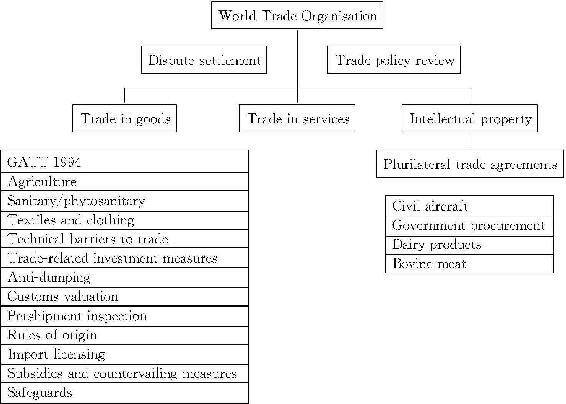
(5)Please describe the structure of WTO.
2. Translate the following terms into English.
(1)争端解决
(2)自由贸易区
(3)特殊保障措施
(4)非关税壁垒
(5)非歧视原则
(6)多边贸易谈判
(7)贸易政策审查机制
3. Translate the following terms into Chinese.
(1)international economic law
(2)General Agreement on Tariffs and Trade(GATT)Uruguay Round
(3)Director-General
(4)safety valves
(5)The Agreement on Trade-Related Aspects of Intellectual Property Rights
(6)The General Agreement on Trade in Services
(7)The Agreement on Technical Barriers to Trade
(8)The Agreement on Customs Valuation
4. Match the given terms with the proper explanation.
A. trade secret
B. Dispute Settlement Understanding
C. intellectual property
D. non-tariff measures
E. subsidy
F. International economic law
(1)It is an agreement of WTO, which is a central element in providing security and predictability to the multilateral trading system.
(2)Trade barriers restrict imports but are not in the usual form of a tariff, such as anti-dumping measures and countervailing duties.
(3)A term refers to a number of distinct types of creations of the mind for which a set of exclusive rights are recognized, including copyrights, trademarks, patents, industrial design rights and trade secrets.
(4)It is a form of financial assistance paid to a business or economic sector.
(5)It is a formula, practice, process, design, instrument, pattern, or compilation of information which is not generally known or reasonably ascertainable, by which a business can obtain an economic advantage over competitors or customers.
(6)It refers to that normative framework which governs mainly the international economic relations between states, and indirectly and consequentially those between individuals.
5. Choose the suitable words from the box and fill in the blanks.
the Uruguay Round non-tariff trade barriers evade impact governed
Non-tariff measures have risen sharply after the WTO rules led to a very significant reduction in tariff use. Some (1) are expressly permitted in very limited circumstances, when they are deemed necessary to protect health, safety, or sanitation, or to protect natural resources. In other forms, they are criticized as a means to (2) free trade rules. Many non-tariff measures are (3) by WTO agreements, which originated in (4)(the TBT Agreement, SPS Measures Agreement, the Agreement on Textiles and Clothing), as well as GATT articles. Some of non-tariff measures are not directly related to foreign economic regulations, but they have a significant (5) on foreign-economic activity between countries.
6. Translate the following sentences into Chinese.
(1)Membership in GATT gave countries access to foreign markets but imposed upon them the obligation to keep their own markets open and to reduce trade barriers through the multilateral GATT negotiation.
(2)The WTO, for the first time, offers an internationally accepted neutral and nonconfrontational venue for countries to negotiate on a multilateral basis for trade activities.
(3)The dispute settlement services offered by the WTO to member countries offers, in theory, an opportunity for disputes to be adjudicated in an open, fair and objective manner therefore allowing countries to conclude disputes in a peaceful and reasonable fashion.
(4)By opening its country to trade China has created closer links with the rest of the world, creating personal as well as business relationships between Chinese and people overseas.
(5)Under the WTO agreements, countries cannot normally discriminate between their trading partners. Grant someone a special favor(such as a lower customs duty rate for one of their products) and you have to do the same for all other WTO members.
(6)The WTO's intellectual property agreement amounts to rules for trade and investment in ideas and creativity. The rules state how copyrights, patents, trademarks, geographical names used to identify products, industrial designs, integrated circuit,layout-designs and undisclosed information such as trade secrets should be protected when trade is involved.
(7)The Trade Policy Review Mechanism's purpose is to improve transparency, to create a greater understanding of the policies that countries are adopting, and to assess their impact. Many members also see the reviews as constructive feedback on their policies.
(8)Since 1995, the updated GATT has become the WTO's umbrella agreement(26) for trade in goods. It has annexes dealing with specific sectors such as agriculture and textiles, and with specific issues such as state trading, product standards, subsidies and actions taken against dumping.
(9)The WTO's top level decisionmaking body is the Ministerial Conference which meets at least once every two years. Below this is the General Council(normally ambassadors and heads of delegation in Geneva, but sometimes officials sent from members' capitals) which meets several times a year in the Geneva headquarters. The General Council also meets as the Trade Policy Review Body and the Dispute Settlement Body.
(10)The Doha Development Agenda(DDA) adds negotiations and other work on non-agricultural tariffs, trade and environment, WTO rules such as antidumping and subsidies(27), investment, competition policy, trade facilitation, transparency in government procurement, intellectual property, and a range of issues raised by developing countries as difficulties they face in implementing the present WTO agreements.
————————————————————
(1) Marrakech Agreement:《马拉喀什协议》。其全称是Marrakech Agreement Establishing the World Trade Organization。该协议是关贸总协定乌拉圭回合谈判达成的协议,1995年1月1日生效。根据该协议成立了世界贸易组织。它由序言、正文16条和4个附件组成。
(2) General Agreement on Tariffs and Trade(GATT):关税与贸易总协定。GATT是世界贸易组织成立之前,唯一协调和处理国家和地区间关税与贸易政策的多边协定。关税与贸易总协定的宗旨是通过彼此削减关税及其他贸易壁垒,消除国际贸易上的歧视待遇,以便充分利用世界资源,扩大商品生产和交换,保证充分就业以及实际收入和有效需求的增加。关税与贸易总协定自1948年开始临时实施至1995年1月1日世界贸易组织正式成立,拥有47年的历史,截至1994年底,关税与贸易总协定共有128个缔约方。
(3) ratify:批准,认可。(1) to confirm by expressing consent, approval, or formal sanction: to ratify a constitutional amendment. (2) to confirm(something done or arranged by an agent or by representatives) by such action.
(9) Ministerial Conference:部长级会议。部长级会议是WTO最高级别的决策机构。The WTO's top level decisionmaking body is the Ministerial Conference.
(10) General Council:总理事会。通常由驻日内瓦的大使和代表团团长组成,但有时也包括从成员国首都派来的官员;总理事会每年在日内瓦总部召开几次会议。总理事会也可以“贸易政策审查机构和争端解决机构”的身份而召开会议。Below this is the General Council(normally ambassadors and heads of delegation in Geneva, but sometimes officials sent from members' capitals) which meets several times a year in the Geneva headquarters. The General Council also meets as the Trade Policy Review Body and the Dispute Settlement Body.
(12) non-tariff barriers:非关税壁垒。最为常见的非关税壁垒形式是反倾销措施和反补贴措施。Non-tariff barriers to trade(NTBs) are trade barriers that restrict imports but are not in the usual form of a tariff. Some common examples of NTB's are antidumping measures and countervailing duties, which, although they are called “non-tariff” barriers, have the effect of tariffs once they are enacted.
(13) multilateral trade negotiation:多边贸易谈判。
(14) schedule(list) of concessions:关税减让表。
(15) ceiling bindings:上限约束;关税水平上限。在WTO的框架下,当成员通过消除贸易壁垒来开放其市场时,他们需要保持其承诺。因此,当WTO成员通过谈判来取消或者降低其关税时,他们需要承诺去保持其关税减让,并且不得超过此水平。Under the World Trade Organization, when members open their markets through the removal of barriers to trade, they “bind” their commitments. Thus, when they remove or reduce their tariffs through negotiations, they commit to bind the tariff reduction at a fixed level negotiated with their trading partners beyond which tariffs may not be increased.
(16) Trade Policy Review Mechanism:《贸易政策审议机制》(TPRM)是世界贸易组织管辖的一项多边贸易协议。《贸易政策审议机制》规定的审议频率为,在世界贸易市场份额中居前4名的成员每2年审议一次,居前5—20名的成员每4年审议一次,其他成员每6年审议一次,最不发达国家成员可以有更长的审议间隔时间。WTO建立了贸易政策审议机构(TPRB),负责贸易政策审议机制的运作,对各成员的贸易政策进行定期审议。该机制目的在于提高透明度,使各国对其采用的政策有更好的理解,同时也是为了评估这些政策的影响。许多成员国也把审查当作是对自己政策的建设性反馈意见。The Trade Policy Review Mechanism's purpose is to improve transparency, to create a greater understanding of the policies that countries are adopting, and to assess their impact. Many members also see the reviews as constructive feedback on their policies.
(17) quota:配额。此处的“配额”是指“进口配额”。An import quota is a type of protectionist trade restriction that sets a physical limit on the quantity of a good that can be imported into a country in a given period of time. Quotas, like other trade restrictions, are used to benefit the producers of a good in a domestic economy at the expense of all consumers of the good in that economy.
(18) free trade area:自由贸易区,简称FTA。 A free trade agreement(FTA) is a trade bloc whose member countries have signed a free trade agreement, which eliminates tariffs, import quotas, and preferences on most(if not all) goods and services traded between them.
(19) customs union:关税联盟。A customs union is a type of trade bloc which is composed of a free trade area with a common external tariff. The participant countries set up common external trade policy, but in some cases they use different import quotas.
(20) subsidies:补助金、补贴。subsidies, monetary assistance granted by a government to a person or group in support of an enterprise regarded as being in the public interest.为政府给予个人或团体以支持被看作是有益于公众的企业的津贴。这里指出口国政府或其他任何公共机构提供的并为接收者(通常为出口企业)带来任何利益的财政资助及任何形式的收入或者价格支持。
(21) dispute settlement:争端解决。
(22) 需要说明的是,下述表格中的时间是并不是固定不变的。此外,争端的当事方可以选择从任何一个阶段开始其争端解决程序。These approximate periods for each stage of a dispute settlement procedure are target figures — the agreement is flexible. In addition, the countries can settle their dispute themselves at any stage. Totals are also approximate.
(23) consultation phase:磋商阶段。
(24) appeal:上诉。In law, an appeal is a process for requesting a formal change to an official decision.
(25) mediation:调解。Mediation, as used in law, is a form of alternative dispute resolution(ADR), is a way of resolving disputes between two or more parties.
(26) umbrella agreement:总括协定、一揽子协定。an agreement covering rules of several aspects指WTO货物贸易多边协议,该协议项下包括协议的总体解释说明、1994年的关贸总协定、农业协议、纺织品与服装协议等许多方面。
(27) subsidies:补助金、补贴;subsidies, monetary assistance granted by a government to a person or group in support of an enterprise regarded as being in the public interest。为政府给予个人或团体以支持被看作是有益于公众的企业的津贴。这里指出口国政府或其他任何公共机构提供的并为接收者(通常为出口企业)带来任何利益的财政资助及任何形式的收入或者价格支持。