1.2.3
Lesson 3 Judicial System of the United States 第三课 ...
Lesson 3 Judicial System of the United States 第三课 美国法院体系
Ⅰ. Text & Its Translation
1. General Introduction
Court organization in the United States is complicated by the form of government, federalism(1). Instead of a single, unified court system such as exists in Great Britain or France, the United States actually has fifty-one court systems—the federal courts and the courts of the fifty individual states.
The United States Congress and the state legislatures are free to organize their respective court system to meet their own needs. Not only is the federal court structure different from those in the states, but there is also tremendous diversity among the individual states. A trial court(2) might be called a district court in one state, a superior court in another, and a supreme court in yet another. Most states have a single supreme court; two states, Oklahoma and Texas, have two courts of last resort—one for civil appeals and one for criminal appeals. Such diversity makes it difficult to generalize about the “typical” sate court system.
Each state is free to determine for itself what behavior is forbidden, and each is free to establish reasonable punishment for defined crimes. Consequently, two states may have entirely different definitions of the same criminal act and two entirely different penalties for it.
2. State Court System
Although there is no“typical” state court system because federalism allows each state to adopt a court system fitted to its individual needs, a state court system usually includes several levels, or tiers, of courts.(3) State courts may include(1) trial courts of limited jurisdiction(4), (2) trial courts of general jurisdiction, (3) appellate courts, and(4) the state's highest court(often called the state supreme court). Generally, any person who is a party(5) to a lawsuit(6) has the opportunities to plead the case before a trial court and then, if he or she loses, before at least one level of appellate court. Finally, if a federal statute or federal constitutional issue is involved in the decision of the state Supreme Court, that decision may be further appealed to the United States Supreme Court.
(1) Courts of limited jurisdiction(7)
All state courts have had their jurisdiction limited in some way. The jurisdiction of any court comes from the state constitution or from statutes passed by the state legislature, or both. Courts of limited jurisdiction, as their name implies, are created to handle cases of limited or specialized nature. Court of limited jurisdiction is the first set of state trial courts.
One of the most common courts of limited jurisdiction is the municipal court(8). Municipal courts are often limited to minor offenses or misdemeanors(9). Municipal courts are often referred as “traffic courts” because their main function is to hear cases involving traffic violations within the city limits. Municipal courts frequently have jurisdiction over cases involving violations of city ordinances(10).
Another category of courts of limited jurisdiction includes county courts(11). Like municipal courts, which are limited to exercising their jurisdiction within city limits, county courts jurisdiction is limited to county lines. County courts typically have a greater expanse of jurisdiction than municipal courts. In criminal cases, for example, county courts may have jurisdiction over offenses with penalties as great as one year in prison and relatively high fines.
(2) Courts of general jurisdiction
A second level of courts in most state judicial system consists of courts of general jurisdiction. A court of general jurisdiction has the power to hear any case that falls within the general judicial power of the state. That is, a court of general jurisdiction has the authority to render a verdict in any case capable of judicial resolution under the constitution and laws of the state. Courts of general jurisdiction are the major trial courts of the state. They may be called superior courts, district courts, circuit courts, or, as in the case of Now York, supreme courts. Court of general jurisdiction is another set of state trial courts.
(3) Appellate courts
All states have some kind of appeals mechanism available for litigants who were unsuccessful at the trialcourt level. Most states have created an intermediate appeals court between the trial courts and the states highest court of appeal.The purpose of intermediate appeals is to guarantee the litigants the right to at least one appeal while preventing the state's highest court from having to hear “routine” appeals. These intermediate appellate courts screen out the routine cases so that only the most important cases reach the state's highest court.
(4) State Supreme(Highest) Courts
Every state has a highest appellate court, usually called the state supreme court. Many states have chosen to pattern their state's highest court after the U.S. Supreme Court in the number of justices, procedures, and so forth. The highest appellate court in a state is usually called the Supreme Court but may be called by some other names. For example, in both New York and Maryland, the highest state court is called the court of appeals.(12) The decisions of each state's highest court on all questions of state law are final. Only when issues of federal law are involved can a decision made by a state's highest court be overruled(13) by the United States Supreme Court.
State
Court of first instance(general jurisdiction)
Intermediate appellate court
Court of last resort(State supreme court)
Alaska
(District) Superior Court(4 districts)
Court of Appeals
Supreme Court
Arizona
(County) Superior Court (15 counties)
(Division) Court of Appeals(2 divisions)
Supreme Court
California
(County)Superior Court(58 counties)
(District) Court of Appeal(6 appellate districts)
Supreme Court
District of Columbia
Superior Court
(none)
Court of Appeals(previously: Municipal Court of Appeals)
Superior Court (159 counties, divided into 49 judicial circuits); also State Court(not in all counties)
Court of Appeals
Supreme Court
Louisiana
District Court(40 districts)
(Circuit) Courts of Appeal(5 circuits)
Supreme Court(-1813: Superior Court)
Maine
Superior Court
(none)
Supreme Judicial Court
Maryland
Circuit Court(8 judicial circuits)
Court of Special Appeals
Court of Appeals
Massachusetts
Superior Court(14 divisions)
Appeals Court
Supreme Judicial Court
Minnesota
District Court(10 districts)
Court of Appeals
Supreme Court
Nebraska
District Court(12 districts)
Court of Appeals
Supreme Court
Nevada
District Court(9 districts)
(none)
Supreme Court
New Hampshire
Superior Court
(none)
Supreme Court
* (The above table notes the names of the courts in several states of the United States)
3. The Federal Court System
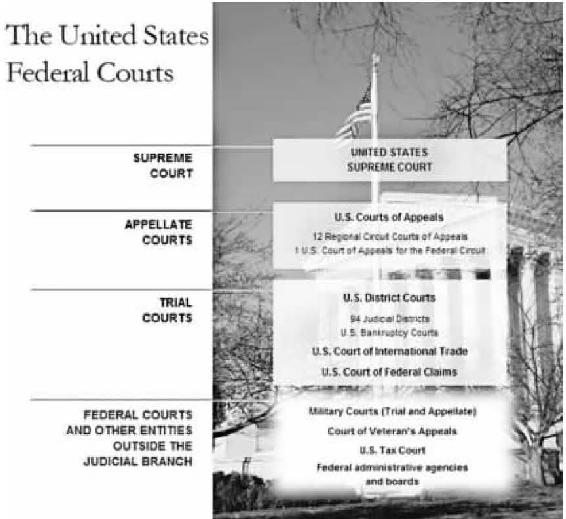
The federal court system is characterized by two types of courts: constitutional and legislative. Constitutional courts are sometimes referred as Article Ⅲ courts because they are created under Article Ⅲ(14) of Constitution, which authorizes Congress to “ordain and establish” courts inferior to the Supreme Court. The Constitution also states that judges of both the supreme and inferior courts “shall hold their Offices during good Behavior(15)”, which is tantamount to a lifetime appointment, subject to removal only through the impeachment process. Furthermore, Congress may not reduce the salaries of constitutional court judges “during their Continuance in Office.” U.S. district courts(16), U.S. courts of appeal, and the U.S. Supreme Court are examples of constitutional courts.
Legislative courts are created by Congress, pursuant to one of its legislative powers. Article Ⅰ empowers Congress to make all laws “... for organizing, arming, and disciplining the Militia.” Under that authority, Congress may establish military tribunals for the purpose of disciplining soldiers. Two major distinctions generally differentiate legislative courts from constitutional courts. First, the judges who serve in the legislative courts do not have lifetime appointments, but instead serve fixed terms of office. The length of the term designated by Congress is often a long one in order to ensure judicial independence. The second distinction is that a legislative court judge's salary is not protected by Constitution, as in the case of constitutional court judges.
In conclusion, the federal court system is composed of courts created by Congress under either Article Ⅰ or Article Ⅲ powers. The federal courts are not “superior” to state courts; rather, they exist alongside state courts. The vast majority of cases are tried in state courts. Nevertheless, the federal courts remain an alternative forum that citizens can turn to for relief if state courts prove unresponsive. It is no surprise to discover that southern African Americans preferred to file their civil rights cases in federal rather than state courts, since southern judges were notoriously unsympathetic to African American claims. Despite the confusion caused by federalism, a dual court system provides additional guarantees that justice will eventually prevail.
From 1789 to 1801, the Supreme Court heard few cases. The Court's power and prestige waxed during the Marshall Court(1801—1835). Under Marshall, the Court established the principle of judicial review, including specifying itself as the supreme expositor of the Constitution(Marbury v.Madison) and made several important constitutional rulings giving shape and substance to the balance of power between the federal government and the states. The Marshall Court also ended the practice of each justice issuing his opinion seriatim, a remnant of British tradition, and instead issuing a single majority opinion.
From Taney to Taft
From the 1860s until the 1930s, the court sat in the Old Senate Chamber of the U.S. Capitol(17).
The Taney(18)Court(1836—1864) made several important rulings, such as Sheldon v.Sill, which held that while Congress may not limit the subjects the Supreme Court may hear, it may limit the jurisdiction of the lower federal courts to prevent them from hearing cases dealing with certain subjects. Nevertheless, it is primarily remembered for its ruling in Dred Scott v.Sandford(19), which may have helped precipitate the Civil War(20).
Under the White(21) and Taft(22)Courts(1910—1930), the Court held that the Fourteenth Amendment had incorporated some guarantees of the Bill of Rights against the states, grappled with the new antitrust statutes, upheld(23) the constitutionality of military conscription and brought the substantive due process doctrine(24) to its first apogee.
The New Deal Era
From 1930 to 1953, the Court gained its own accommodation in 1935 and changed its interpretation of the Constitution, giving a broader reading to the powers of the federal government to facilitate President Franklin Roosevelt's New Deal(25). During World War Ⅱ, the Court continued to favor government power, upholding the internment of Japanese citizens and the mandatory pledge of allegiance.
Warren and Burger
The Warren(26) Court(1953—1969) dramatically expanded the force of Constitutional civil liberties. It held that segregation in public schools violates equal protection(Brown v.Board of Education) and that traditional legislative district boundaries violated the right to vote(Reynolds v.Sims). It created a general right to privacy, limited the role of religion in public school, incorporated most guarantees of the Bill of Rights against the States and required that criminal suspects be apprised of all these rights by police(Miranda v.Arizona).
The Burger(27) Court(1969—1986) expanded Griswold's right to privacy to strike down abortion laws(Roe v.Wade), but divided deeply on affirmative action and campaign finance regulation, and dithered on the death penalty, ruling first that most applications were defective, then that the death penalty itself was not unconstitutional.
Rehnquist and Roberts
The Rehnquist(28) Court(1986—2005) was noted for its revival of judicial enforcement of federalism, emphasizing the limits of the Constitution's affirmative grants of power and the force of its restrictions on those powers. It struck down single-sex state schools as a violation of equal protection, laws against sodomy as violations of substantive due process, and the line item veto, but upheld school vouchers and reaffirmed Roe's restrictions on abortion laws. The Court's decision in Bush v.Gore, which ended the electoral recount during the presidential election of 2000, became controversial.
The Roberts(29) Court(2005—present) is regarded by some as more conservative than the Rehnquist Court. Some of its major rulings have concerned federal preemption, civil procedure, abortion, and the Bill of Rights.
Ⅳ. EXERCISES Ⅳ.练习
1. Answer the following questions.
(1)Describe briefly the state court system.
(2)Describebriefly the federal court system.
(3)What is the difference between courts of limited jurisdiction and courts of general jurisdiction?
(4)Describe briefly the difference between the judges of constitutional courts and judges of legislative courts.
2. Translate the following terms into English.
(1)初审法院
(2)有限管辖权
(3)普遍管辖权
(4)民事纠纷
(5)刑事诉讼
(6)巡回法院
3. Translate the following terms into Chinese.
(1)state court system
(2)trial court of limited jurisdiction
(3)appellate court
(4)United States Supreme Court
(5)intermediate appellate court
(6)district court
4. Match the given terms with the proper explanation.
A. circuit
B. plead
C. general jurisdiction
D. testimony
E. lawsuit
(1)A court's authority to hear a wide range of cases, civil or criminal, that arise within its geographic area.
(2)Any proceeding by a party or parties against another in a court of law.
(3)Address a court of law as an advocate on behalf of either the plaintiff or the defendant.
(4)Evidence that a complete witness under oath or affirmation gives at trial or in an affidavit or deposition.
(5)A judicial division of the United States—that is, the 13 circuits where the U.S. courts of appeals sit.
5. Choose the suitable words from the box and fill in the blanks.
Every level of the federal courts has the power to (1) the federal Constitution, and federal laws and regulations. The courts also exercise (2) over federal statutes and agency actions, and determine the (3) of federal and state laws. To the extent any statute or agency action is found to be (4), it is invalid. Federal courts also interpret federal (5) and federal agency rules and decisions.
6. Translate the following sentences into Chinese.
(1)Unlike state court judges, who are usually elected, federal court judges—including the justices of the Supreme Court—are appointed by the President and confirmed by Senate for life terms.
(2)The judicial system of the U.S. is a dual court structure consisting of federal and state courts. Coexistence of dual governments(state and federal) gives rise to separate court systems.
(3)Jurisdiction is the authorized power of a court to hear a particular case and render a binding decision.
(4)Whenever the U.S. government is a party, a lawsuit will be tried in the federal system. The U.S. is a party when it brings suit or is named as a defendant.
(5)Heard before United States Supreme Court are appeals from specialized courts and claims arising from decisions of federal administrative agencies.
(6)State trial courts of general jurisdiction have jurisdiction over a wide variety of subjects, including both civil disputes and criminal prosecutions. In some cases, trial courts of general jurisdiction may hear appeals from courts of limited jurisdiction.
(7)Appellate courts usually, do not look at the questions of fact(such as whether a party did, in fact, commit a certain action, such as burning a flag) but at questions of law(such as whether the act of flagburning is a form of speech protected by the First Amendment to the Constitution).
(8)Appellate courts normally defer to a trial court's findings on questions of fact because the trial court judge and jury were in a better position to evaluate testimony—by directly observing witnesses' gestures, demeanor, and nonverbal behavior during the trial.
(9)The federal court system is basically a threetiered model consisting of(1) U.S. district courts(trial courts of general jurisdiction) and various courts of limited jurisdiction, (2) U.S. courts of appeals(intermediate courts of appeals), and(3) the United States Supreme Court.
(10)The United States Supreme Court consists of nine justices. Although the Supreme Court has original, or trial, jurisdiction in rare instances(e.g., in legal disputes in which a state is a party, cases between two states, and cases involving ambassadors), most of its work is as an appeals court.
————————————————————
(1) federalism:联邦制。a principle of government in which several states or countries are united as a single political entity with a common government while retaining a considerable degree of autonomy with respect to their internal affairs。与此相对的是Unitarianism, 单一制(集权制)。
(2) trial court:初审法院,一审法院。亦作“court of first instance”, “instance court”, “court of instance”。A court of original jurisdiction where the evidence is first received and considered.
(3) 在我国,审判权由地方各级人民法院(包括基层人民法院、中级人民法院、高级人民法院)、专门人民法院(包括军事法院、海事法院、铁路交通法院)、最高人民法院行使。它们对应的英文表达为:Local People's Court(GrassRoots People's Court, The Intermediate People's Court, The Higher People's Court); Special People's Courts(Military Tribunal, Maritime Court, Railway Transportation Court); Supreme People's Court.
(4) jurisdiction:司法管辖权;jurisdiction , a court's power to decide a case or issue a decree。包括“有限管辖权”(limited jurisdiction: jurisdiction that is confined to a particular type of case or that may be exercised only under statutory limits and prescription)和“普遍管辖权”(general jurisdiction: a court's authority to hear a wide range of cases, civil or criminal, that arise within its geographic area)。
(5) party:当事人,指进行一定事务或诉讼的人。party, one by or against whom a lawsuit is brought or one who takes part in a transaction. 本文指诉讼当事人,即原告和被告(人)。
(6) lawsuit(or suit, suit at law):诉讼;lawsuit, n. any proceeding by a party or parties against another in a court of law,例如 enter/bring/file a lawsuit against sb、 to proceed against(an adversary) in a lawsuit 均表示“起诉某人”或“对某人提起诉讼”。
(7) jurisdiction:管辖权。A court's power to decide a case or issue a decree;包括“有限管辖权”(limited jurisdiction: jurisdiction that is confined to a particular type of case or that may be exercised only under statutory limits and prescription)和“普遍管辖权”(general jurisdiction: a court's authority to hear a wide range of cases, civil or criminal, that arise within its geographic area)。
(8) municipal court:市镇法院,也可翻译为市法院,或者都市法院。亦作city court。A court having jurisdiction(usually civil and criminal) over cases arising within the municipality in which it sits. A municipal court's civil jurisdiction to issue a judgment is often limited to a small amount, and its criminal jurisdiction is limited to petty offenses.
(9) misdemeanor:轻罪。亦作“minor crime”,“summary offense”。在美国,联邦和州刑法将重罪以下的犯罪均归属于轻罪,一般处以罚金、没收财产或一年一下在地方看守所关押的监禁刑。A crime that is less serious than a felony and is usu. punishable by fine, penalty, forfeiture, or confinement(usu. for a brief term) in a place other than prison(such as a county jail).
(10) ordinance:条例。Cities possess ordinance power, that is, the power to enact laws enforceable within the city limits. Such laws include prohibitions against discharging firearms, burning trash, and letting animals run loose within the city limits.
(11) county court:县法院,州法院的一种。亦作parish court。A court with powers and jurisdiction dictated by a state constitution or statute. The county court may govern administrative or judicial matters, depending on state law.
(12) The New York Court of Appeals is the highest court in the U.S. state of New York. The Court of Appeals consists of seven judges: the Chief Judge(首席法官;院长)and six associate judges(联席法官)who are appointed by the Governor(州长)to 14year terms. The Chief Judge of the Court of Appeals is also the head of the State's court system's administration, and is thus also known as the Chief Judge of the State of New York. The Court of Appeals of Maryland is the supreme court of the U.S. state of Maryland. The court is composed of one chief judge and six associate judges.
(13) overrule:(上级法院)否决或推翻(下级法院的判决);overrule, (of a court) to overturn or set aside(a precedent) by expressly deciding that it should no longer be controlling。
(14) 美国宪法第3条对司法部门的建立作出了规定。Article Three of the United States Constitution establishes the judicial branch of the federal government. The judicial branch comprises the Supreme Court of the United States and lower courts as created by Congress.
(15) good Behavior:廉洁行为,品行良好,(正在服刑的罪犯)遵守监规。该词一般指(1)(of federal judges)absence of corrupt or criminal conduct,意思是(联邦法官)没有渎职或刑事犯罪行为。在美国,联邦最高法院、上诉法院和地区法院的联邦法官都是终身制,只有专门法院的联邦法官才是任期制。终身制法官又被称为“第3条法官”(Article Ⅲ Judges);任期制法官被称为“第1条法官”(Article Ⅰ Judges)。(2)(of a prisoner serving a sentence)compliance with prison rules,指(正在服刑的罪犯)遵守监规。
(16) 美国共有94个联邦地区法院(Federal District Court),一个州至少有一个。通常由一名法官审理一起案件。由于全国共分为13个司法巡回区,联邦上诉法院(Federal Court of Appeals)有时又被称为联邦巡回上诉法院(Federal Circuit Court)。这里不搞独任审判,案件通常由3名法官组成的合议庭进行。案情重大时,也可由全院法官集体审理,即满席听审(En banc)。与各州一样,案子到了联邦上诉法院,也只有法律审,没有事实审了。