Historical Background
Period of Pre-romanticism:
A. First Half of the 19thcentury
a. The number of statesincreased for 13 to 34 by the beginning of the Civil War.
b. The west rose in powerand challenged the political dominance of the East and the South.
c. In 1831, the firstanti-slavery group Liberator was established.
B. By the 1840’s: the Age ofCommon Man
a. Egalitarianism replacedJeffersonian concept of a Natural Aristocracy: all men were equal for politicalleadership.
b. Industrialization andUrbanization of society: New York became the largest city, supplanting Bostonand Philadelphia as the economic and cultural capital.
c. Invention of cotton gin,sewing machine, and telegraph.
ThePrinciple of the Assembly Line Mass Production had been established.
d. The Steam Enginesymbolized the beginning of Technology which would bring vast materialbenefits, and cause social disorder in creating great gap between the rich andthe poor.
nC. 1850-1865
a. Conflicts between the Northern and states (the Union) and theSouthern states (the confederacy) caused by two fundamental different economic andsocial systems: the south’s large plantations, staple crops and institution ofslavery versus free industry of the North.
b. In 1850, the new Fugitive Slave Law was passed, deeplyoffending the majority of Northerners.
c. In 1852, Harriet Beecher Stowe published Uncle Tom’s Cabin.
d. In 1860, Abraham Lincoln was elected President of the USA, representingpeople’s aspiration for a peaceful union and for the restriction of slavery.
e. In February 1861, seven southern states formed theConfederate States of America, separating from the Union.
f. On April 12, 1861, the Southerners attacked the Fort Sumterin Charleston Harbor.
g. On April 15, 1861, President Lincoln declared war against thesouth.
h. In 1862, the Homestead Act and the Emancipation Proclamationwere declared, a turning point in the Civil War.
i. On April 9, 1865, Robert E. lee, the general of theConfederate force, surrendered his army to Ulysses S. Grant, the general of theUnion army.
What are the key features of American Romanticism? Try to comment on one of the novels of American romanticism fromthe perspective of theme analysis with no less than 150-200 words.
I. Time:from the end of the 18th century through the outbreak of theCivil War.
II. Ideals:Democracy and political equality became the ideals of the
new nation.
III. Economicboom: industrialism

Immigration optimism andhope among people
Westward expansion
IV. AmericanRomanticism was both imitative and independent.
Imitative: English and European Romanticists
Independent: Emerson and Whitman
V. Themes:
Imitative: home, family, nature, children andidealized love
Independent: major problems of American life, like thewestward expansion and democracy and equality.
Readers immediately took to “The Legend of Sleepy Hollow” and another tale from the Sketch Book, “Rip Van Winkle.” Although little formal criticism greeted the arrival of the story specifically, the Sketch Book became wildly popular and widely reviewed both in the United States and in England. It was the first book by an American writer to become popular outside the United States, and helped establish American writing as a serious and respectable literature. In 1864, “The Legend of Sleepy Hollow” was published as a separate illustrated volume for the first time, and there have been dozens of editions since. Today, most of Irving’s work has been largely forgotten, but the characters of Ichabod Crane and the Headless Horseman have lived on as part of American folklore.
“The Legend of Sleepy Hollow” takes place in Sleepy Hollow,
New York, a snug rural valley near Tarrytown in the Catskill Mountains. Constructed from German tales but set in America, it is a classic tale of the conflict between city and country, and between brains and brawn. Ichabod Crane courts Katrina Van Tassel, but is frightened away by his rival, Brom Bones, masquerading as the headless horseman. The story demonstrates the two qualities for which Irving is best known: his humor, and his ability to create vivid descriptive imagery.
Plot Summary for Sleepy Hollow
In the early United States of America, young policeman Ichabod Crane is sent to from New York to the fledgling settlement of Sleepy Hollow to investigate a series of ghoulish murders. On his arrival, the town council informs him that the three victims were killed in open ground, and the heads had disappeared - taken by a headless ghost that is supposedly responsible. Ichabod is unconvinced of this, but learns more about the ghostly horseman - it is the ghost of a Hessian sent by the British during the revolutionary war, and he was caught by redcoats and decapitated with his own sword. When Ichabod sees the ghost kill one of the town council members, his skepticism evaporates - and he soon discovers that the horseman's ghost has an unholy connection to Balthus Van Tassel, a wealthy farmer - and whose daughter Ichabod is falling in love with.
Constable Ichabod Crane of the New York police arrives in the small village of Sleepy Hollow in 1799 to solve a mystery of murders. With all the victims found with their heads missing, everybody in Sleepy Hollow is talking about the ghost of the "headless horseman" who is out in the woods seeking revenge for his murder many years ago. Crane, believing only in logic, refuses to believe the public's theory about the horseman and begins his investigations, only to find his faith shattered when he himself encounters the headless horseman. A magical tale of sense against myth.
Questions:
1. Setting: What is the location of this story? The atmosphere and the history of this area?
2. Who is the protagonist of this story? Describe his physical features and the meaning of his name. Where did he come from? What was he doing there to make a living?
3. What is the main conflict?
4. Describe the plot of the story.
5. Retell the story of the headless horseman.
6. Brom Bones ( (see question No. 2)
7. Katrina Van Tassel
American Romanticism
American Romanticism was also called "the American Renaissance", anartistic and intellectual movement originating in Europe in the late 18thcentury and characterized by a heightened interest in nature, emphasis on theindividual's expression of emotion and imagination, departure from theattitudes and forms of classicism, and rebellion against established socialrules and conventions, stretching from the end of the eighteenth centurythrough the outbreak of the civil war. It was a rebellion against theobjectivity of rationalism. For romantics, the feelings, intuitions andemotions were more important than reason and common sense. They stressed theclose relationship between man and nature, emphasized individualism andaffirmed the inner life of the self.
“The Legend of Sleepy Hollow” narrates the memorable event of an apparentlyheadless horseman throwing his head at his rival in love, and the memorablecharacter of Ichabod(伊卡博德).
The story is setabout 1790 in the Dutch settlement of Tarry Town,New York,in a secluded glen called Sleepy Hollow. It tells the story of IchabodCrane, a lean, lanky(瘦长的), and extremely superstitious schoolmaster from Connecticut who competeswith Abraham "Brom Bones" Van Brunt, the town rowdy(粗暴的人), for the hand of18-year-old Katrina Van Tassel, the daughter and sole child of a wealthyfarmer.
As Crane leaves aparty he attended at the Van Tassel home on an autumn night, he is pursued bythe Headless Horseman,who is supposedly the ghost of a Hessian trooper(黑森雇佣兵) who had his headshot off by a stray cannonball during "some nameless battle" of theAmerican Revolution War, and who "rides forth to the scene of battle innightly quest of his head". Ichabod mysteriously disappears from town,leaving Katrina to marry Brom Bones, who was "to look exceedingly knowingwhenever the story of Ichabod was related".
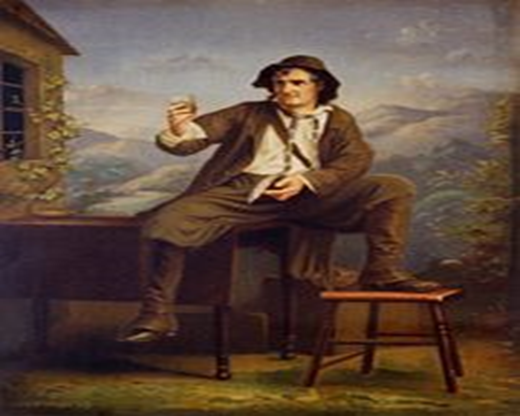
“Rip Van Winkle” got suggestions from a German source. Irving changed thesetting of the original and added conflicts of his own to make it American. Itis a fantasy tale about a man who somehow stepped outside the main stream oflife.
Rip Van Winkle is a simple, good-natured, andhen-pecked(妻管严的) man. He does everything except take care of his own farm and family. Hehelps everyone except his wife and his own folks. So he is welcome everywhereexcept at home. “He is one of those happy mortals, who take the world easy, eatwhite bread or brown, whichever can be got with least thought or trouble, andwould rather starve on a penny than work for a pound.”
The story of Rip Van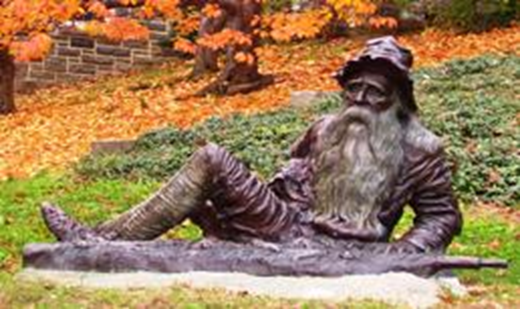 Winkle is set in the years before and after the American Revolutionary War. RipVan Winkle, a villager of Dutch descent, lives in a nice village at the foot ofNew York's Catskill Mountains. An amiable man whose home and farm suffer fromhis lazy neglect, he is loved by all but his wife. One autumn day he escapeshis nagging wife by wandering up the mountains. After encountering strangelydressed men, rumored to be the ghosts of Henry Hudson’s crew, who are playingnine-pin(九柱球戏), and after drinking some of their liquor, he settles down under a shadytree and falls asleep.
He wakes up twentyyears later and returns to his village. He finds out that his wife is dead andhis close friends have died in a war or gone somewhere else. He immediatelygets into trouble when he hails himself a loyal subject of King George III, notknowing that in the meantime the American Revolution has taken place. An oldlocal recognizes him, however, and Rip's now grown daughter eventually puts himup. As Rip resumes his habit of idleness in the village, and his tale issolemnly believed by the old Dutch settlers, certain hen-pecked husbandsespecially wish they shared Rip's luck.