目录

  • 1 Orientation
    • 1.1 Introduction
    • 1.2 Tips for passing this course
  • 2 Lecture 1: Breaking the Ice
    • 2.1 Tips for ice breakers
    • 2.2 Checklists before class
    • 2.3 Things I Learnt
  • 3 Lecture 2: Organizing your speech
    • 3.1 Speech Structure
    • 3.2 Organize Speech
    • 3.3 Speaker's Objectives
    • 3.4 Things I Learnt 2
  • 4 Lecture 3: Get to the Point
    • 4.1 Purpose of the Speech
    • 4.2 Effective Evaluation
    • 4.3 Speaker's Objectives
    • 4.4 Things I learnt 3
  • 5 Lecture 4: How to Say It
    • 5.1 Write for the Ear
    • 5.2 Rhetorical Devices
    • 5.3 Speaker's Objectives
    • 5.4 Things I learnt 4
  • 6 Lecture 5: Your Body Speaks
    • 6.1 Body Language
    • 6.2 Speaker's Objectives
    • 6.3 Things I learnt 5
  • 7 Lecture 6: Vocal Variety
    • 7.1 Good speaking voice
    • 7.2 Speaker's Objectives
    • 7.3 Things I learnt 6
  • 8 Lecture 7: Research Your Topic
    • 8.1 Supporting Material
    • 8.2 Speaker's Objectives
    • 8.3 Things I learnt 7
Tips for passing this course
  • 1 How do ...
  • 2 2.  &nb...
  • 3 3.  &nb...
  • 4 Quick test

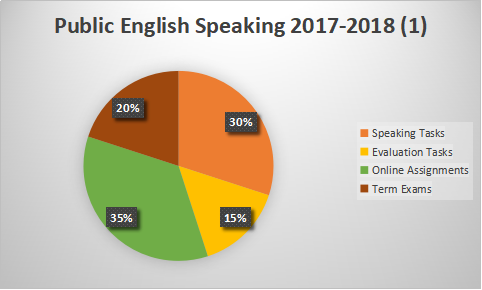
Public English Speaking (PES) is designed for all students who are willing to improve the public speaking skills; thus each student is required to finish at least 3 speaking tasks in-class, 3 evaluating tasks in-class and all the assignments online.

Each speaking task counts for 10 points of the final score. That will be 30 points in total.

Each evaluating task counts for 5 points of the final score. That will be 15 points in total.

All the assignments online count for 35 points of the final score.

Term examination will be a prepared speech representing 20 points.