
-
1 Teaching video
-
2 Teaching cou...
-
3 Training pro...
-
4 Teaching design
-
5 Test
-
6 Teaching case
【Practical training project 1】
【Mission Objectives】
Help students to design a brand name for a product.
【Task content】 【】
(1) 48 students in the class, and freely divided into groups of 6.
(2)A group member designs a brand name for a product.
【Task requirements】
(1)The training will be conducted by the instructor.
(2)48 students in the class, and freely divided into groups of 6.
(3)48 students in the class, and freely divided into groups of 6.
(4)Each group forms a simulated company, creates a simulated brand, and names the simulated brand according to the common naming method of the brand.
(5)Each group will have one student responsible for recording and summarizing.
(6)At the end of the activity, each group was asked to select a representative to report on the discussion in class.
(7)The preparation time is 10 minutes.
【Task organization】
表2-1 Brand name design training task organization table
Activities | Implementation | time | remark |
Brand name design training | (1)48 students in the class, and freely divided into groups of 6. (2)The panelists discussed brand naming principles, common brand naming methods, steps of brand naming, brand naming strategies, and brand naming precautions. (3Each group forms a simulated company, creates a simulated brand, and names the simulated brand according to the common naming method of the brand. (4)Organize students to discuss the problems encountered in the process of brand name design training. | 30 minutes | In the classroom, the desks and chairs are moved to the sides and the middle space is vacated. |
【Task evaluation】
表2-2 Brand name design training task evaluation form
Evaluation indicators | 评价标准 | Grade (100分) | assess grades | Proportion |
Brand name design training Performance Situation Effects
| 1.Understand brand naming principles, common brand naming methods, brand naming steps, brand naming strategies, and brand naming precautions. | twenty | seventy% | |
2.Able to understand brand name design training is prone to making mistakes | twenty | |||
3.Able to flexibly use the brand name to design coping strategies for training | twenty | |||
4.Observe the time of the event | ten | |||
5.real performance | ten | |||
6.obvious effects | ten | |||
7.Activity evaluation | ten | |||
Teaching process | Attendance, attitude and enthusiasm | One hundred | thirty% | |
Group composite score |
assignment | Brand naming principle | class hour | 2 |
knowledge objective | 1. Master the brand naming principles | ||
Ability to target | 1. Be able to use the brand naming principles to analyze brands | ||
Teaching process design | remarks | ||
Teaching steps and main contents |
The introduction of the story
Goldenlion Once, a company chairman gave two superior "golden Lion" ties to one of his relatives. The result is unhappy said: " I don't wear your tie, lose, lose, lose everything."Originally," the lion "and" the loser " in the same pronunciation. Therefore, the chairman racked his brains and came up with a perfect solution, with the combination of Italian translation and transliteration, "Gold Lion" as "Jinli", as a result, the tie produced by the company sold well and became a well-known brand. Ask about the premise of the class How to design the brand name? (Objective: To guide students to enter the brand name design task course with questions, and to grasp the relevant knowledge points and the key points and difficulties of teaching as a whole. Teaching methods: a combination of questioning and explanation) Related: relevant knowledge points] 1. Brand naming principle Brand name is the part of the brand composition that can be expressed in words and can be communicated and communicated in language. The brand name provides the brand association, maximizing the "direct association power" of consumers, which is one of the basic characteristics of a successful brand name. The brand name also has a direct impact on product sales. Small thinking How do people name themselves? What are the principles? Import of cases Do you know the meaning behind the Starbucks LOGO? The Starbucks (Starbucks) logo has two versions, the first of the brown logo is a 16th-century two-tailed mermaid with naked breasts and a fully visible double fish tail. Starbucks was later merged by Daily Coffee, created by Mr.Howard Schultz, with a new trademark. The trademark of the second edition used the original mermaid pattern, but it was slightly modified. She did not have naked breasts and changed the trademark color to the green representing the daily coffee, so the trademark combining the original Starbucks and daily coffee was born. The current "first" Starbucks store in Seattle Parker Market still has the original trademark, including most of the goods sold inside the logo. The so-called first one has actually moved away from its original site, though still on Pike Market Street. (1) Marketing level 1. Culture of various countries 2. Develop pipelines 3. Indicate the product benefits 4. Have the role of promotion, advertising and persuasion. (2) Legal level (3) Language level 1. Good, easy to spread 2. Good to write: simple strokes, not obscure 3. Easy to remember 4. Product attributes 5. Semantics to inspire positive associations Import of cases Name of the SONY At the beginning of its business, SONY had a less attractive name "Tokyo Communications Industry". Morita and Inita, inspired by RCA and AT & T, and decided to change the company name to a name in four or five English letters. The name is to be used as the company name and the product name, so it must be impressive. After a long period of research, Morita and Jing Shen feel that Latin SOUNDS (indicating the meaning of voice) is good, in line with the nature of the company's products. They changed it in English, influenced by Mr.Morita's favorite song, "Sunshine Boy" (Sunny Boy), to Sonny, which is also considered cute. But the Japanese pronunciation of Sonny means "losing money", and in order to suit Japanese culture, remove the second "n", SONY was finally born. It reads like that in English but not in English.
| ||
Class summary | |||
Summary of knowledge points | Brand name is the part of the brand composition that can be expressed in words and can be communicated and communicated in language. Brand naming principle: the marketing level has the national culture, the development pipeline, implies the product benefit, has the role of promotion, advertising and persuasion. On the legal level, whether a brand is legal or whether it is protected is very important. At the language level, it is easy to spread, easy to write: simple strokes, not obscure, easy to remember, product attributes, semantic inspiration and positive association. | ||
Think after class | |||
Use the brand naming principle to analyze the brand | |||
Teaching reflection of this course (classroom design concept, actual teaching effect and improvement idea) | |||
assignment | Brand common naming method | class hour | 2 |
knowledge objective | 1. Familiar with common brand naming methods 2. Master the steps of brand naming 3. Be familiar with the brand-naming strategy | ||
Ability to target | 1. Be able to name the brand with the knowledge learned | ||
Teaching process design | remarks | ||
Teaching steps and main contents |
2. Brand common naming method (1) Divided by brand text type According to the brand text type, the brand name can be divided into text brand name and digital brand name. (2) Divide the word according to the meaning source of the brand name According to the meaning of the brand name, it can be divided into: enterprise name brand name, character name brand name, place name brand name, animal name brand name and plant name brand name. Small thinking The "bat" brand electric fan, produced by Nanjing Changjiang Machinery Factory, had to be changed to "Meijia Le" in foreign markets. "Goubuli" has long been famous in the north, and had to be changed to "Xi yingmen" in Hong Kong and Macao. 3. Steps for brand naming (1) Preliminary investigation (2) naming strategy (3) Brain-moving meeting (4) Divergence of the names (5) legal examination (6) Language review (7) Internal screening (8) Test (9) Determine the name 4. Brand-naming strategy (1) Target market strategy (2 i) Product positioning strategy (3) Descriptive and independence strategies (4) Selection strategy of localization and globalization 5. Brand naming takes note (1) Strong sowing power (2) and the force to be strong (3) Good protection
〖 training battalion 〗 [training mission] Brand name design training [task object] Help students to design a brand name for a particular product. [task definition] (1) The whole class of 48 people, free groups, forming 6 groups. (2) Team members shall design the brand name for a certain product. [mission requirements] (1) The training is hosted by the teacher. (2) The whole class of 48 people, free groups, forming 6 groups. (3) The team members discuss the brand naming principles, the common brand naming methods, the steps of brand naming, the brand naming strategies, and the attention points of brand naming. (4) Each group establishes a simulated company, creates a simulated brand, and names the simulated brand according to the common naming method of the brand. (5) Arrange one student for each group to record and summarize it. (6) After the activity, each group is required to select a representative to report the discussion experience in class. (7) The preparation time is 10 minutes.
| ||
Class summary | |||
Summary of knowledge points | Common brand naming methods are divided into text brand name and digital brand name according to the brand text type. According to the word meaning source of the brand name, it can be divided into: enterprise name brand name, character name brand name, place name brand name, animal name brand name and plant name brand name. Brand naming steps: preliminary investigation, naming strategy, brain meeting, name divergence, legal review, language review, internal screening, testing and name determination. The brand naming strategy includes target market strategy, product positioning strategy, descriptive and independence strategy, and localization and globalization selection strategy. Brand naming attention: strong, and force to strong, good protection. | ||
Think after class | |||
1. Understand the common brand naming methods, the steps of brand naming, the brand naming strategy, and the attention points of brand naming. 2. Combined with the actual situation, I can understand that the brand name design training is easy to make mistakes, and I can flexibly use the brand name design training coping strategies. | |||
Teaching reflection of this course (classroom design concept, actual teaching effect and improvement idea) | |||
Lux brand name - a classic
In 1899, Unilever introduced a soap to the market under the name "Monkey". Soap trademark with "monkey", there is no connection, there is unclean feeling; Then it uses Sunlight, but it's still a cliche.
The following year, Thompson, the Liverpool patent agent, proposed to the company to adopt Lux as the brand name. Lux as a refreshing soap trademark was immediately approved by the board. After the trademark change, the sales were booming, and soon became a world famous brand. Although the quality of soap has not been much improved, its name has a great effect on innovation.
Excellent features: First, there are only three letters, simple and clear, easy to read and remember, consistent pronunciation in all national languages, with international brand characteristics;
Secondly, it comes from the old Latin Lux, but it is more elegant and noble than the English Sunlight.
Finally, the spelling and pronunciation are reminiscent of Luxury and Lucks,
Lux is now a classic production of brand naming.
The origin of Audi's name
The founder of Audi, August Horch, left Mercedes-Benz at the age of 31 to set up his own company, August Horch Automobiles. The year was 1899.
Soon, Horch showed his genius with products and inventions, and Horch gradually became known as a car brand. Horch himself has also competed in several auto races, winning championships. But in June 1906, a failed engine test led to a bitter quarrel between Horch and other Horch investors, and Horch left the company that bears his name in anger.
Within a month, another Horch Motor company opened across the street from the original Horch Company. This is, of course, Horsey's own stove. Two companies of the same name soon went to court, suing each other for infringement. Although there was no such term as "intangible asset" at the time, both sides understood that Horch was valuable as a brand. After six months of litigation, Horsey himself lost the case.
When Horch learned that his company would have to change its name, he was chagrined and rushed to consult with his hardcore followers. The Horch company got there first, registering a bunch of names that were close or similar to "Horch." And Horsey and they discussed for a long time, still can not find a name to use. Then Horch's son, who had been doing his Latin homework in the corner, suddenly shouted, "Daddy, Odie! Why not 'Horsey Odie'?" All the people present were suddenly enlightened. It turns out that the German word Horch itself means "hear," while the Latin word "hear" is pronounced "Audi," which actually means the same thing, but Audi is crisper and louder.
The famous Audi just shouted out of the child's mouth. From then on, Horch and Audi went their separate ways, but in 1932, they finally came together.
Hisense -- a model of the Western Wall
In 1994, Qingdao TV Set Factory was reorganized as Hisense Company. Reform from the brand name change, when Qingdao TV factory is one of China's top 500 industrial, "Qingdao" brand is more valuable. However, the company's leaders firmly believe that the brand name of the planned economic system in this area is not adapted to the operation of the global modern economy, in the company's CI planning, the adoption of a new brand name - Hisense, which tells the company's "integrity broad" mind.
In order to adapt to the global marketing strategy, the company added a homophonic English brand - HiSense on the basis of "Hisense". It means "high sensitivity, high clarity", as a trademark of electronic products is very suitable, and it can be extended to "excellent vision", reflecting the business purpose of the enterprise.
Hisense and its English brand are the model of the Chinese brand name Sino-West Hebi in recent years.
Origin of the name Lamborghini
Lamborghini interprets a man's blood and dignity. The old Lamborghini is a loyal fan of Ferrari, he owns 4 Ferrari sports cars, when he recommended to Enzo Ferrari to improve the transmission was ridiculed (the old Lamborghini used to sell tractors) the fierce Lamborghini under anger to start a new car and create Lamborghini company, but Lamborghini did not see the success of his own brand in his lifetime. It was later acquired by Volkswagen Group and became Ferrari's biggest rival
The Lamborghini logo is an angry bull, which perfectly explains the tireless and persistent pursuit of dreams of Lamborghini and the entire company. At the same time, it also represents the Lamborghini sports car "challenge the limit, proud, bold and uninhibited" brand characteristics. That's right, Ferruggio. Lamborghini's constellation is Taurus, and it is appropriate to use the "running bull" as the brand's logo. At the same time, it also symbolizes the characteristics of the car produced by the company, which is powerful, fast and invincible. At the same time, Lamborghini's model names also have a deep history with cattle: Miura is a cattle breeders in the past bullring, Espada is a dagger used by bullfighters... All of this has to do with the logo.
Do you understand the meaning behind the Starbucks LOGO?
Starbucks coffee is positioned as a "luxury that most people can afford", and its reputation can be described as a household name, so it is also popular with a more interesting saying: whether a city has Starbucks represents the criteria for many fashionable men and women to judge the local development.
Starbucks' iconic two-tailed mermaid Logo has always been talked about, and in the process of its gradual evolution, those hidden various hints, do you understand it?
The sea has an air of adventure and romance about the origin of the name "Starbucks"
The name Starbucks comes from the greatest American novel of the 19th century, "Moby Dick", the calm, charismatic, and coffee loving first mate Starbuck.
In the early 1970s, three young Seattle men - English teacher JerryBaldwin, history teacher Zev Siegl, and writer Gordon Bowker - wanted to bring the best coffee to Seattle and decided to open a local coffee shop.
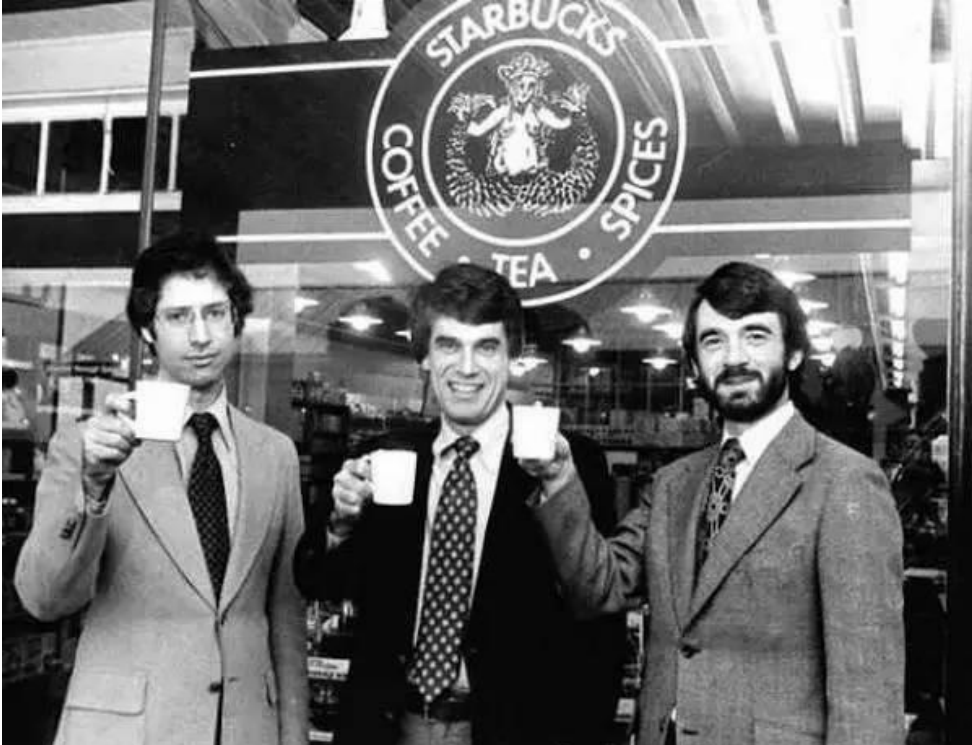
Everyone agrees that the character of Starbuck in Moby Dick is very famous for both the sense of adventure and romance in the vast ocean and the cultural origin of the early coffee traders roaming the world in search of quality coffee beans.
In 1982, Howard Schultz, the global CEO who was attracted by the aroma of coffee, joined Starbucks as the marketing manager of the company, and soon left Starbucks due to inconsistent ideas, and then he found venture capital to buy all the shares of Starbucks for $3.8 million, and then created the Starbucks coffee business empire. The lawyer who led the deal was Bill Gates Sr., the father of the world's richest man.
Mermaids full of sexy and seductive nudity, about the evolution of the Starbucks logo
There are two versions of the Starbucks logo, with the logo featuring a two-tailed siren resembling a mermaid.
The first version of the brown logo was created in 1971 by young Seattle designer Teri Heckler, who was inspired by a 16th-century Scandinavian wooden sculpture of a two-tailed mermaid with bare breasts and a clearly visible double fish tail.
In the 1980s, Starbucks was merged with the Daily Coffee company founded by Howard Schultz, so the second edition of the new logo, which used the original mermaid image, but made a lot of changes. The current "first" Starbucks store in Seattle's Pike Place Market retains the original logo.
The second version of the mermaid is no longer naked, and like many veiled beauties, she has gone from the initial bare breast showing her belly button, to the hair covering the nude and the unrecognizable double fish tail, the mermaid has become increasingly veiled.
As customers reflected, in the past, the logo of the mermaid was too realistic and direct, the image was aggressive and "sexual" seductive, like the beauty of the fish tail with open legs, and the posture and artistic conception were full of sexual insinuation, which was very unelegant. At the same time, they changed the color of the logo to green, representing the daily coffee, and thus the logo was born combining the characteristics of the original Starbucks and the daily coffee, and the later changes were only related to the thickness of the line.
In 2011, when it changed to the latest version from full body to bust, it also caused many users and designers to complain and ridicule, how could the sexy mermaid not be naked, so it also designed a back for it.
They believe that the logo no longer embodies the meaning of the original Starbucks coffee, especially the symbolic image, without the full breasts, nudity and potential sexual attraction, it is not the original.
So who is the "mermaid" on the Starbucks Logo?
In fact, this two-tailed mermaid is called the Siren, and its earliest origin comes from Greek mythology. In Homer's epic poem The Odyssey, the goddess Kal warned Odysseus that when they passed the Sea of desire, the siren would sing a beautiful song to lure the passing sailors, causing the ship to hit the reef and be silent. Odysseus blocked the ears of other companions with beeswax and tied himself to the mast to restrain his desire and pass through the dangerous sea. The siren was originally described as half human and half bird, and later evolved into a two-tailed mermaid. Because Western artists like to learn from the tradition of Greek mythology, it often appeared in later cultural and painting works and gradually evolved into a cultural symbol. The closest it came to our China was in the Book of the Later Han Dynasty - Chronicles of the Western Regions, when Gan Ying, an envoy of the Silk Road, returned to report that she had encountered a sailor who said there were demons on the sea "good to make people nostalgic."z
Due to the image of Siren in Greek mythology, it has also become one of the symbols of neutrality, love, desire and seduction in Western culture. In this regard, just like Chinese mythology, when it comes to beauty and temptation, it will think of the fox spirit, and human nature is complicated, but love is indispensable.
When the siren first appeared, it was mostly written descriptions and lacked concrete images, while the concrete image of the two-tailed long-haired mermaid first appeared on the Mosaic floor of the Cathedral of Otranto in Pesaro, Italy. This pattern was created in the Byzantine era in the seventh century AD to remind people to resist temptation and not deviate from their own path.
Starbucks claims that the Logo was inspired by a 16th-century Scandinavian woodcut of a siren or sea god, but no one has ever found the original layout of the woodcut.
Woodcut was popular in Europe around the 14th century, and the protagonist of the two-tailed mermaid story in Europe at that time was not a siren, so the original image of the picture may come from Meleucinus, rather than the original siren, which is the human snake tail Melusine in the French edition of the Legend of the White Snake in the 14th century.
Mei Luxin is like Bai Suzhen, because love helps the downhearted aristocrat Raymond, such a "Diaosi + fairy" story combination is not only in China, even in Europe is also very popular. The story of Mei Luxin first spread in France, its initial image of the human snake tail may come from the Celtic, Germanic national culture, similar to China's Nuwa, and later gradually evolved into a two-tailed mermaid. It appears on the crest of the Lusignan family in northwestern France, and is said to have appeared on the crest of the early royal family of Luxembourg, where the founder of Dove Chocolate had an affair with the princess, but the authenticity of this story is highly questionable.
Later, in the 16th century, after a hundred years of bards singing, the story of Melouxin spread to Scotland and the whole of Europe, and was very popular, even the second Plantagenet king of England, Charles the Lion Heart, also claimed to be a descendant of Melouxin.
Because in the legend of King Arthur, the leader of the Knights of the Round Table in England, Mei Luxin's mother is the sister of the lake fairy Vivian, who is loved by the mage Merlin, to strengthen his image of providence.
The Arthurian legend in addition to the stirring epic legend, the original version of the entire incest, adultery, adultery and love triangle and other promiscuous plots, it seems that as long as there is a two-tailed mermaid place, are inseparable from sex and love. So, the story is likely that the designer took inspiration from a 16th-century woodcut of Mei Luxin, whom he mistook for a siren, whose story is very different but whose mythic image is very similar, and that Starbucks chose the siren to show that "Starbucks coffee is as attractive as the siren's song."

