
-
1 Teaching video
-
2 Teaching cou...
-
3 Training pro...
-
4 Teaching design
-
5 Test
-
6 Teaching case
【Practical training project 2】
【Mission Objectives】
Help students identify brands in practice.
【Task content】
(1)48 students in the class, and freely divided into groups of 6.
(2)The team members are able to identify the brand in practice.
【Task requirements】
(1)The training will be conducted by the instructor.
(2)There are 48 students in the class, and they are freely divided into groups of 6。
(3)The panelists discussed the definition of brand identity, the six elements of brand attributes, and brand classification
(4)Each group will have one student responsible for recording and summarizing。
(5)At the end of the activity, each group was asked to select a representative to report on the discussion in class。
(7)The preparation time is 10 minutes.
【Task organization】
表1-3 Brand Recognition Training Task Organization Table
Activities | Implementation | Time | remark |
Brand Recognition Training | (1)There are 48 students in the class, and they are freely divided into groups of 6. (2)The panelists discussed the definition of brand identity, the six elements of brand attributes, and brand classification (3)6 groups were guided by the teacher and discussed at the same time. (4)Organize students to discuss the problems encountered in the process of brand recognition training.
| 30 minutes | There is one table and eight chairs in each group of classrooms |
【Task evaluation】
表1-4 Brand Recognition Training Task Evaluation Form
Evaluation indicators | Evaluation Criterion | score (100分) | assess grades | occupied proportion |
Brand recognition training performance situational effect
| 1.Understand the definition of brand identity, the six elements of brand attributes, and brand classification. | twenty | seventy% | |
2.Understand that brand recognition training is prone to mistakes | twenty | |||
3.Able to flexibly use the coping strategies of brand recognition training | twenty | |||
4.Observe the time of the event | ten | |||
5.real performance | ten | |||
6.obvious effect | ten | |||
7.Activity evaluation | ten | |||
教学过程 | Attendance, attitude and enthusiasm | One hundred | thirty% | |
Group composite score |
assignment | brand identity | class hour | 2 | |
knowledge objective | 1. Master, brand identification 2. Master the six elements of brand attributes 3. Master, brand classification | |||
Ability to target | Ability of brand identification and classification | |||
Teaching process design | remarks | |||
Teaching steps and main contents | Import of cases Brand strategy decoding of " The Voice of China On July 13,2012, Zhejiang TV blockbuster launched a large inspirational music review program "China good voice", it is broadcast the first ratings reached 1.477%, on September 30, "China good voice" broadcast peak night hit a 5.23% ratings, this not only refresh the mainland 2012 provincial TV ratings records, also won the ratings at the same time. The hit of "The Voice of China" makes us remember "a spinning chair", "a V-pose sculpture with a microphone" and the catchy slogan. These three elements are constantly repeated in each program. The simple but easy to remember visual and auditory symbols make the brand of "The Voice of China" prominent personality and highly recognizable. In particular, the setting of the symbolic element of "blind selection of rotating chair" cleverly lets the suspense throughout the program. When each mentor presses the button, the light of "I WANT YOU" is lit up, the chair turns around, and the corresponding sound effect creates the visual shock combined with the audience's expectation, and the unique and novel integration of "blind listening" makes "The Voice of China" has a unique logo that all other TV programs do not have. This distinctive personality of brand image identification and throughout the "good voice is the only pass" the professional indicators, makes the audience from the short-term unique brand personality, to gradually form a long-term brand recognition, cultivate the audience brand loyalty, makes a TV brand really played its brand effect. Teacher inspiration The great success of The Voice of China is first due to its clear and unique brand identity. Through the analysis of brand recognition, enterprises can screen out the elements to express their brand recognition, so as to highlight their brand personality and establish a highly recognizable brand image.
Ask about the premise of the class
How to identify a brand? (Objective: To guide students to enter the brand recognition task course with questions, and to grasp the relevant knowledge points and teaching key points and difficulties of this task on the whole. Teaching methods: a combination of questioning and explanation) Related: relevant knowledge points] 1. Definition of brand identification Brand identification refers to the definition of the brand association that can impress consumers and distinguish it from competitors from the aspects of products, enterprises, people, symbols and other aspects, and forms the full brand association together with the core value of the brand. Brand recognition can also be called the association that brand owners look forward to staying in the minds of consumers. A strong brand must have a plump, distinct brand identification. After the scientific and complete planning of the brand identification system, the core value of the brand can be effectively implemented, and effectively connected with the daily marketing communication activities (value activities), so that the marketing communication activities of the enterprise will have a standard and direction.
Ask questions in class What is brand recognition? 2. Brand attributes of the six elements
In class thinking Practice: please refer to the example, find a familiar brand in life to its six elements analysis.
3. Brand classification 1. By brand ownership: manufacturer brand and middleman brand 2. By brand influence: local brands, national or national brands, international brands and global brands 3. According to the target groups: special brands for special people, mass brands, high-end brands and customized brands 4. According to the growth cycle of the brand: new brand, developing brand, mature brand, leading brand, declining or dying brand, and time-honored brand 5. According to the attributes of the brand: product brand, service brand, enterprise brand, organization or institutional brand 6. According to the origin of brands: foreign brands, joint venture brands and domestic independent brands 7. Comprehensive classification In class thinking 1. Please list the three middleman brands. 2. Please list the top Chinese international brands.
〖 training battalion 〗 [Training Task 1-2] Brand recognition training [task object] Help students to identify brands in practice. [task definition] (1) The whole class of 48 people, free groups, forming 6 groups. (2) Team members can identify the brand in practice. [mission requirements] (1) The training is hosted by the teacher. (2) The whole class of 48 people, free groups, forming 6 groups. (3) Team members discuss the definition of brand recognition, six elements of brand attribute, and brand classification (4) Arrange one student for each group to record and summarize it. (5) After the activity, each group is required to select a representative to report the discussion experience in class. (7) The preparation time is 10 minutes.
| |||
Class summary | ||||
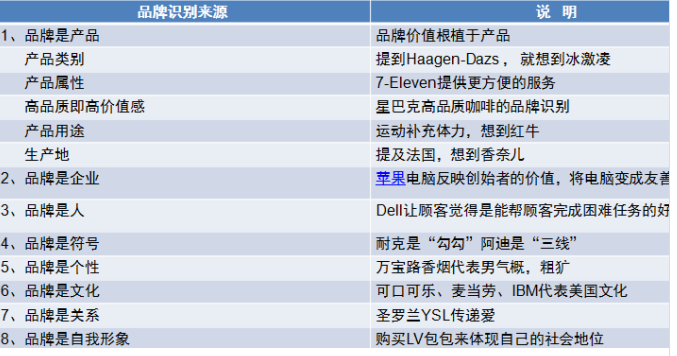
Summary of knowledge points | Brand recognition refers to the association that the brand wants to create and maintain and can give people a good impression of the brand. These associations express what the brand represents, and also imply the commitment of enterprises to consumers. Brand identification sources are products, enterprises, people, symbols, personality, culture, relationships and self-image. Six elements of brand attribute: attribute, interest, value, culture, personality, users. Brand classification can be divided according to the brand belonging, influence, target group, growth cycle, attributes and origin. | |||
Think after class | ||||
1. Understand the definition of brand recognition, the six elements of brand attributes, and brand classification. 2. Combined with the reality, understand that the brand recognition training is easy to make mistakes, and can flexibly use the coping strategies of the brand recognition training. | ||||
Teaching reflection of this course (classroom design concept, actual teaching effect and improvement idea) | ||||

Decode the brand strategy of the Voice of China
On July 13, 2012, Zhejiang Satellite TV launched a large-scale inspirational music review program "The Voice of China", which reached a rating of 1.477% in the first period. On September 30, the peak night of the broadcast of "The Voice of China" reached a rating of as high as 5.23%, which not only refreshed the rating record of mainland provincial satellite TV in 2012. It also won the title of the ratings champion at the same time.
After the popularity of "The Voice of China", self-made programs such as "Good Taste of China" and "Good role Model of Chinese Workplace" appeared on the Internet, and the words "China" and "good" became the new trend words after "the tip of the tongue" and "roaring body". This concise and catchy title has, in turn, enhanced the influence of The Voice of China as it has spread through major communication channels. In addition, the use of the word "China" in the program name has also imperceptibly enhanced the brand temperament of the program and shaped the brand personality. This clever use of the majestic "China" word, not only in line with the TV blockbuster in the program brand positioning, but also to attract more excellent students to participate in this large-scale program, so that many audience attention condensed to the program.
The popularity of "The Voice of China" has made us remember "a chair that turns", "a sculpture holding a microphone in a V pose" and the catchy slogan of the show. These three elements are constantly repeated in each program, and the simple but easy-to-remember visual and auditory symbols make the program brand of The Voice of China prominent and recognizable. In particular, the setting of the symbolic element of "swivel chair blind selection" cleverly lets the suspense run through the whole show. When each tutor presses the button, the light of "I WANT YOU" turns on, the chair turns around, and is matched with the corresponding sound effect. The visual shock created by this combination with the audience's expectation, combined with the unique and novel way of "blind listening", makes the Voice of China have a unique identity that is not found in other kinds of TV programs. This highly distinctive brand image identification and the professional index of "The Voice is the only pass" throughout make the audience attracted by the unique brand personality in the short term, and gradually form a long-term brand recognition, cultivate the brand loyalty of the audience, and make a TV program brand really play its brand effect.
SONY uses brand endorsers
Brand spokesperson refers to the brand in a certain period of time, in the form of a contract to designate one or several can represent the brand image and display, promote the brand image of the person or thing. In modern society, the best carrier of the brand is the people, especially the dazzling celebrities, they are all "star news", so the celebrity endorsement is not only high-pitched but also a big response.
In addition, many communication opportunities come from influential users, and using users as resources for communication can also establish valuable brand associations. Britain's Prince of Wales became a SONY customer, a success story. When the Prince of Wales attended the 1970 International Exhibition in Tokyo, SONY Corporation installed a SONY TV in the Prince of Wales' residence at the British Embassy. In this way, SONY has established something of a relationship with the Prince of Wales. Later, in a reception speech, the Prince also expressed his gratitude to SONY and invited SONY to invest in the Commonwealth. Since then, SONY's partnership with SONY has been a happy one, as can be seen in many documents from the Welsh Business Development Council.
Brand story – Chanel
August 19, 1883. Coco. Chanel was born in the French town of Chamur on the river Royal. Her father was born poor, a marketing salesman, was not at home for a long time, and her mother undertook all the housework, but Chanel was 12 years old, her mother died, and Chanel had to live in an orphanage. Later, she went to a monastery to learn social etiquette, household management, and probably because she was afraid of poverty, she paid special attention to money. Chanel learned a solid sewing skill in an orphanage. At the age of 18, she became an assistant seaman in a clothing store in town. Her background and difficult childhood deeply influenced Chanel's views on fashion. Her early designs went against the fashion of the time, looking simple, crisp and edgy without being weird. As a result of her hard work, fashionable clothes keep popping up. Chanel said her lively and elegant clothing style came from the simplicity of natural colors. In 1924 she set up a workshop specializing in making ornaments. In 1929, she created Chanel No. 5, which became the world's best-selling perfume. After World War II, on February 5, 1954, Chanel announced to the world in the form of a grand fashion conference: Chanel is back! From the 1920s to the 1970s, Chanel clothing was at the forefront of The Times, reflecting social trends, especially the rising sense of female independence and self-reliance. She captured the psychology of the public and took a different path, creating the "Chanel style" that has been popular to this day. Chanel died in 1971.
The Virgin story
In 1970 Richard Bronson and a few friends set up a small mail-order business in London, and the following year opened a medium-sized retail store on Oxford Street. The partners were named "Virgin" because they themselves were young and inexperienced in business. However, 13 years later, Virgin became the UK's most famous record chain and largest independent label, including famous artists such as Phil Collins, Sexy Pistols and Rolling Stones. In 1990, Virgin developed hundreds of large retail stores around the world, such as the "Times Square Department Store", with its striking appearance, size and interior design as a striking endorsement of the brand.
In 1984, a young lawyer presented Bronson with a plan to start an airline. The board thought the idea was ridiculous, but Bronson thought that what had worked in the entertainment industry could be applied to the airline industry. Boo himself thought that air travel at that time was very boring, and he dreamed of making flying fun, so he proposed that "all classes of passengers spend the least money, enjoy the most noble service." Three months later, the first Virgin Atlantic flight took off from London's Gatwick Airport. In the face of competitive pressure from British Airways, Virgin grew steadily, with annual sales of more than $3.5 billion by 1997, and began to enjoy the reputation of a major international airline.
AI Virgin's success is due to a number of factors, including Bronson's sensitivity to new business opportunities, strategic vision, the quality and entrepreneurial spirit of management, the boldness of Virgin's partners, and a lot of luck. But how does this sprawling empire bring its various business areas together through the Virgin brand? At the heart of the Virgin brand are four clear values and associations: innovation, fun, quality of service and value for money.
1 Innovation
Virgin's innovation philosophy is simple - "Do it first, do it best for customers". Virgin has had lounges in the cabin since 1986 (BA didn't have cradle seats until nine years later), in-flight information, child seat belts and separate video screens for business class passengers, all new features and levels of service that exceed the standards of other airlines. In short, Virgin drives innovation like no other. Virgin spends 3% of its revenues on quality-of-service improvements, almost twice as much as the average American airline.
2 Fun
Virgin's lounge features a driving range, massage therapists, beauticians and places to shower and rest. Hand-sewn shirts were provided at the end of the flight for first-class passengers. Passengers can even choose a convenient special window, like a car pulling into a McDonald's restaurant. These are the usual enhancements that Virgin Atlantic adds when it meets standards, such as a vegetarian meal or a cup of Steinberg coffee, in order to make the flight memorable and fun for passengers.
3 Service Quality
There are many moments when customers in the airline industry can directly feel and appreciate the quality of service. In this regard, Virgin has won several awards. In 1997, Virgin was voted Best Transatlantic transport Company for the seventh consecutive time and Best Operator for the ninth time. Other awards for Virgin included Best entertainment service and best ground and check-in service. Virgin's service is no less impressive than that of British Airways and Singapore Airlines, which are known for their service.
4. Great value for money
Virgin's premium service is for business class passengers, which is equivalent to the first-class standard of many other airlines. Its mid-level service offers business class at a very affordable price, while most Virgin Economy tickets can be bought at a discount. This lower price may serve as an advantage, but Virgin never stresses its pricing. Cheap in itself is not Virgin's message. These four core elements of brand identity are the main drivers of the Virgin brand. In addition, Virgin's identity includes three extensions: brand personality, brand symbol and disadvantaged business model.
After Virgin Atlantic scrapped its extended economy first-class class, its print ads featured a pair of oversized feet wearing red Virgin socks, prompting travelers to imagine the casual comfort of taking off their shoes and stretching their legs on board.
(1) Virgin's personality
Virgin has a strong, even unconventional personality, which fully reflects its vibrant sense of innovation, and the values and behavior of its founder Bronson. If Virgin were a person, it would be: deviating from the rules, having a good sense of humour, sometimes stepping out of line, challenging authority, being highly capable, demanding and getting things done beautifully. The key to Virgin's success is that Bronson himself has turned his personality into a Virgin personality, and it is showing.
(2) Virgin symbols
The Virgin symbol is ultimately Bronson himself, who embodies most of Virgin's characteristics. There are other symbols, such as the Virgin Blimp, the Virgin Island and the Virgin name symbol. The Virgin logo is an angular hand-lettering, in contrast to the traditional flat type. The handwriting gives the impression that this is Bronson's handwriting, and its sharp corners seem to tell people that this is not your usual big company.
(3) Turn disadvantage into advantage
Virgin's business model is straightforward, and its hallmark is that companies in industries and markets where the best are known (BA in airlines, Coca-Cola in Coca-Cola) come across as a bit complacent, bureaucratic and unresponsive to consumers. Virgin, by contrast, comes across as an up-and-comer in the middle of a battle with these experts, caring about consumers' feelings, constantly innovating and making the things they buy so attractive. As Boo himself said, Virgin is a modern-day Robin Hood, a good friend to the little guy.
4 Excellent brand extension
Virgin's example shows how a brand can reach so far beyond what common sense can imagine. From the beginning of the video store, Virgin has extended to aviation, Coke, express, retail, communication industry, clothing, wedding and other dozens of categories. Indeed, the decision to expand Virgin, then famous among rock 'n 'roll and youth, into aviation could also have been a legendary failure. This decision cleverly integrated quality, innovation and distinctiveness into Virgin's values, allowing brand managers to see that brand associations need not be tied to a narrow product.
5. Excellent brand extension
It can be said that Virgin has become a lifestyle brand representing certain attitudes to life, and the solid relationship that customers have with Virgin is not only based on functional benefits. Virgin's silver bullets are Virgin Atlantic and Virgin Retail, which have garnered major resources and management attention.
6 Use the power of public relations
Branding depends on the power of communication, and Bronson knew that he could not match British Airways in advertising, so he used a series of publicity techniques to create awareness and association. On Virgin's maiden flight in 1984, Bronson and his friends, celebrities and journalists were among the first passengers. Bronson was wearing a World War I flying cap in the cabin and greeted the passengers. When the "Virgin Bride" engaged in wedding services opened, the cloth himself wore a wedding dress. When Virgin opened its first mall in Times Square in 1996, Bronson flew a balloon 100 feet above the mall.
A variety of techniques bring unexpected publicity to the Virgin brand. Although some of these tactics are out of line, they are not out of line. Virgin is exciting, surprising and even shocking, but not angry. Boo's good use of British humor and a fondness for mocking the system have won him close to consumers, and his adherence to the brand's core values of innovation, fun, service and value for money has earned him loyalty and trust.
Virgin's brand identity
Brand essence: (internal communication, while the advertising slogan reflects the positioning, for external communication)
★ Against tradition
Core identification:
★ Service quality: Provide first-class service in a relaxed and humorous atmosphere from beginning to end
★ Innovative spirit: the first to provide high value-added services full of creativity
★ Fun: A fun company
Value for money: All services have value and don't have to be expensive to enjoy them
Extended identification:
Challengers: Challenge old, bureaucratic companies with innovative services
★ Personality:
Be at ease; Sense of humor, sometimes out of line; A fighter who challenges authority; Have strength, work beautiful, high standard
★ Virgin symbols:
Bronson and his dramatic lifestyle; Virgin's airship; The Virgin handwriting logo

