英国概况

谭思蓉

目录

  • 1 Geography 01
    • 1.1 Geography Part  One
    • 1.2 Great Britain Overview
    • 1.3 British Flag
    • 1.4 PPT of the textbook
    • 1.5 Song: God Save the Queen
    • 1.6 Song: Blow the Wind Southerly
    • 1.7 Movie: Buckingham Palace-1
    • 1.8 Test One
  • 2 Geography 02
    • 2.1 Geography Part Two-video course by Professor Tan
    • 2.2 Song: Auld Lang Syne
    • 2.3 Movie: Buckingham Palace-2
  • 3 People and Language
    • 3.1 Language
    • 3.2 Dialects and Accents of English
    • 3.3 Irish
    • 3.4 British English vs. American English
    • 3.5 People in the UK
    • 3.6 PPT of the textbook
    • 3.7 Song: Molly Malone
    • 3.8 Song: Ye Banks & Braes
    • 3.9 Movie: 《四个婚礼一个葬礼》
  • 4 History 01
    • 4.1 Early Britain till 1066
    • 4.2 Roman Britain
    • 4.3 Anglo Saxon Invasions of Britain
    • 4.4 The Spread of Christianity
    • 4.5 The Vikings and the Normans
    • 4.6 Music: Lilibulero
    • 4.7 Movie: Henry VIII & Elizabeth I
    • 4.8 UK history documentary 1-4
  • 5 History 02
    • 5.1 Medieval Britain: 1066-1485
    • 5.2 Castles, Manors and Feudalism
    • 5.3 The Norman Conquest of England
    • 5.4 Song: The Vicar of Bray
    • 5.5 Supplementary reading material
    • 5.6 Movie: The Young Victoria
    • 5.7 UK history documentary 5-8
  • 6 History 03
    • 6.1 Transition to the Modern Age 1485-1714
    • 6.2 Henry VIII and the Church
    • 6.3 Glorious Revolution and Bill of Rights
    • 6.4 Song: Rule Britannia!
    • 6.5 Movie: The King's Speech
    • 6.6 UK history documentary 9-12
  • 7 History 04
    • 7.1 The Age of Empire and the 20th century
    • 7.2 British Empire
    • 7.3 Queen Victoria
    • 7.4 Britain in the 20th century
    • 7.5 Movie: Elizabeth II
    • 7.6 UK history documentary 13-15
  • 8 Government and Politics
    • 8.1 Learning Objectives
    • 8.2 UK Government
    • 8.3 House of Commons Chamber
    • 8.4 An Introduction to Parliament
    • 8.5 Song: Land of Hope and Glory
    • 8.6 Music: British Grenadiers March
    • 8.7 Movie: The Iron Lady
    • 8.8 Exercises
  • 9 Economy
    • 9.1 Learning Objectives
    • 9.2 Supplementary reading material
    • 9.3 Video course by Professor Tan
    • 9.4 Keynes' General Theory
    • 9.5 Britain's Labor government ushers in socialism
    • 9.6 Britain's mixed economy flounders
    • 9.7 Thatcher takes the helm
    • 9.8 Video: TED speech on Brexit
    • 9.9 Song: Yesterday
    • 9.10 Exercises
  • 10 Social services
    • 10.1 Learning Objectives
    • 10.2 Supplementary reading material
    • 10.3 Healthcare in the UK
    • 10.4 Civil partnerships become legal in UK
    • 10.5 Britain's housing crisis on young people
    • 10.6 NHS and London Olympic Games
    • 10.7 Song: Amazing Grace
  • 11 Religion
    • 11.1 Learning Objectives
    • 11.2 Supplementary reading material
    • 11.3 Islam rapidly grows as Christianity declines in UK
    • 11.4 Religion in England and Wales
    • 11.5 Song: Guide Me O Thou Great Redeemer
    • 11.6 Exercises
  • 12 Education
    • 12.1 Learning Objectives
    • 12.2 This is Britain - School
    • 12.3 Great Education of Great Britain
    • 12.4 British education VS. Chinese education
    • 12.5 Song: Eton Boating Song
    • 12.6 Exercises
  • 13 British Liberature
    • 13.1 Learning Objectives
    • 13.2 British Literature-PPT
    • 13.3 William Shakespeare
    • 13.4 King James Bible
    • 13.5 Exercises
  • 14 Foreign Relations
    • 14.1 Learning Objectives
    • 14.2 Foreign Relations-PPT
    • 14.3 Movie: Brexit: The Uncivil War
    • 14.4 Exercises
  • 15 Media
    • 15.1 Learning Objectives
    • 15.2 Brtitish Media-PPT
    • 15.3 Media in Britain
    • 15.4 Sexism in British media
    • 15.5 Music: BBC News Radio Opening Theme
  • 16 British Way of Life
    • 16.1 Learning Objectives
    • 16.2 Unit PPT
    • 16.3 Bonfire Night
    • 16.4 St. Patrick's Day
    • 16.5 Exercises
Great Britain Overview

Britain’s geographical position is marked by latitude 50 °N in southern

England and latitude 60° N across the Shetlands. It lies within 10 ° of latitude and

has a small and compact size when compared with other major European

countries. Yet it also possesses a great diversity of physical features, which surprises

those visitors who may expect a mainly urban and industrialized country.

The many recreation areas and beauty spots, such as the fifteen National Parks in

England (for example, the Lake District), Wales (for example, Snowdonia) and

Scotland (for example, the Cairngorms), and other areas of natural beauty may

be easily reached without much expenditure of time or effort.
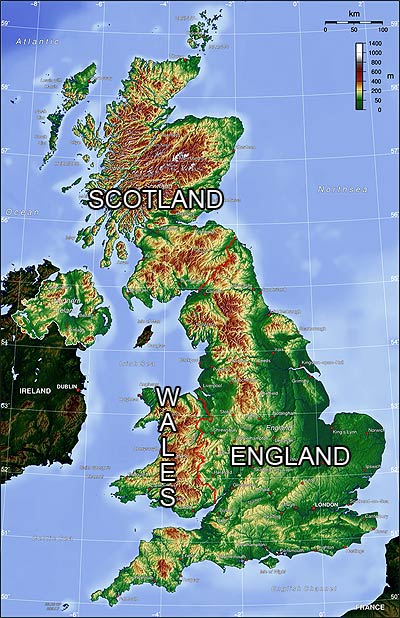

Britain’s physical area covers 93,025 square miles (242,842 square kilometres).

Most is land, with the rest comprising inland water such as lakes and

rivers. England has 50,052 square miles (129,634 sq km), Wales has 7,968

(20,637), Scotland has 29,799 (77,179) and Northern Ireland has 5,206 (13,438).

England is larger than the other countries and has the biggest population (51,

446,000 or 84 per cent) in an estimated UK total of 61, 383,000 in mid-2008,

up by 408,000 since 2007. These factors partly explain the English dominance in

British history and the often hostile attitudes of Scotland, Ireland and Wales

towards their neighbour.