
Dialects and Accents of English
English is actually an unusual language. Already a blend of early Frisian and Saxon, it absorbed Danish and Norman French, and later added many Latin and Greek technical terms. In the US, Canada, Hawaii, Australia, New Zealand, South Africa, and elsewhere, it absorbed terms for indigenous plants, animals, foodstuffs, clothing, housing, and other items from native and immigrant languages. Plus, the various dialects, from Cockney to Jamaican, and innumerable sources of slang, from Polari to hip hop, continue to add novel terms and expressions to the mix. It is no surprise to hear from people learning English what a student once told me: English just has too many words!
British English
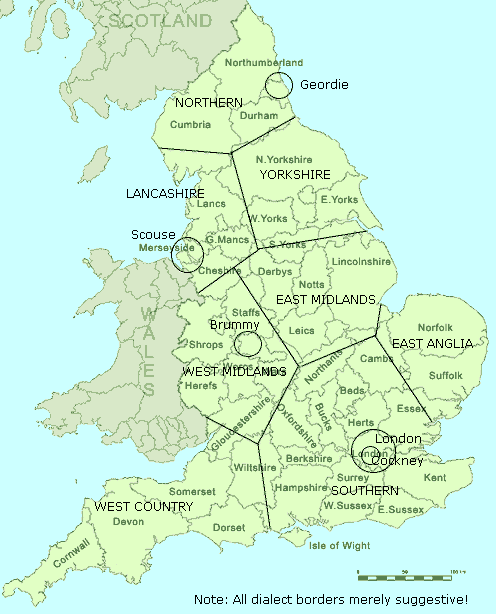
Map from Pictures of England (http://www.picturesofengland.com)
What is a dialect?
Dialect is one of those words that almost everybody thinks they understand, but which is in fact a bit more problematic than at first seems to be the case. A simple, straightforward definition is that a dialect is any variety of English that is marked off from others by distinctive linguistic features. Such a variety could be associated with a particular place or region or, rather more surprisingly, it might also be associated with a certain social group—male or female, young or old, and so on.
But whether the focus is regional or social, there are two important matters that need to be considered when defining ‘dialect’. We have to decide what the building blocks of a dialect might be. And even before this, we could usefully confront the most common mistakes that people make when referring to ‘dialect’.
Dialect or accent?
A common mistake is to confuse a ‘dialect’ with an accent, muddling up the difference between words people use and the sounds they make, their pronunciation. If vocabulary and grammar are being considered alongside pronunciation, then ‘dialect’ is a reasonable term to use. But often, when claiming to discuss a dialect, someone will concentrate just on pronunciations. If what is being spoken about are sounds alone—that is, accent—then the area of language study is rather pronunciation, or phonology.
It will be obvious from this that accent, or pronunciation, is a special element of a dialect that needs separate attention to be properly understood. Arguably the best-known phonological distinction in England is the so-called ‘BATH vowel’, the quality of the a sound differing between north and south. Another, still more significant on the world stage, concerns the issue of rhoticity, relating to whether or not written r is sounded when it follows a vowel. Whilst most people in England and Wales do not pronounce the r (and are therefore non-rhotic), those in the English West Country and parts of Lancashire do. In this they are joined by most Scots and Irish speakers of English, and by the majority of North Americans. Although the English tend to regard rhoticity as an exotic aberration, it is in fact numerically and geographically the dominant form in world terms.
English is spoken in more than 60 countries in the world and, according to some figures, is used by more than 1 billion people.
Many varieties, accents and dialects of English exist worldwide.
English accents in the UK
The UK is a relatively small country, but we have a surprising variety of English accents and dialects.
Visitors and immigrants who have learned to speak English abroad can find the range of dialects and accents in the UK confusing, and some accents difficult to understand.
Areas of the UK with distinct accents include Scotland, Wales and Northern Ireland; the counties of Cornwall, Yorkshire and Norfolk; and the cities of Liverpool, Manchester, Bristol, Newcastle, Birmingham, and Belfast. And these are just a few examples, so you begin to get an idea of the wide variation in English pronunciation across the UK!
Immigrants to the UK, or students residing here temporarily to learn English, are very likely to learn to speak English with a specific accent, depending on their location in the UK.
Many students tell me they want to learn to speak ‘English English’ (as opposed to American English, for instance) – they are often surprised to learn just how many variations of English accent exist here in the UK.
You can hear how pronunciation varies across the UK with recordings of modern and old dialects, received pronunciation, and minority ethnic English pronunciation, on the British Library Sounds Familiar? web site.
English dialects in the UK
Generally speaking, English accents are varieties that differ only in terms of pronunciation: for instance, Standard English can be spoken with a regional accent, whereas English dialects differ in terms of pronunciation, grammar and vocabulary.
However, the distinction is not always clear-cut and there is much debate about how many non-pronunciation features (grammar, vocabulary, idiom) it takes before an accent becomes a dialect.
Regional dialects of the UK include those of Orkney, Shetland, Glasgow and Edinburgh, Wales (where the dialect is strongly influenced by the Welsh language), and Ireland where we have:
Anglo-Irish used by the descendants of English settlers;
Ulster Scots – the speech of the descendants of 17c Protestant Scots settlers;
and Hiberno-Irish spoken by usually Catholic people whose ancestral tongue was Gaelic.
These are just a few of the many English dialects in the UK.

