目录

  • 1 Introduction
    • 1.1 Introduction
    • 1.2 Application
  • 2 Chapter 1
    • 2.1 The nature of chemistry
    • 2.2 Team work
  • 3 Chapter 2
    • 3.1 Chemistry as a Quantitative   Science
    • 3.2 Describe a chemical change
  • 4 Chapter 3
    • 4.1 Atoms, Molecules and Ions
    • 4.2 Team Work
  • 5 Chapter 4
    • 5.1 The Gaseous State
    • 5.2 Team work
  • 6 Chapter 5
    • 6.1 Chemical Reactions and Stoichiometry
    • 6.2 ​Advanced Assignment
  • 7 Chapter 6
    • 7.1 Thermochemistry
    • 7.2 Challenging Assignment
  • 8 Chapter 7
    • 8.1 Nomenclature for Organic Compounds and Groups
    • 8.2 In-Class Design
  • 9 Chapter 8
    • 9.1 Literature studying
    • 9.2 Team Work
  • 10 Chapter 9
    • 10.1 Abstract
    • 10.2 Reading, writing, and translating abstracts
Nomenclature for Organic Compounds and Groups

Nomenclature for Organic Compounds and Groups


IUPAC NOMENCLATURE of COMPOUNDS with FUNCTIONAL GROUPS


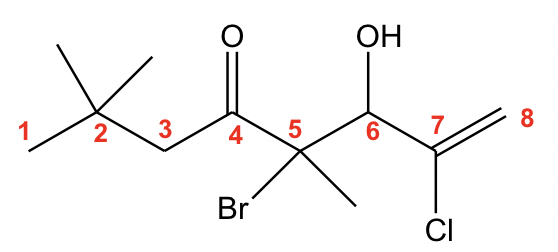
Find the longest carbon chain containing the functional group with highest priority (see Table 2.3). This chain determines the parent name of the compound.

Change the ending of the parent alkane/alkene/alkyne to the suffix of the highest priority group, which gives the parent name of the compound (usually, drop the last letter “e” before adding the suffix, except for nitrile where the “e” is kept).

Number the chain from the end closest to the highest functional group.

The other groups are named as substituents by using the appropriate prefixes.

Assign stereochemistry, E/Z or R/S, as necessary

clipboard_e8392bf0194aeee7086daf692a03c3e65.png

subordinate-group-update-1024x509.png

""

""