材料化学13级双语

刘志明 教授

目录

  • 1 第一章 绪论
    • 1.1 Historical Perspective
    • 1.2 Materials Science and Engineering
    • 1.3 Why  Study  Materials Chemistry?
    • 1.4 Materials and Its Components
    • 1.5 Classification of Materials
    • 1.6 Materials Science and Materials Chemistry
    • 1.7 Research Field of Materials Chemistry
    • 1.8 Development of materials
    • 1.9 Composition, Structure and Performance of Materials
    • 1.10 Performance of Materials
  • 2 第二章  固体相图化学
    • 2.1 Phase Changes of Solids, Liquids and Gases
    • 2.2 Differences between the Three States of Matter
    • 2.3 The Close Packed Solid
    • 2.4 Phase relations between individual solids
      • 2.4.1 Phase Diagram and Phase Chemistry
    • 2.5 One-component system单元系相图
    • 2.6 Binary system phase diagram 二元系相图—固溶体相图、合金相图
      • 2.6.1 Binary fully soluble phase diagram二元匀晶相图
      • 2.6.2 Eutectic Phase Diagram, Eutectoid Phase Diagram二元共晶、共析相图
      • 2.6.3 Peritectic Phase Diagram & Peritectoid Phase Diagram包晶和包析相图
      • 2.6.4 Stable Compound or Intermetallic Compound  形成稳定化合物或中间相的二元相图
      • 2.6.5 Basic Rules of  Binary System  二元相图的一些基本规律
    • 2.7 Ternary Phase Diagram 三元系相图
      • 2.7.1 三元相图的表示方法
      • 2.7.2 三元系平衡相的定量法则
      • 2.7.3 三元匀晶相图
      • 2.7.4 三元共晶相图
      • 2.7.5 Summary of ternary phase diagram
  • 3 第三章 固体结构测定
    • 3.1 Scientific determination of the structure of solids
    • 3.2 Bragg’s Equation
    • 3.3 Miller Indices
    • 3.4 Ewald and Reciprocal Lattice
    • 3.5 Energy Band Models
    • 3.6 Solid Structure Conventions and protocols
  • 4 Chapter 4 Defects in Solids
    • 4.1 Three kinds of Defects
      • 4.1.1 Types of point defects expected in a homogeneous
      • 4.1.2 The point defect in heterogeneous solids
      • 4.1.3 The line defect
      • 4.1.4 The Volume Defect
    • 4.2 Mathematic and equations of the points
      • 4.2.1 The Plane Net
    • 4.3 Non-stoichiometric solids
    • 4.4 Defect equation symbolism
    • 4.5 Some applications for defect chemistry
      • 4.5.1 Phosphors
      • 4.5.2 Defect equilibria and their energy
      • 4.5.3 Defect equilibria in various type of compounds
      • 4.5.4 Defect concentrations in MXs Compounds
  • 5 Mechanisms and Reactions in the Solid State
    • 5.1 Phase changes
    • 5.2 The role of phase boundaries in solid state reactions
    • 5.3 Reaction rate processes in solids
    • 5.4 Defining heterogeneous nucleation process
    • 5.5 Phase changes of solid state
    • 5.6 Fick’s Laws of Diffusion— Kinetics Equation of Diffusion
      • 5.6.1 Fick’s First Law
      • 5.6.2 Fick’s Second Law
      • 5.6.3 Driving force of Diffusion
    • 5.7 Diffusion Mechanism
      • 5.7.1 The Tarnishing Reaction
      • 5.7.2 Kirchendall Effect
      • 5.7.3 Types of diffusion reactions
    • 5.8 硅酸盐固相反应
      • 5.8.1 固相反应机理
      • 5.8.2 固相反应动力学
      • 5.8.3 影响固相反应的因素
    • 5.9 硅酸盐固相烧结
      • 5.9.1 烧结过程和机理
      • 5.9.2 烧结动力学
      • 5.9.3 影响固相烧结的因素
  • 6 Particles and Particle Technology
    • 6.1 Sequences in particle growth
    • 6.2 粒子径与粒度分布
      • 6.2.1 粒子径的表示方法
      • 6.2.2 粒度分布
      • 6.2.3 平均粒子径
      • 6.2.4 新建课程目录
    • 6.3 Particle size
    • 6.4 Measuring particle distributions
    • 6.5 Analysis of PD parameters
    • 6.6 Types of log normal particle distributions
    • 6.7 粒子形态
      • 6.7.1 形状指数
      • 6.7.2 形状系数
      • 6.7.3 粒子的比表面积
    • 6.8 粉体的密度与孔隙率
      • 6.8.1 粉体的密度
      • 6.8.2 粉体孔隙率
    • 6.9 Methods of measuring particle distributions
      • 6.9.1 Optical-The microscope-visual counting particles
  • 7 Growth of Crystals
    • 7.1 Methods of growth of crystals
    • 7.2 Furnace construction
      • 7.2.1 Elements of furnace design
    • 7.3 Steps in growing a single crystal
    • 7.4 Czochralski growth of single crystals
      • 7.4.1 Czochralski crystal growth parameters
      • 7.4.2 Operation of the Czohralski apparatus
      • 7.4.3 Defects produced in the growing crystal as a function of growth conditions
    • 7.5 The Bridge-Stockbarger Method for Crystal Growth
    • 7.6 Zone melting as a means for forming single crystals
    • 7.7 Zone refining
    • 7.8 The Vernuil method of crystal growth
  • 8 Plasma Chemistry
    • 8.1 等离子化学
      • 8.1.1 等离子体
      • 8.1.2 Plasma空间的各种现象—碰撞、激发、电离、复合、附着、离脱扩散和迁移
      • 8.1.3 低温等离子体的发生与放电特性
      • 8.1.4 等离子体化学的特征
      • 8.1.5 等离子体化学的应用—气—固相反应
      • 8.1.6 等离子体检测
    • 8.2 光化学
The Close Packed Solid

2.3 The Close Packed Solid

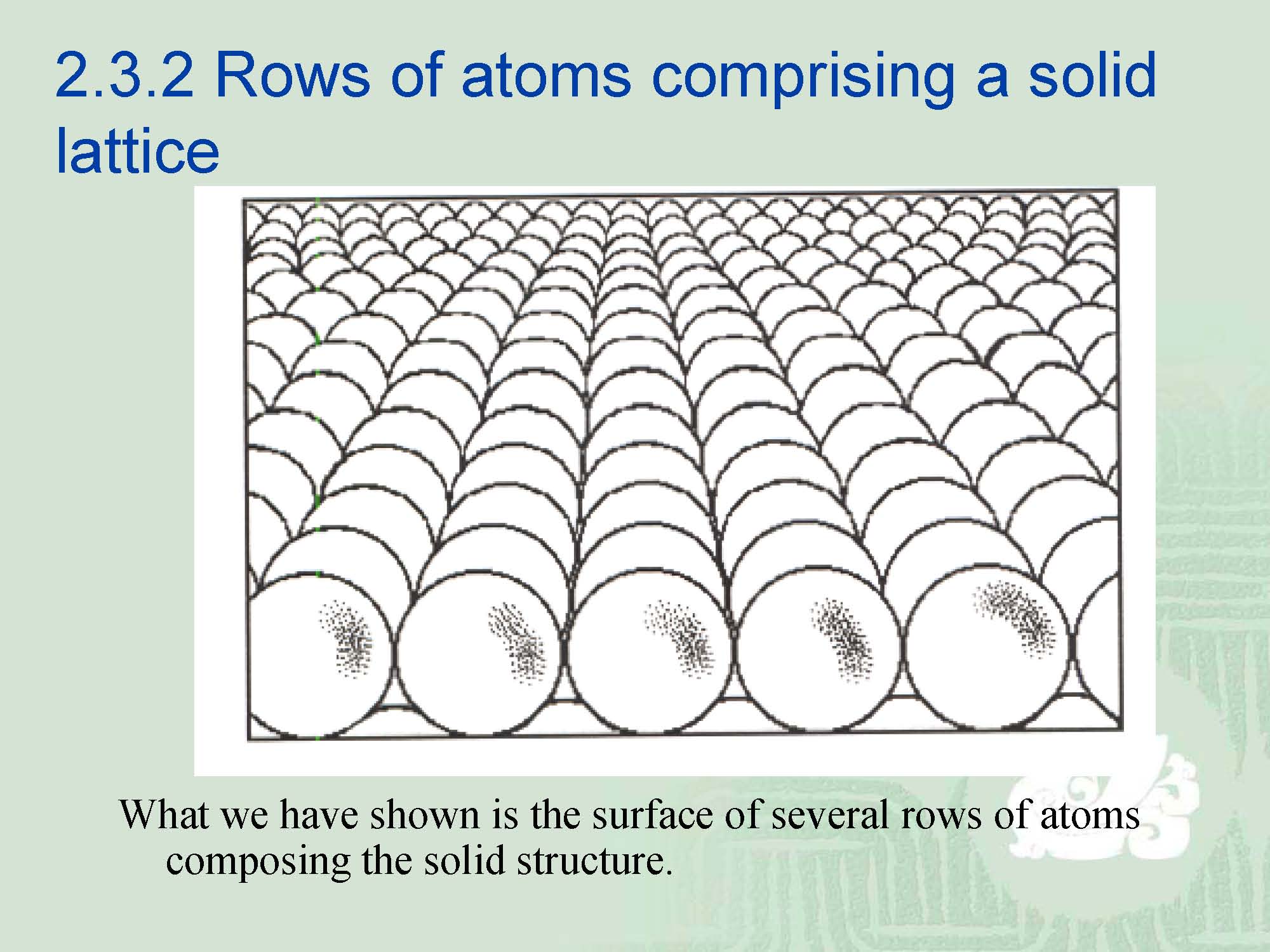
¡We have already said that the solid differs from the other states of matter in that a long range ordering of atoms or molecules has appeared.

¡All of the atoms should be required to be arranged in a symmetrical pattern in three dimensions.--building blocks, propagation models
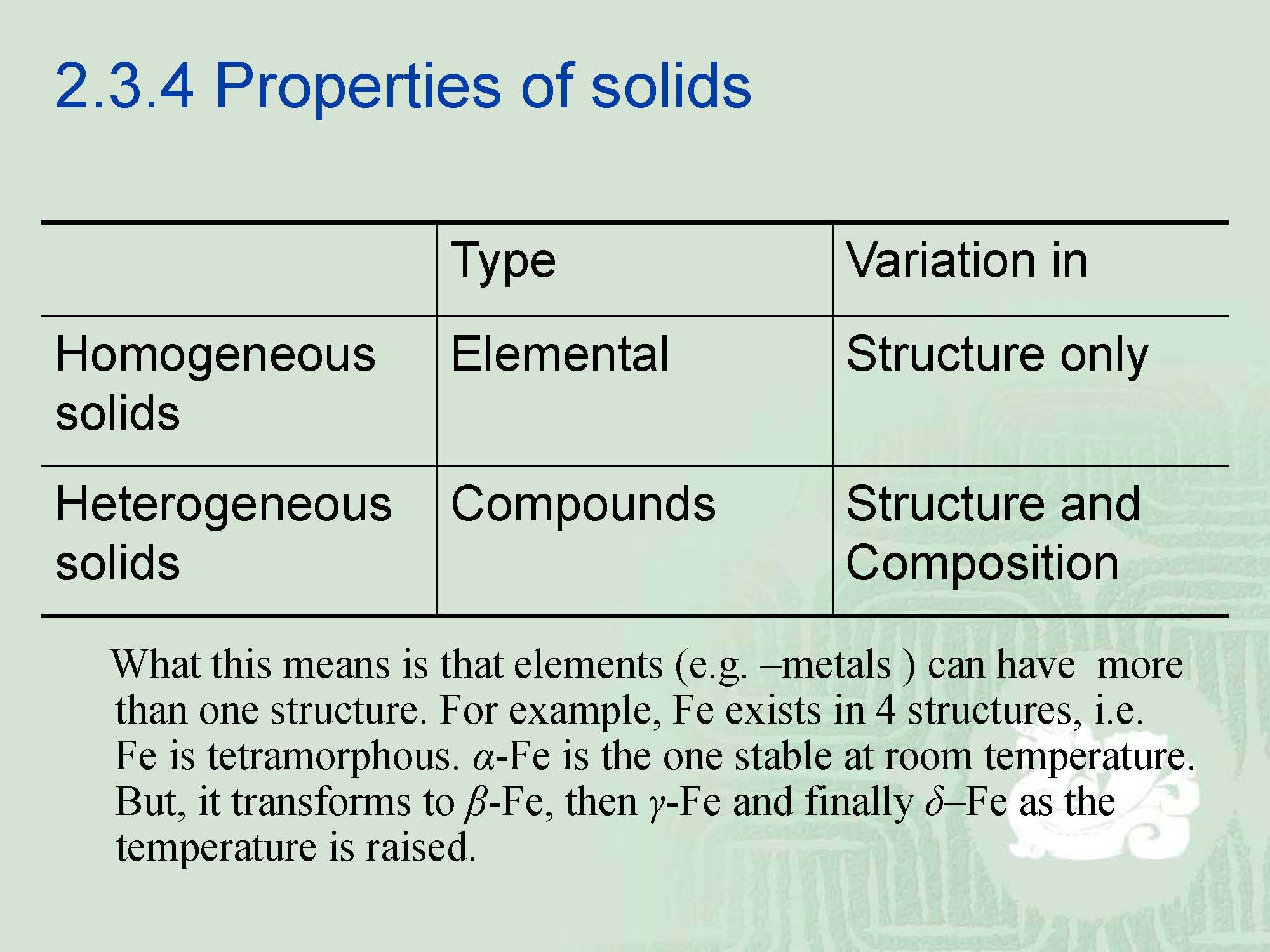
¡In general, there are two kinds of solids, homogeneous and heterogeneous.

¡Homogeneous solid is composed from atoms that are all the same.

¡Heterogeneous solid is composed from atoms not the same.

¡If the atoms are all of one kind, i.e.-one of the elements, the problem is straight forward.

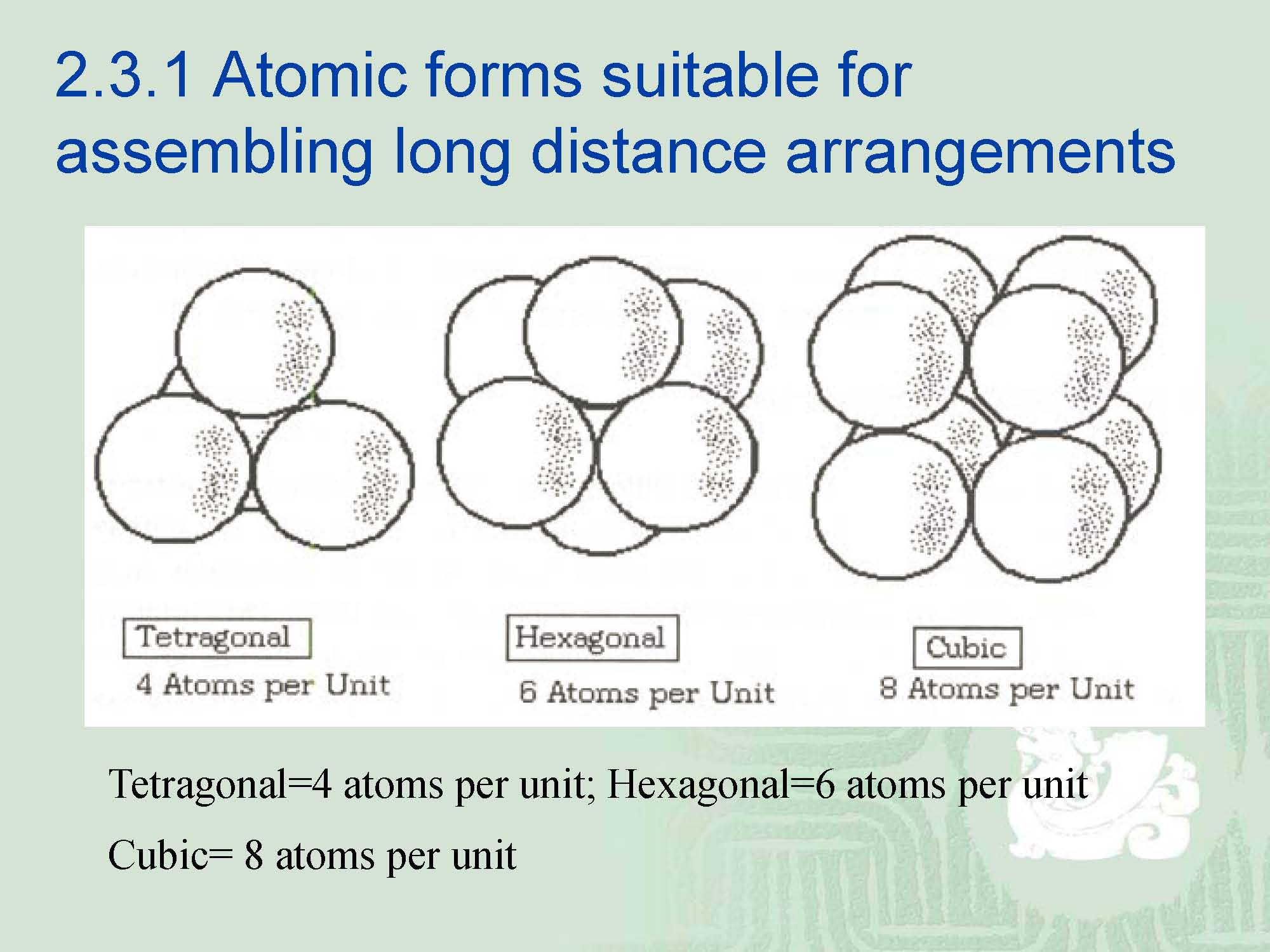
¡Sets of 8 atoms, each set arranged as a cube, will generate a cubic structure.

¡Two sets of 3 atoms, each set of three arranged in a triangle, will propagate a hexagonal pattern with three dimensional symmetry.

¡Elemental solids having a tetragonal structure are very few and it is easy to ascertain that most of the elements from structures that are either cubic or hexagonal,but rarely tetragonal.

¡The reason for this is that tetragonal units are more conductive for the case where not all of the atoms are the same, i.e.--heterogeneous case.e.g.  -PO4;   -CO3

¡There is also another important factor. Thatis, in building a solid structure are based on the largest atom present, as well as how it stacks together in space filling-form.

¡For most inorganic compounds, this is the oxygen atom, e.g.- oxides, silicates, phosphates, sulfates, borates, tungstates, vanadates, etc.

¡The few exceptions involve chalcogenides (氧、硫化物), halides卤化物, hydrides, etc.

¡Thus 4 atoms will form a 3-dimensional tetrahedron which is valid propagation unit.-pyramid

¡This means that we can take tetrahedrons and fit them together 3-dimensionally to form a symmetrical structure which extendsto infinity.

¡However, if one more atom is added to the pyramid, we then have an octahedron which is space-filling with translational properties. This results in a hexagonal structure.

¡Going further, combinations of seven atoms are asymmetrical, but eight atoms form a cube which can be propagated to infinity to form a cubic structure.

2.3.4 Propagation unitsusually found in solids

¡Tetrahedron-4

¡Octahedron-6

¡Hexagon-6or 8

¡Cube-8

¡We conclude that structures of solids are based, in general, upon these four basic propagation units, which can be stacked in a symmetrical and space-filling form to near infinity.

¡The symmetry will be that of the largest atoms in the structure, usually oxygen in inorganic solids.

¡In many cases they are smaller and will fitinto the interstice of the propagation unit, illustrated by the PO4-tetrahedron mentioned above. 

¡In this case, the P5+ atom is small enough to fit into the center(interstice) of the tetrahedron formed by the four oxygen atoms.
2.3.5 Known calcium silicates

¡For example, a large number of calcium silicates are known, including:

¡Ca2SiO3,Ca3Si2O7, CaSi2O5, Ca2SiO4, Ca4(Si4O17)(OH)2,  Ca4SiO7(OH)2, Ca9Si6O21(OH),  CaSiO3 ---58 known compounds

In order to differentiate among such complicated systems, i.e.-oxygenated compounds of calcium and silicon, we resort to what that is called a “phase-diagram”.