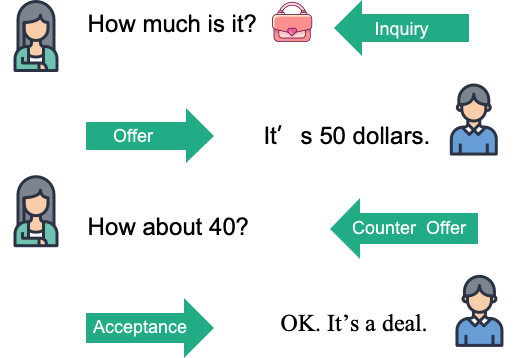
Regardless of the form adopted, business negotiations typically involve processes such as inquiry, offer, counter-offer, and acceptance.
1.Inquiry
An inquiry, also known as an invitation to offer. It refers to the act of an importer or exporter requesting the other party to provide commercial information about specific goods.
For instance, an importer sending an email to request a quotation or price list for a certain product from an exporter, or a seller providing a sample to a potential customer along with detailed information about trade terms, all constitute inquiries.
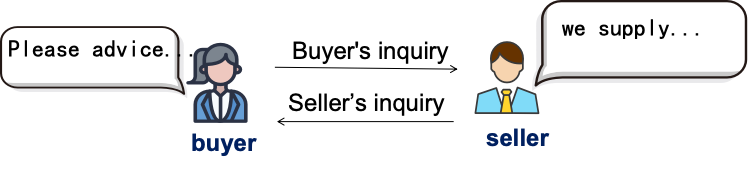
Generally, an inquiry from the buyer is referred to as a buyer's inquiry, while an inquiry made by the seller is known as a seller's inquiry.
After receiving the inquiry, the exporter shall reply immediately. However, it should be noted that the inquiry is not legally binding on the party making the inquiry.
In order to facilitate price comparison and preferential transaction, inquiries can be sent to multiple trading partners. The content of the inquiry is mainly price, but other key transaction terms should also be understood as much as possible for comprehensive evaluation.
2.Offer
(1)Definition of offer
An offer is usually made by advertisement, leaflet, letter or in response to an inquiry. The definition provided by the Convention is: ‘A proposal for concluding a contract addressed to one or more specific persons constitutes an offer if it is sufficiently definite and indicates the intention of the offeror to be bound in case of acceptance.’ ‘An offer becomes effective when it reaches the offeree.’ Thus, an effective offer must have certain conditions.
(2)Example
Dear Mr White,
We well received your inquiry. We quote below as you required:
Name of commodity: Soybean
Quality: Grade A Packaging: In bulk
Quantity: 100/MT
Price: CIF Singapore USD1.80
Payment terms: Irrevocable L/C
Delivery date: No later than Oct. 30, 2024
Any further questions, please feel free to let me know. Best regards!
(3)Elements of an effective offer
In international trade practice, not all quotations are valid. According to the stipulations of CISG, an effective offer must :
a. be addressed to one or more specific persons; An offer should specify the name of the offeree to distinguish it from a commercial advertisement. If it is not made to one or more specific persons, it can only be regarded as an inquiry or invitation.
b. be sufficiently definite;
As per CISG, the offer should indicate the goods and expressly or implicitly fix or make provision for determining the quantity and the price. In practice, it’s better to indicate cargo packaging, delivery and payment in an offer. Other conditions can be supplemented after the establishment of the contract.
c. indicates the intention of the offeror to be bound in case of acceptance;
A valid offer should indicate that once accepted by the offeree, the offeror becomes be bound. An oral offer is binding only when the offeree accept it at once.
d. reach the offeree
Under the Convention, an offer takes effect when it reaches the offeree. An offer can be made by either the seller or the buyer. A buyer's offer can also be called a "bid". Sometimes the offer does not fully have the conditions of the offer, only indicating the intention of the transaction. It can not constitute a firm offer, which can be called non-firm offer. If there are any of the following words and sentences, they are non-firm offer: ‘Without engagement.’ ‘subject to prior sale’ ‘All quotations are subject to our final confirmation unless otherwise stated.’ ‘Our offer is subject to approval of export licence.’ A non-firm offer has no legal effect.
(4)Withdraw and Revocation of An Offer
As per CISG, an offer may be withdrawn if the withdrawal reaches the offeree before or at the same time as the offer.
It is evident that withdrawal essentially prevents the offer from taking effect. So how to deal with the withdraw after the offer takes effect? In fact, at this time, the withdraw is transformed into a revocation. According to CISG, until a contract is concluded, an offer may be revoked if the revocation reaches the offeree before he has dispatched an acceptance. Revocation of the offer refers to the act taken by the offerer to cancel the offer and terminate the validity after the offeree received the offer.
However, an offer could not be withdrawn under the following circumstances: The offer is irrevocable as indicated by the period of validity or other terms. It can be seen that the withdrawal essentially prevents the offer from taking effect. The offeree has taken measures, such as the seller delivering the goods or the buyer applying for the issuance of a letter of credit, based on the belief that the offer is irrevocable.
(5)Termination of an offer
The situations leading to the invalidation of an offer include: Counter offer or refusal is made by the offeree; Offeror revoked the offer; The offeree don’t accept the offer within its validity; Force majeure, either party become incapacitated or dead or go bankruptcy before the offer is accepted. When an offer is terminated, the offeror is no longer bound by it. Acceptance of a terminated offer is legally invalid and can only be regarded as a new offer. At this point, the original offeree becomes the new offeror, and the original offeror becomes the new offeree.
3.Counter offer
(1)Definition of a counter-offer
Counter-offer is also known as bargaining. It happens when the offeree does not agree with or totally agree with terms and conditions the offeror put in the offer. It is an indication of the offeree to change and amend the original offer.
Any additional or different terms relating, among other things, to the price, payment, quality and quantity of the goods, place and time of delivery extent of the party’s liability to the other or the settlement of disputes are considered to alter the terms of the offer materially.
Counter-offer is the offeree's refusal to the original offer, as well as a new offer made by offeree to the previous offerer.
Counter-offer does not necessarily happen during the negotiation.
(2)Example
Dear Mr. Black,
Thanks for your offer. After our carefully study, we found your price is on the high side. We know your goods are of high quality, but we do hope you kindly reduce the price approximately by 5% for our long term cooperation.
We look forward to your reply.
Best regards!
This e-mail proposes to reduce the price by 5%, which constitutes a counter offer.
4.Acceptance
After one or several counter-offers, the offeree accepts the terms of the offer, and the contractual relationship between the two parties is established.
(1)definition
Acceptance is a statement made by or other conduct of the offeree indicating assent to an offer . Silence or inactivity does not in itself amount to acceptance.
An acceptance of an offer becomes effective at the moment the indication of assent reaches the offeror.
Here is an example.
(2)Example of Acceptance
Dear Mr. Black,
We have received your offer of toy cars, and we are pleased to confirm buying toy cars from you on the terms and conditions in your offer.
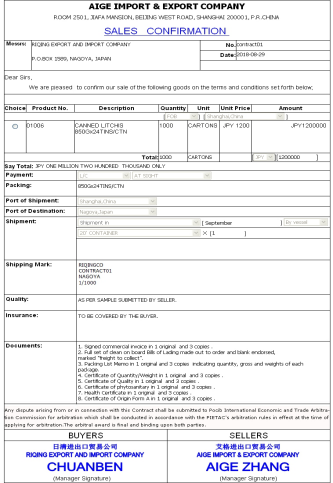
We enclose our Sales Confirmation in duplicate, a copy of which please sign and return to us for our file.
Best regards!
This email indicates that the purchase of toy cars was confirmed based on the terms of the offer, without changing the terms of the offer. Thus it is an acceptance.
(3)Conditions for Effective Acceptance
Based on the definition of acceptance, the conditions for effective acceptance has to:
be made by the offeree;
be indicated in some way;
be completely consistent with the offer;
be delivered to the offeror within validity.
‘be made by the offeree’ means that only the specific person who receives the offer is qualified to accept the offer or not. Any ‘acceptance’ made by others who have not received the offer is invalid. Actually the ‘acceptance’ is a new offer.
‘be indicated in some way’
Acceptance must be stated with words usually by email or verbally. It can also be indicated by “action” ,like dispatching of the goods or paying of the price.
‘be completely consistent with the offer’
A reply still constitutes acceptance if the content of the offer is not modified materially. According to CISG, ‘additional or different terms relating, among other things, to the price, payment, quality and quantity of the goods, place and time of delivery, extent of one party's liability to the other or the settlement of disputes are considered to alter the terms of the offer materially.’ All other amendments are non-material and do not change the nature of acceptance.
Acceptance must be received by or communicated to the offeror within the time fixed in the offer, or within a reasonable time if there is no time fixed. An oral offer must be accepted immediately unless the circumstances indicate otherwise. If the acceptance is made by conduct, it becomes effective at the moment the act is performed.
(4)Late Acceptance
Acceptance must be delivered within the validity period specified in the offer. If the offer validity period is not provided, it shall be delivered within a reasonable period. If acceptance is delivered to the offeror later than the period of validity or the reasonable period, the acceptance will become a late acceptance or delayed acceptance, usually of no legal bindings. In fact, the late acceptance is a new offer. Unless the original offeror accepts this new offer, there will be no contract concluded.
There are two exceptions to the effect of late acceptance.
A late acceptance is nevertheless effective as an acceptance if without delay the offeror orally so informs the offeree or dispatches a notice to that effect.
If a letter or other writing containing a late acceptance shows that it has been sent in such circumstances that if its transmission had been normal it would have reached the offeror in due time, the late acceptance is effective as an acceptance unless, without delay, the offeror orally informs the offeree that he considers his offer as having lapsed or dispatches a notice to that effect.
(5) Withdrawal of Acceptance
Just like the offer, any acceptance can be withdrawn before it becomes effective. An acceptance may be withdrawn if the withdrawal reaches the offeror before or at the same time as the acceptance would have become effective.
A contract is concluded at the moment when an acceptance of an offer becomes effective. So, an acceptance cannot be revoked by the offeree. Revocation of acceptance means canceling a contract, whereas contract revocation shall be approved by both parties, not just one party.