Chapter 7
The Respiratory System and Its Regulation
The raspiratory and cardiovacular sysems combine to provide an efeccive delivery system that carries oxygen to,and removes carbon dioxide from, all tissues of the body.
This transportation involves four separate processes:
Pulmonary ventilation (breathing): movement of air into and out of the lungs
Pulmonary diffusion: the exchange of oxygen and carbon dioxide between the lungs and the blood
Transport of oxygen and carbon dioxide via the blood
Capillary diffusion: the exchange of oxygen and carbon dioxide between the capillary blood and metabolically active tissues
The first two processes are referred to as external respiration because they involve moving gases from outside the body into the lungs and then the blood. Once the gases are in the blood, they must be transported to the tissues. When blood arrives at the tissues, thefourth step of respiration occurs. This gas exchange between the blood and the tissues is called internal respiration. Thus, external and internal respiration are linked by the circulatory system. The following sections examine all four components of respiration.
In Review
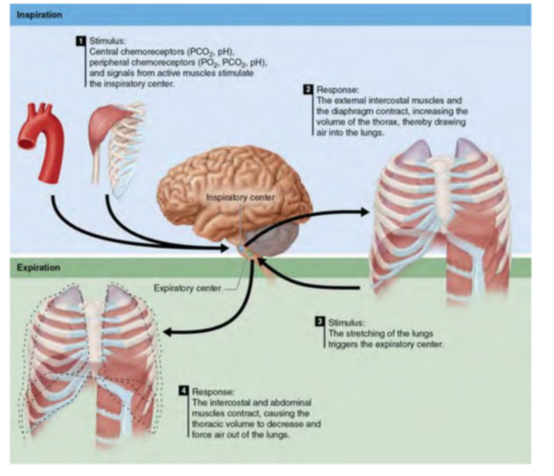
Pulmonary ventilation (breathing) is the process by which air is moved into and out of the lungs. It has two phases: inspiration and expiration.
Inspiration is an active process in which the diaphragm and the external intercostal muscles contract, increasing the dimensions, and thus the volume, of the thoracic cage. This decreases the pressure in the lungs, causing air to flow in.
Expiration at rest is normally a passive process. The inspiratory muscles and diaphragm relax and the elastic tissue of the lungs recoils, returning the thoracic cage to its smaller, normal dimensions. This increases the pressure in the lungs and forces air out.
The pressure changes required for ventilation at rest are small, as little as 2 to 3mmHg. However, during maximal respiratory effort the intrapulmonary pressure can decrease by 80 to 100 mmHg.
Forced or labored inspiration and expiration are active processes and involve accessory muscle actions.
Breathing through the nose helps humidify and warm the air during inhalation and filters out foreign particles from the air. Mouth breathing dominates at moderate to high exercise intensities.
Lung volumes and capacities, along with rates of airflow into and out of the lungs, are measured by spirometry.
In Review
Pulmonary diffusion is the process by which gases are exchanged across the respiratory membrane in the alveoli.
Dalton's law states that the total pressure of a mixture of gases equals the sum of the partial pressures of the individual gases in that mixture.
The amount and rate of gas exchange that occur across the membrane depend primarily on the partial pressure of each gas, although other factors are also important, as shown by Fick's law. Gases diffuse along a pressure gradient, moving from an area of higher pressure to one of lower pressure. Thus, oxygen enters the blood and carbon dioxide leaves it.
Oxygen diffusion capacity increases as one moves from rest to exercise. When exercising muscles require more oxygen to be used in the metabolic processes, venous oxygen is depleted and oxygen exchange at the alveoli is facilitated.
The pressure gradient for carbon dioxide exchange is less than for oxygen exchange, but carbon dioxide's diffusion coefficient is 20 times greater than that of oxygen, so carbon dioxide crosses the membrane readily without a large pressure gradient.
In Review
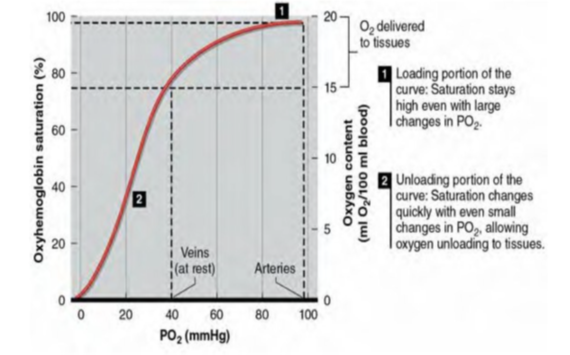
Oxygen is transported in the blood primarily bound to hemoglobin (aoxyhemoglobin), although a small part of it is dissolved in plasma.
To better respond to increased oxygen demand, hemoglobin unloading of oxygen(desaturation) is enhanced (i.e., the curve shifts to the tight) when PO2decreases, pH decreases, or temperature increases.
Because of the sigmoid shape of the curve, loading of hemoglobin with oxygen in the lungs is only minimally affected by the shift.
In the arteries, hemoglobin is usually about 98% saturated with oxygen. This is a higher oxygen content than our bodies require, so the blood's oxygen- carrying capacity seldom limits peformance in healthy individuals.
Carbon dioxide is transported in the blood primarily as bicarbonate ion. This prevents the formation of carbonic acid, which can cause H* to accumulate and lower the pH. Smaller amounts of carbon dioxide are either dissolved in the plasma or bound to hemoglobin.
Regulation of Pulmonary entilation
Study Questions
1.Describe and differentiate between external and internal respiration.
2.Describe the mechanisms involved in inspiration and expiration.
3.What is a spirometer? Describe and define the lung volumes measured using spirometry.
4.Explain the concept of partial pressures of respiratory gases -oxygen, carbon dioxide, and nitrogen. What is the role of gas partial pressures in pulmonary diffusion?
5. Where in the lung does the exchange of gases with the blood occur? Describe the role of the respiratory membrane.
6.How are oxygen and carbon dioxide transported in the blood?
7.How is oxygen unloaded from the arterial blood to the muscle and carbon dioxide removed from the muscle into the venous blood?
8.What is meant by the arterial- mixed venous oxygen difference? How and why does this change from resting conditions to exercise conditions?
9.Describe how pulmonary ventilation is regulated. What are the chemical stimuli that control the depth and rate of breathing? How do they control respiration during exercise?

