book

Starter
How do you feel if someone tells you that his new car won’t start whenever he comes back from a store after buying a vanilla ice cream? Don’t jump to a conclusion that it is impossible. As a matter of fact, this is a true story. Discuss with your classmates what might be the cause of the problem.
Text
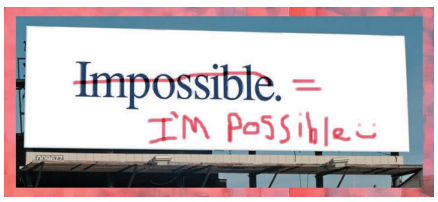
“Impossible” or “I’m Possible”
Author Unknown
1.This is a true story that happened between a customer of General Motors and its customer-care executive.
2.The Pontiac Division of General Motors received a complaint:
3.“This is the second time I have written to you, and I don’t blame you for not answering me, because I sounded crazy, but it is a fact that we have a tradition in our family of having ice cream for dessert after dinner each night. But the kind of ice cream varies so, every night, after we’ve eaten, the whole family votes on which kind of ice cream we should have and I drive down to the store to get it.
4.It’s also a fact that I recently purchased a new Pontiac and since then my trips to the store have created a problem. You see, every time I buy a vanilla ice cream, when I come back from the store my car won’t start. If I get any other kind of ice cream, the car starts just fine.
5.I want you to know I’m serious about this question, no matter how silly it sounds: ‘What is there about a Pontiac that makes it not start when I get vanilla ice cream, and easy to start whenever I get any other kind?’”
6.The Pontiac President was understandably skeptical about the letter, but sent an engineer to check it out anyway. The latter was surprised to be greeted by a successful, obviously well-educated man in a fine neighborhood. He had arranged to meet the man just after dinnertime, so the two got into the car and drove to the ice cream store.
7.It was vanilla ice cream that night and, sure enough, after they came back to the car, it wouldn’t start. The engineer returned for three more nights.
8.The first night, they got chocolate. The car started. The second night, he got strawberry. The car started. The third night he ordered vanilla. The car failed to start.
9.Now the engineer, being a logical man, refused to believe that this man’s car was allergic to vanilla ice cream. He arranged, therefore, to continue his visits for as long as it took to solve the problem. And toward this end he began to take notes: he jotted down all sorts of data: time of day, type of gas used, time to drive back and forth, etc.
10.In a short time, he had a clue: the man took less time to buy vanilla than any other flavor. Why? The answer was in the layout of the store.
11.Vanilla, being the most popular flavor, was in a separate case at the front of the store for quick pickup. All the other flavors were kept in the back of the store at a different counter where it took considerably longer to check out the flavor. Now, the question for the engineer was why the car wouldn’t start when it took less time.
12.Once time became problem — not the vanilla ice cream, the engineer quickly came up with the answer: “Vapor lock.” It was happening every night; but the extra time taken to get the other flavors allowed the engine to cool down sufficiently to start. When the man got vanilla, the engine was still too hot for the vapor lock to dissipate.
13.Remember: Even crazy-looking problems are sometimes real and all problems seem simple when we find the solution with cool thinking.
14.Don’t just say it’s “IMPOSSIBLE” without putting in a sincere effort...
15.Observe the word “IMPOSSIBLE” carefully… You can see “I’M POSSIBLE”...
(572 words)
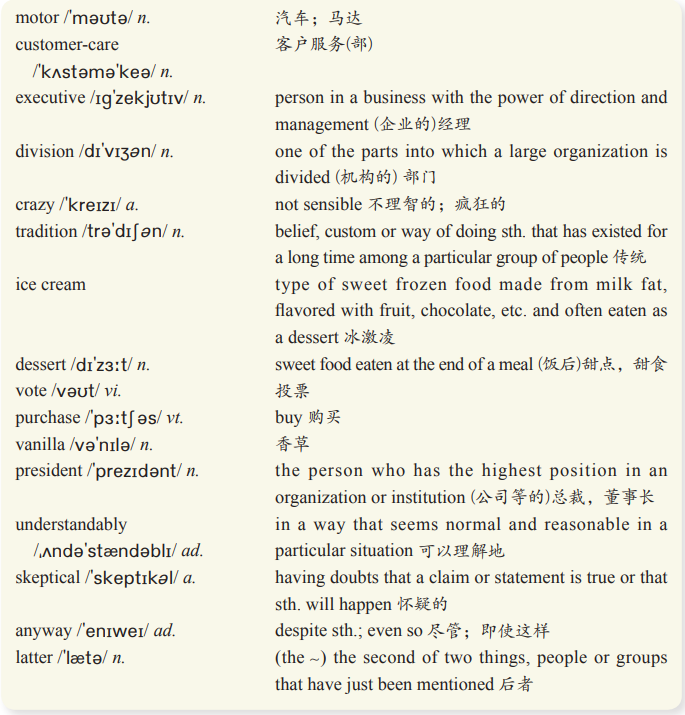
New Words
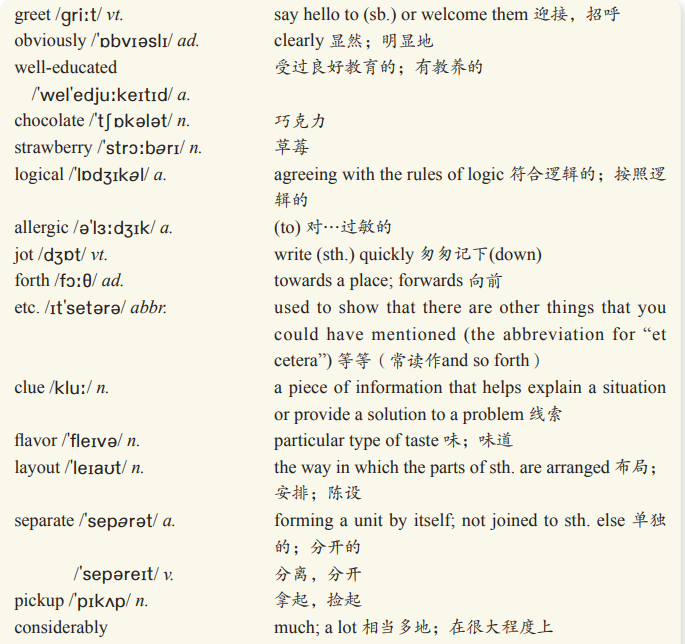

Phrases & Expressions
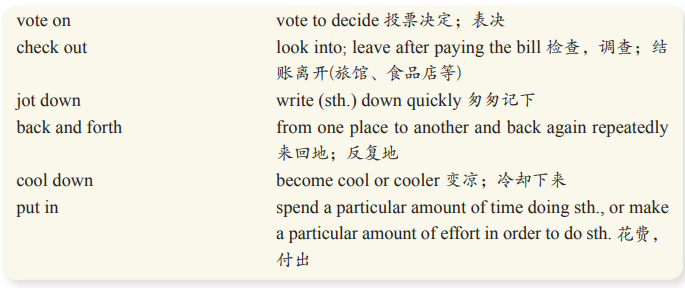
Proper Names

Notes on the Text
1. “Impossible” or “I’m possible”:在英语中,通常不说:“I’m possible.” 作者以一种类似文字游戏的形式来说明,看似不可能的事情中包含着可能性。
2. This is the second time I have written to you... 这是我第二次给你们写信……本句中从句的时态用现在完成时,因为主句中含有表示第几次的短语 (the second time)。又如:This is the first time I have seen such a crazy person. 我还是第一次看到这样疯狂的人。
3. ... it is a fact that we have a tradition in our family of having ice cream for dessert after dinner each night. ……但事实是,我们家族有个传统,即在每晚用餐后吃冰激凌作甜食。本句中fact后面that引导的从句是fact的同位语从句,that不可以省略。第四段开头第一句话也是同样的句型。
4. You see, every time I buy a vanilla ice cream, when I come back from the store my car won’t start. 是这样的,每次我买了香草冰激凌从店里回来时,我的车就无法启动。本句中的You see用作插入语,意思是“你瞧”或“听我说”;every time sb. does something意为“每次某个人做某事”。又如:Every time he goes to meet his girlfriend, he puts on his best suit. 每次去见女朋友,他都穿上最好的西装。
5. What is there about a Pontiac that makes it not start when I get vanilla ice cream, and easy to start whenever I get any other kind? 一辆庞蒂亚克车里有什么东西使得它在我买了香草冰激凌后不能启动而在我买了任何其他种类的冰激凌后又很容易启动呢?本句中有两点需要注意:第一,What is there about a Pontiac意思是“庞蒂亚克有什么问题”;第二,make sb./sth. (not) do sth.意思是“使某人/某物(不)能做某事”,其中的不定式不加to。
6. The Pontiac President was understandably skeptical about the letter, but sent an engineer to check it out anyway. 庞蒂亚克的总裁对这封信持怀疑态度是可以理解的,但他还是派了一名工程师去检查一下。本句中,check out这个短语中的out是副词,当宾语是代词的时候就必须放在out的前面,但如果宾语是名词,则既可以放在out的前面,也可以放在out的后面(如第11段中的check out the flavor)。
7. Now the engineer, being a logical man, refused to believe that this man’s car was allergic to vanilla ice cream. 这位工程师是个有逻辑头脑的人,他不相信这位男士的汽车对香草冰激凌过敏。句中的being a logical man是现在分词短语作主句的原因状语,说明工程师为什么拒绝相信汽车会对香草冰激凌过敏。第11段中的Vanilla, being the most popular flavor, was in a separate case at the front of the store for quick pickup也同样含有一个现在分词短语插入在主语和谓语之间,作原因状语。
8. He arranged, therefore, to continue his visits for as long as it took to solve the problem. 所以他便安排继续他的访问直到解决问题为止。句中含有it takes time to do sth. 这个句型。又如:I will be with him for as long as it takes to get the job done. 我会一直和他在一起,直到把工作完成为止。
9. All the other flavors were kept in the back of the store at a different counter where it took considerably longer to check out the flavor. 所有其他味道的冰激凌则放在商店后面另一个柜台里,买了这些味道的冰激凌结账离开花的时间要长得多。本句中的where it took considerably longer to check out the flavor是定语从句,语法上修饰a different counter,但语义上则进一步说明在另一个柜台挑选口味需要的时间要长得多。
Exercises
Understanding the Text
1.Answer the following questions.
1.Where did the true story happen?
2.What did the Pontiac Division of General Motors receive?
3.Why is the writer of the complaint not angry at getting no response to his first letter from the customer-care executive?
4.How does the family decide on which kind of ice cream every night?
5.What problem has the letter writer been having on his trips to the store?
6.What does the customer want to find out?
7.How did the Pontiac President react to the letter? And what did he do anyway?
8.What kind of person was the writer of the letter?
9.Why did the engineer arrange to meet the man just after dinner?
10.How many times did the engineer go to the store with the man?
11.What kind of person was the engineer? How do you know?
12.What clue did the engineer soon have?
13.Why did the car start fine if the man bought the other flavors of ice cream?
14.What suggestions does the author give at the end of the text?
2.Topics for Discussion.
1.How do you understand the title of Text A “Impossible or I’m possible”?
2.If you were the Pondiac engineer, what would you have done? Would you have taken the same actions to find out the cause of the trouble?
3.What lessons can you draw from this story that may inspire you in your future career?
Reading Analysis
3.Read Text A again and complete the following table.
Vocabulary
4.Fill in the blanks with the words given below. Change the forms where necessary.

5.Fill in the blanks with the expressions given below. Change the forms where necessary.

Structure
6.Study the following example and complete the following sentences by translating the Chinese in brackets into English, using present perfect tense (现在完成时) or past perfect tense (过去完成时).
Model:
This is the second time I have written to you. (我给你写信)
7.Combine the following pairs of sentences according to the model just below.
Model:
Now the engineer refused to believe that.
The engineer was a logical man.
→Now the engineer, being a logical man, refused to believe that.
Translation
8.Translate the following sentences from Chinese into English.
9.Translate the following sentences into Chinese, paying attention to the underlined words.

