
Unit 4 Emerging Adulthood
Is 30 the New 20 for Young Adults?
Learning Objectives for This Unit
Upon completion of this unit, teachers are expected to haveenabled students to:
1. have a thorough understanding of the text contextually and linguistically;
2. build up an active vocabulary to talk about growing up and adulthood and know how to use the key words and expressions in context properly;
3. compare American and Chinese views on emerging adulthood;
4. write a paragraph with a topic sentence by comparison and contrast;
5. write an essay about their views on emerging adulthood.
Pre-reading Tasks
Task 1 Watch a video clip and fill in the blanks accordings to what you have heard.
Segment 1
A22-year-old is considered to be part of which generation?
People born in the 1980s or ’90s are generally considered to ______________________.
Segment 2
OK, so it’s the generation born after 1980to either late baby boomers (婴儿潮一代) or early Gen Xers (X一代). Last year, Pew Research reported that Millennials___________________ than the generations before them, but they’re_________________having it in the future. Politically, they say they’re ____________________thantheir predecessors (前辈) and they’re less likely to __________________ as patriotic (爱国的) than Generation Xers or babyboomers. Millennials are the most racially (在种族方面) ______________generation in U.S.history. Their shared expertise (专业知识) with _________________ is something that separates them in the U.S.____________________.
Segment 3
The way they think and the way they ___________________is completely different. They move _____________________ mentally than anyother generation before. They are________________. Millennials can go in andlearn anything very, very quick. Their brain is very adaptable. Change doesn’t _________________as much as other generations because they had to learn something new every day.
Segment 4
So what makes them different? Millennialsare the first generation to have always__________________, which has transformed the way people _________________. I can’t live without my iPhone. I just — I feel naked if I don’t______________.
Task2: Read the followinginformation to answer questions.
Emerging Adulthood: Starting in 1995, psychologist Jeffrey Jensen Arnett interviewed300 young people aged 18 to 29 in cities around the nation over five years,asking them questions about what they wanted out of life. Working from thoseinterviews and examining broad demographic indicators, Arnett proposed a newperiod of life-span development he calls “emerging adulthood.”
Emerging adulthood is a phase of the life span between adolescence andfull-fledged adulthood which encompasses late adolescence and earlyadulthood, proposed by JeffreyArnett in a 2000 article in the American Psychologist. The termdescribes young adults who do not have children, do not live in their own home,or do not have sufficient income to become fully independent. Arnett suggestsemerging adulthood is the distinct period between 18 and 25 years of age whereadolescents become more independent and explore various life possibilities.Arnett argues that this developmental period can be isolated from adolescence and youngadulthood. Emerging adulthood is a new demographic, is contentiouslychanging, and some believe that twenty-somethings have always struggledwith "identity exploration, instability, self-focus, and feelingin-between”. Arnett called this period "roleless role" becauseemerging adults do a wide variety of activities, but are not constrained by anysort of "role requirements".
Task 3 Look at the two graphs on page89, then work with your partner and answer the questions on page89.
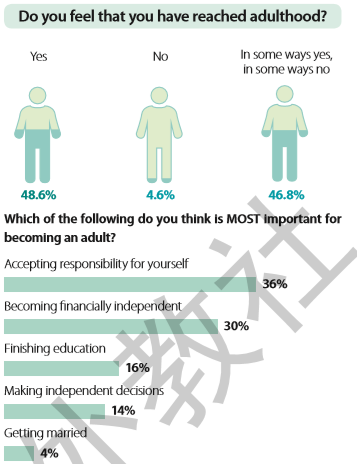
1. What is the graph about?
2.What is the general conclusion you may draw from the graph?
3.Do youfeel that you have reached adulthood? Why or why not?
4.Which do you think is most important for becoming an adult, accepting responsibility foryourself, becoming financially independent, finishing education, makingindependent decisions, or getting married?
Task4 Words and Phrases and Expressions Studying:Before-classStudents should read Words and Phrases at Side Note Part on Page90-92 in thetextbook. Make sure that students can read every word and every phrasecorrectly and that they are familiarized with the pronunciation, word form,English meaning and Chinese meaning. Then they are supposed to study thefollowing words and phrases that are crucial in the text “Is 30 the New 20 forYoung Adults”:
breed positive emerging typical identify identity obligation text adolescence internship delicate parenthood be equal to be typical of figure out try out carve out make one’s waysucceed

