Unit 3 Cultural Differences
How My ChineseMother-in-LawReplaced My Husband
LearningObjectives for This Unit
Instudying this unit, you must be able to:
1. have a thorough understanding of the text contextually andlinguistically;
2. expand their vocabulary about cultural differences and know howto use the key words and expressions in context properly;
3. talk about the impact of the cultural differences on interculturalcommunication and how to live flexibly in globalization;
4. act out an interview about cultural differences, which centers onchildcare and household;
5. get familiar with the writing of paragraph6 with a topic sentencethat clearly states the main idea.
Pre-readingTasks
Task 1 Oral Activity:
1) Students are expected to searchthe internet for some background information related to the text, like culturaland historical heritage, cultural differences, 入乡随俗, gender equity, or parenting practices etc.
2) choose one of them tomake introduction with 2 key words and further details for each key word.
Task2 Words andPhrases and Expressions Studying: Underline Words and Phrases at Side Note Parton Page 64-66 in the textbook and make sure that you can read every word andevery phrase correctly and that they are familiarized with the pronunciation,word form, English meaning and Chinese meaning. Then theyare supposed to study the following words and phrases that are crucial in thetext “How My ChineseMother-in-LawReplaced My Husband”:
negotiation hono(u)r phase maintain bonus
in the eyes of leavingbehind relieve me of work out
Sacrifice prominent extreme
Parenting equivalent look over one’s shoulder devotion
strike a balance put … in(to) perspective
While-readingTasks
Task 1 First Reading
Read the text again. You may underline or mark thedifficult sentences or phrases that you do not understand.
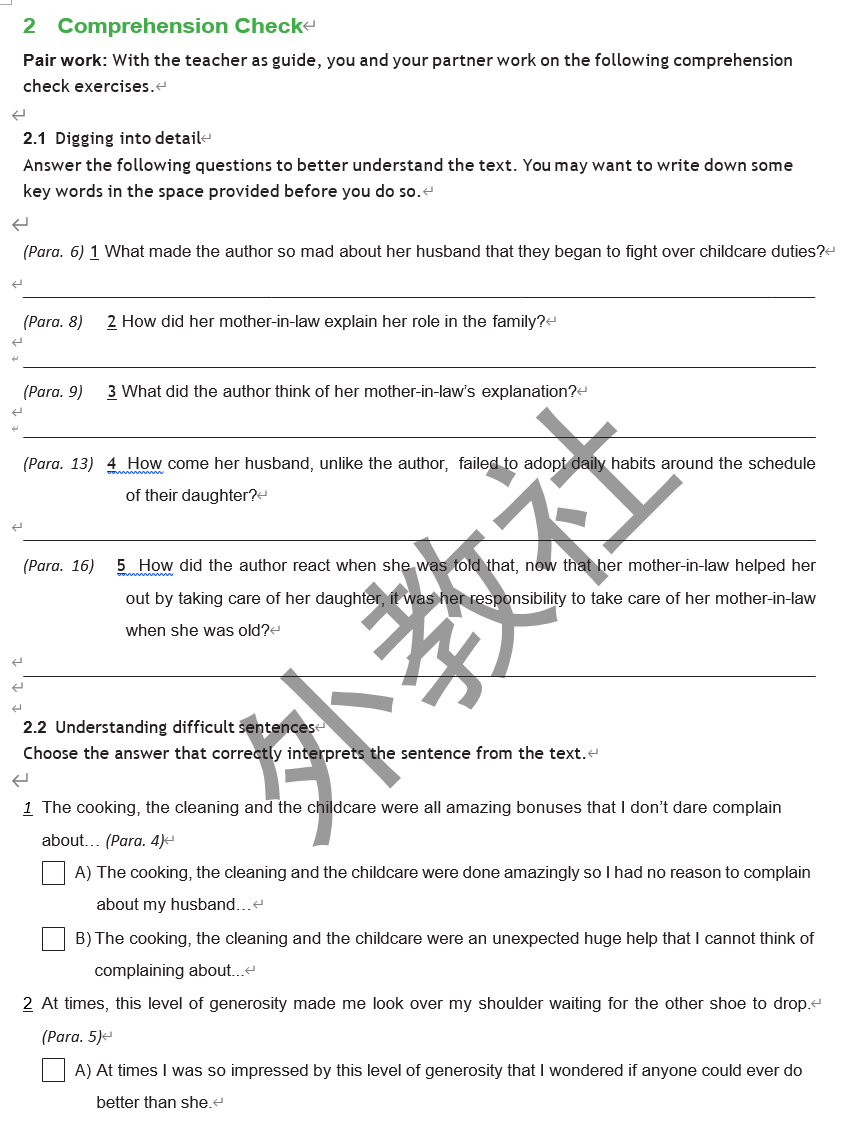
1) Try to answer the following questions at Exercise 2.1 in ComprehensionCheck on Page 68. You may underline the answers in the text or write down somekey words of each answer in the space.:
(1 )What made the author so mad about herhusband that they began to fight over childcare duties? (Para. 6)
(2) How did her mother-in-law explain her role in the family? (Para. 8)
(3) What did the author think of her mother-in-law’s explanation? (Para.9)
(4) How come her husband, unlike the author, failed to adopt dailyhabits around the schedule of their daughter? (Para. 13)
(5) How did the author react when she was told that, now that hermother-in-law helped her out by taking care of her daughter, it was herresponsibility to take care of her mother-in-law when she was old? (Para. 16)
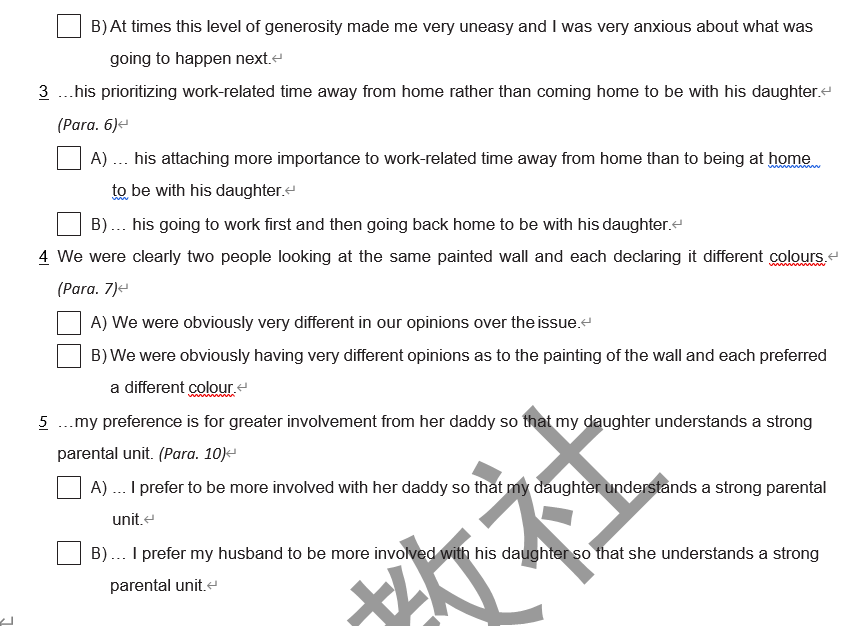
2) Try to finish Exercise 2.2 in Comprehension Check onPage 68 to check your understanding to some difficult sentences.
Task 2 Second Reading
Read the text again and fill in the blanks
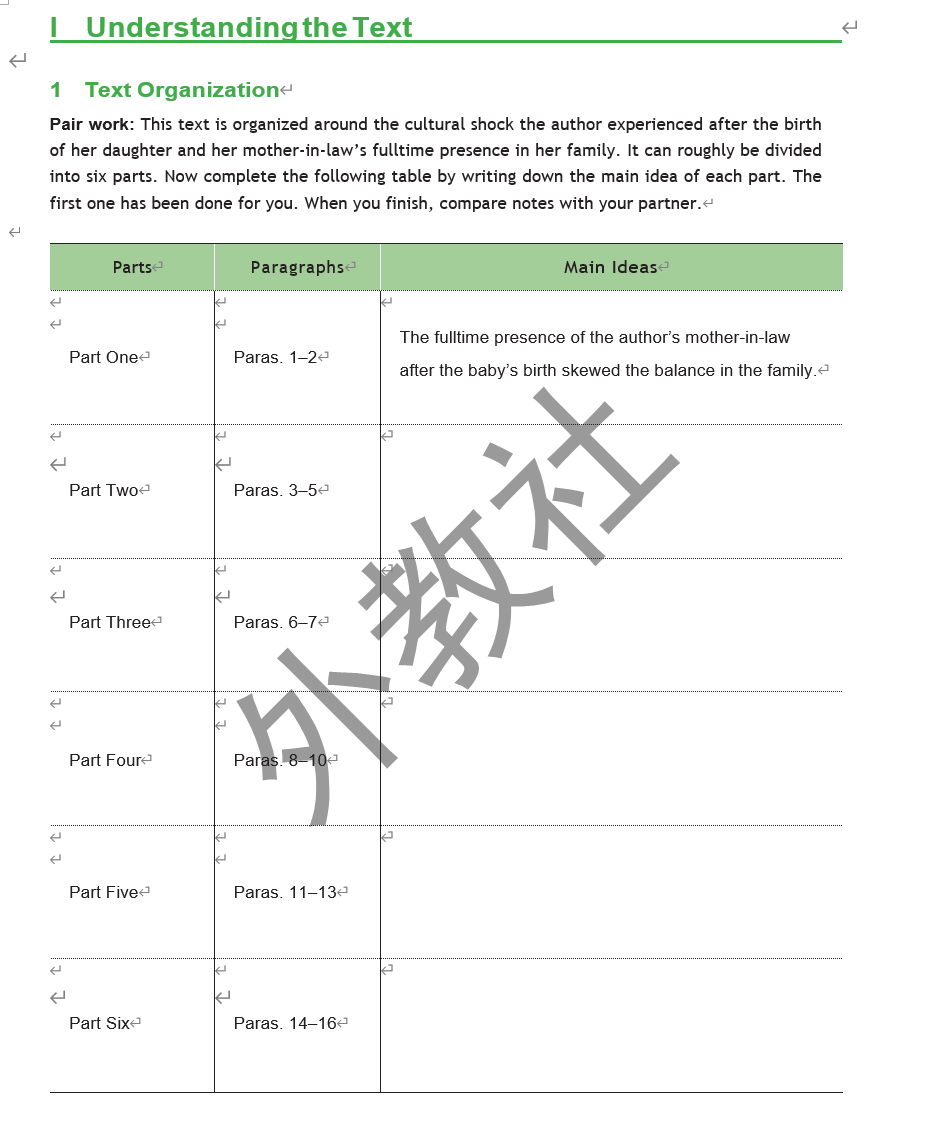
Part one. The fulltime presence of the author’smother-in-law after the baby’s birth __________________ in the family.(Paras. 1—2)
Part two. Her mother-in-law's ____________________________,even suspicious at times.. (Paras. 3—5)
Part three. The author and her husbandexperienced ________ because of their _____________________ on familyrelationship and gender equity. (Para. 6—7)
Part four. Her mother-in-law's explanationof her role in the family was a complete ____________, because the author,brought up in Canadian culture, prefers greater ________________________ inraising their daughter. (Para. 8—10)
Part five. The women at the dinner tablehelped put things _________________for the author. (Para. 11—13)
Part six. The author finally understood theChinese way of raising a child, but she is unlikely to____________________ forher mother-in-law in the future. (Para.14—16)