
Suzan-Lori Parks
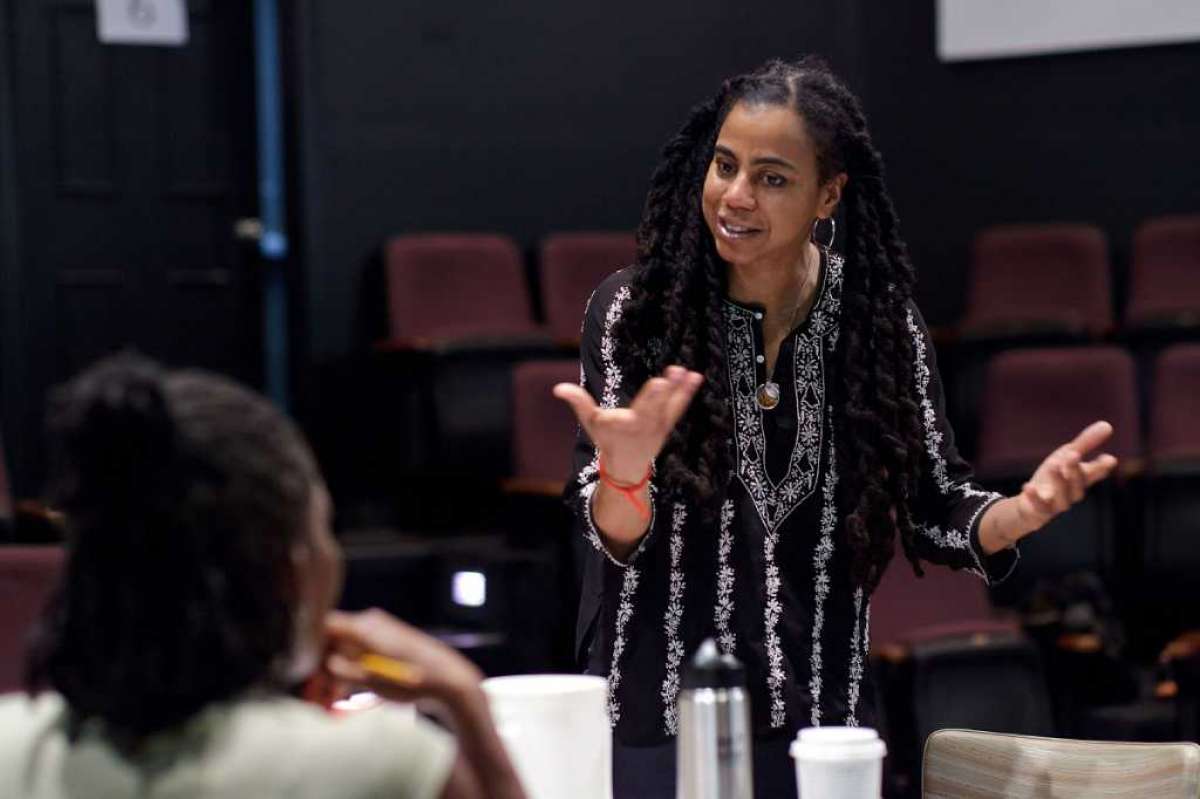
Life: Suzan-Lori Parks is a renowned American playwright, screenwriter, and novelist, celebrated for her innovative and provocative works that explore themes of race, history, identity, and the human condition. Born on May 10, 1963, in Fort Knox, Kentucky, Parks grew up in a military family, which exposed her to diverse cultures and experiences from a young age. She attended Mount Holyoke College, where she studied under the influential writer James Baldwin, who encouraged her to pursue playwriting.
Parks' work is characterized by its lyrical language, unconventional structure, and deep engagement with historical and cultural narratives. She often employs a technique she calls "rep & rev" (repetition and revision), which involves revisiting and reworking themes and motifs to uncover new meanings and perspectives.
Representative play: One of her most acclaimed plays, *Topdog/Underdog* (2001), won the Pulitzer Prize for Drama, making Parks the first African American woman to receive this honor. The play tells the story of two brothers, Lincoln and Booth, whose lives are intertwined with themes of family, ambition, and survival. Another notable work, *The America Play* (1994), explores the legacy of Abraham Lincoln and the concept of history as a performance.
Screenplays: In addition to her plays, Parks has written screenplays, including the adaptation of Zora Neale Hurston's *Their Eyes Were Watching God* for television, and novels such as *Getting Mother's Body* (2003). She has also been involved in music, collaborating with her husband, blues musician Paul Oscher, on various projects.
Parks' contributions to the arts have earned her numerous awards and accolades, including a MacArthur Fellowship (the "Genius Grant") in 2001. She continues to be a vital voice in contemporary theater, challenging audiences to rethink history and identity through her bold and imaginative storytelling.
Her work not only entertains but also provokes thought and dialogue, making her one of the most important and influential figures in modern American theater.
Suzan-Lori Parks' plays are known for their distinctive style and thematic depth. Here are some keywords and features that characterize her work:
1. Repetition & Revision (Rep & Rev)Parks often uses repetitive language and revises phrases or scenes to create layered meanings, mirroring how history and identity are constantly reinterpreted.
2. Historical Reimagining
Her plays frequently revisit and reimagine historical events or figures, such as Abraham Lincoln in The America Play or the legacy of slavery in Father Comes Home from the Wars.
3. Race & Identity
Central to her work are explorations of African American experiences, racial identity, and the legacy of systemic oppression.
4. Lyrical Language
Parks' dialogue is often poetic and musical, blending colloquial speech with rhythmic, almost song-like patterns.
5. Metatheatricality
Many of her plays self-consciously reflect on the nature of theater itself, breaking the fourth wall or using performance as a metaphor for life and history.
6. Absurdism & Surrealism
Parks incorporates absurd and surreal elements, challenging traditional narrative structures and creating dreamlike, symbolic worlds.
7. Intertextuality
Her works often reference or reinterpret classic texts, myths, or historical narratives, creating a dialogue between past and present.
8. Minimalist Staging
Parks' plays often rely on sparse, symbolic sets, allowing the language and performances to take center stage.
9. Exploration of Time
Time in her plays is often nonlinear, with past, present, and future blending together to highlight the cyclical nature of history and trauma.
10. Family & Relationships
Many of her plays, such as Topdog/Underdog, focus on complex familial dynamics, often exploring themes of love, betrayal, and survival.
11. Social & Political Commentary
Parks uses her plays to critique societal structures, including racism, capitalism, and gender inequality.
12. Humor & Irony
Despite tackling heavy themes, her work often includes dark humor and irony, creating a balance between tragedy and comedy.
13. Music & Rhythm
Influenced by her love of music, Parks infuses her plays with rhythmic dialogue and musical elements, reflecting the blues and jazz traditions.
14. Fragmentation
Her plays often feature fragmented narratives, reflecting the fractured nature of history and identity.
·
15. Empowerment & Resistance
·
Many of her characters embody resilience and resistance, challenging oppressive systems and reclaiming their narratives.
These features make Suzan-Lori Parks' work uniquely powerful, blending poetic language, historical inquiry, and social critique to create thought-provoking and transformative theater.

