
目录

  • 1 Unit 1 An Introduction
    • 1.1 3 Basic Questions
    • 1.2 What is culture?
    • 1.3 What is communication?
    • 1.4 What is intercultural communication?
    • 1.5 Application
    • 1.6 教师单元导学教学录课
    • 1.7 学生作品分享1
  • 2 Unit 2 Daily Verbal Communication (I)
    • 2.1 Form of Address
    • 2.2 Greeting
    • 2.3 Conversation Topics
    • 2.4 Visiting and Parting
    • 2.5 Application
    • 2.6 教师单元导学教学录课
    • 2.7 学生作品分享2
    • 2.8 Table Manners in Different Countries
    • 2.9 Gift in Different Countries
  • 3 Unit 3 Daily Verbal Communication (II)
    • 3.1 Daily Communication
    • 3.2 Compliments and Compliment Responses
    • 3.3 Gratitude and Apology
    • 3.4 Theory Study: Hall's Cultural Context Model
    • 3.5 Application
    • 3.6 学生作品分享3
  • 4 Unit 4 Verbal Communication
    • 4.1 Verbal Communication
    • 4.2 Language and Culture
      • 4.2.1 Bamboo-Structured Language vs Tree-Structured Language
    • 4.3 Culturally Loaded Words
    • 4.4 Proverbs
    • 4.5 Taboos
    • 4.6 Colors
    • 4.7 Animals
    • 4.8 Names
    • 4.9 Thought Patterns
    • 4.10 Application
    • 4.11 Theory Study: Sapir-whorf Hypothesis
    • 4.12 教师单元录课导学视频
    • 4.13 学生作品分享4
  • 5 Unit 5 Nonverbal Communication
    • 5.1 Importance of Nonverbal Communication
    • 5.2 Time Language--Chronemics
    • 5.3 Space Language-- Proxemics
    • 5.4 Body Language
    • 5.5 Paralanguage
    • 5.6 Application
    • 5.7 Theory Study: Kluckhohn and Strodtbeck's Model
    • 5.8 教师单元导学录课视频
    • 5.9 学生作品分享5
  • 6 Unit 6 Cross-Gender Communication
    • 6.1 Sex and Gender
    • 6.2 Feminine and Masculine Communication Cultures
    • 6.3 Understanding Cross-Gender Communication
    • 6.4 Application
    • 6.5 Theory Study: Hofstedes' cultural dimensions
    • 6.6 学生作品分享6
  • 7 Unit 7 Cultural Identity&Culture Values
    • 7.1 Cultural Identity
    • 7.2 Cultural Values
      • 7.2.1 Value Orientations
      • 7.2.2 Culture Patterns
      • 7.2.3 American Values
      • 7.2.4 Chinese Traditional Values
    • 7.3 Intercultural Personhood: An Integration of Eastern and Western Perspectives
    • 7.4 Application
    • 7.5 教师录课导学视频
    • 7.6 学生作品分享7
      • 7.6.1 Story -telling&Cultural Communication
        • 7.6.1.1 Culture Through Stories
        • 7.6.1.2 Integration-China and the world in the 21st century
        • 7.6.1.3 China in the Eyes of Foreigners
        • 7.6.1.4 A Bird's Eye View of Today's China
        • 7.6.1.5 Cloud Social Practice of Chinese Cultural Communication:Tell Chinese Stories Well
        • 7.6.1.6 Story of Telling Chinese Stories
  • 8 Unit 8 Cultural Variations and Business Styles
    • 8.1 Cultural Variations in Conducting Business
      • 8.1.1 Culture and Negotation
    • 8.2 Variations in Selecting Negotiators
      • 8.2.1 How to Talk and Observe in Negotiation
    • 8.3 Cultural Variations in Decision-Making
      • 8.3.1 How to Achieve a Win-win Solution
    • 8.4 Intercultural Business Communication and Working Practice
      • 8.4.1 America
      • 8.4.2 Britain
      • 8.4.3 France
      • 8.4.4 Germany
      • 8.4.5 Italy
      • 8.4.6 Spain
      • 8.4.7 Korea
      • 8.4.8 Japan
      • 8.4.9 Egypt
      • 8.4.10 The United Arab Emirates
      • 8.4.11 China
    • 8.5 Intercultural Communication--Comparing China to Other Countries
    • 8.6 Application
    • 8.7 学生作品分享12
    • 8.8 Reading Material
    • 8.9 Negotiation&Corporate Culture in Different Countries
      • 8.9.1 Chinese Corporate Culture
      • 8.9.2 German  Corporate Culture
      • 8.9.3 American Corporate Culture
      • 8.9.4 Japanese  Corporate Culture
      • 8.9.5 Negotiation and Culture
      • 8.9.6 How to Achieve Win-win Negotiation
    • 8.10 Intercultural Business Conflicts
    • 8.11 The Integration of Corporate Culture
  • 9 Unit 9 Intercultural Communication Competence
    • 9.1 Intercultural awareness and Transcultural Competence
    • 9.2 Cultural Shock and Cultural Adaptation
    • 9.3 Humor as a Pathway to Intercultural Communication Competence
    • 9.4 Intercultural understanding and Ways to Understand Diversity
    • 9.5 Procedures to analyze cases
    • 9.6 Assessment of IC
    • 9.7 Application
    • 9.8 学生作品分享8
    • 9.9 Reading Materials
    • 9.10 Culture in Discourse
  • 10 Unit10 Introduction to Chinese Culture
    • 10.1 Overview of Chinese Geography and Introduction to Chinese I Heritage
    • 10.2 Chinese Time System (Rule of Nature)
    • 10.3 Chinese Festivals
    • 10.4 Chinese Religion and Philosophy
    • 10.5 Chinese Science and Technology
    • 10.6 Chinese Architecture and Art
    • 10.7 Chinese Food, Kongfu and Medicine
    • 10.8 Chinese Panda Diplomacy
    • 10.9 Chinese  Dynasty
    • 10.10 Extended Study
    • 10.11 学生作品分享9
  • 11 选学Unit 11 Introduction to Culture in English-speaking Countries
    • 11.1 British Tea and Food
    • 11.2 American Tipping Custom
    • 11.3 Festivals
    • 11.4 The Story of Old English
    • 11.5 The United States on Wheels
    • 11.6 Extended Study
    • 11.7 学生作品分享10
  • 12 Unit 12 Cultural Comparison and Integration
    • 12.1 ​British Gentleman & Chinese Junzi
    • 12.2 Nations and Holidays
    • 12.3 Western & Chinese Architecture
    • 12.4 Window to the World
    • 12.5 Influence&Integration
      • 12.5.1 Marriage Across Nations
      • 12.5.2 Chinatown in the World
      • 12.5.3 Traditional Chinese Medicine in Americans' Eyes
      • 12.5.4 Adventure in Another Country
      • 12.5.5 Documentaries about China
      • 12.5.6 学生作品分享11
  • 13 选学 TEM Mock Practice
    • 13.1 TEM 4 Translation
    • 13.2 TEM8Mini-lectures from TED
  • 14 选看不算任务 中西方文化交流
    • 14.1 丝绸之路
    • 14.2 东西方文化传播
  • 15 选看不算任务  中西方文化差异
    • 15.1 文化符号
    • 15.2 建筑文化差异
    • 15.3 饮食文化差异(上)
    • 15.4 饮食文化差异(下)
    • 15.5 艺术文化差异
  • 16 选看不算任务 交际与跨文化交际
    • 16.1 交际的方式
    • 16.2 人际交际
    • 16.3 社交技巧
    • 16.4 跨文化交际礼仪
  • 17 选看不算任务 语言交际差异
    • 17.1 语言交际概述
    • 17.2 东西方语境差异
    • 17.3 东西方语言交际差异
  • 18 选看不算任务 非语言交际差异
    • 18.1 非语言交际概述
    • 18.2 体态语差异
    • 18.3 符号差异
    • 18.4 距离差异
  • 19 选看不算任务 跨文化交际障碍
    • 19.1 语言障碍(上)
    • 19.2 语言障碍(下)
    • 19.3 文化障碍(上)
    • 19.4 文化障碍(下)
  • 20 选看不算任务 跨文化交际实践
    • 20.1 文化冲突
    • 20.2 文化冲突案例分析
    • 20.3 跨文化交际原则及策略
  • 21 选看不算任务 跨文化交际经验分享
    • 21.1 跨文化交际攻略
      • 21.1.1 留学攻略
      • 21.1.2 学术攻略
      • 21.1.3 生活攻略
      • 21.1.4 求学与交际能力
      • 21.1.5 法律与安全意识
      • 21.1.6 跨文化交际收获
    • 21.2 冲突化解攻略
  • 22 选看不算任务 阅读
    • 22.1 阅读
  • 23 选看不算任务 问卷调查
    • 23.1 问卷调查
Thought Patterns
  • 1 Thought Patt...
  • 2 Case Study

So far, we have already learned different aspects about verbal communication, such as addressing, compliments, taboos and culturally loaded words, which will help you to have  better communications with people by recognizing the cultural differences with linguistic signs. While during intercultural communication, there will always be some differences that cannot be recognized or presented superficially, and these differences take roots inside our mind and play a more decisive role. They are different patterns of thought.

Sometimes, we will find people from different cultures inscrutable not because of the words or grammar they use, but the different ways of communication, or to be more exact, that’s because the different thinking patterns encouraged by that certain culture.

Thinking patterns are not born to be with us, but influenced by the cultures we live in, and people of the same race may act differently when they grow up in different cultures. This phenomenon is reflected in some movies involving intercultural communication. Now let’s firstly enjoy a video clip from the movie The Farewell, and in this video you will see different responses to the serious topic of life – death.

Ok, have you found out the different thinking patterns in this movie? Yes, they are the typical high-context thinking pattern being more indirect and euphemistic, and the typical low-context thinking pattern,  likely to be more direct and facts-oriented.

Facing the fact that her grandma has cancer, Bill, who migrated to America when she was 6 years old, advocate that grandma deserves the truth. While her parents and relatives who live in China and Japan for long time would like to keep it a secret to grandma, thinking that truth will cause a more serious suffering than the disease itself. You see, what a striking contrast between a typical Oriental thinking pattern and a Western thinking pattern.

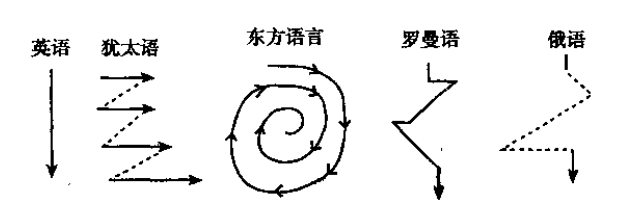
Robert Kaplan, the famous linguist, used different shapes to demonstrate different thinking patterns in different cultures. 

English           Semitic                       Oriental                  Romance                   Russian


Figure 1 Sequencing Differences by Culture

As you can see in figure 1, English-speakers were likely to be more linear and direct than Semitic individuals who solve problems using a combination of tangential and semi-direct approaches. Asians employed a circular approach, Romance cultures used a more consistently circuitous approach, and Russians used a combination of direct and circuitous approach.

Learning one language is not only learning the grammar and vocabulary, but learning the logic and problem-solving approach embedded in its culture. Understanding and appreciation of differences among cultures in cognitive processing and problem solving will be a major step towards successful intercultural communication. And for the students, it will also help you make great progress in learning in terms of listening, speaking, reading, writing, and even translation.

Differences in Cultural Thought Patterns

• A culture’s worldview(世界观), belongs to the core part of culture, for it influences all aspects of our perception and consequently affects our belief and value system as well as how we think and act.

• Eastern culture’s worlview: holistic(整体的,全盘的), Chinese philosophers emphasized the “One”, the ”blending” and the “harmony”. The notion of stressing oneness or wholeness took root in the minds of Chinese people.  intuitive wisdom

• Nature and Man are blended into one harmonious identity.(天人合一)  They stress adapting to nature instead of conquering it.

• Traditional Chinese Medicine stresses the whole human body that is compose of different parts. Being part of nature, the human body, if it isn’t functioning well, needs to be broght back into balance. So medicine has to stimulate the body’s own resources which work to restore normality.   

• Western culture’s worldview: dualistic(二元的), the ancient Greek philosophers tended to believe that the Universe is divided into two opposites and there is a clear-cut demarcation(划界) between the two: man and nature, subject and object, mind and matter, the divine and the secular(世俗). Christianity prevalent in the West helps explain this.

• Western Medicine lays emphasis on the parts that make up a man. The human body is taken as an object that can be studied and controlled.

• Reasoning is humankind’s highest faculty and achievement. There is also a strong reliance on “facts” as opposed to “opinions”.