目录

  • 1 Unit 1 An Introduction
    • 1.1 3 Basic Questions
    • 1.2 What is culture?
    • 1.3 What is communication?
    • 1.4 What is intercultural communication?
    • 1.5 Application
    • 1.6 教师单元导学教学录课
    • 1.7 学生作品分享1
  • 2 Unit 2 Daily Verbal Communication (I)
    • 2.1 Form of Address
    • 2.2 Greeting
    • 2.3 Conversation Topics
    • 2.4 Visiting and Parting
    • 2.5 Application
    • 2.6 教师单元导学教学录课
    • 2.7 学生作品分享2
    • 2.8 Table Manners in Different Countries
    • 2.9 Gift in Different Countries
  • 3 Unit 3 Daily Verbal Communication (II)
    • 3.1 Daily Communication
    • 3.2 Compliments and Compliment Responses
    • 3.3 Gratitude and Apology
    • 3.4 Theory Study: Hall's Cultural Context Model
    • 3.5 Application
    • 3.6 学生作品分享3
  • 4 Unit 4 Verbal Communication
    • 4.1 Verbal Communication
    • 4.2 Language and Culture
      • 4.2.1 Bamboo-Structured Language vs Tree-Structured Language
    • 4.3 Culturally Loaded Words
    • 4.4 Proverbs
    • 4.5 Taboos
    • 4.6 Colors
    • 4.7 Animals
    • 4.8 Names
    • 4.9 Thought Patterns
    • 4.10 Application
    • 4.11 Theory Study: Sapir-whorf Hypothesis
    • 4.12 教师单元录课导学视频
    • 4.13 学生作品分享4
  • 5 Unit 5 Nonverbal Communication
    • 5.1 Importance of Nonverbal Communication
    • 5.2 Time Language--Chronemics
    • 5.3 Space Language-- Proxemics
    • 5.4 Body Language
    • 5.5 Paralanguage
    • 5.6 Application
    • 5.7 Theory Study: Kluckhohn and Strodtbeck's Model
    • 5.8 教师单元导学录课视频
    • 5.9 学生作品分享5
  • 6 Unit 6 Cross-Gender Communication
    • 6.1 Sex and Gender
    • 6.2 Feminine and Masculine Communication Cultures
    • 6.3 Understanding Cross-Gender Communication
    • 6.4 Application
    • 6.5 Theory Study: Hofstedes' cultural dimensions
    • 6.6 学生作品分享6
  • 7 Unit 7 Cultural Identity&Culture Values
    • 7.1 Cultural Identity
    • 7.2 Cultural Values
      • 7.2.1 Value Orientations
      • 7.2.2 Culture Patterns
      • 7.2.3 American Values
      • 7.2.4 Chinese Traditional Values
    • 7.3 Intercultural Personhood: An Integration of Eastern and Western Perspectives
    • 7.4 Application
    • 7.5 教师录课导学视频
    • 7.6 学生作品分享7
      • 7.6.1 Story -telling&Cultural Communication
        • 7.6.1.1 Culture Through Stories
        • 7.6.1.2 Integration-China and the world in the 21st century
        • 7.6.1.3 China in the Eyes of Foreigners
        • 7.6.1.4 A Bird's Eye View of Today's China
        • 7.6.1.5 Cloud Social Practice of Chinese Cultural Communication:Tell Chinese Stories Well
        • 7.6.1.6 Story of Telling Chinese Stories
  • 8 Unit 8 Cultural Variations and Business Styles
    • 8.1 Cultural Variations in Conducting Business
      • 8.1.1 Culture and Negotation
    • 8.2 Variations in Selecting Negotiators
      • 8.2.1 How to Talk and Observe in Negotiation
    • 8.3 Cultural Variations in Decision-Making
      • 8.3.1 How to Achieve a Win-win Solution
    • 8.4 Intercultural Business Communication and Working Practice
      • 8.4.1 America
      • 8.4.2 Britain
      • 8.4.3 France
      • 8.4.4 Germany
      • 8.4.5 Italy
      • 8.4.6 Spain
      • 8.4.7 Korea
      • 8.4.8 Japan
      • 8.4.9 Egypt
      • 8.4.10 The United Arab Emirates
      • 8.4.11 China
    • 8.5 Intercultural Communication--Comparing China to Other Countries
    • 8.6 Application
    • 8.7 学生作品分享12
    • 8.8 Reading Material
    • 8.9 Negotiation&Corporate Culture in Different Countries
      • 8.9.1 Chinese Corporate Culture
      • 8.9.2 German  Corporate Culture
      • 8.9.3 American Corporate Culture
      • 8.9.4 Japanese  Corporate Culture
      • 8.9.5 Negotiation and Culture
      • 8.9.6 How to Achieve Win-win Negotiation
    • 8.10 Intercultural Business Conflicts
    • 8.11 The Integration of Corporate Culture
  • 9 Unit 9 Intercultural Communication Competence
    • 9.1 Intercultural awareness and Transcultural Competence
    • 9.2 Cultural Shock and Cultural Adaptation
    • 9.3 Humor as a Pathway to Intercultural Communication Competence
    • 9.4 Intercultural understanding and Ways to Understand Diversity
    • 9.5 Procedures to analyze cases
    • 9.6 Assessment of IC
    • 9.7 Application
    • 9.8 学生作品分享8
    • 9.9 Reading Materials
    • 9.10 Culture in Discourse
  • 10 Unit10 Introduction to Chinese Culture
    • 10.1 Overview of Chinese Geography and Introduction to Chinese I Heritage
    • 10.2 Chinese Time System (Rule of Nature)
    • 10.3 Chinese Festivals
    • 10.4 Chinese Religion and Philosophy
    • 10.5 Chinese Science and Technology
    • 10.6 Chinese Architecture and Art
    • 10.7 Chinese Food, Kongfu and Medicine
    • 10.8 Chinese Panda Diplomacy
    • 10.9 Chinese  Dynasty
    • 10.10 Extended Study
    • 10.11 学生作品分享9
  • 11 选学Unit 11 Introduction to Culture in English-speaking Countries
    • 11.1 British Tea and Food
    • 11.2 American Tipping Custom
    • 11.3 Festivals
    • 11.4 The Story of Old English
    • 11.5 The United States on Wheels
    • 11.6 Extended Study
    • 11.7 学生作品分享10
  • 12 Unit 12 Cultural Comparison and Integration
    • 12.1 ​British Gentleman & Chinese Junzi
    • 12.2 Nations and Holidays
    • 12.3 Western & Chinese Architecture
    • 12.4 Window to the World
    • 12.5 Influence&Integration
      • 12.5.1 Marriage Across Nations
      • 12.5.2 Chinatown in the World
      • 12.5.3 Traditional Chinese Medicine in Americans' Eyes
      • 12.5.4 Adventure in Another Country
      • 12.5.5 Documentaries about China
      • 12.5.6 学生作品分享11
  • 13 选学 TEM Mock Practice
    • 13.1 TEM 4 Translation
    • 13.2 TEM8Mini-lectures from TED
  • 14 选看不算任务 中西方文化交流
    • 14.1 丝绸之路
    • 14.2 东西方文化传播
  • 15 选看不算任务  中西方文化差异
    • 15.1 文化符号
    • 15.2 建筑文化差异
    • 15.3 饮食文化差异(上)
    • 15.4 饮食文化差异(下)
    • 15.5 艺术文化差异
  • 16 选看不算任务 交际与跨文化交际
    • 16.1 交际的方式
    • 16.2 人际交际
    • 16.3 社交技巧
    • 16.4 跨文化交际礼仪
  • 17 选看不算任务 语言交际差异
    • 17.1 语言交际概述
    • 17.2 东西方语境差异
    • 17.3 东西方语言交际差异
  • 18 选看不算任务 非语言交际差异
    • 18.1 非语言交际概述
    • 18.2 体态语差异
    • 18.3 符号差异
    • 18.4 距离差异
  • 19 选看不算任务 跨文化交际障碍
    • 19.1 语言障碍(上)
    • 19.2 语言障碍(下)
    • 19.3 文化障碍(上)
    • 19.4 文化障碍(下)
  • 20 选看不算任务 跨文化交际实践
    • 20.1 文化冲突
    • 20.2 文化冲突案例分析
    • 20.3 跨文化交际原则及策略
  • 21 选看不算任务 跨文化交际经验分享
    • 21.1 跨文化交际攻略
      • 21.1.1 留学攻略
      • 21.1.2 学术攻略
      • 21.1.3 生活攻略
      • 21.1.4 求学与交际能力
      • 21.1.5 法律与安全意识
      • 21.1.6 跨文化交际收获
    • 21.2 冲突化解攻略
  • 22 选看不算任务 阅读
    • 22.1 阅读
  • 23 选看不算任务 问卷调查
    • 23.1 问卷调查
Conversation Topics
  • 1 Conversation ...
  • 2 Video
  • 3 Practice

After learning the ways of addressing and greeting in the previous lectures, let’s come to a more interesting and complicated part of communication, which is how to initiate a conversation with people of different cultures and how to make conversations go smoothly.

 Firstly, let’s have a look at a conversation between people of different cultures. In this conversation, there are some common mistakes that usually take place in cross-cultural communication. Please try your best to figure them out. 

Conversation1:

Li works in a foreign company in Dalian, and Robert is his boss. One day, they met in the elevator.

Robert: Morning, Li.

Li: Oh, Good morning, Robert. How’s everything going?

Robert: Not too bad.

Li: Wow, I like your new watch, it must be very expensive. How much is it?

Robert: Well... it’s a birthday gift from my wife, so, in fact, I have no idea how much it is.

Li: Oh, okay.

Robert: Li, we have a new colleague from America to join us. Would you please pick her up at the airport tomorrow?

Li: No problem.

Robert: Thank you!


Conversation2:

The next day. Li went to the airport to pick up Emily Prentiss, the new colleague.

Li: Hi, Ms. Emily, I’m Li. Nice to meet you.

Emily: Nice to meet you, Li. Thank you for picking me up.

Li: You’re welcome. It’s a long journey, and you must be very tired. Sleep for a while.

Emily: Thank you. I’m fine. We can go directly to the company, and I would like to meet my new colleagues first.

Li:Okay.


Li: Emily, how old are you? You look so young.

Emily: (a little bit embarrassed) Thank you.

Li: Is this the first time of your visiting China?

Emily: Yes.

Li: Do you like China?

Emily: Definitely.

Li: Do you think Dalian is a beautiful city?

Emily: Oh, yes.

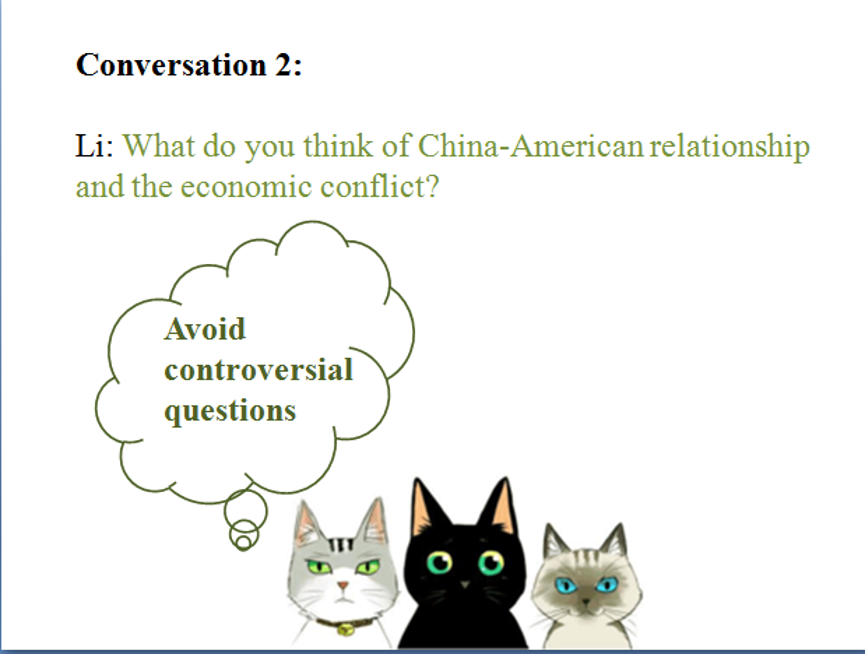
Li: What do you think of China-American relationship and the economic conflict?

Emily: Well, it’s quite a complicated question, maybe we can talk about it later when we have enough time. Do you mind my taking a nap? It’s really a long journey.

Li: Oh, of course not.


During the two conversations, Li had made 5 basic mistakes which are against the rules of cross-cultural communication.

Have you found out all the mistakes?


Have you ever made similar mistakes when having conversations with foreign friends? To become a conversationalist, let’s bear the dos and don’ts in mind when you start a conversation and keep it go smoothly without offending the other person of different cultures.


I. DON’Ts

1. Don’t stare at others or avoid eye-contact all the time.

Conversation between people should occur in a natural way, not contrived. So, pay attention to your behavior, and do not stare at the other person, nor should you try to avoid eye contact all the time.


2. Don’t ask predictable questions.

*Are you an American?

*Is this your first visit to China?

Both the two questions have predictable answers which will kill a good conversation. Avoid the questions which request only yes or no for an answer. Ask some open-ended questions.


3. Don’t choose topics that will intrude on others’ privacy.

Age, money and marriage condition are extremely private and personal questions in the west, so questions involving these topics should be avoided. If you really need to learn about this information, try to be polite by starting your question with “Would you please…?” “I don’t mean to…, but…”.


4. Don’t ask controversial questions.

Controversial topics, such as politics and religion, which may lead to unpleasant response, should also be avoided.


5. Don’t bomb questions without getting the other person’s feedbacks.

Donot fire questions at the person without giving your feedback, because nothing is worse than feeling being interviewed or interrogated. Asking too many questions will only make the other person feel uncomfortable and will leave him/her finding a way out of the conversation.


II. Dos

1. Start the conversation in a natural way, and show your concern.

Make the person you are talking with feel that you care about what he/she is saying and that his/her opinion matters to you. This will be a good start of a conversation.


2. Ask open-ended questions

Open-ended questions are questions that require more than a yes or no for an answer. Open-ended questions allow people to elaborate and create conversations.

For example:

*What do you think about the new season of the TV show?

*Why do people think Chinese is a difficult language to learn?


3. Choose general topics acceptable to both Westerners and Chinese.

Generally speaking, hobbies, weather, films or books are topics acceptable to both Westerners and Chinese.


4. Branch off yourtopics

Branch off your conversation into different topics so that your partner can always find a topic he/she is interested in. In this way, the conversation will notcome to a dead end easily.


For example, I like reading. Reading can create a peaceful atmosphere which can always make me feel satisfied. Suspense stories are my favorite.


This conversation is branched off into three parts: your hobby, your personality, and the type of books you like. It will give the other person some inspiration.


5. Tell stories instead of questioning.

Sharing your own experience will be better than questioning others all the time, and as we mentioned before, nobody likes the feeling of being interviewed. When telling your stories, try to use concise language.