
目录

  • 1 Unit 1 An Introduction
    • 1.1 3 Basic Questions
    • 1.2 What is culture?
    • 1.3 What is communication?
    • 1.4 What is intercultural communication?
    • 1.5 Application
    • 1.6 教师单元导学教学录课
    • 1.7 学生作品分享1
  • 2 Unit 2 Daily Verbal Communication (I)
    • 2.1 Form of Address
    • 2.2 Greeting
    • 2.3 Conversation Topics
    • 2.4 Visiting and Parting
    • 2.5 Application
    • 2.6 教师单元导学教学录课
    • 2.7 学生作品分享2
    • 2.8 Table Manners in Different Countries
    • 2.9 Gift in Different Countries
  • 3 Unit 3 Daily Verbal Communication (II)
    • 3.1 Daily Communication
    • 3.2 Compliments and Compliment Responses
    • 3.3 Gratitude and Apology
    • 3.4 Theory Study: Hall's Cultural Context Model
    • 3.5 Application
    • 3.6 学生作品分享3
  • 4 Unit 4 Verbal Communication
    • 4.1 Verbal Communication
    • 4.2 Language and Culture
      • 4.2.1 Bamboo-Structured Language vs Tree-Structured Language
    • 4.3 Culturally Loaded Words
    • 4.4 Proverbs
    • 4.5 Taboos
    • 4.6 Colors
    • 4.7 Animals
    • 4.8 Names
    • 4.9 Thought Patterns
    • 4.10 Application
    • 4.11 Theory Study: Sapir-whorf Hypothesis
    • 4.12 教师单元录课导学视频
    • 4.13 学生作品分享4
  • 5 Unit 5 Nonverbal Communication
    • 5.1 Importance of Nonverbal Communication
    • 5.2 Time Language--Chronemics
    • 5.3 Space Language-- Proxemics
    • 5.4 Body Language
    • 5.5 Paralanguage
    • 5.6 Application
    • 5.7 Theory Study: Kluckhohn and Strodtbeck's Model
    • 5.8 教师单元导学录课视频
    • 5.9 学生作品分享5
  • 6 Unit 6 Cross-Gender Communication
    • 6.1 Sex and Gender
    • 6.2 Feminine and Masculine Communication Cultures
    • 6.3 Understanding Cross-Gender Communication
    • 6.4 Application
    • 6.5 Theory Study: Hofstedes' cultural dimensions
    • 6.6 学生作品分享6
  • 7 Unit 7 Cultural Identity&Culture Values
    • 7.1 Cultural Identity
    • 7.2 Cultural Values
      • 7.2.1 Value Orientations
      • 7.2.2 Culture Patterns
      • 7.2.3 American Values
      • 7.2.4 Chinese Traditional Values
    • 7.3 Intercultural Personhood: An Integration of Eastern and Western Perspectives
    • 7.4 Application
    • 7.5 教师录课导学视频
    • 7.6 学生作品分享7
      • 7.6.1 Story -telling&Cultural Communication
        • 7.6.1.1 Culture Through Stories
        • 7.6.1.2 Integration-China and the world in the 21st century
        • 7.6.1.3 China in the Eyes of Foreigners
        • 7.6.1.4 A Bird's Eye View of Today's China
        • 7.6.1.5 Cloud Social Practice of Chinese Cultural Communication:Tell Chinese Stories Well
        • 7.6.1.6 Story of Telling Chinese Stories
  • 8 Unit 8 Cultural Variations and Business Styles
    • 8.1 Cultural Variations in Conducting Business
      • 8.1.1 Culture and Negotation
    • 8.2 Variations in Selecting Negotiators
      • 8.2.1 How to Talk and Observe in Negotiation
    • 8.3 Cultural Variations in Decision-Making
      • 8.3.1 How to Achieve a Win-win Solution
    • 8.4 Intercultural Business Communication and Working Practice
      • 8.4.1 America
      • 8.4.2 Britain
      • 8.4.3 France
      • 8.4.4 Germany
      • 8.4.5 Italy
      • 8.4.6 Spain
      • 8.4.7 Korea
      • 8.4.8 Japan
      • 8.4.9 Egypt
      • 8.4.10 The United Arab Emirates
      • 8.4.11 China
    • 8.5 Intercultural Communication--Comparing China to Other Countries
    • 8.6 Application
    • 8.7 学生作品分享12
    • 8.8 Reading Material
    • 8.9 Negotiation&Corporate Culture in Different Countries
      • 8.9.1 Chinese Corporate Culture
      • 8.9.2 German  Corporate Culture
      • 8.9.3 American Corporate Culture
      • 8.9.4 Japanese  Corporate Culture
      • 8.9.5 Negotiation and Culture
      • 8.9.6 How to Achieve Win-win Negotiation
    • 8.10 Intercultural Business Conflicts
    • 8.11 The Integration of Corporate Culture
  • 9 Unit 9 Intercultural Communication Competence
    • 9.1 Intercultural awareness and Transcultural Competence
    • 9.2 Cultural Shock and Cultural Adaptation
    • 9.3 Humor as a Pathway to Intercultural Communication Competence
    • 9.4 Intercultural understanding and Ways to Understand Diversity
    • 9.5 Procedures to analyze cases
    • 9.6 Assessment of IC
    • 9.7 Application
    • 9.8 学生作品分享8
    • 9.9 Reading Materials
    • 9.10 Culture in Discourse
  • 10 Unit10 Introduction to Chinese Culture
    • 10.1 Overview of Chinese Geography and Introduction to Chinese I Heritage
    • 10.2 Chinese Time System (Rule of Nature)
    • 10.3 Chinese Festivals
    • 10.4 Chinese Religion and Philosophy
    • 10.5 Chinese Science and Technology
    • 10.6 Chinese Architecture and Art
    • 10.7 Chinese Food, Kongfu and Medicine
    • 10.8 Chinese Panda Diplomacy
    • 10.9 Chinese  Dynasty
    • 10.10 Extended Study
    • 10.11 学生作品分享9
  • 11 选学Unit 11 Introduction to Culture in English-speaking Countries
    • 11.1 British Tea and Food
    • 11.2 American Tipping Custom
    • 11.3 Festivals
    • 11.4 The Story of Old English
    • 11.5 The United States on Wheels
    • 11.6 Extended Study
    • 11.7 学生作品分享10
  • 12 Unit 12 Cultural Comparison and Integration
    • 12.1 ​British Gentleman & Chinese Junzi
    • 12.2 Nations and Holidays
    • 12.3 Western & Chinese Architecture
    • 12.4 Window to the World
    • 12.5 Influence&Integration
      • 12.5.1 Marriage Across Nations
      • 12.5.2 Chinatown in the World
      • 12.5.3 Traditional Chinese Medicine in Americans' Eyes
      • 12.5.4 Adventure in Another Country
      • 12.5.5 Documentaries about China
      • 12.5.6 学生作品分享11
  • 13 选学 TEM Mock Practice
    • 13.1 TEM 4 Translation
    • 13.2 TEM8Mini-lectures from TED
  • 14 选看不算任务 中西方文化交流
    • 14.1 丝绸之路
    • 14.2 东西方文化传播
  • 15 选看不算任务  中西方文化差异
    • 15.1 文化符号
    • 15.2 建筑文化差异
    • 15.3 饮食文化差异(上)
    • 15.4 饮食文化差异(下)
    • 15.5 艺术文化差异
  • 16 选看不算任务 交际与跨文化交际
    • 16.1 交际的方式
    • 16.2 人际交际
    • 16.3 社交技巧
    • 16.4 跨文化交际礼仪
  • 17 选看不算任务 语言交际差异
    • 17.1 语言交际概述
    • 17.2 东西方语境差异
    • 17.3 东西方语言交际差异
  • 18 选看不算任务 非语言交际差异
    • 18.1 非语言交际概述
    • 18.2 体态语差异
    • 18.3 符号差异
    • 18.4 距离差异
  • 19 选看不算任务 跨文化交际障碍
    • 19.1 语言障碍(上)
    • 19.2 语言障碍(下)
    • 19.3 文化障碍(上)
    • 19.4 文化障碍(下)
  • 20 选看不算任务 跨文化交际实践
    • 20.1 文化冲突
    • 20.2 文化冲突案例分析
    • 20.3 跨文化交际原则及策略
  • 21 选看不算任务 跨文化交际经验分享
    • 21.1 跨文化交际攻略
      • 21.1.1 留学攻略
      • 21.1.2 学术攻略
      • 21.1.3 生活攻略
      • 21.1.4 求学与交际能力
      • 21.1.5 法律与安全意识
      • 21.1.6 跨文化交际收获
    • 21.2 冲突化解攻略
  • 22 选看不算任务 阅读
    • 22.1 阅读
  • 23 选看不算任务 问卷调查
    • 23.1 问卷调查
What is intercultural communication?
  • 1 Intercultural&nbs...
  • 2 Case Study
  • 3 Critical Thi...
  • 4 Discussion
  • 5 Further Study

1. Definition

Intercultural Communication studies how people from different cultural backgrounds communicate with each other. It covers knowledge from many disciplines, including psychology, philosophy, anthropology and sociology. The American anthropologist Edward T. Hall is said to be the father of Intercultural Communication. He once said that the ultimate reason for intercultural communication is to learn more about how one’s ownsystem works. So, the primary objective of this course is to arouse ourcultural awareness, build cultural confidence, and besides, be well-preparedfor intercultural communication.

2. History 

Intercultural communication is as old as history. It occurs whenever there is communication between people from different cultural backgrounds, as what happened on the Silk Road in ancient China, in Marco Polo’s stay, Monk Jianzhen’s mission to Japan, and Zheng He’s seven voyages to the Western Seas. But as a discipline, its history is rather short. The term was first proposed by Edward T. Hall in his publication The Silent Language in 1959. Ever since, it developed very fast. Because of convenient transportation systems, innovative communication systems, economic globalization and widespread migrations, it has become a necessity for college students today to know more knowledge about intercultural communication, so as to communicate effectively with people from other countries and solve problems across cultures.

3. Model of Intercultural Communication

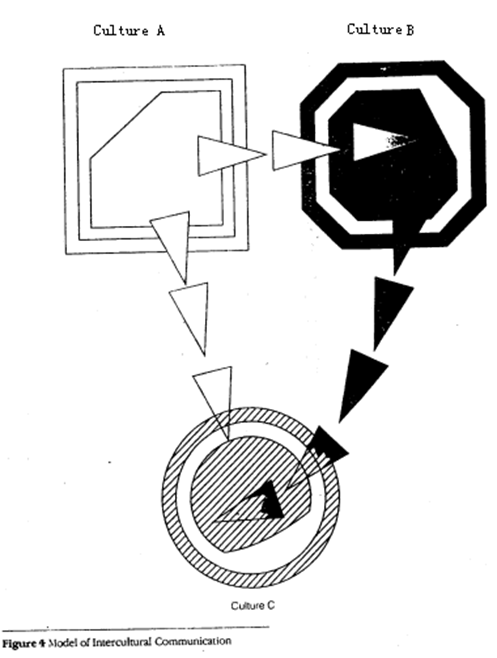
Two American scholars, Samovar and Porter, illustrated model of intercultural communication through the following picture. Culture A and culture B are closer in distance and similar in shape, one square, the other octagon. They bear more similarities compared with culture C, which is farther away and different in shape. So it will be easier for people from these two cultures to communicate with each other.

That is to say, the more similarities two cultures share, the less influence culture will have on communication. Therefore, the less messages will be changed during communication. The less the cultures are alike, the more likely the messages will be changed. Misunderstanding in intercultural communication often arises here. 
 

4. Two obstacles in intercultural communication

There are two obstacles that hinder successful intercultural communication. One is stereotype, the other is ethnocentrism.

Stereotype is a fixed idea or image that many people have of a particular type of person or thing, but which is often not true in reality. Ethnocentrism is the ideas and beliefs of one particular culture, and the using of these to judge other cultures. Both stereotypes and ethnocentrism are harmful in intercultural communication. They block us from seeing the goodness in other cultures, even lead us to errors in decision making that may carry the potential for negative consequences.