综合商务英语 (二)

赵紫君、匡颖、彭祥英

目录

  • 1 课程介绍
    • 1.1 (开学前必读)学习方法指南
    • 1.2 教学大纲
    • 1.3 教学日历
    • 1.4 教学设计和考核方式
    • 1.5 演讲技巧和评分标准
  • 2 语音学习任务
    • 2.1 Phonetic Symbol
  • 3 Unit 1 The business of Language and the language of business
    • 3.1 导学任务单
    • 3.2 Activation
    • 3.3 Text I A World Empire by Other Means
    • 3.4 Text I Language Exercise and Further Discussion
    • 3.5 Text I 补充学习 I
    • 3.6 Text I 补充学习 II
    • 3.7 Text II Talking Business? Watch your language
    • 3.8 Grammar and Exercise
    • 3.9 项目任务(1)优秀视频展示
    • 3.10 第一单元知识点整理
  • 4 Unit 2 Bridging the Cross-cultural Gap
    • 4.1 导学任务单
    • 4.2 Activation
    • 4.3 Activation-补充
    • 4.4 Text II 课前任务
    • 4.5 Text II How to Negotiate Across Culture
    • 4.6 Quiz on Text II
    • 4.7 Text II 补充学习
    • 4.8 Text III
    • 4.9 Text III 补充学习
    • 4.10 Grammar and Exercise
  • 5 Unit 3 College Education
    • 5.1 导学任务单
    • 5.2 Activation
      • 5.2.1 “习总书记谈大学之道”翻译题中的近义词辨析学生讲解视频
    • 5.3 Text I Warm-up Activities
    • 5.4 Text I 自学内容
    • 5.5 Text I Part I 课上任务
    • 5.6 Text I Part II 课上任务
    • 5.7 Text I Part III 课上任务
    • 5.8 Text I-III参考译文
    • 5.9 Quiz on Text I
    • 5.10 微课视频学习
    • 5.11 Text III
    • 5.12 Grammar
    • 5.13 Writing skills
  • 6 Unit 6 A Flat World
    • 6.1 导学任务单
    • 6.2 Activation 1
    • 6.3 Activation 2
    • 6.4 Text I -Structure Analysis
    • 6.5 Text I-Part 1
    • 6.6 Text I- Part 2
    • 6.7 Text I -Part 3
    • 6.8 Text I -Part 4
    • 6.9 Text I - Part 5
    • 6.10 Overview of Text I
    • 6.11 Complementary learning of Text I
    • 6.12 Glocalization
    • 6.13 Grammar
    • 6.14 Writing
    • 6.15 Intercultural Business Communication Skills
  • 7 Unit 7 Is There a Golden Rule in Business?
    • 7.1 导学任务单
    • 7.2 Activation
    • 7.3 Text II Pre-reading Tasks
    • 7.4 Text II Notes
    • 7.5 Text II Comprehension Check
    • 7.6 Unit 7 Text translation
    • 7.7 Case Study
  • 8 Unit 8 Economy and Trade in a Changing World
    • 8.1 导学任务单
  • 9 专四辅导
    • 9.1 Cloze
  • 10 优秀作品展示区
    • 10.1 模仿
    • 10.2 作文
    • 10.3 项目任务
    • 10.4 复杂句分析
  • 11 TEM-4 专项语法
    • 11.1 第一节
    • 11.2 第二节
    • 11.3 第三节
    • 11.4 第四节
    • 11.5 第五节
    • 11.6 第六节
    • 11.7 第七节
    • 11.8 第八节
    • 11.9 第九节
    • 11.10 第十节
    • 11.11 第十一节
    • 11.12 第十二节
    • 11.13 第十三节
    • 11.14 第十四节
    • 11.15 第十五节
    • 11.16 Test 1
Activation
  • 1 语言与知识学习
  • 2 Pre-reading ...

I. Vocabularies and Phrases

Directions: Study the following vocabularies and phrases. And then finish the exercise below. 

补充:

  • take advantage of sb. (para.2)

    to exploit or use someone unfairly for one's own benefit. It often implies that the person being taken advantage of is in a weaker position or is unaware of the exploitation.

    e.g. Lisa felt betrayed when she realized that her so-called friend had only been taking advantage of her generosity to get free meals.

  • early on (para.2)

    at an early stage of a situation, relationship, period of time, etc.

    e.g. I knew quite early on that I wanted to marry her.

  • live through ... (para.3)

    to experience or endure a difficult or challenging situation. It implies that the person has successfully navigated and survived the ordeal.

    e.g. Despite the hardships of war, my grandparents managed to live through those turbulent times and build a better future for themselves and their family.

  • break out of sth. (para.3)

    to escape from a confining or restrictive situation, often abruptly and forcefully

    e.g. After years of feeling trapped in her mundane routine, Sarah finally summoned the courage to break out of her comfort zone and pursue her lifelong dreams of traveling the world.

  • fat commissions (para. 9)

    significant or substantial amounts of money earned as compensation for sales or services rendered

    e.g. Working as a real estate agent in the luxury market, Sarah was able to earn fat commissions on high-end property sales.

  • tail between one's legs (para. 12) 

    embarrassed or unhappy because you have failed or been defeated

    e.g. I made a bunch of money and lost it, and then came back to New York City with my tail between my legs, essentially.

  • come up with (para. 17)

    [no passive] to suggest or think of an idea or plan

    e.g. She's come up with some amazing scheme to double her income.

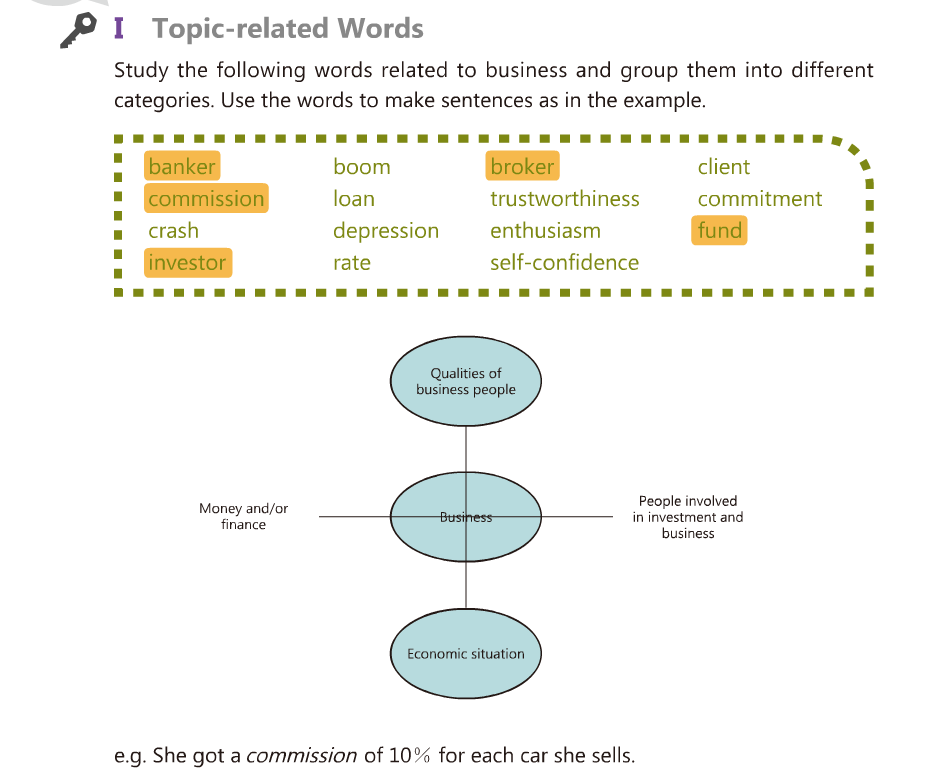
    II. Topic-related Words


    See page 203 in your textbook.

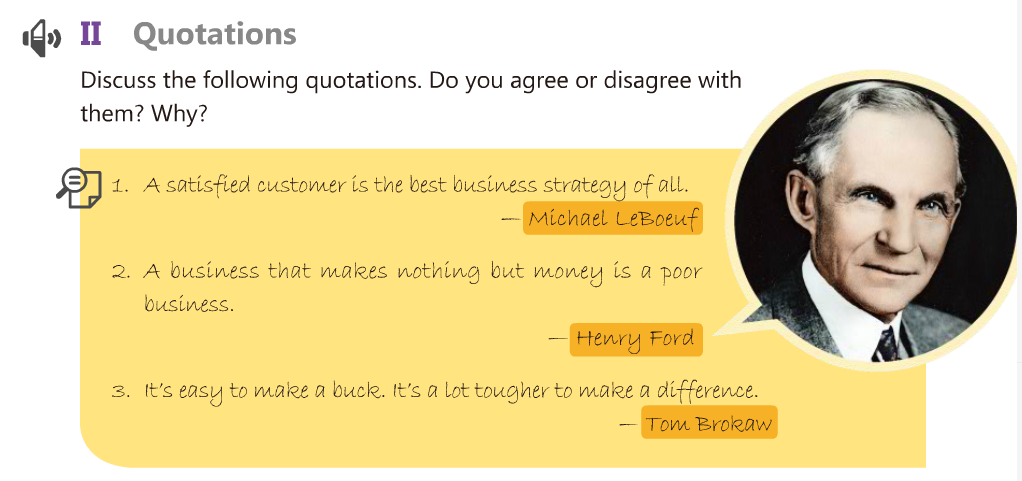
III. Qotations

See page 203 in your textbook.