
目录

  • 1 Unit 1 A Class Act
    • 1.1 Keys and answers
    • 1.2 Paraphrasing sentences
    • 1.3 assignments
    • 1.4 listening exercise
    • 1.5 Episode: middle construction
    • 1.6 Episode: eat the frog
  • 2 Unit 2 Bards of the Internet
    • 2.1 Keys and answers
    • 2.2 Paraphrasing sentences
    • 2.3 assignment
    • 2.4 listening exercise
    • 2.5 Episode: last name effect
    • 2.6 Episode: Korea vs Corea
    • 2.7 Episode: Occam’s razor
  • 3 Unit 3 On Reading
    • 3.1 keys and answers
    • 3.2 paraphrasing sentences
    • 3.3 assignment
    • 3.4 listening exercise 1: talk
    • 3.5 listening exercise 2: mini-lecture
    • 3.6 Grammar: the way+clause
    • 3.7 Phrase: do justice to
    • 3.8 Episode: Chicken soup for soul
    • 3.9 Episode: CFC vs RFC
    • 3.10 Fun time: what are u thinking about?
  • 4 A mini-lecture on 'mini-lecture'
    • 4.1 PPT slides
    • 4.2 listening exercise: 2016 mini-lecture
  • 5 Unit 4 Matriculation Fixation
    • 5.1 keys and answers
    • 5.2 paraphrasing sentences
    • 5.3 Phrase: wear+X
    • 5.4 Use: feign
    • 5.5 Video: glottal stop
    • 5.6 Video: flap /t/ in AmE
    • 5.7 assignment
    • 5.8 listening exercise
    • 5.9 S1 paragraph 12
  • 6 Unit 12 Disney World
    • 6.1 keys and answers
    • 6.2 paraphrasing sentences
    • 6.3 assignment
    • 6.4 listening exercise
  • 7 Unit 5 A Few Kind Words For Superstitions
    • 7.1 keys and answers
    • 7.2 paraphrasing sentences
    • 7.3 Episode: where do superstitions come form
    • 7.4 Episode: why supersititons good for you
    • 7.5 Add-on: 短文改错训练和技巧
  • 8 Unit 9 How to grow old
    • 8.1 keys and answers
    • 8.2 paraphrasing sentences
    • 8.3 200+ Ways to Describe Death & Dying
    • 8.4 Episode: kick the bucket
  • 9 Unit 7 I'd rather be black than female
    • 9.1 keys and answers
    • 9.2 paraphrasing sentences
    • 9.3 Listening comprehension
    • 9.4 keys to listening comprehension
    • 9.5 N-N vs Adj-N compounding
    • 9.6 Episode:Eponyms
  • 10 期末补充练习
    • 10.1 6月11日 周二 听力训练
    • 10.2 6月13日 周四 课堂训练
  • 11 期末考试题型和分值
    • 11.1 题型和分值
Episode: eat the frog

Meaning behind "Eat the frog"

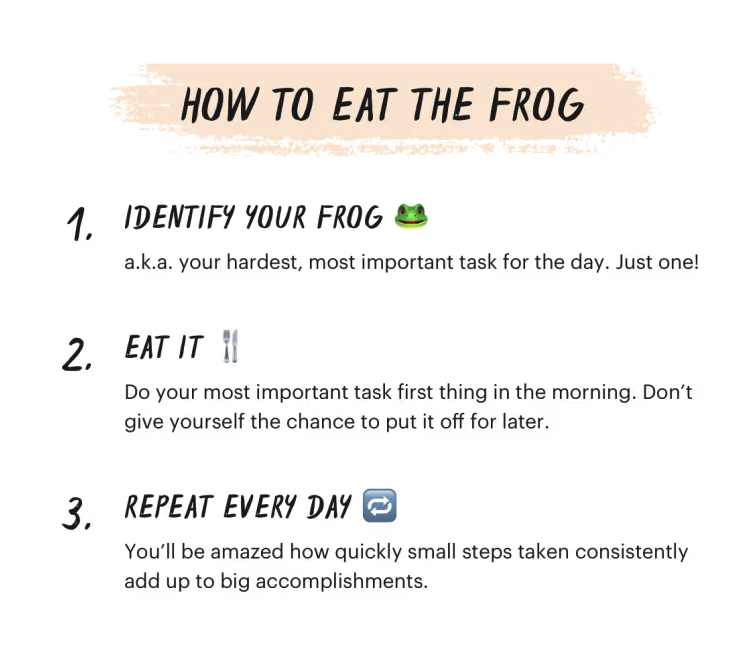
'Eat the frog' is a productivity metaphor that means to start your day by completing your biggest, most important or most dreaded task first thing in the morning, before doing anything else.

The phrase refers to the idea that if the first thing you do each morning is to "eat a live frog," which is probably the worst thing you'll have to do all day, it will give you a huge sense of accomplishment and relief, and the rest of your tasks for the day will seem easier in comparison.

The concept was popularized by Brian Tracy in his book "Eat That Frog!" and is based on a quote attributed to Mark Twain: "If it's your job to eat a frog, it's best to do it first thing in the morning. And if it's your job to eat two frogs, it's best to eat the biggest one first."

By prioritizing and knocking out your biggest challenge early, you avoid procrastination and increase your productivity for the rest of the day. It helps overcome the tendency to procrastinate on complex or unpleasant tasks.
参考:https://todoist.com/zh-CN/productivity-methods/eat-the-frog