Section A Word Bank
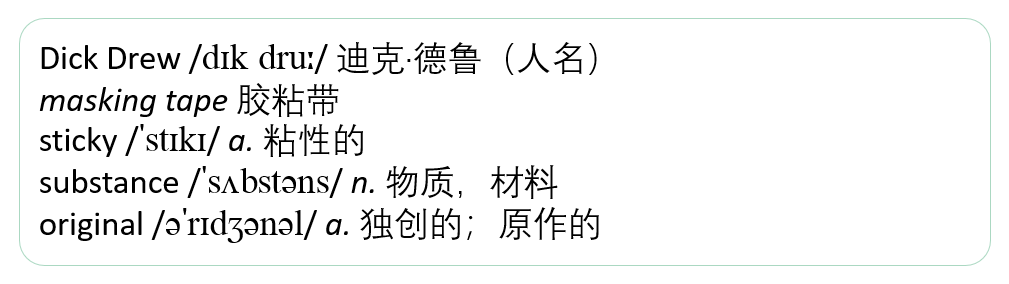
In this section you will hear a short passage about creativity. The following words maybe of some help.
Choose the best answer to complete each of the following sentences according to the information contained in the listening passage.
Listen to the recording again and fill in each of the following blanks according to what you have heard.
Script
Creativity is the key to a brighter future, say education and business experts. Here is how schools and companies can encourage this vital skill in people.
If Dick Drew had listened to his boss in 1925, we might not have aproduct that we now think of as practically essential: masking tape. Drew worked for the company known as 3M. At work, he developed a sticky-side substance strong enough to hold things together. But his boss told him not to pursue the idea. Finally, using his own time, Drew perfected the tape, which now is used everywhere. Now 3M learned from its mistake and encourages people to spend 15 percent of their work time just thinking and developing new ideas. Experts say if we teach our students to think creatively, they will be able to function better in tomorrow's society.
Creativity is not a natural ability, nor is it necessarily a characteristic of high intelligence. Just because a person is highly intelligent does not mean that he or she is creative. Creativity is a matter of using the resources one has to produce original ideas that are good for something.
Unfortunately, some schools have not tended to promote creativity. With a strong emphasis on test scores, many educators sacrifice creativity for correct answers. The result is that students can give back information but can't recognize ways to apply it to new situations.
In some other schools, however, educators are trying their best to encourage creativity in their students. Some teachers are combining the basics with activities where the students must use their imagination. For example, instead of simply asking WHEN Columbus discovered the New World, teachers might ask students: “If you had been Columbus, how would you have planned your trip from Europe to the New World at that time?” Answers from students may seem silly, but it's OK because being silly is sometimes an essential step toward creativity.