Three Communiqués
From Wikipedia, the free encyclopedia
The Three Communiqués or Three Joint Communiqués (Chinese: 三个联合公报) are a collection of three joint statements made by the governments of the United States and the People's Republic of China (P.R.C.). The communiqués played a crucial role in the establishment of relations between the U.S. and the P.R.C. and continue to be an essential element in dialogue between the two states, along with the Six Assurances and Taiwan Relations Act.[1]
Contents
1st[edit]
 | Wikisource has original text related to this article: |
The first communiqué (February 28, 1972), known as the Shanghai Communiqué, summarizes the landmark dialogue begun by President Richard Nixon and Premier Zhou Enlai during February 1972. Some of the issues addressed in this communiqué include the two sides' views on Vietnam, the Korean Peninsula, India and Pakistan and the Kashmir region, and perhaps most importantly, the Taiwan (Republic of China) issue (i.e., Taiwan's political status). Essentially, both sides agreed to respect each other's national sovereignty and territorial integrity. The United States formally acknowledged that "all Chinese on either side of the Taiwan Strait maintain there is but one China".
The use of the word "acknowledge" (rather than "accept") is often cited as an example of the United States' ambiguous position regarding the future of Taiwan.[1]
2nd[edit]
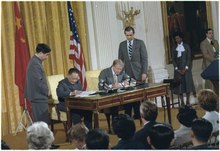
Deng Xiaoping and Jimmy Carter during the Sino-American signing ceremony
| Wikisource has original text related to this article: Joint Communiqué on the Establishment of Diplomatic Relations |
The second communiqué (January 1, 1979), the Joint Communiqué on the Establishment of Diplomatic Relations, formally announces the commencement of normal relations between the United States and the People's Republic of China. In so doing, the United States recognized that the government of the People's Republic of China was the sole legal government of China. In addition, the United States government declared that it would end formal political relations with the Republic of China ("Taiwan") while preserving economic and cultural ties. Both sides reaffirmed their wish to reduce the risk of international conflict as well as avoidance of hegemony of any nation in the Asia-Pacific region.
3rd[edit]
| Wikisource has original text related to this article: |
The third and final communiqué (August 17, 1982), also known as August 17th communiqué, reaffirms the desire of both sides to further strengthen economic, cultural, educational, scientific, and technological ties. Both sides also reaffirmed the statements made about the Taiwan issue in the previous communiqué. Although no definitive conclusions were reached on the issue of arms sale to Taiwan, the United States did declare its intent to gradually decrease its sale of arms to Taiwan.
A declassified cable sent on July 10, 1982 from Secretary of State Lawrence Eagleburger to AIT director James R. Lilley explained that reducing arms sales to Taiwan would be contingent on the commitment of the PRC to a peace across the Taiwan Strait.[2] Afterwards, the US unilaterally complemented the third communique by issuing the Six Assurances to Taiwan.
See also[edit]
References[edit]
^ a b deLisle, Jacques. "Trump, Tsai, and the Three Communiques: Prospects for Stability in US-China-Taiwan Relations". Foreign Policy Research Institute. Retrieved January 10, 2021.
^ "Declassified Cables: Taiwan Arms Sales & Six Assurances (1982)". American Institute in Taiwan. Retrieved January 10, 2021.
管辖权:立法、行政、司法
立法:法国人的例子,汽车
行政:艾希曼的例子,本拉登的例子
司法:民事、刑事
民事:被告所在地,英美国家可以是偶然就有管辖权,大陆法系国家获得管辖权的基础大多要有惯常居所。
刑事:主观所在地与客观所在地
苏格兰洛克比空难?
荷花号:
