目录

  • 1 Unit1 Making People's Life Better
    • 1.1 Objectives 学习目标
      • 1.1.1 Unit Objectives (单元目标)
      • 1.1.2 Task for the Unit (单元任务)
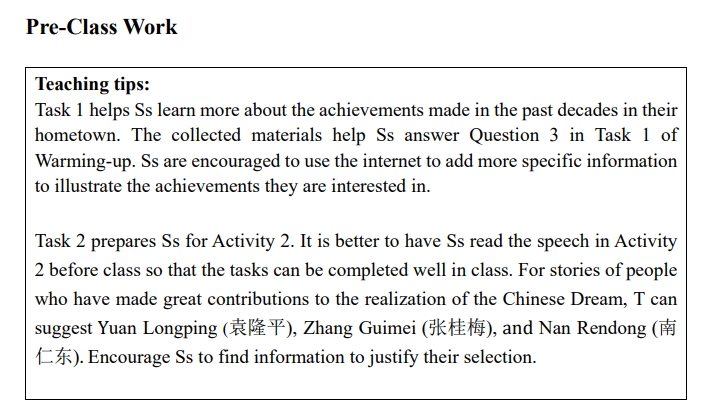
    • 1.2 Pre-Class Work (课前准备)
      • 1.2.1 Ideological and Political Elements of the Unit (单元思政元素挖掘)
      • 1.2.2 Topic Background (话题背景知识)
    • 1.3 Warming-up (热身练习)
      • 1.3.1 Oral Activities (口语活动)
      • 1.3.2 Pronunciation Practice (发音练习)
    • 1.4 Understanding Contemporary China (理解当代中国)
      • 1.4.1 Test Analysis (课文分析)
      • 1.4.2 Theme Input (主题内容输入)
    • 1.5 Understanding Public Speaking (理解公共演讲)
      • 1.5.1 Public Speaking Skills (演讲技巧)
      • 1.5.2 Learning from Examples (演讲范例)
    • 1.6 Making Your Voice Heard (传播中国声音)
      • 1.6.1 Students' Language Output Presentation(学生语言产出成果展示)
      • 1.6.2 Speech Samples (演讲实例)
    • 1.7 Language Bank (语言库)
      • 1.7.1 Related Expressions (相关表述)
      • 1.7.2 Reading materials (阅读拓展)
    • 1.8 Unit Test (单元测试)
    • 1.9 Unit Assessment (单元评价)
  • 2 Unit 2 Upholding the Core Socialist Values
    • 2.1 Objectives 学习目标
      • 2.1.1 Unit Objectives(单元目标)
      • 2.1.2 Task for the Unit (单元任务)
    • 2.2 Pre-Class Work (课前准备)
      • 2.2.1 Ideological and Political Elements of the Unit (单元思政元素挖掘)
      • 2.2.2 Topic Background (话题背景知识)
    • 2.3 Warming-up (热身练习)
      • 2.3.1 Oral Activities (口语活动)
      • 2.3.2 Pronunciation Practice (发音练习)
    • 2.4 Understanding Contemporary China (理解当代中国)
      • 2.4.1 Test Analysis (课文分析)
      • 2.4.2 Theme Input (主题内容输入)
    • 2.5 Understanding Public Speaking (理解公共演讲)
      • 2.5.1 Public Speaking Skills (演讲技巧)
      • 2.5.2 Learning from Examples (演讲范例)
    • 2.6 Making Your Voice Heard (传播中国声音)
      • 2.6.1 Students' Language Output Presentation(学生语言产出成果展示)
      • 2.6.2 Speech Samples (演讲实例)
    • 2.7 Language Bank (语言库)
      • 2.7.1 Related Expressions (相关表述)
      • 2.7.2 Reading materials (阅读拓展)
    • 2.8 Unit Test (单元测试)
    • 2.9 Unit Assessment (单元评价)
  • 3 Unit3 Boosting Cultural Confidence
    • 3.1 Objectives 学习目标
      • 3.1.1 Unit Objectives(单元目标)
      • 3.1.2 Task for the Unit (单元任务)
    • 3.2 Pre-Class Work (课前准备)
      • 3.2.1 Ideological and Political Elements of the Unit (单元思政元素挖掘)
      • 3.2.2 Topic Background (话题背景知识)
    • 3.3 Warming-up (热身练习)
      • 3.3.1 Oral Activities (口语活动)
      • 3.3.2 Pronunciation Practice (发音练习)
    • 3.4 Understanding Contemporary China (理解当代中国)
      • 3.4.1 Test Analysis (课文分析)
      • 3.4.2 Theme Input (主题内容输入)
    • 3.5 Understanding Public Speaking (理解公共演讲)
      • 3.5.1 Public Speaking Skills (演讲技巧)
      • 3.5.2 Learning from Examples (演讲范例)
    • 3.6 Making Your Voice Heard (传播中国声音)
      • 3.6.1 Students' Language Output Presentation(学生语言产出成果展示)
      • 3.6.2 Speech Samples (演讲实例)
    • 3.7 Language Bank (语言库)
      • 3.7.1 Related Expressions (相关表述)
      • 3.7.2 Reading materials (阅读拓展)
    • 3.8 Unit Test (单元测试)
    • 3.9 Unit Assessment (单元评价)
  • 4 Unit 4 Making Development People-Centered
    • 4.1 Objectives 学习目标
      • 4.1.1 Unit Objectives (单元目标)
      • 4.1.2 Task for the Unit(单元任务)
    • 4.2 Pre-class Work(课前准备)
      • 4.2.1 Ideological and Political Elements of the Unit(单元思政元素挖掘)
      • 4.2.2 Topic Background (话题背景知识)
    • 4.3 Warming-up (热身练习)
      • 4.3.1 Oral Activities (口语活动)
      • 4.3.2 Pronunciation Practice(发音练习)
    • 4.4 Undstanding Contemporary China(理解当代中国)
      • 4.4.1 Text Analysis(课文分析)
      • 4.4.2 Theme Input (主题内容输入)
    • 4.5 Understanding Public Speaking(理解公共演讲)
      • 4.5.1 Public Speaking Skills(演讲技巧)
      • 4.5.2 Learning from Examples(演讲范例)
    • 4.6 Making Your Voice Heard(传播中国声音)
      • 4.6.1 Students' Language Output Presentation(学生语言产出成果展示)
      • 4.6.2 Speech Sample(演讲实例)
    • 4.7 Language Bank(语言库)
      • 4.7.1 Related Expressions(相关表述)
      • 4.7.2 Extended Reading Materials(拓展阅读)
    • 4.8 Unit Test(单元测试)
    • 4.9 Unit Assessment(单元评价)
  • 5 Unit5 Furthering Reform and Opening Up
    • 5.1 Objectives 学习目标
      • 5.1.1 Unit Objectives (单元目标)
      • 5.1.2 Task for the Unit(单元任务)
    • 5.2 Pre-class Work(课前准备)
      • 5.2.1 Ideological and Political Elements of the Unit(单元思政元素挖掘)
      • 5.2.2 Topic Background (话题背景知识)
    • 5.3 Warming-up (热身练习)
      • 5.3.1 Oral Activities (口语活动)
      • 5.3.2 Pronunciation Practice(发音练习)
    • 5.4 Undstanding Contemporary China(理解当代中国)
      • 5.4.1 Text Analysis(课文分析)
      • 5.4.2 Theme Input (主题内容输入)
    • 5.5 Understanding Public Speaking(理解公共演讲)
      • 5.5.1 Public Speaking Skills(演讲技巧)
      • 5.5.2 Learning from Examples(演讲范例)
    • 5.6 Making Your Voice Heard(传播中国声音)
      • 5.6.1 Students' Language Output Presentation(学生语言产出成果展示)
      • 5.6.2 Speech Sample(演讲实例)
    • 5.7 Language Bank(语言库)
      • 5.7.1 Related Expressions(相关表述)
      • 5.7.2 Extended Reading Materials(拓展阅读)
    • 5.8 Unit Test(单元测试)
    • 5.9 Unit Assessment(单元评价)
Pre-Class Work (课前准备)


2016“外研社杯”大学生英语挑战赛决赛现场,外交部翻译司姚梦瑶女士以“国际人才:英语能力、爱国情怀、国际视野”为题进行了一次温暖的分享,为大家讲述在一名外交官眼中,“国际人才”需要具备哪些要素。


金句合集:


■  On a serious note, what do we learn from debating. 


I see in all the contestants the quality of being aspiring, adaptable and absorbed, three As.


■ Debating nurtures an inquisitive mind and a compassionate heart. You wake up every morning with a genuine interest to explore and embrace something new, to excel at school, at work and in life full of hope and drive, for a larger purpose.


■ To become the best that you can be, you need to give it your all.


■ I learned that language is more than syllables and rhymes. It is a tool for communication. It connects people, bridges different cultures and brings hearts and minds closer. It. As Chinese, we speak English to make our voice heard, loud and clear, to make our narratives more compelling, more convincing, and more appealing.


■ I learned that debating is more about reasoning, not arguing. It’s as much about getting your message across as listening to what others have to say. It’s more about being open-minded and tolerant than outwitting others or winning the game. Ignite curiosity and inspire action. That’s what debating is all about.