目录

  • 1 第一课时
    • 1.1 Course Objectives
    • 1.2 Reading Research Articles
      • 1.2.1 Understanding the characteristics of a research article
      • 1.2.2 Reading titles for prediction
    • 1.3 Writing Research Articles
      • 1.3.1 Writing a working title
        • 1.3.1.1 Components of a title
        • 1.3.1.2 Titles in 4 grammatical constructions
        • 1.3.1.3 Writing techniques
    • 1.4 Literature Retrieval (文献检索)
    • 1.5 Keywords
  • 2 Abstract
    • 2.1 Reading the abstract
    • 2.2 Writing an abstract
      • 2.2.1 Formality
      • 2.2.2 Tense
  • 3 Introduction
    • 3.1 Reading the introduction
    • 3.2 Writing the introduction
      • 3.2.1 Writing the initial sentences in the introduction
      • 3.2.2 Expressing the objective or purpose
      • 3.2.3 Turning the research question into the objective
      • 3.2.4 Indicating the gap to be filled
      • 3.2.5 Postulating the hypothesis
    • 3.3 Bridging Course (衔接课程为自主学习部分)
      • 3.3.1 Vocabulary
      • 3.3.2 Paraphrase
      • 3.3.3 Listening comprehension
  • 4 Literature review
    • 4.1 Literature review
    • 4.2 Bridging courses
      • 4.2.1 Grammar
    • 4.3 Compilation of literature (如何整理文献)
  • 5 Methods section
    • 5.1 Writing methods section
  • 6 Results section
    • 6.1 Writing results section
  • 7 Discussion and conclusion
    • 7.1 Writing discussion section
  • 8 Lingusitic features of academic articles
    • 8.1 Nominalization
    • 8.2 The use of single , formal verbs
    • 8.3 Premodification (前置限定语)
    • 8.4 Hedging expressions.(definition 定义))
      • 8.4.1 Types of hedging expressions (类别)
    • 8.5 Impersonal structure
  • 9 Academic skills
    • 9.1 Paraphrase (转述)
    • 9.2 Definition
      • 9.2.1 Definition :  Flipped classroom model  (翻转课堂模式)
    • 9.3 Summary
      • 9.3.1 Identifying the main ideas  and topic sentences
      • 9.3.2 Writing a summary
        • 9.3.2.1 Reporting verbs
          • 9.3.2.1.1 Tense of Reporting verbs
          • 9.3.2.1.2 Functions of Reporting verbs
          • 9.3.2.1.3 Three  Academic Contexts (situations)
    • 9.4 Synthesizing
      • 9.4.1 Summary and Synthesis
        • 9.4.1.1 Refutation of an argument  (批驳类作文写法)
    • 9.5 Citation
      • 9.5.1 Citation
        • 9.5.1.1 Citation types
        • 9.5.1.2 Citation methods
          • 9.5.1.2.1 Quotations
          • 9.5.1.2.2 Summarizing
          • 9.5.1.2.3 Paraphrasing
        • 9.5.1.3 Citation function
        • 9.5.1.4 Verbs used to report past studies
  • 10 Academic integrity
    • 10.1 How to avoid plagiarism
  • 11 Academic Listening
    • 11.1 Listening strategy1
      • 11.1.1 Identifying the topic of a lecture
        • 11.1.1.1 Watch the video clip and do the following comprehensive exercise
      • 11.1.2 Listening strategy2
        • 11.1.2.1 Identify the signal language (textbook p80))
        • 11.1.2.2 Identifying the type of introduction.
        • 11.1.2.3 Understanding definition
  • 12 Academic lecture
    • 12.1 Oral presentation
      • 12.1.1 Paying attention to the introduction.
        • 12.1.1.1 How to open a presentation(textbook p76)这不是任务点不用做,对演讲展示感兴趣的同学可以看,不感兴趣可以不用看
  • 13 Review
    • 13.1 Review
Reading the introduction


Reading the introduction 

The introduction section of a research article not only introduces the background information of the topic it will discuss, but also summaries and outlines the main points of the article . The most important sentences in the introduction are towards the end where the thesis statement is often expressed by using such phrases as "The thesis of this article is " , "This article will argue that " or "The objective of the study/research  is ... " In addition to the thesis , the introduction section outlines methods and structures of the article . This paves the way for a better understanding of the article .


What should your introduction include ? 

Introduction presents a proposal the writer makes to the reader .An introduction for a research paper should announce your paper's topic and purpose .

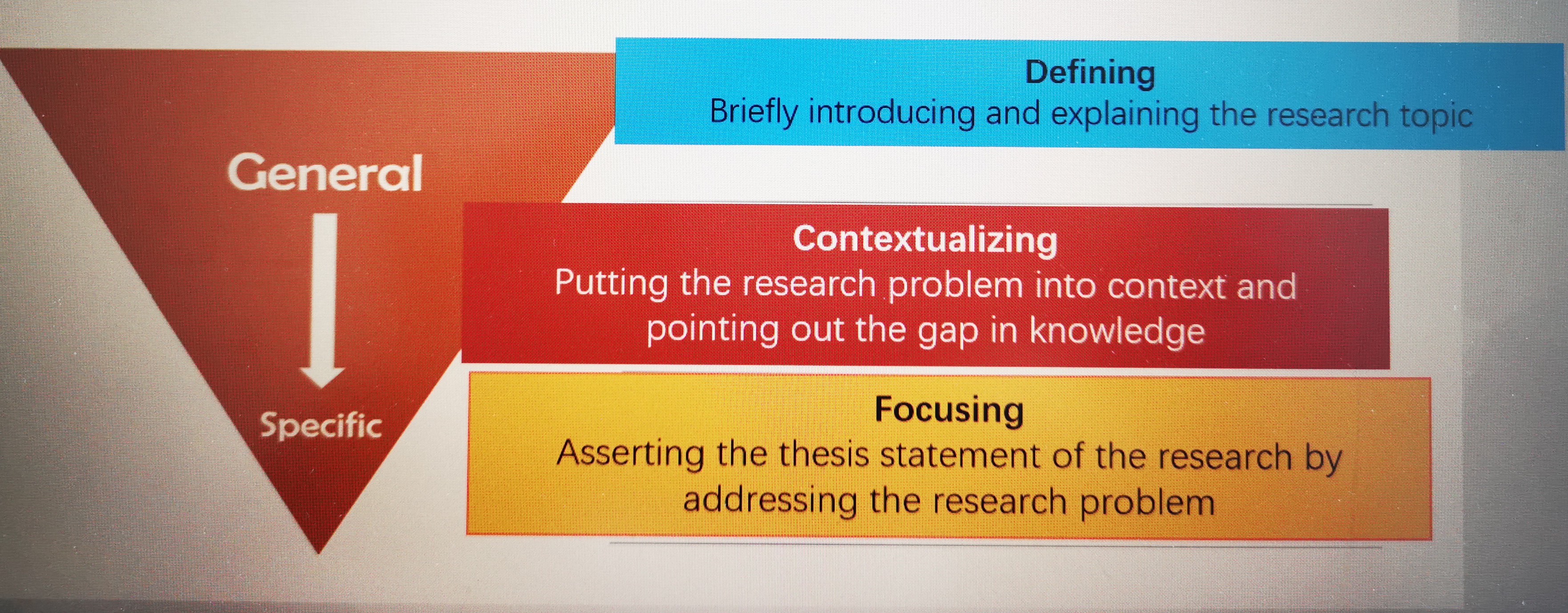
Step one  : address the topic (definition)

Step two :  contextualize the topic (introduce the topic in the background)

Step three: identify the gap in the existing literatures regarding the  paticular context and topic

Step four:  thesis statement (不是文章的核心观点,相当于研究目的--- a promise your paper is going to make (objective of the study /research), not just cover a topic . The thesis statement should excite and engage your readers ' curiosity .

An introduction should engage readers , so they will become interested in your writing.

When should  you write the introduction?

You do not write introduction first .Some writers prefer to write introduction in the middile of the drafting process , while others decide to write introduction last .

Model of introduction.

In an article the contextualization of the research problem is always featured in the introduction. In academic writing , a simplified structure of  introduction section resembles an inverted triangle from top to bottom. The writer starts from the most general background information and narrows down to address the particular aspect being focused on in the article.